
A product-by-product comparison of Zluri and ConductorOne across identity discovery, JML automation, access reviews, SoD, and compliance. See where each platform wins and who each one is actually built for.
If you're managing identity governance for an organization where not every app goes through SSO, not every team member lives in the terminal, and your next compliance audit isn't optional, this comparison is for you.
ConductorOne was built for a specific profile: engineering-led teams, Slack and CLI-first workflows, and a primary need for JIT access to cloud infrastructure. It does that well. But most IT and security leaders evaluating identity governance aren't just managing the access their IdP already knows about. They're managing the access that exists whether the IdP knows about it or not: shadow apps, service accounts, AI agents, access accumulated informally over years of employee tenure.
That's the problem Zluri was built to solve. And it's the frame through which this comparison makes the most sense.
The Core Question Before Any Feature Comparison
Before looking at any capability, ask yourself one question: how much of your actual access surface sits outside your IdP?
If the answer is "not much" — your stack is mostly SSO-controlled, your team is technical, and your primary governance need is zero-standing-privileges for cloud infrastructure — ConductorOne is worth serious evaluation.
If the answer is "more than we'd like to admit" — and for most organizations, 60% of applications operate outside IT control — then you're evaluating platforms on the assumption that your access surface is already fully mapped. It isn't. And a governance platform that can't find what it can't see can't govern it either.
Keep that question in mind as you read through each capability below.
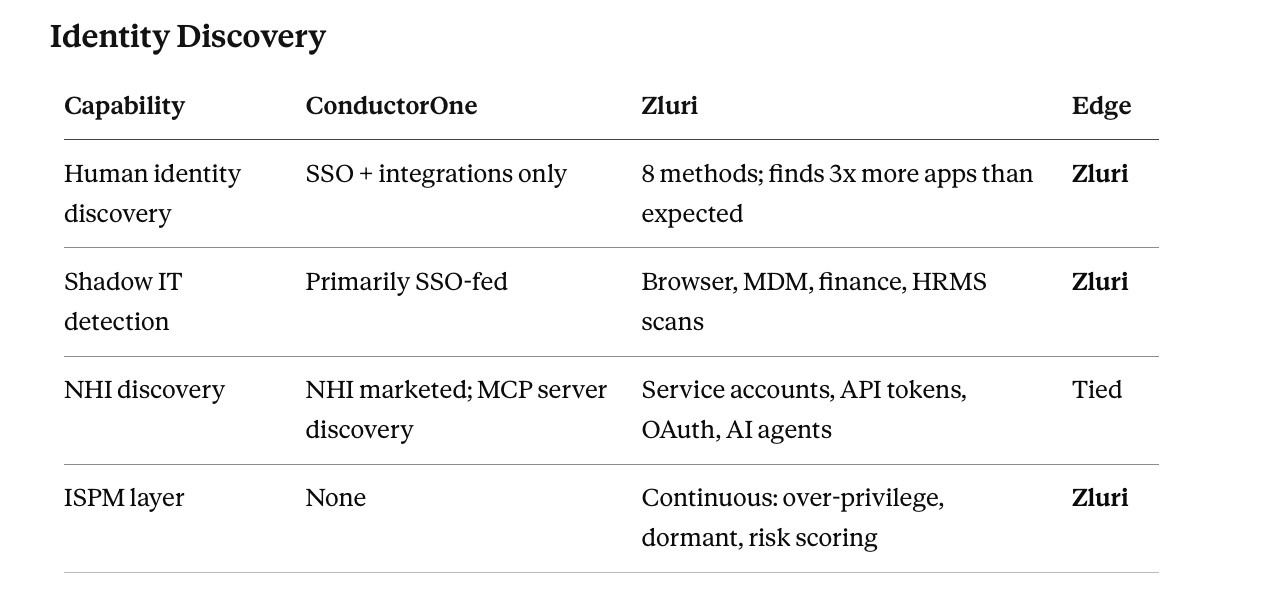
Every downstream governance capability (reviews, SoD rules, provisioning, offboarding) is only as complete as what discovery found first. If discovery is SSO-bound, governance is SSO-bound. That's not a feature gap. It's a structural ceiling on what the platform can ever govern, regardless of how sophisticated the review workflow looks on top of it.
ConductorOne's discovery is limited to what's already connected to your identity provider. Apps employees connected outside SSO (purchased on a company card, signed in with a personal account, accessed through an AI agent calling an API directly) don't appear. Not because ConductorOne isn't looking. Because SSO-dependent discovery has no mechanism to find what doesn't register in SSO.
Zluri's discovery engine pulls from eight sources simultaneously — SSO, MDM, direct app integrations, finance and expense data, CASBs, HRMS, directories, and optional browser and desktop agents. The practical result is consistent: organizations discover far more than they expect. One customer described it plainly after deployment: "We thought that we have around 100 SaaS applications, known and also Shadow IT. It appears we have more than 300+ apps. Most of them are unknown to IT" (Shahar Cohen, Assured Allies). Another team that believed they had a couple hundred applications found "well over 2,500 apps" in their environment.
TechRadar tested our discovery engine directly against a competing platform and concluded Zluri "is better at spotting shadow IT," attributing it to the multi-method approach.
ConductorOne has no continuous posture layer between formal review cycles, which means access drift accumulates silently until the next campaign runs (potentially months away). Our ISPM runs continuously, flagging over-privilege, dormant accounts, and risk signals as they emerge. By the time your next review campaign runs, a significant share of posture issues have already been caught and addressed.
The one row where both platforms are genuinely comparable is non-human identity (NHI) discovery. ConductorOne markets NHI coverage and MCP server discovery; we cover service accounts, API tokens, OAuth credentials, and AI agents. Neither has a decisive lead here, and we won't overstate it.
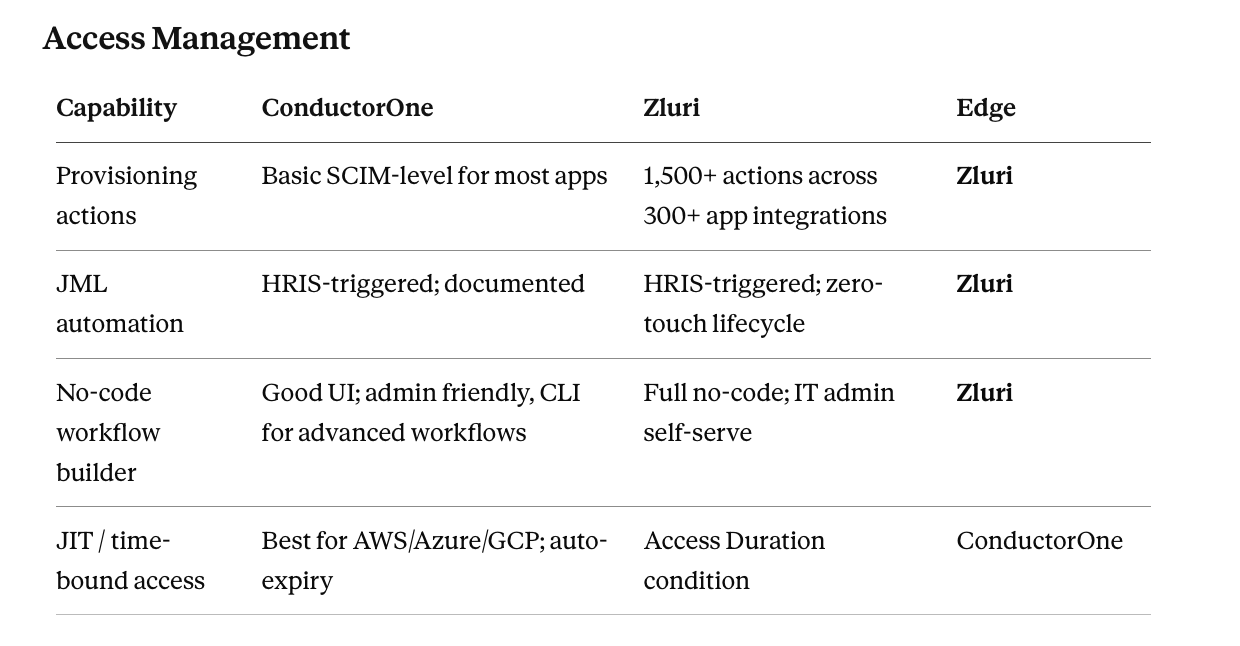
ConductorOne's provisioning operates at basic SCIM level for most apps — accounts are created or removed, but permission-level granularity within those apps is limited. That works until you need more than account-level control: role transitions where specific permissions need to change without deprovisioning the account entirely, or offboarding where you need to know exactly what access existed before you can confirm it's been fully removed.
Zluri's provisioning runs 1,500+ discrete actions across 300+ app integrations. A single automation rule can grant GitHub Triage to one role and GitHub Admin to another, based on conditions like department, designation, or location, without a developer writing a custom connector.
The offboarding difference is worth dwelling on, because it's structural.
Zluri is the only IGA platform that offboards employees from their actual discovered access footprint, including shadow apps. When you trigger an offboarding workflow, we scan that specific employee's every app they have access to based on real usage and account data, and pre-populate the workflow with suggested deprovisioning actions per app. This includes the Figma seat a teammate shared, the Notion workspace from a cross-functional project, the Slack channels they got added to manually. Because our discovery engine found these apps, offboarding can act on them. No other IGA tool in the market does this today.
ConductorOne's offboarding runs off a role template, not the employee's actual access, which means it systematically misses anything outside the model. That's precisely how ex-employees retain access to a dozen apps nobody remembered to revoke.
Our offboarding stops being "remove what we think this role should have" and becomes "remove what this specific person actually has access to." One G2 reviewer described what this feels like in practice: "No more guesswork! You no longer have to figure out on your own what actions to perform while deprovisioning users, because Zluri suggests actions, which are right and applicable for those particular user roles."
ConductorOne's advanced workflows require CLI, which limits who can actually operate the platform day to day.Building and maintaining complex automation rules means non-technical IT admins either can't do it or have to open a ticket every time something needs to change. Our no-code builder lets IT admins self-serve the full configuration, including advanced rules, without developer dependency.
ConductorOne does have a genuine, specific advantage here: JIT access to cloud infrastructure (AWS, Azure, GCP) with auto-expiry and MFA. If zero-standing-privileges for infrastructure is your primary requirement, that's a real reason to evaluate ConductorOne closely. Most organizations, though, have a broader access management challenge than cloud infrastructure JIT alone.
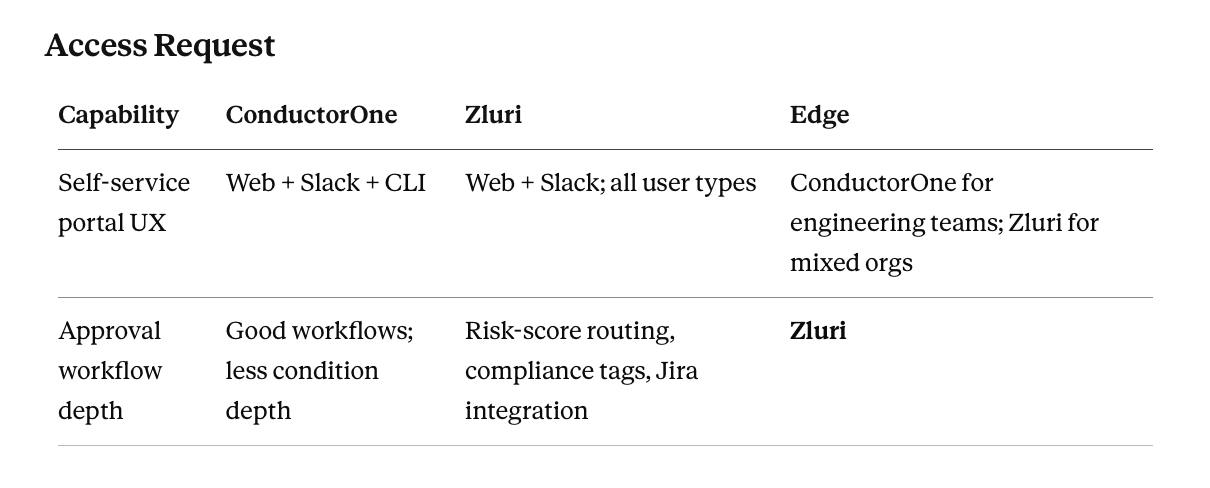
ConductorOne's request experience was designed for engineering teams — native Slack, Teams, and CLI as first-class request channels. If your entire requester base lives in the terminal, that's a fast, familiar flow.
But most organizations don't have an engineering-only requester base. Finance needs access to billing systems. HR needs access to HRIS tools. Sales needs access to CRM. Marketing needs access to analytics platforms. A CLI-first design optimizes for the technical minority of requesters while adding friction for the majority. We built Zluri's catalog to work for every user type, not just the ones who know what a command line is.
Where the gap matters more is approval workflow depth. Our approval workflows support risk-score routing, compliance tags, and Jira integration. The path a request takes changes based on the sensitivity of the specific access being requested, not just who the requester is. A request for admin access to a finance system and a request for read-only access to a shared folder shouldn't follow the same approval chain. With ConductorOne, they often do.
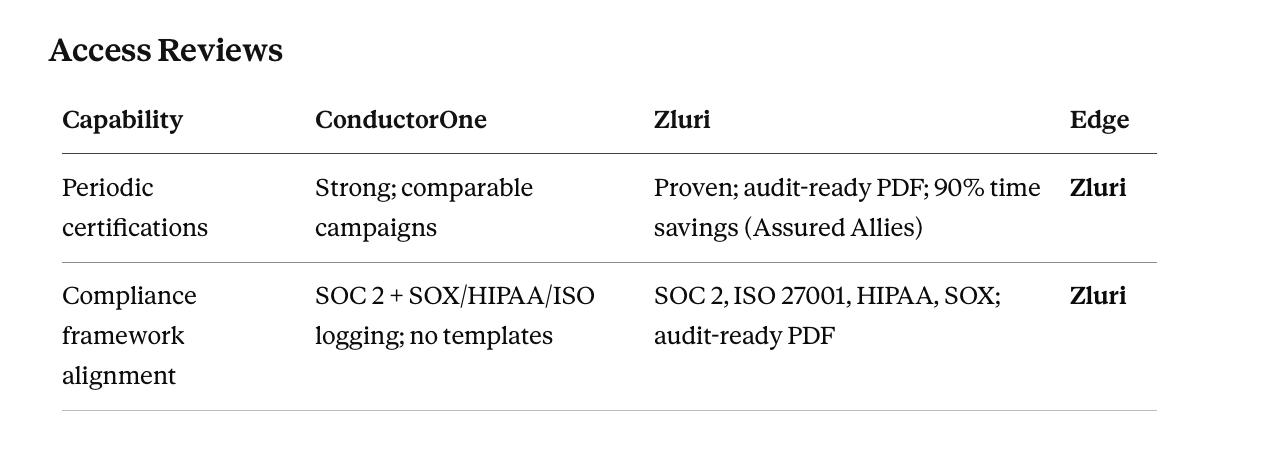
Both platforms run certification campaigns. The difference is in what those campaigns are actually reviewing.
Access reviews are only as accurate as the data behind them. ConductorOne doesn't sync IdP and HRMS data in real time, which means reviewers can be making access decisions based on a snapshot that's already outdated: someone whose role changed last week is still showing the old role, an account that should have been deprovisioned is still appearing as active. Combine that with no ISPM layer between cycles and you get a specific failure pattern: access posture drifts silently for months, a review eventually runs on stale data, and the campaign produces a false sense of governance coverage.
Every quarter you run reviews on outdated data is another quarter your access posture isn't what your reports say it is.
Zluri's reviews run on current data, with continuous posture monitoring between cycles. Our HRMS and IdP sync runs on a 24-hour default cycle, with real-time sync for key integrations including BambooHR, Google Workspace, Azure AD, and Okta. The ISPM layer catches drift continuously between cycles. By the time a formal review runs, the data is current, and a meaningful share of the posture issues have already been addressed.
Assured Allies cut SOC 2 audit prep time by 90% (from a full workday to roughly 30 minutes) after deploying Zluri's access reviews. ConductorOne logs for SOC 2, SOX, HIPAA, and ISO but doesn't produce audit-ready templated output, pushing more compliance burden onto your internal team.
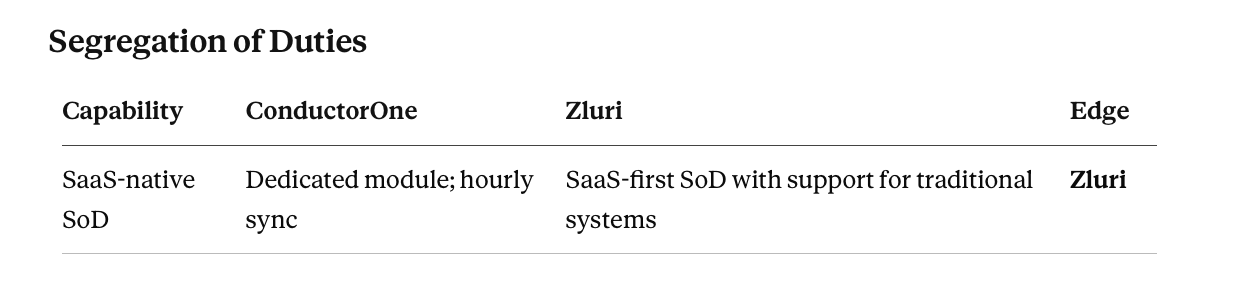
ConductorOne has a dedicated SoD module with hourly sync. It's a real capability. The question is what model of conflicting access it was built for.
Most SoD risk today runs through SaaS-to-SaaS combinations, not legacy infrastructure. Salesforce admin paired with finance-system write access, Okta admin combined with GitHub admin, HR system access combined with payroll approval — these are the conflicts that actually show up in a modern stack. Zluri's SoD engine was built SaaS-first:SaaS-to-SaaS is the default case, traditional systems are supported alongside it. ConductorOne's module was built around a more infrastructure-centric model, which means SaaS-to-SaaS conflict combinations may not surface as reliably.
As more of your business logic moves through SaaS tools, the SoD engine that treats SaaS-to-SaaS conflicts as primary catches more of the actual risk.
Before You Evaluate Either Platform, Ask These Questions
Take these into any demo or proof-of-concept. The answers will tell you more than any feature comparison:
"How does your discovery find apps that employees connected outside SSO?" A platform that can't answer this specifically (with named methods beyond SSO and integrations) is telling you its governance ceiling is your IdP.
"What does your offboarding workflow do for an app that IT never formally sanctioned?" If the answer is "it won't appear in the workflow," that's a gap. Template-based offboarding misses anything outside the template, by design.
"How current is the data your access review campaigns run on?" Ask for the sync frequency from HRMS and IdP, and ask what posture monitoring happens between formal review cycles.
"What does it take to build an advanced automation workflow — can a non-technical IT admin do it, or does it require CLI or developer support?" The answer determines who can actually operate the platform day to day.
"How does your SoD module handle conflicts between two SaaS applications, like Salesforce admin and NetSuite approver?" A module built for traditional infrastructure will handle this differently than one built SaaS-first.
Who Should Choose Zluri
You're the right fit for Zluri if:
Your app environment extends beyond what's connected to SSO, and you know there's access happening outside your IdP that you're not currently governing. Our discovery finds it. Our governance acts on it.
Your offboarding process currently works from role templates, and you're aware that employees accumulate access through informal channels that templates don't capture. Our offboarding runs from the actual access footprint, shadow apps included.
Your requesters and reviewers span technical and non-technical teams. Engineering, Finance, HR, and Sales all need access to things. They shouldn't all need a command line to request it.
You have compliance requirements (SOC 2, ISO 27001, HIPAA, SOX) and need audit-ready output, not just logging infrastructure that your team has to turn into a report.
Your SoD risk runs across SaaS tool combinations, not just within traditional infrastructure.
Who ConductorOne Fits Better
ConductorOne is worth serious evaluation if JIT, zero-standing-privileges access to cloud infrastructure is your primary requirement, your team is engineering-led with Slack and CLI as the natural workflow, and you're buying access governance specifically rather than a broader identity security platform. For that profile, ConductorOne's JIT capability and Slack-native request experience are genuine strengths.
For organizations that need to govern beyond the SSO-connected, IdP-known portion of their access surface (which describes most organizations once you look honestly at how access actually accumulates) the structural ceiling of SSO-dependent discovery is a constraint that better review workflows can't fix.
Frequently Asked Questions
What is the main difference between Zluri and ConductorOne?
The core difference is in how each platform defines the access surface it governs. ConductorOne discovers and governs access connected to your SSO and IdP. Zluri discovers access across eight sources (including finance systems, MDM, browser agents, and HRMS) meaning it finds and governs apps that never registered in SSO, including shadow IT. Every downstream capability (provisioning, reviews, SoD, offboarding) is limited by what discovery can see, which is why this architectural difference matters more than any individual feature comparison.
Does ConductorOne detect shadow IT?
ConductorOne's discovery is primarily SSO-fed, meaning it finds apps connected to your identity provider through integrations. Apps that employees access outside SSO (connected with personal credentials, purchased on company cards, or accessed through AI agents directly) generally don't appear in ConductorOne's discovery. Zluri's eight-method discovery approach is specifically designed to surface these apps.
Can ConductorOne offboard employees from shadow apps?
No. ConductorOne's offboarding runs from role templates built on your known app inventory. If an employee connected apps outside SSO during their tenure, those apps won't appear in the offboarding workflow. Zluri's offboarding pre-populates from the employee's actual discovered access footprint, including shadow apps, which means deprovisioning covers access IT didn't formally sanction.
Which platform is better for compliance — Zluri or ConductorOne?
Both platforms support SOC 2, SOX, HIPAA, and ISO 27001. The difference is in output and data freshness. Zluri produces audit-ready PDF exports and syncs HRMS and IdP data on a 24-hour default cycle (real-time for major integrations). ConductorOne logs compliance data but doesn't produce audit-ready templated output, and doesn't sync IdP/HRMS data in real time, meaning review campaigns may run on outdated snapshots.
Is ConductorOne better than Zluri for JIT access?
Yes, for privileged cloud infrastructure specifically. ConductorOne's JIT access for AWS, Azure, and GCP with auto-expiry and MFA is best-in-class and is the area where ConductorOne has the clearest advantage. Zluri supports time-bound access as a policy condition rather than a dedicated JIT workflow. If zero-standing-privileges for cloud infrastructure is your primary requirement, ConductorOne is worth evaluating closely for that use case.
How does Zluri's SoD differ from ConductorOne's?
ConductorOne has a dedicated SoD module with hourly sync, built around a traditional, infrastructure-centric model of conflicting access. Zluri's SoD is built SaaS-first, treating SaaS-to-SaaS conflict combinations (such as Salesforce admin combined with NetSuite approver access) as the default case rather than an edge case. For organizations where most conflicting-access risk runs through SaaS tool combinations rather than legacy systems, a SaaS-native SoD approach catches more of the actual risk.
Can non-technical teams use Zluri for access requests?
Yes. Zluri's self-service catalog is built for all user types, not just technical ones. ConductorOne's request experience is optimized for engineering teams, with CLI and Slack as first-class channels. For organizations where Finance, HR, Sales, and Marketing are requesting access alongside engineering, Zluri's catalog creates less friction for the majority of requesters.



.svg)