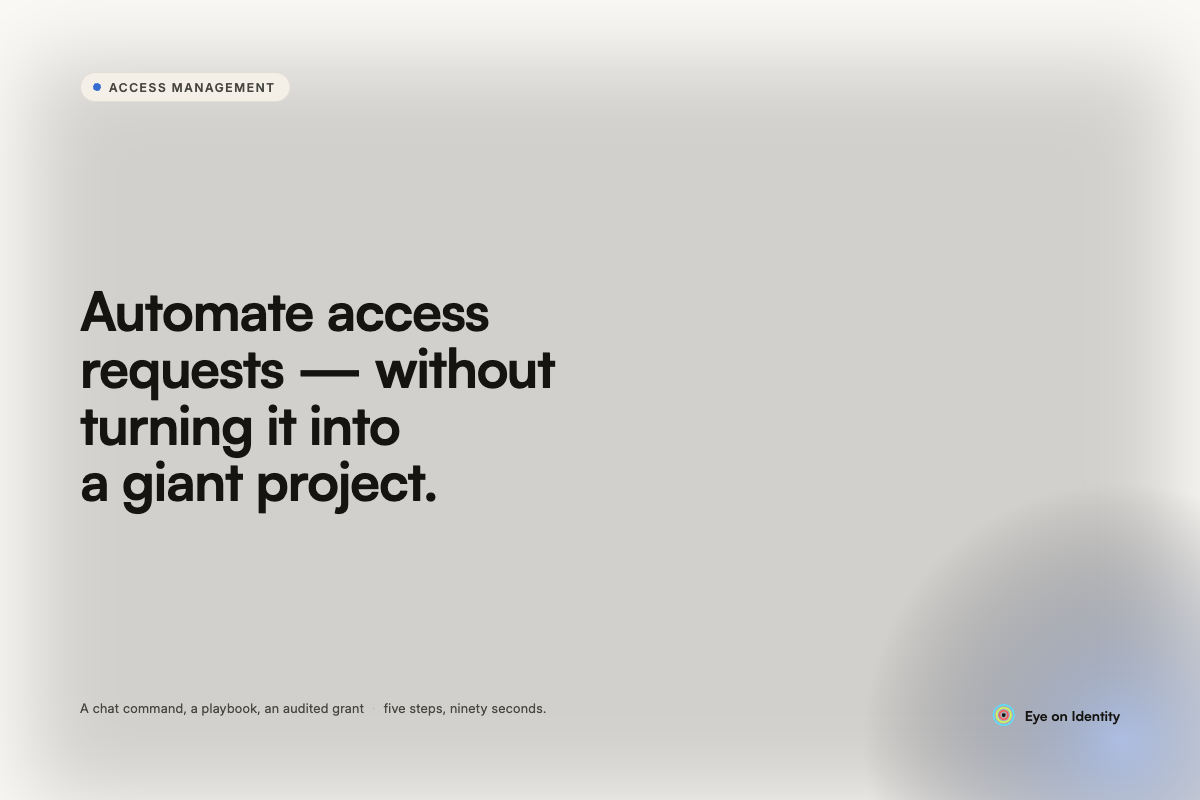


If access requests are consuming your team's week, you're not dealing with a tooling problem. You're dealing with a structural one. Portals don't fix it. Group-based access doesn't fix it. Workflow tools don't fix it — at least not the way most teams implement them. The requests keep coming in through Slack, through DMs, through "hey can you just match Mary's permissions," and every one of them lands in someone's lap as a manual triage task.
The teams that have actually solved this didn't build a more sophisticated portal. They stopped treating access requests as tickets and started treating them as identity events — things that happen to a user's record, get evaluated against policy, and either resolve automatically or route to the right approver without anyone playing air traffic controller.
Here's what that looks like in practice.
Why the Current Approach Keeps Breaking Down
The exhaustion pattern is recognizable: a manager messages IT asking for access for someone on their team. The message says "can you give Jake the same setup as Mary?" IT has to interpret what "Mary's setup" means, figure out which apps are in scope, check whether Jake already has some of them, create tickets for the ones that need provisioning, chase approvals, and then document everything afterward for the next audit.
Multiply that by a team of twenty managers making similar requests throughout the week, and the math stops working. The problem isn't that IT is inefficient — it's that the system routes every request through a human who has to do interpretation work that a properly configured automation could handle in seconds.
The fix isn't a better ticketing system. It's removing the interpretation layer entirely.
How Do You Move Access Requests Into a Governed Channel?
The first thing to address is where requests arrive. If half of your access requests show up in Slack as casual messages, the answer isn't to redirect people to a portal they won't use. It's to make Slack itself the governed channel.
A Slack-native access request flow works by replacing the casual message with a structured command — something like /accessrequest — that opens a form inside Slack. The form feels conversational but captures the structured data IT actually needs: who is requesting, which application, which role or license tier, and the business justification. No interpretation required because the form constrains the inputs.
Approvals happen inside Slack too. The approver gets a notification with an Approve or Reject button directly in the message. The request doesn't go to email, doesn't sit in a Jira queue, and doesn't get lost in someone's inbox. The approval loop closes in the same channel where work already happens.
The speed difference is real. Organizations that have moved from email and Jira-based approval flows to Slack-integrated request catalogs report turnaround improvements in the range of eight times faster — not because the underlying work changed but because the friction of context-switching and inbox management was eliminated.
How Do You Handle "Match Mary's Permissions" Requests?
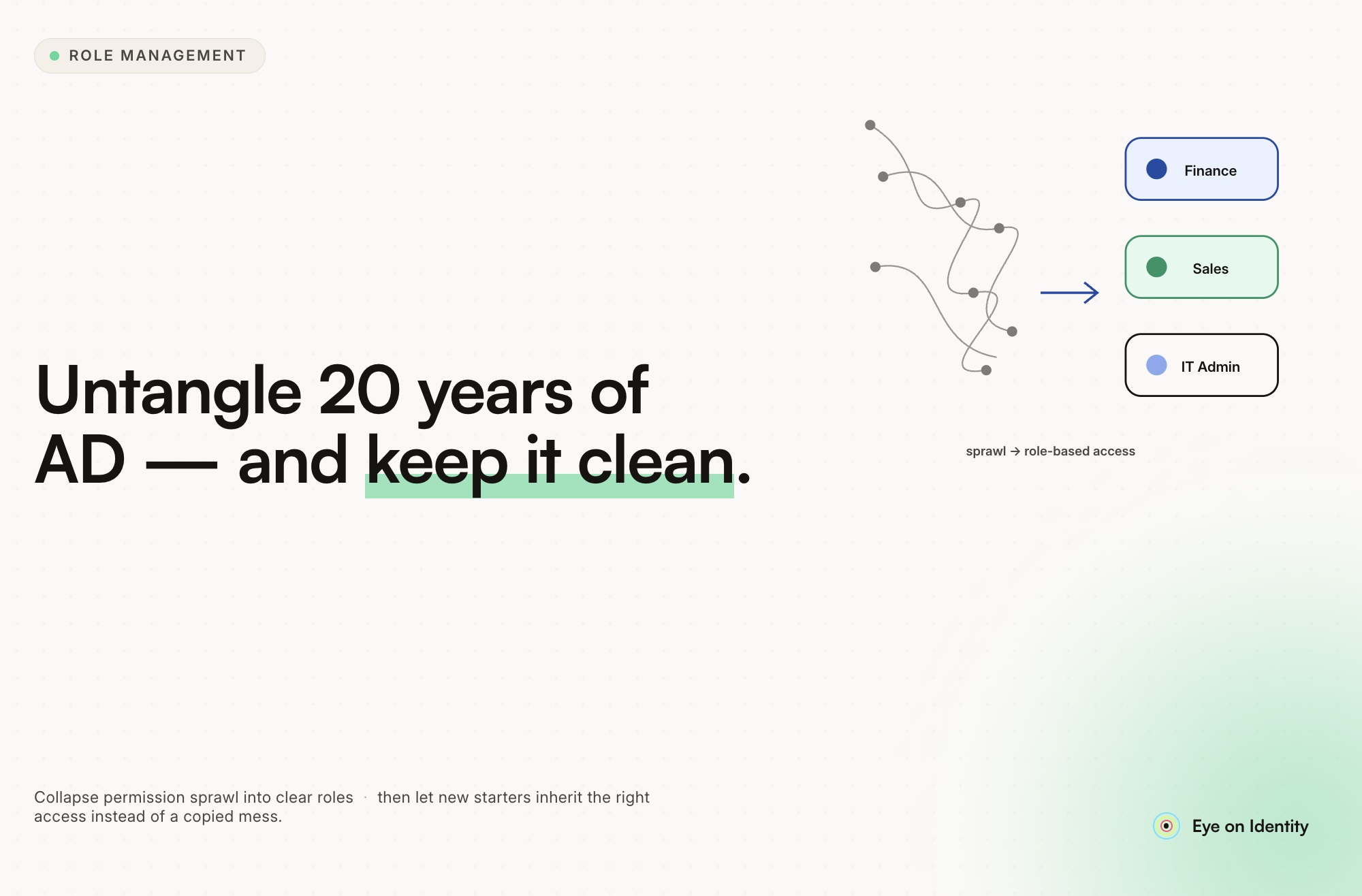
The "match Mary's permissions" request is a specific failure mode that deserves a specific solution. The problem with permission matching is that it's error-prone by design — Mary's access is the product of years of provisioning decisions, some of which are probably over-provisioned, and copying it wholesale spreads whatever access hygiene issues exist in Mary's profile to the next person.
The cleaner approach is to remove the "match someone else" option entirely and replace it with a predefined dropdown of roles and license tiers for each application. When a manager opens the access request form and selects "Multiple Users or Others," they're presented with official options — Viewer, Editor, Admin, or whatever tiers the organization has defined — rather than a free-text field or a person to copy.
This does two things simultaneously. It prevents permission sprawl from matching, and it gives managers a real choice between meaningful options rather than asking them to make a judgment call they're not equipped to make accurately.
What Prevents Access Automation From Becoming a Maintenance Nightmare?
The maintenance nightmare most teams encounter comes from a specific architectural mistake: building one large, complex workflow that tries to handle every provisioning scenario through branching logic. When the Zoom licensing model changes, you have to find every branch in every workflow that references Zoom and update them individually. One change becomes a project.
The alternative is modular, app-level playbooks. Instead of a "Sales Onboarding" workflow that includes Zoom provisioning logic inside it, you build a standalone "Provision Zoom" playbook that handles Zoom and only Zoom. Your Sales Onboarding workflow becomes an orchestrator that calls the Zoom playbook, the Slack playbook, the Salesforce playbook, and whatever else Sales needs — but it doesn't contain their logic.
When the Zoom licensing model changes, you update the Zoom playbook once. Every onboarding workflow, access request flow, and mover playbook that references Zoom automatically gets the updated behavior. One change, one place, zero ripple effects.
Naming matters here too. Playbooks named by application — "Provision Zoom," "Provision GitHub," "Provision Salesforce" — are easier to maintain, easier to audit, and easier for new team members to understand than monolithic workflows with complex internal branching.
How Do You Reduce the Volume of Approvals Without Creating Risk?
Not every access request needs a human decision. A request for Viewer access to a non-sensitive internal wiki is not the same risk profile as a request for Admin access to a production database, and treating them identically wastes approver attention on decisions that don't actually require judgment.
Automation rules structured around a When–Conditions–Then logic handle this cleanly. When a request comes in for a specific application, evaluate the conditions — role tier requested, sensitivity classification of the app, requester's department — and then either auto-approve if the conditions indicate low risk, or initiate an approval process routed to the appropriate approver if they don't.
The approver routing itself can be policy-driven rather than manually configured. If the HRMS is the source of truth for organizational structure, the approval automatically routes to the requester's reporting manager or the designated app owner without anyone having to decide where it goes.
The result is a tiered system where routine requests resolve without any human intervention, and human attention is concentrated on decisions that actually warrant it.
What Happens to the Audit Trail?
A significant portion of the exhaustion in manual access request processes comes from documentation — trying to reconstruct after the fact who requested what, who approved it, and when it was provisioned. This documentation work exists because the process itself doesn't generate it automatically.
When requests flow through a governed system, every interaction generates a record without any additional effort. Each request gets a unique identifier. Each Slack interaction, approval decision, and provisioning event gets logged against it. The result is an audit trail that exists as a byproduct of the process rather than as additional work on top of it.
When an auditor asks for evidence that access was appropriately requested, approved, and provisioned, the answer is a report export — non-editable, timestamped, and complete — rather than a manual reconstruction effort that takes days and still has gaps.
Where to Start Without Making It a Giant Project
The instinct when facing a problem this entrenched is to try to solve all of it at once. That's usually what produces the giant project and the maintenance nightmare.
A more practical starting point: identify the ten applications that generate the most access requests in a typical week. Enable the Slack integration. Build app-level playbooks for those ten applications. Configure auto-approval for the low-risk tiers within those apps.
That scope is achievable in weeks rather than months, and it addresses the majority of volume because access request distribution is rarely even — a small number of applications generate most of the requests. Solving for the top ten gets you most of the relief without requiring you to solve for every edge case before you can deploy anything.
The edge cases don't go away. But they become manageable exceptions rather than the defining character of the process.


.svg)