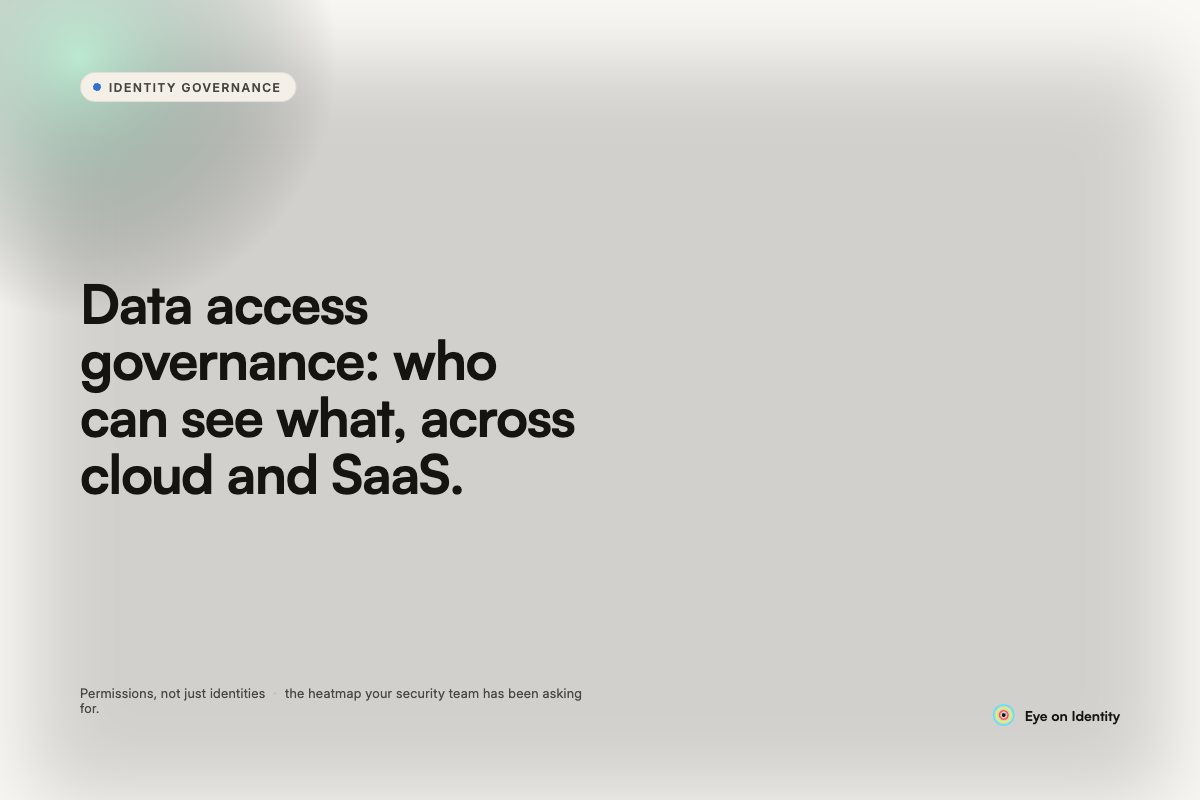


The frustration in this thread is real and reflects a genuine market gap: tools that claim to do data access governance tend to do one half of it well and the other half poorly. Legacy IGA tools are strong on identity lifecycle and access reviews but don't tell you where sensitive data actually lives or which access paths represent real risk. DSPM tools (Data Security Posture Management) are strong on data discovery and sensitivity classification but may not connect to your identity governance workflows. Finding a tool that does both — showing who has access to sensitive data and why, in a way that's actually operationalizable — is harder than vendor marketing suggests.
The most useful framing from the opscontext comment in this thread: the question isn't "which tool has the most features" but "does this tool actually show who can access sensitive data and why, instead of just dumping a list of permissions at you."
The Two Halves of Data Access Governance
Before evaluating specific tools, it's worth understanding why the market is fragmented:
The identity/permissions half — IGA and IAM tools. This side knows who has what role, when access was provisioned, whether it was certified, and what the lifecycle state of each identity is. Tools like SailPoint, Saviynt, and Zluri operate here. They're strong at answering "who has access" but not "what sensitive data does that access expose."
The data/sensitivity half — DSPM and data security tools. This side knows where sensitive data lives (which S3 buckets, which SharePoint drives, which Salesforce records), how it's classified, and which access paths lead to it. Tools like Cyera, BigID, Sentra, Varonis, and Lightbeam operate here. They're strong at answering "what sensitive data is exposed" but may not connect seamlessly to your identity lifecycle workflows.
The opscontext account of going through a ransomware tabletop and having no good answer to "who can actually touch sensitive data right now" describes exactly this gap: the IGA tools answer the identity side, the DSPM tools answer the data side, and the intersection requires either a tool that bridges both or a custom integration layer between them.
What Practitioners Are Actually Using
Cyera is the most frequently cited positive experience in this thread. The specific capabilities practitioners cited: cross-cloud discovery, sensitive data context alongside access paths (so you know which over-permissioned roles are actually exposing regulated data rather than just low-risk internal data), and risk-based prioritization that focuses remediation on access paths that matter rather than generating alerts for everything. For organizations that have already identified sensitive data classification as the primary governance driver, Cyera addresses the data-context-plus-identity combination directly.
Varonis is strong for file system environments — on-premises file servers, SharePoint, and similar structured data stores. The opscontext comment that Varonis is "really good for file systems but less fun once everything starts spreading into SaaS and cloud storage" reflects accurate feedback: it handles the traditional file access governance problem well and has expanded into SaaS, but organizations with primarily cloud-native or SaaS-heavy environments may find it less complete.
BigID does "a million things" per the practitioners in this thread — which means significant tuning and configuration before it produces actionable results. Strong on entitlement analysis and detecting over-permissioned access; the tradeoff is implementation overhead. Better fit for organizations with dedicated data governance teams than for lean security teams.
Sentra is positioned as the lighter-weight alternative to BigID — faster to roll out, clearer exposure scoring, easier to use results for actual remediation. The trade-off is depth relative to BigID for complex multi-cloud environments.
Lightbeam was cited specifically for mapping identity + access + sensitive data in one place — which is the combination the opscontext team was looking for after other tools solved only half the problem.
Microsoft Purview is the right answer for Microsoft-heavy environments with E5 licensing. For mixed environments or organizations without E5, the value proposition is less clear.
Veza operates at the identity security posture layer — granular entitlement visibility for complex cloud infrastructure (AWS, Snowflake, databases). Most relevant for organizations where cloud infrastructure entitlement mapping is the primary concern rather than SaaS-level access governance.
Where IGA Tools Fit in This Picture
The IGA tools the OP mentioned — SailPoint, Saviynt — address the identity governance half of the problem: access reviews, lifecycle management, provisioning and deprovisioning, and compliance evidence. What they don't provide natively is the data sensitivity context that makes access reviews meaningful.
A SailPoint or Saviynt access review shows you that someone has "Salesforce System Administrator" access. It doesn't tell you which Salesforce objects contain regulated customer data, how much data that role exposes, or whether the access path represents critical risk versus low risk.
Zluri's ISPM (Identity Security Posture Management) layer extends traditional IGA toward this gap — mapping access paths to data sensitivity signals from connected systems and surfacing risk-contextualized findings rather than flat access lists. The Unified Data Fabric approach (pulling from SSO, HRMS, financial systems, and browser agents) addresses the "who has access to what" question across the full application stack including shadow IT. What it doesn't replace is a purpose-built DSPM tool for organizations where deep data classification and cloud data store mapping are the primary requirements.
The practical architecture for many organizations is pairing: an IGA platform for identity lifecycle governance and access reviews, plus a DSPM or data security tool for data classification and exposure prioritization. The two inform each other — the DSPM identifies which access paths lead to sensitive data, and the IGA platform handles the governance and remediation workflows.
The "Start With Visibility, Phase In Cleanup" Principle
The consistent advice from practitioners who've been through this is to avoid big-bang governance rollouts that try to enforce least privilege everywhere simultaneously. Start with visibility and risk context, tighten access incrementally.
The sequence that works:
Phase 1: Inventory and classify. Know what data you have and where it lives. Know who has what access. A DSPM tool handles the data side; an IGA or discovery tool handles the identity side. Don't try to fix anything yet — generate the map.
Phase 2: Risk-prioritize. Use sensitivity classification and access path analysis to identify which over-permissioned access represents real risk versus theoretical risk. Not all overexposure is equally concerning. A developer with write access to a non-sensitive internal database is different from a contractor with admin access to Salesforce records containing regulated customer data.
Phase 3: Tighten incrementally. Address the highest-risk access paths first. Use access reviews for the certification evidence that compliance requires, but focus remediation effort on the access that the risk prioritization surfaced rather than reviewing everything at the same priority level.
Phase 4: Automate ongoing monitoring. Once the initial cleanup is done, automated policies that flag new overexposure as it develops (new shadow IT apps, role changes that create new access paths to sensitive data, dormant accounts that accumulate permissions) prevent the problem from returning.
What to Watch Out For in Evaluation
"Auto least-privilege" claims without usage pattern understanding. Tools that enforce least privilege based on role definitions without understanding actual usage patterns will break workflows. The right approach is access right-sizing based on what users actually use, not theoretical minimum permissions. Verify that the tool analyzes actual usage before making revocation recommendations.
Alert volume without prioritization. Tools that surface thousands of "overexposed" findings without risk-based prioritization create noise that paralyzes security teams. The question to ask in any demo: how does the tool help me decide which overexposure to fix first?
API data gaps for role metadata. Only 15 of 50 common applications provide full role metadata via API. For the rest, governance visibility is limited to application-level access rather than permission-level. Verify specifically for your most important applications.
Integration depth for your environment. If your primary concern is AWS S3 or Snowflake overexposure, verify that the tool has the specific cloud storage integrations for those services. Generic claims about "cloud and SaaS support" cover wide ranges of actual coverage depth.
Frequently Asked Questions
What is data access governance and how does it differ from identity governance?
Data access governance focuses on who can access sensitive data — mapping access paths to data classification, identifying overexposed data, and tightening permissions based on data sensitivity. Identity governance (IGA) focuses on who has identity-level access — access lifecycle management, access reviews, and compliance evidence. Data access governance typically requires DSPM tools (Cyera, BigID, Sentra) for the data discovery and classification side, and IGA platforms for the access review and remediation workflows. Many mature governance programs use both.
What are DSPM tools and which ones work best for SaaS and cloud environments?
Data Security Posture Management (DSPM) tools discover where sensitive data lives across cloud storage and SaaS, classify it by sensitivity, and map the access paths that expose it. For cloud-native and SaaS-heavy environments, Cyera and Sentra are most frequently cited for their cross-cloud discovery and lighter deployment overhead. BigID is more comprehensive but requires significant tuning. Varonis is strong for file systems and structured data stores but less complete for SaaS. Microsoft Purview is the right choice for E5-licensed Microsoft-heavy environments.
How do you reduce over-permissioned access without breaking workflows?
The approach that consistently works is risk-prioritized incremental tightening rather than big-bang least privilege enforcement. Start with data discovery and sensitivity classification to understand which over-permissioned access actually exposes regulated or high-risk data. Prioritize remediation on those access paths first. Use access reviews for certification evidence, but focus actual revocation effort on the highest-risk overexposure rather than reviewing everything at the same priority level. JIT access for particularly sensitive resources reduces standing exposure without requiring permanent permission changes.
Is SailPoint or Saviynt the right choice for data access governance?
SailPoint and Saviynt are strong for the identity governance half of data access governance — lifecycle management, access certifications, provisioning and deprovisioning at scale. They don't natively provide data sensitivity context — which access paths expose regulated or sensitive data, and at what risk level. For organizations whose primary governance driver is compliance evidence (access review certifications for SOC 2 or SOX), IGA platforms may be sufficient. For organizations whose primary driver is risk reduction based on actual data exposure, pairing an IGA platform with a DSPM tool for data context produces better outcomes.


.svg)