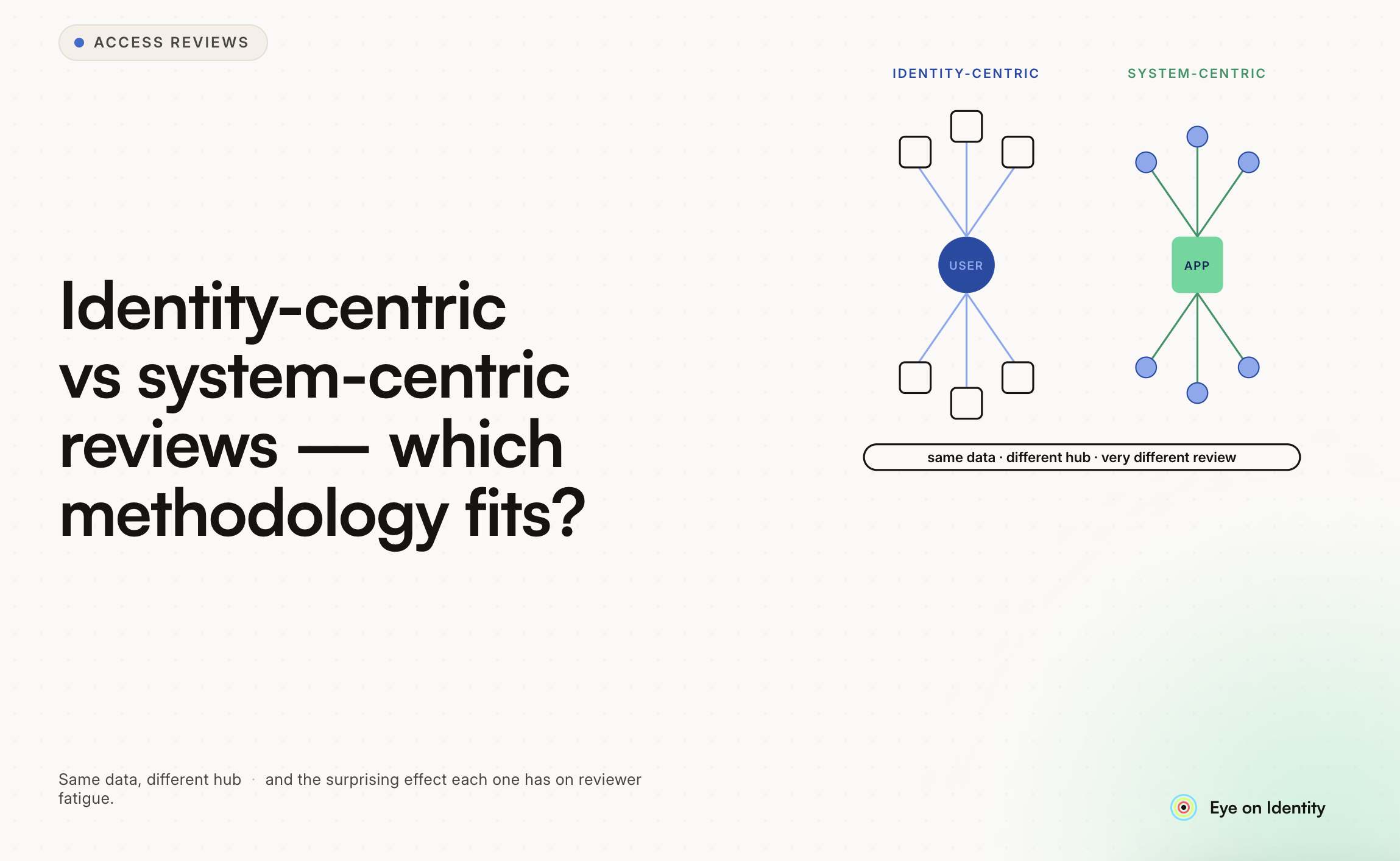


The intuition that system/data owner reviews are more efficient than manager-led identity reviews is partly right — but the full picture is more nuanced, and the tradeoffs of each approach explain why neither is universally better.
Here's a clear breakdown of how each method works, what each gets wrong on its own, and what the recommended approach looks like for organizations that need both efficiency and meaningful oversight.
Identity-Centric Reviews: Manager-Led
In the identity-centric model, each manager reviews the access records for their direct reports. The manager certifies whether each person on their team still needs the access they hold across the applications in scope.
The strength of this approach is contextual accuracy about functional need. Managers know when someone has changed roles, when a project has ended, or when a team member's responsibilities have shifted. They're best positioned to answer "does this person still need this tool to do their job?" — which is the core governance question for standard business application access.
Where it breaks down is in depth and volume. A manager reviewing a list of their direct reports' access to Salesforce, Jira, GitHub, Slack, and 15 other applications doesn't necessarily know what each specific permission level means within each of those systems. "John Smith — Salesforce — Administrator" doesn't tell a non-technical manager whether that admin access is appropriate without understanding what Salesforce admin access actually enables.
The rubber-stamping problem emerges directly from this gap: managers who don't understand the technical implications of specific permission levels, or who are reviewing a large list under time pressure, approve everything by default. The review technically completes, but it doesn't produce meaningful security assurance.
System-Centric Reviews: Data/System Owner-Led
In the system-centric model, the owner of each system or application reviews all users who have access to that system. One person who understands the system's security implications evaluates the entire user list.
The strength of this approach is exactly what you've identified: efficiency and technical depth. One reviewer with system expertise is typically more efficient than distributing review tasks across dozens of managers who may have limited context. The system owner understands what each permission level enables and can make informed judgments about whether specific access is appropriate.
Where it breaks down is in the inverse of the manager's gap: the system owner doesn't know why specific individuals need access. They know what the permissions enable, but they don't know whether the user's current job function still requires those permissions. An IT admin reviewing 200 Salesforce users may know that Admin access is high-privilege, but they don't know which of those 200 people recently changed departments and no longer needs admin access for their current role.
This creates the risk of accidental revocations — removing access that the person actually still needs — and missed revocations of access that looks legitimate from the system perspective but is no longer appropriate from a functional perspective.
Why Neither Approach Alone Is Sufficient for Critical Systems
The two approaches are answering different questions:
- The manager answers: does this person still need this tool?
- The system owner answers: is this permission level appropriate and aligned with security policy?
For low-risk applications and standard access levels, the manager's question is often sufficient. A manager confirming that their team still needs access to the project management tool they use daily is a straightforward review that doesn't require technical depth.
For sensitive data systems, critical infrastructure, and high-privilege access, both questions need to be answered. A user might legitimately still need Salesforce access (manager says yes) but their Admin permission level may be inconsistent with their current role and department (system owner would flag this). Neither reviewer alone catches the problem.
The Multi-Level Approach: Combining Both
The hybrid that addresses this is sequential multi-level review, where the manager review and the system owner review happen in sequence on the same access record.
Level 1 — Functional need (manager): The reporting manager reviews first and certifies whether the user still requires the tool for their job function. This catches the cases where access is no longer functionally justified — people who've changed roles, projects that have ended, team members whose responsibilities have shifted.
Level 2 — Security and privilege alignment (system/application owner): The application owner or IT owner reviews second, with visibility into the manager's decision. They assess whether the specific permission level is appropriate and whether it aligns with security policy — catching over-privilege, unusual access patterns, and cases where the manager confirmed functional need but didn't have the technical context to evaluate whether the privilege level is appropriate.
This sequencing matters: the manager makes the functional call first, and the system owner validates the technical call second. Running them in the other order — system owner first — can result in access being revoked before the manager has confirmed whether it's still needed, potentially disrupting legitimate work.
Practical Guidance for Your Situation
For Critical Systems and Sensitive Data
Use the multi-level approach (manager → system owner) for applications that contain sensitive data, have highly privileged access tiers, or are in scope for compliance frameworks like SOC 2, ISO 27001, or SOX.
The specific systems that warrant this rigor: financial systems (ERP, accounting platforms), infrastructure access (AWS, Azure, production servers), systems containing customer PII, and any application where Admin or elevated access enables significant organizational risk.
For Standard Business Applications
Manager-led review is typically sufficient for standard-risk applications when reviewers have the context to make meaningful decisions. The key is preventing rubber-stamping — which requires giving managers useful context, not just a list of names.
Specifically: last login dates and access frequency significantly improve review quality without requiring technical knowledge. A manager who sees that a team member hasn't accessed an application in three months has a clear basis for a revocation decision. A manager reviewing a list with no usage data has no particular reason to revoke anything.
Risk-Based Scoping
Rather than reviewing every user for every application with equal intensity, scope reviews by risk: prioritize privileged access, sensitive data systems, and inactive accounts. A user with Admin access who hasn't logged in for 60 days across any system is higher priority than a user with standard read access who logs in daily.
This approach lets you concentrate review rigor where it creates the most security value, rather than distributing it evenly across a large population and finding that reviewers are giving equal attention (or lack of attention) to everything.
The Efficiency Question
Your observation about efficiency is correct for the wrong reason. System owner reviews aren't inherently more efficient than manager reviews — they're more efficient when the scope is a single high-risk system with a concentrated review workload. Asking one system owner to review 150 users of a critical application is efficient. Asking that same person to review 150 users across 20 applications is not.
The efficiency gain comes from matching the right reviewer type to the right scope, and from giving reviewers decision-useful data rather than a raw list. An owner reviewing a risk-sorted list of users with last login data, flagged anomalies, and activity patterns makes decisions faster and more accurately than a manager or owner reviewing the same users without that context.
The combination of multi-level review for high-risk systems + activity-driven context for all reviewers + risk-based scoping that concentrates attention on high-priority records is what produces both efficiency and meaningful oversight — rather than having to choose between them.


.svg)