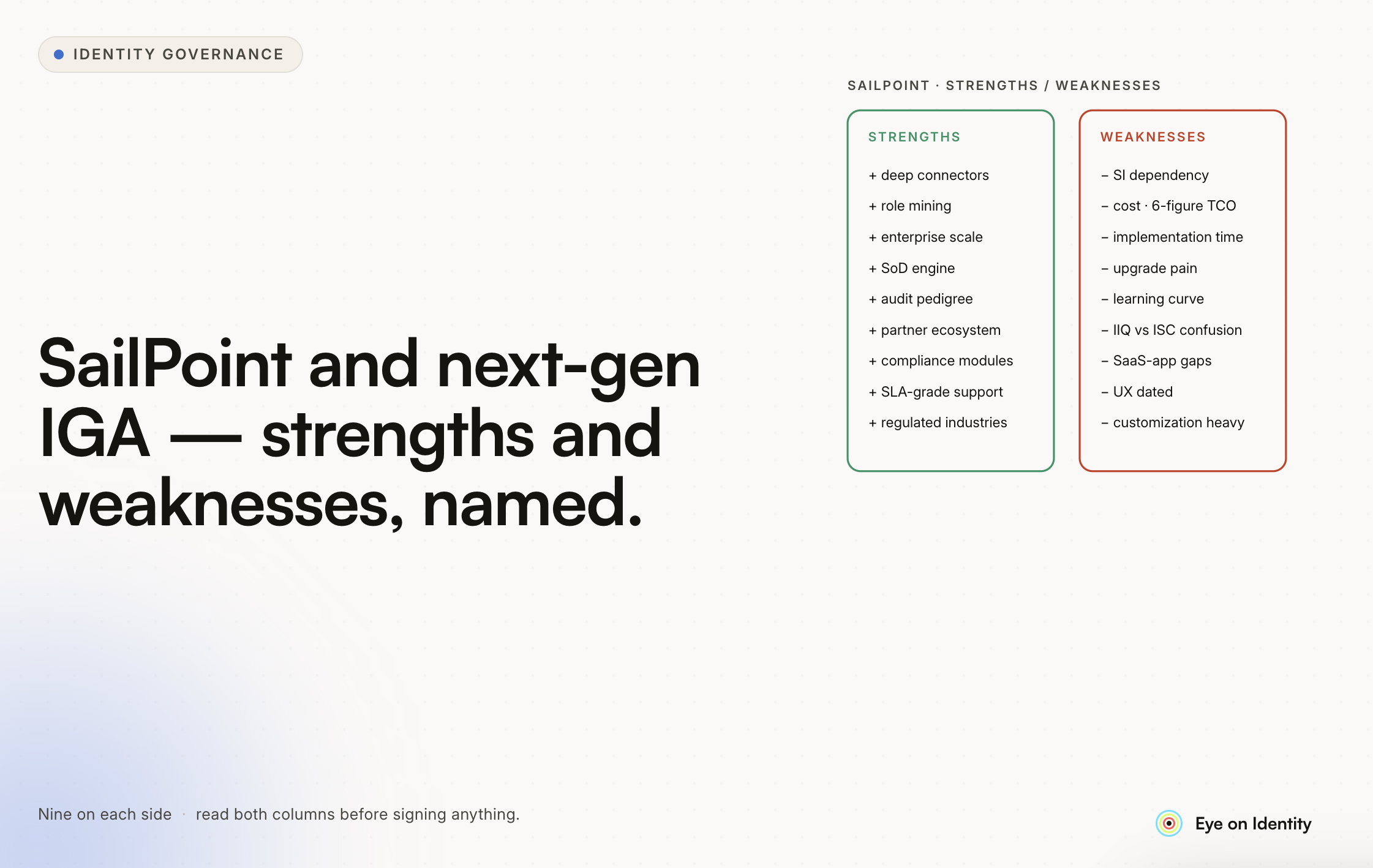


The IGA market is genuinely bifurcated right now in a way that makes vendor comparisons more interesting than they've been in years. The legacy enterprise platforms — SailPoint at the top — were built for a specific era of enterprise identity: on-premises infrastructure, SSO-connected application estates, complex role hierarchies, and organizations with dedicated IGA teams. That era still exists in large regulated enterprises, and SailPoint still serves it well.
A newer generation of platforms has emerged that take different architectural bets: faster deployment, broader visibility, modern data models, and governance capabilities for identity types that didn't exist when the legacy platforms were designed. Neither category is universally better — the right choice depends on which environment you're trying to govern and what your operational constraints are.
Here's an honest assessment across the dimensions that actually matter.
Implementation Timeline and Complexity
SailPoint's reality: SailPoint IdentityIQ (on-premises) implementations routinely run six to twelve months and require either specialized internal resources or an implementation partner with SailPoint-specific expertise. The implementation model involves defining static access profiles for each connected application, writing BeanShell rules for custom provisioning logic, and configuring the role model before meaningful governance can operate. The complexity is genuine — it exists because the governance problems SailPoint was designed for are genuinely complex — but it creates a long gap between purchase and operational value.
SailPoint Identity Security Cloud (ISC), the SaaS offering, reduces some of this complexity and is where SailPoint is actively investing. ISC implementations are shorter than IIQ but still substantially longer than what newer platforms achieve.
Next-gen platforms: Newer platforms targeting four to twelve week implementations typically achieve this through a different architecture: API-first integrations with pre-built connectors for common SaaS applications, no-code playbook builders for provisioning logic, and UI-driven configuration rather than custom development. The tradeoff is that these platforms may have shallower connector support for legacy on-premises systems and specialized enterprise applications where SailPoint has decades of connector development.
What this means in practice: If your environment is primarily cloud and modern SaaS, and your team doesn't have IGA-specific expertise, the implementation time advantage of newer platforms is significant. If your environment includes substantial legacy on-premises systems with complex integration requirements, SailPoint's deeper connector library may be worth the implementation investment.
Visibility: What Each Platform Can Actually See
This is arguably the most structurally significant difference between the approaches, and it's worth understanding precisely.
SailPoint governs what it's connected to. The SSO-integrated applications, the systems with pre-built connectors, the applications your team has manually configured — these are in scope. The shadow application estate (tools employees use independently, AI tools connected via personal accounts, department purchases outside IT procurement) is not visible to SailPoint unless someone specifically builds a connector or import process for each system.
For organizations with well-controlled application estates where employees primarily use formally provisioned tools, this is acceptable. For organizations with active shadow IT problems — which is most organizations above a certain headcount — this represents a meaningful governance gap.
Next-gen platforms with discovery capabilities close this gap through multi-source signals: browser agents that track application launches, financial data ingestion that surfaces spend-based subscriptions, SSO log analysis that catches "Login with Google" applications that aren't formally onboarded. This produces an application inventory that reflects what's actually being used rather than what IT has formally cataloged.
For offboarding specifically, this difference is consequential. SailPoint-driven offboarding reaches the applications SailPoint knows about. Shadow applications that an employee was using — and that IT didn't know about — retain active accounts after departure. Discovery-driven offboarding surfaces these applications and includes them in the offboarding workflow.
Governance Depth: Entitlements and Role Mining
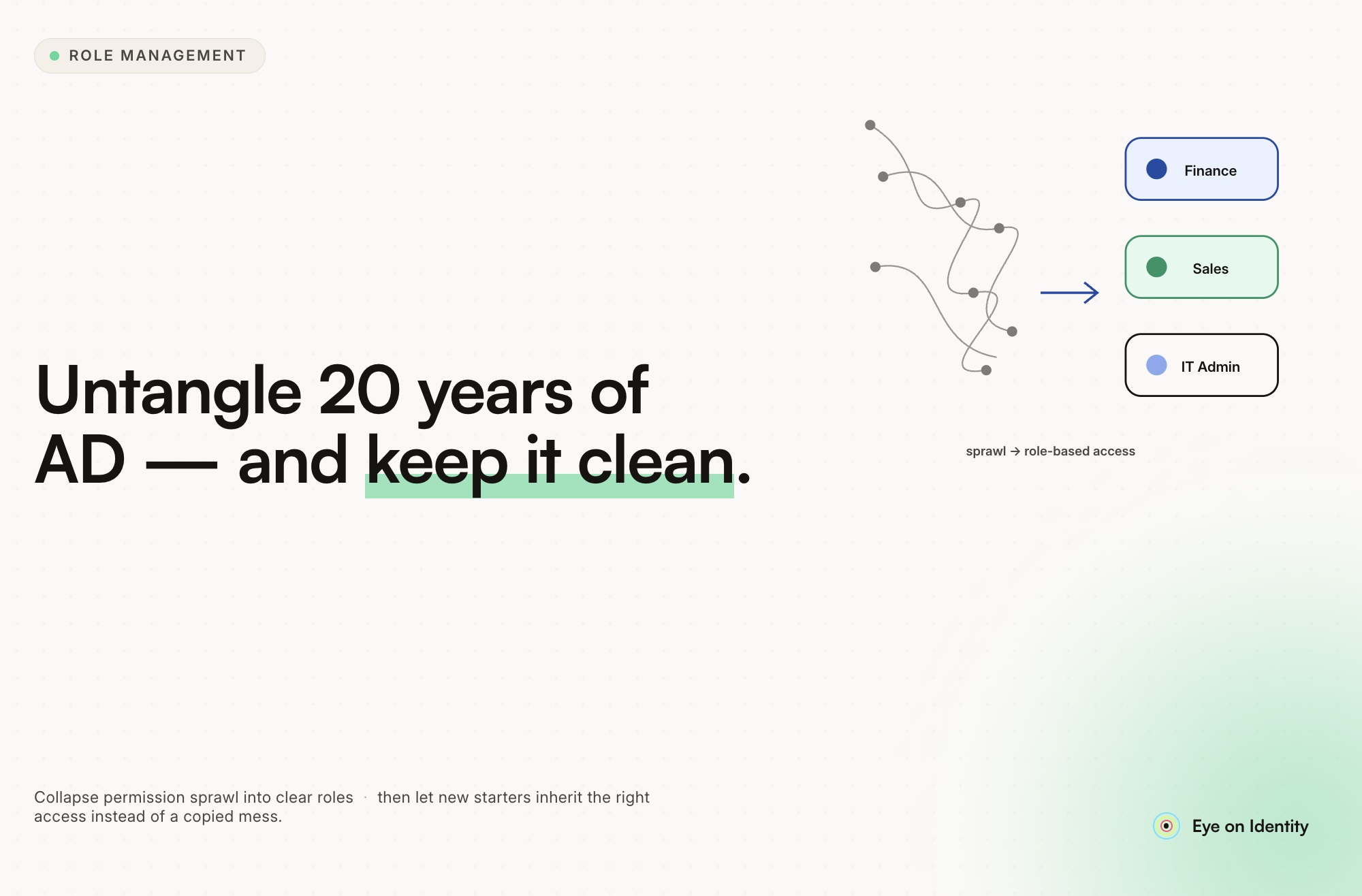
SailPoint's genuine strength: Deep role mining at the application entitlement level is where SailPoint has established its strongest reputation. The ability to analyze entitlement patterns across a large user population, model complex role structures, and map granular application permissions — this is what SailPoint does best, and it's legitimately difficult to replicate.
For large enterprises in regulated industries with complex application permission structures (SAP, Oracle, custom ERP systems with hundreds of roles), SailPoint's depth in this area is a genuine differentiator. The certifications, the role mining tools, and the workflow capabilities for governance of highly complex entitlement landscapes are mature in a way that newer platforms haven't yet matched for every use case.
The cost of this depth: the static access profile model that makes SailPoint's role mining powerful also requires upfront definition work that's time-consuming and needs ongoing maintenance as application configurations change.
Next-gen platforms: Focus on intelligence-driven governance — using activity and usage data to identify what access is actually being used versus just provisioned, detecting access outliers relative to peer groups, and surfacing cross-application segregation of duties violations. The relationship graph approach (mapping identities to entitlements to resources across multiple systems simultaneously) is architecturally different from the static role model approach and better suited to dynamic SaaS environments where role structures change more frequently.
SoD detection across multiple applications — detecting when a user holds combinations of entitlements across different systems that together create a control risk — is a capability that next-gen platforms have built with modern architectures. Cross-application SoD is technically achievable in SailPoint but requires more configuration effort.
Non-Human Identities and AI Agents
This is the area where the architectural generation gap is most visible.
SailPoint was designed in an era when identity primarily meant human users. Service accounts, API tokens, machine identities, and bot accounts existed but weren't the governance priority. SailPoint is actively working to add NHI governance capabilities, but it's retrofitting onto an architecture that wasn't designed for it.
Next-gen platforms built more recently have designed for non-human identities as a first-class concern alongside human users. Discovery and classification of service accounts, API tokens, and AI agents; lifecycle management for machine identities; governance of AI tool access — these are native capabilities in platforms built for the current environment rather than adaptations.
For organizations that are actively governing AI tool usage or that have significant service account sprawl (common in cloud-native or hybrid environments), this architectural difference translates to meaningfully different operational capability.
Commercial Model
SailPoint: Enterprise licensing with comprehensive suite pricing. The commercial model is structured around large enterprise deployments, and the pricing reflects that. Organizations that need a subset of IGA capabilities are often buying more than they need.
Next-gen platforms: More modular licensing models have emerged — purchasing access review capabilities without buying the full provisioning and discovery stack, or vice versa. This allows organizations to start with the specific governance problem they're trying to solve and expand over time. For organizations that have a specific gap to close rather than a need for full-stack IGA, this commercial flexibility is meaningful.
What SailPoint Is Actually Right For
SailPoint is well-matched to organizations that:
- Have 10,000+ identities in a complex on-premises or hybrid environment with mature IGA requirements
- Have dedicated internal IGA resources or budget for an implementation partner
- Require the depth of role mining and entitlement modeling that SailPoint's governance model provides
- Are in regulated industries where SailPoint's track record and audit evidence capabilities carry weight
- Have a primarily SSO-integrated application estate where the shadow IT visibility gap is manageable
Where SailPoint is harder to justify:
- Organizations with primarily cloud-native or modern SaaS application estates
- Organizations without dedicated IGA expertise or implementation partner budget
- Organizations where time-to-first-governance is a priority
- Environments with significant shadow IT or AI tool governance requirements
- Mid-market organizations where the SailPoint pricing model doesn't match the scale
The Honest Bottom Line
SailPoint is the right answer for the specific environment it was designed for: large, complex, often regulated enterprises with deep governance requirements, dedicated IGA resources, and the patience for a thorough implementation. The platform's depth in those scenarios is genuine and hard to replicate.
The next generation of platforms is the better answer for organizations that don't fit that profile — cloud-forward environments, faster implementation requirements, broader visibility needs, or organizations that need to start governing quickly rather than in twelve months.
The mistake most organizations make in IGA evaluations is matching vendors against a generic "best IGA platform" question rather than against their specific environment, governance requirements, and operational constraints. Those specifics determine whether SailPoint's depth is worth its implementation cost, or whether a newer platform's agility is more aligned with what the organization actually needs.
A note on scope: neither SailPoint nor next-gen IGA platforms perform privileged access management functions — session monitoring, credential vaulting, password rotation. For PAM requirements, CyberArk, BeyondTrust, and similar PAM tools are a separate and complementary layer.


.svg)