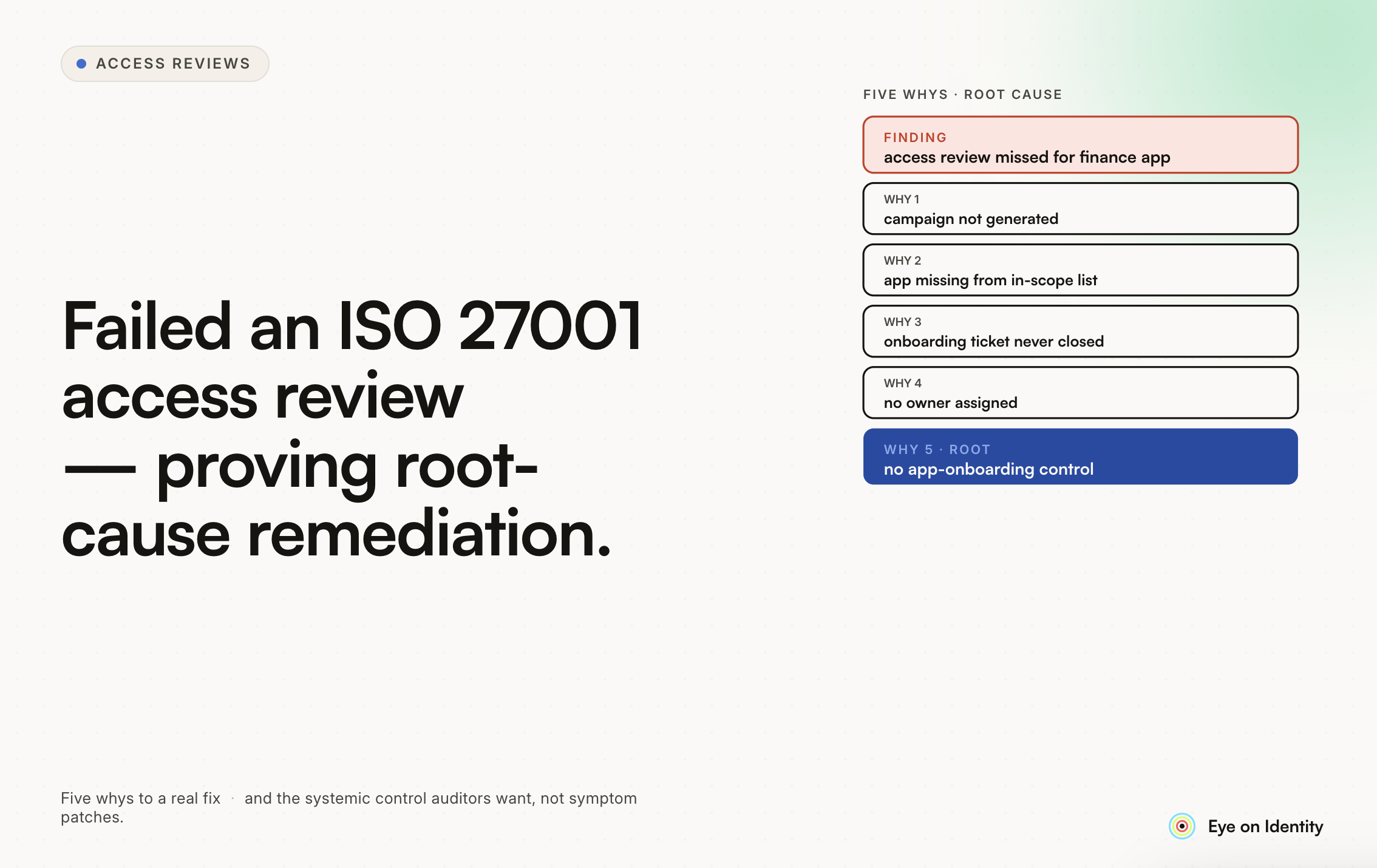


An ISO 27001 finding for a failed access review control is one of the more instructive audit outcomes you can receive, because the finding itself tells you something specific about what broke down. The challenge most organizations face after receiving it is that the instinctive fix — run the overdue review, revoke the access that should have been revoked, produce the evidence — addresses the symptom rather than the root cause. Auditors reviewing your corrective action know the difference, and a corrective action that treats only the symptom will generate the same finding in the next surveillance cycle.
What Is Root Cause for an Access Review Control Failure? Root cause analysis for access review failures consistently points to one of a small number of underlying causes. Understanding which one applies to your situation determines what the remediation actually needs to look like. No Defined Process The review happened informally or not at all because there was no documented procedure specifying who is responsible for reviews, what the scope is, what the cadence is, and what happens if a review doesn’t complete on schedule. The fix is a documented procedure — not just a policy statement that reviews will occur, but a procedure that specifies the operational steps: how campaigns are launched, who assigns reviewers, what the deadline structure is, what escalation happens when deadlines aren’t met. Process Existed But Wasn’t Enforced The procedure was written, but the enforcement mechanism didn’t exist. Reviews were supposed to happen quarterly; they happened when someone remembered. Reviewer tasks were sent; there was no follow-up when reviewers didn’t respond. The fix here is enforcement infrastructure: a governance platform that launches campaigns automatically, sends reminders, escalates to fallback reviewers when primary reviewers miss deadlines, and closes campaigns with automatic action on unreviewed access rather than leaving them open indefinitely. Process and Enforcement Existed But Scope Was Wrong Reviews were happening on schedule but not covering the right systems. The access review scope was defined as “applications in the SSO” while the audit looked at an application outside that scope. The fix requires expanding the scope definition to match the actual access estate, which means first completing a discovery exercise to understand what the full access estate actually is. Wrong Evidence Format Reviews were conducted and evidence was collected, but in a format that doesn’t satisfy the auditor’s requirements: a spreadsheet that could have been modified, an email chain that doesn’t capture reviewer decisions per-record, a report that shows approvals but no revocations or justifications. The fix is both procedural — changing what evidence is collected and how — and potentially tooling-related, if the current process can’t produce the required evidence format without new tooling.
How Do You Prove Root Cause Remediation to an ISO 27001 Auditor? ISO 27001 follows a Plan-Do-Check-Act cycle, and when a finding is raised, the corrective action process requires demonstrating not just that the specific issue was fixed, but that the underlying cause was identified and addressed in a way that prevents recurrence. The corrective action record that satisfies an ISO 27001 auditor typically needs to show: Nonconformity Description What specifically failed: which control, what was found, what evidence or lack of evidence triggered the finding. Root Cause Analysis What underlying condition caused the control to fail — not just “the review didn’t happen” but why it didn’t happen. This is where the categories above apply: was there no process, no enforcement, wrong scope, or wrong evidence format? Root Cause Remediation What was changed to address the underlying cause — the new procedure, the new tooling, the expanded scope definition, the changed evidence format. This is the section auditors scrutinize most closely, because it’s where they determine whether the fix was substantive or cosmetic. Effectiveness Evidence What demonstrates that the remediation worked — typically, evidence from the next review cycle showing that the process ran as designed and produced the required outputs. This is why effectiveness verification is the most time-sensitive part of the corrective action: you need at least one successful review cycle to complete the evidence package.
What Does Substantive Remediation Look Like? The distinction between substantive and cosmetic remediation is whether the underlying condition that caused the failure has actually changed. Cosmetic remediation: “We ran the overdue access review and revoked the access that should have been revoked.” This addresses the specific instance of the failure but leaves the process that produced it unchanged. The next review cycle will face the same conditions and likely produce the same outcome. Substantive remediation: “We identified that reviews weren’t happening because there was no automated launch mechanism and reviewers had no deadline enforcement. We implemented a governance platform with scheduled campaign launch, automated reviewer reminders, and automatic access revocation for access not reviewed within the deadline. The evidence from the next quarterly cycle demonstrates that the review ran without manual intervention, all reviewers received and responded to their tasks within the deadline, and the resulting access revocations were executed and confirmed automatically.” The auditor reading this sees a changed process, not just a corrected outcome. The evidence from the next cycle demonstrates that the changed process works. For the specific case where your concern is that you’ve treated only the symptom — the access was revoked, the review was belatedly conducted — the question is: what changed that would prevent the same situation from occurring next quarter? If the answer is “we’ll be more diligent,” that’s cosmetic. If the answer is “the review now launches automatically on the 15th of the last month of each quarter, reviewers have a 14-day window with automated reminders, and access not reviewed by day 14 is automatically revoked,” that’s substantive.
How Long Does Effectiveness Verification Take? ISO 27001 surveillance auditors typically want to see at least one full cycle of the corrected process running successfully before they’ll close a corrective action as effective. For a quarterly access review finding, that means waiting until the next quarterly review cycle has run and produced evidence before the corrective action is fully verifiable. If your surveillance audit is scheduled before the next cycle completes, you’ll need to present: The procedural changes made (new documented procedure, new tooling, expanded scope). Evidence that the next campaign has been scheduled and is configured correctly. A clear timeline for when effectiveness evidence will be available. Auditors who understand implementation timelines will accept this as an in-progress corrective action rather than treating it as an open finding, provided the procedural changes are substantive and the timeline for effectiveness evidence is realistic.
What the Evidence Package for Corrective Action Closure Should Include For ISO 27001 corrective action closure on an access review finding, the evidence package typically needs: The finding description from the audit report. The root cause analysis document, signed by the process owner, identifying the underlying cause. The corrective action plan describing the specific process changes made. Implementation evidence: the new procedure document, configuration records for new tooling, updated scope definition. Effectiveness evidence: the evidence package from the first review cycle conducted under the new process, demonstrating that the review ran as designed, produced the required outputs, and that any revocations were executed and confirmed. This evidence package is what closes the finding in the next surveillance audit. Without the effectiveness evidence, the finding remains open regardless of how thorough the corrective action documentation is.


.svg)