

The combination of requirements you're describing — just-in-time access that's flexible enough to handle non-standard integrations, alongside continuous monitoring for when application teams change entitlements without governance oversight — is a real gap in the market. Most tools are built for one or the other, not both.
Here's how to think about the architecture and what to look for in solutions.
The Two Problems You're Actually Solving
It helps to separate the two concerns, because they're related but distinct in how they're addressed.
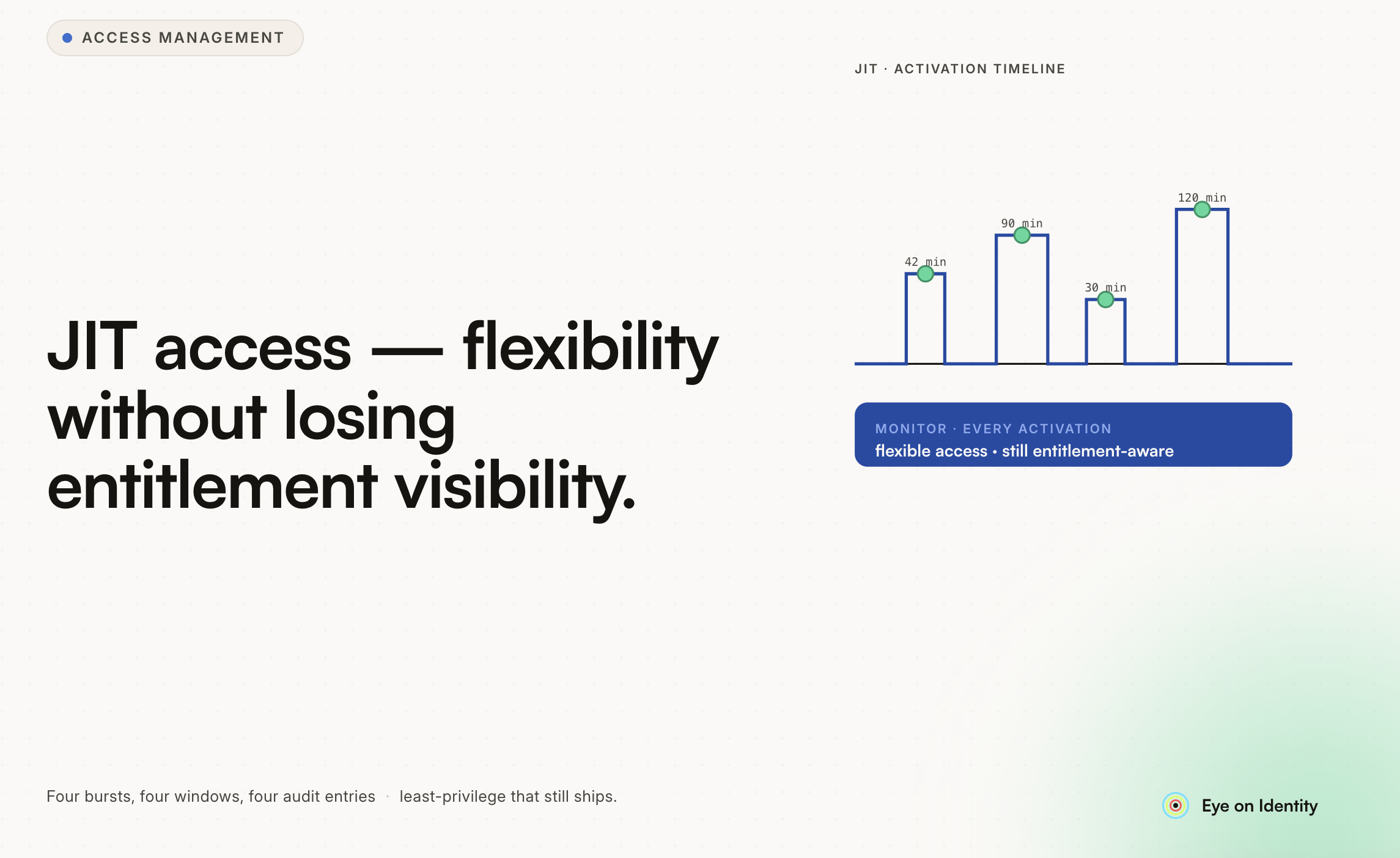
JIT access governance is about controlling the lifecycle of time-bound access: who can request temporary access to what, for how long, through what approval process, and with automatic revocation when the window expires. The challenge you're describing — needing more flexibility than standard tools provide — typically shows up when your environment includes non-standard integrations: homegrown applications, cloud environments with custom role structures, or services that need API calls that pre-built connectors don't support.
Entitlement drift monitoring is about catching changes that happen outside your governance processes: an application team adds a user to a privileged role directly, cloud role policies get modified without an approval workflow, or permission configurations change in ways that create security risk you aren't aware of until the next audit. This is a visibility and detection problem rather than an access control problem.
Both need to be solved, but the solutions work differently. Getting them both from the same platform is ideal; getting them from integrated tools that share data is acceptable.
JIT Access: What Flexibility Actually Requires
Standard JIT access implementations work well when the applications you're granting access to are well-supported by pre-built connectors. When they aren't — custom internal applications, cloud environments with non-standard role structures, services that need specific API calls — most tools hit a wall.
The flexibility requirement for JIT access in complex environments has three components:
Custom action support. The ability to define arbitrary API calls against any endpoint, with control over HTTP method, headers, URL parameters, and request body. This covers the cases where you need to execute a specific administrative action that a native connector doesn't support — adding a user to a specific Kubernetes role, calling an internal service's user management API, or triggering a custom cloud IAM role assignment.
Universal or custom connector capability. For homegrown applications and legacy cloud services that won't have a pre-built connector, an SDK or framework that lets you define the integration from scratch — specifying what metadata to pull (users, roles, group memberships) and what actions to execute (add to group, assign role, remove permission) — extends JIT governance to applications that would otherwise be ungoverned.
Time-bound expiry with automatic revocation. The core JIT requirement: access that is granted for a defined duration and automatically revoked when that duration expires, regardless of whether the user remembers to release it or whether someone remembers to deprovision it. This is the mechanism that prevents temporary access from becoming permanent through inertia.
The approval workflow layer sits on top of these mechanisms: multi-level approval chains that ensure time-bound access to sensitive environments goes through appropriate authorization before being granted, with the approval decision and justification recorded for audit purposes.
Entitlement Monitoring: Catching Changes You Didn't Make
This is the harder problem to solve with most governance tools, because it requires continuous monitoring of entitlement state rather than just controlling access at the point of granting.
The specific failure mode: your governance process controls what access is granted through your request workflow. But application teams can also grant access directly — adding users to roles in cloud IAM, modifying group memberships in the application, or changing permission policies that affect broad user populations. These changes bypass your governance workflow entirely, and you only discover them when an audit, an incident, or a periodic review surfaces the discrepancy.
Continuous Entitlement Scanning
The detection mechanism is periodic or continuous scanning that compares current entitlement state against known good state — what your governance records say should exist — and flags deviations. When an application team adds a user to a privileged role outside your workflow, the next scan detects the new assignment, compares it against what your records show as the approved state, and flags the difference for review.
The scanning frequency matters for how quickly you detect drift. Daily scanning catches changes within 24 hours. Near-real-time monitoring (event-driven rather than scheduled) catches them within minutes. The right frequency depends on the risk profile of the environments you're monitoring — production cloud IAM roles warrant faster detection than development environment access.
SoD Violation Detection
Segregation of duties violations are a specific entitlement monitoring use case where you're not just looking for unauthorized access but for dangerous combinations of access — cases where a user holds two or more entitlements that together enable them to perform actions that should require multiple people.
The classic examples: a user who can both create and approve financial transactions, or who has both read and write access to audit logs. In cloud environments, the equivalent might be a user who can both modify IAM policies and approve their own policy changes.
Detecting these requires defining the toxic combinations explicitly — which roles or permissions from which systems, when held simultaneously, create an SoD violation — and then scanning the entitlement landscape against those definitions. Cross-application SoD violations, where the dangerous combination spans two different systems, are particularly hard to catch without tooling that has visibility across both.
Policy Change Monitoring
Beyond individual user entitlements, monitoring cloud role policy changes is a separate concern. When someone modifies an IAM role definition in AWS, Azure, or GCP — changing what actions the role permits — that affects every user or service account assigned to that role, potentially expanding access for a large population simultaneously.
Cloud provider audit logs (CloudTrail for AWS, Activity Log for Azure, Cloud Audit Logs for GCP) capture these policy changes, but surfacing them as governance events — triggering review workflows when role policies change, alerting on changes that expand permissions — requires integrating those logs into your governance process rather than treating them as separate operational logs.
What to Look for When Evaluating Tools
Given the combination of requirements, the evaluation criteria that actually differentiate tools for your use case:
Integration extensibility. Does the tool support custom API actions for non-standard integrations, and does it have an SDK or framework for building connectors to homegrown applications? Test this specifically with one of your non-standard integrations during evaluation rather than taking the vendor's word for it.
Entitlement depth. Does it pull role and permission data, or just user existence? Monitoring for entitlement drift requires knowing what entitlements exist, not just which users have access to an application.
Continuous monitoring vs. point-in-time. Does the platform scan entitlements continuously or on a scheduled basis, and how does it surface drift when detected? A tool that only reviews entitlements during manually-initiated campaigns can't detect changes that happen between campaigns.
SoD policy definition. Can you define custom SoD policies for the specific role combinations that create violations in your environment, and does it detect cross-application violations?
Cloud IAM integration. For cloud role policy monitoring specifically, does the tool integrate with your cloud providers' audit logs to detect policy changes as governance events?
Time-bound access with automated expiry. Can access duration be set at the request level (not just at the policy level), and does expiry trigger an automated revocation action rather than a notification that someone has to act on?
No single tool perfectly covers all of these, and you may end up combining a JIT access governance platform with cloud security posture management (CSPM) tooling for the cloud IAM policy monitoring layer. The integration between those tools — whether governance decisions flow to the CSPM layer and whether CSPM findings trigger governance workflows — determines how well the combined solution addresses your overall requirements.
Starting Point
Before evaluating tools, document your specific non-standard integration requirements — which applications need custom connector support, what API calls those integrations require, and what the entitlement structure looks like. Vendors who can demonstrate working custom connector support for your specific cases during evaluation are meaningfully differentiated from those who claim broad integration support but haven't solved your specific scenarios.
Similarly, document the specific entitlement change scenarios you're trying to detect — which role policy changes trigger a review, which permission combinations constitute an SoD violation, which cloud environments need continuous monitoring — so you can evaluate each tool against concrete requirements rather than abstract capability claims.


.svg)