

The standard pitch for Identity Governance and Administration — months-long implementation, dedicated IAM engineers, enterprise licensing — describes a product designed for organizations with 10,000 employees and a team to match. For a two-person IT team managing 200 employees and 80 SaaS applications, that's not a solution, it's a deterrent.
The good news: the core problems that IGA solves — orphaned accounts after offboarding, privilege accumulation through role changes, and evidence-free access reviews for SOC 2 auditors — exist in SMBs just as much as enterprises. The difference is that an SMB doesn't need the full enterprise governance stack to solve them. It needs the right four things, in the right order.
What Actually Matters for a Small IT Team
The governance problems that consume the most time and create the most risk in small organizations consistently fall into four categories:
Offboarding gaps. When someone leaves, how many applications does your current process miss? The honest answer for most SMBs is: several. Every application that wasn't connected to Okta, every tool a department signed up for on a credit card, every legacy system with its own authentication — these accounts remain active until someone manually finds and removes them. The orphaned account that shows up in a SOC 2 audit is almost always from one of these categories.
Onboarding friction. A new hire who needs access across 15+ applications creates 15+ manual tasks for IT. Each one is a potential delay on the new hire's first day and a potential error if the wrong access level is assigned. The manual work also means IT is the bottleneck for every new hire, regardless of how well-understood the access requirements are.
Compliance evidence. SOC 2 and ISO 27001 both require periodic access reviews — documented evidence that someone verified current access is still appropriate and that inappropriate access was revoked. When this process runs on spreadsheets and email chains, it takes weeks, produces inconsistent evidence, and is frequently flagged by auditors as inadequate.
Shadow IT visibility. The applications your employees use outside of IT-provisioned tools — tools signed up for individually with work email, AI tools adopted by individual contributors, department-level SaaS subscriptions on a credit card — are outside your governance scope. You can't offboard users from tools you don't know about.
The Phased Approach That Works for SMBs
The advice that consistently comes from practitioners who've implemented governance in small environments: start with visibility, add automation, then tackle compliance.
Phase 1: Get visibility. Before automating anything, know what you're governing. This means discovering all the applications your employees actually use — not just the ones IT provisioned. Multi-source discovery (SSO logs, financial transaction analysis, browser agents) builds this map. You're looking for the 40 apps everyone uses but only 20 are in your SSO, the AI tools that showed up in expense reports, and the orphaned accounts in the apps you do know about.
This phase doesn't require a large implementation. It requires connecting discovery to your existing SSO and HRMS and letting it run.
Phase 2: Automate the JML essentials. With the full application map visible, automate the three lifecycle events that create the most manual work and security risk:
Joiners — connect your HRMS as the trigger source. When HR adds a new employee with a start date, a birthright access playbook provisions the standard set of applications (M365, Slack, and whatever else your organization uses as baseline) based on role and department. This is the zero-touch onboarding that eliminates manual IT provisioning for standard hires.
Leavers — this is the highest-risk lifecycle event for SMBs. When HR records a termination, an offboarding playbook runs against every application in the departing employee's access profile — SSO-connected and non-SSO, including the shadow IT discovered in Phase 1. Every license is reclaimed, every session terminated, every manual task tracked for applications that can't be automated.
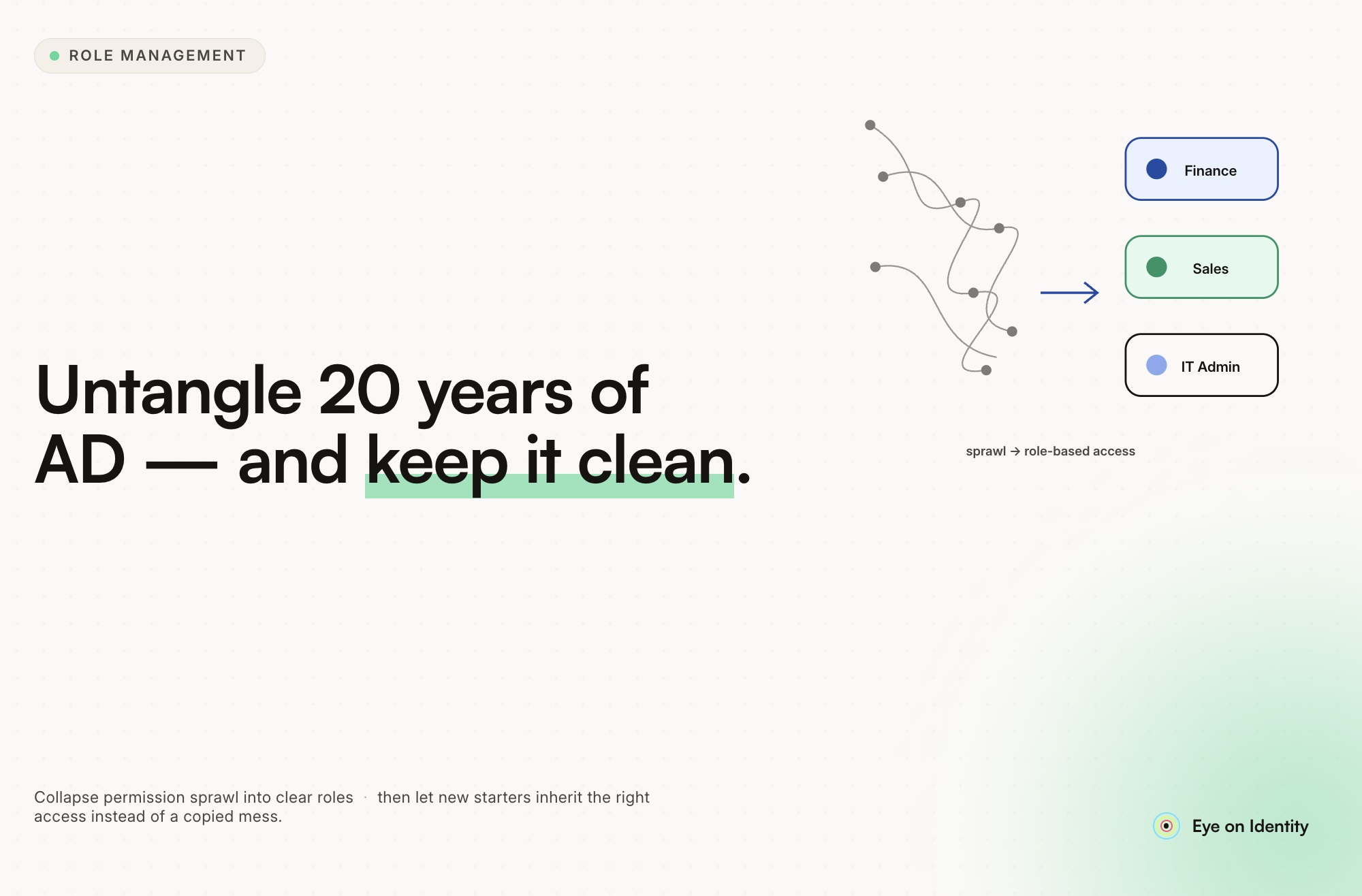
Movers — when someone changes roles, the playbook simultaneously removes access from the previous role and provisions access for the new role. This is the mechanism that prevents privilege accumulation from building up over years of role changes.
Phase 3: Access reviews for compliance. With lifecycle automation handling the ongoing governance, periodic access reviews shift from being the primary governance mechanism to being the audit evidence layer. Access review campaigns that surface usage data (last login, activity frequency) alongside the access record give reviewers meaningful context — they're confirming that current access matches current role rather than blindly approving a list of technical entitlements they don't recognize.
Why Enterprise IGA Tools Don't Fit SMBs
The enterprise IGA platforms — SailPoint, Saviynt — are designed for environments with dedicated IAM teams and 12-month implementation budgets. Several specific architectural decisions make them a poor fit for small organizations:
Static access profiles require upfront mapping. Enterprise IGA builds role-entitlement maps from scratch before governance begins. For a two-person IT team, the upfront configuration work to define every role's access profile across every connected application is weeks of work before the platform provides any value.
Implementation requires professional services. Enterprise IGA implementations typically involve significant professional services investment. For an SMB, this cost often exceeds the value the platform would deliver.
Maintenance is resource-intensive. Practitioners report 0.5-2 FTE of ongoing maintenance for enterprise IGA platforms. A two-person IT team can't dedicate that capacity to platform maintenance.
Licensing tiers are priced for enterprise. Enterprise IGA per-user pricing at SMB user counts still reflects enterprise economics.
Modern IGA platforms designed for the mid-market and SMB segment (Zluri, Lumos, and others) deploy in weeks rather than months, use no-code playbook configuration rather than static access profiles, and require less ongoing maintenance because connectors are maintained by the vendor.
The Shadow AI Problem for SMBs
AI tool adoption by employees is accelerating faster than IT teams at any size can track formally. ChatGPT, Claude, Gemini, Perplexity, and dozens of specialized AI tools are being used for work at most organizations, regardless of whether IT has sanctioned them or configured them.
For SMBs, this creates a specific governance gap: employees using AI tools with work data generate exposure that IT doesn't know about and can't govern. The shadow AI problem is a subset of the shadow IT problem — tools adopted outside formal IT channels — with the added dimension that the data processed by these tools may be subject to confidentiality or regulatory obligations.
Discovery that includes browser agent signals surfaces shadow AI usage the same way it surfaces shadow SaaS — by seeing what employees actually access at the endpoint level rather than relying on formal procurement or SSO logs.
What Works in Small Environments (and What Doesn't)
Works: Modular playbooks rather than one complex workflow. Separate birthright playbooks from department-specific playbooks from location-specific playbooks. Each is independently maintainable — when the engineering team's access changes, only the engineering playbook needs updating, not the entire onboarding workflow.
Works: App owner-driven access reviews. For SOC 2 access reviews in a small organization, the application owner (the person accountable for the tool, not necessarily in IT) can run the certification for their own application. A platform with a reviewer interface that non-technical users can navigate without training dramatically increases completion rates and decreases IT involvement per review.
Works: Treating offboarding as the highest-priority automation. The security and cost impact of orphaned accounts is immediate and visible. Starting with offboarding automation — ensuring that every departing employee's access is revoked across every discovered application — delivers immediate, measurable risk reduction.
Doesn't work: Manual precedence overrides. In any IGA platform, manually editing a user's data in the platform itself often gives that edit highest precedence, blocking future automated updates from the HRMS source of truth. Manual overrides should be the exception with a documented reason, not the default path when the automation doesn't work exactly right.
Doesn't work: Reviewing everything at once. An SMB with 80 applications attempting a comprehensive access review of all 80 simultaneously will get low completion rates and rubber-stamping. Start with the 10 highest-risk applications (production systems, financial tools, customer data systems) and build a regular review cadence for those before expanding scope.
Frequently Asked Questions
Does an SMB with a small IT team need IGA?
The governance problems IGA solves — orphaned accounts, privilege accumulation, compliance evidence for access reviews — affect SMBs just as they affect enterprises. The question isn't whether the problems exist but whether the solution fits the team's capacity. Modern "light IGA" platforms deploy in weeks and are designed for small teams without dedicated IAM engineers. The ROI typically comes from offboarding automation (reclaimed licenses, reduced orphaned account risk) and compliance evidence that previously required weeks of manual spreadsheet work.
What is the fastest way for an SMB to improve identity governance?
Start with offboarding automation — it delivers the most immediate security and compliance value. Connect your HRMS as the authoritative source, configure a deprovisioning playbook that covers all discovered applications, and ensure that departing employee offboarding is triggered automatically from the HR termination event rather than depending on manual IT action. This single improvement closes the orphaned account gap that auditors most commonly flag.
How do SMBs conduct access reviews for SOC 2 without months of work?
Modern IGA platforms run access certification campaigns that route review tasks to designated reviewers (application owners or managers), capture decisions with timestamps, require justification for retained access, and generate non-editable PDF reports as audit evidence. The entire campaign for a focused set of 10-15 applications typically takes 2-3 weeks from setup to completed evidence. Spreadsheet-based reviews that achieve the same auditor-ready output typically take the same duration but with significantly more IT coordination overhead.


.svg)