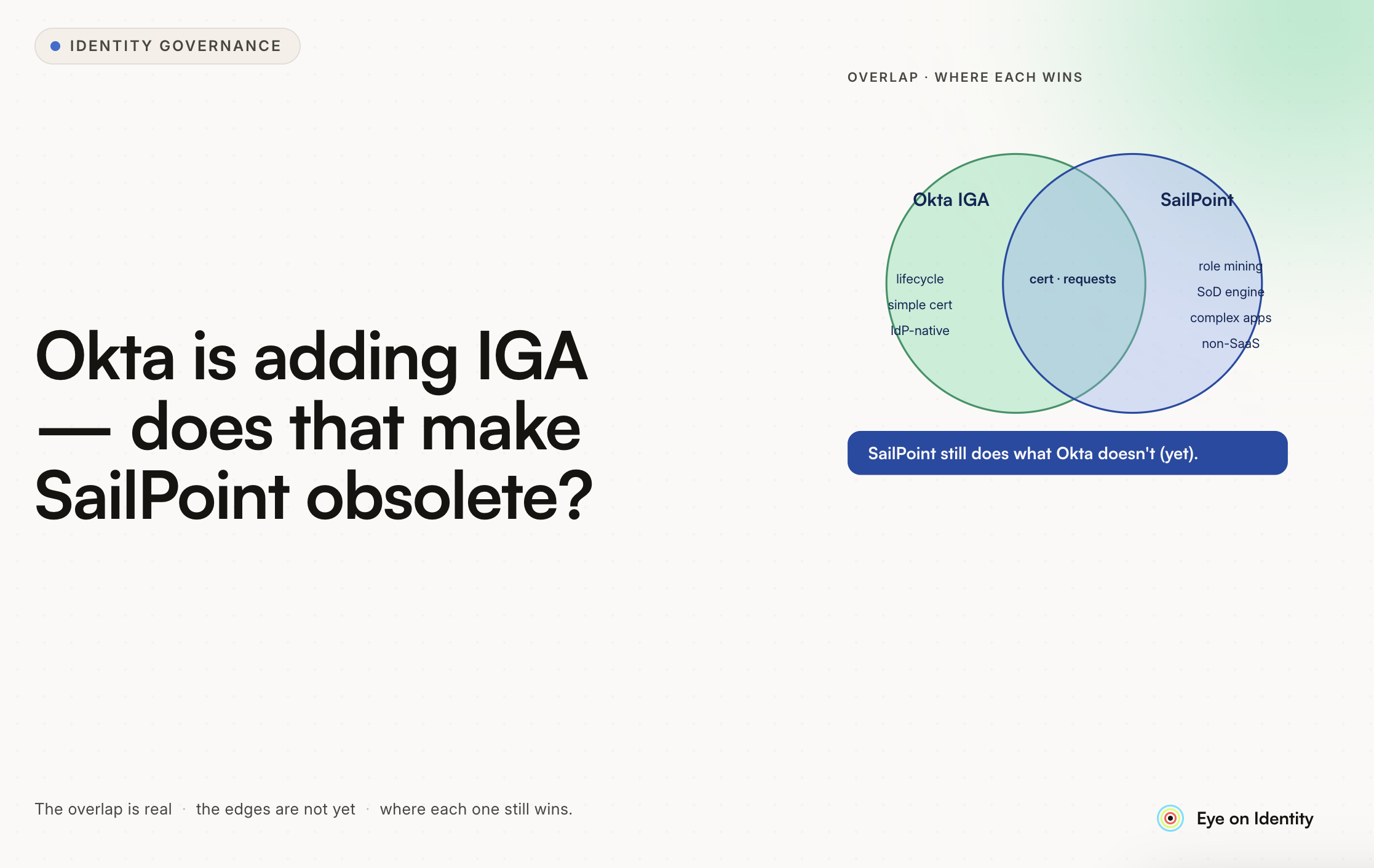


Okta's move into identity governance is real and it's significant — the company has been building out access request workflows, access certifications, and lifecycle management capabilities that overlap with what dedicated IGA platforms like SailPoint provide. For organizations already using Okta as their identity provider, the question of whether they still need a separate IGA platform is a legitimate one worth thinking through carefully.
The short answer is: it depends on what governance problem you're trying to solve. For many organizations, Okta's governance features will be sufficient. For others — particularly those with regulatory requirements, complex application estates, or cross-application risk scenarios — the gaps in Okta-native governance still justify a dedicated IGA platform.
Here's the distinction that matters.
What Okta Is Good At (Governance Included)
Okta's core strength is authentication and access management for the applications in its SSO catalog. As it adds governance features — access request workflows, manager certification campaigns, lifecycle automation tied to HRMS events — it extends that strength into the governance layer for those same applications.
For organizations with a relatively contained, SSO-integrated application estate and governance requirements focused on basic access certifications and lifecycle management, Okta's governance capabilities are increasingly capable of meeting those requirements. The integration advantage is real: having access governance in the same platform as authentication simplifies the architecture and reduces the integration complexity that comes from connecting a separate IGA tool to Okta.
The birthright access use case — defining standard access packages for specific roles and automatically provisioning them when a user joins — is well-served by Okta. Basic access certifications for SSO-connected applications with manager review workflows are functional. For organizations earlier in their IGA maturity, this may be entirely sufficient.
Where Dedicated IGA Still Adds Value
The Maker-Checker Separation
This is the most principled argument for a dedicated IGA platform, and it resonates strongly with compliance auditors. The system that grants access (Okta, as the identity provider) is the "Maker." The system that periodically certifies whether that access remains appropriate should be independent — a "Checker" that's not the same system that made the original access decision.
When Okta is both the authentication layer and the certification layer, the organization is essentially having the same system review its own decisions. For internal operational purposes, this works fine. For compliance frameworks like SOX or SOC 2 Type II where access review independence is specifically evaluated, having the same platform perform both functions can create audit findings.
A dedicated IGA platform that connects to Okta via API and certifies the access that Okta has granted provides the independence that compliance frameworks look for. This doesn't require SailPoint specifically — any dedicated governance platform that operates independently of Okta satisfies this requirement.
Visibility Beyond the SSO Perimeter
This is arguably the more practically significant gap. Okta governs applications that are connected to Okta. It has no visibility into applications that employees are using outside SSO: SaaS tools purchased by departments on corporate cards, AI tools accessed through personal accounts, legacy applications with local authentication, vendor portals with basic auth.
In most enterprise environments, this unmanaged application estate is substantial. Estimates consistently put the share of enterprise applications outside formal IT oversight above 60%. Okta-native governance reviews the formally managed portion. The rest is outside its perimeter.
For organizations with audit requirements that extend to the full application estate — or where offboarding needs to reach every application an employee accessed, not just the SSO-connected ones — this gap is meaningful. Dedicated IGA platforms with discovery capabilities (browser agents, financial data ingestion, SSO log analysis) surface and govern the applications outside the Okta perimeter.
Deep Entitlement Visibility and Role Mining
Okta knows that a user has access to Salesforce. It doesn't necessarily know what permission sets that user holds within Salesforce, what their effective data access scope is, or how their Salesforce entitlements compare to their peers in the same role.
Dedicated IGA platforms that connect directly to application APIs pull this entitlement depth. For access certifications to be meaningful — reviewers evaluating whether a user's permission level, not just their application access, is appropriate — you need the entitlement data that Okta's SSO-level view doesn't provide.
Role mining is a function that dedicated IGA platforms have invested heavily in: analyzing entitlement patterns across a user population to identify common access groupings, model role structures that reflect actual organizational access patterns, and support the design decisions that drive birthright access. Okta's governance features handle role assignment once roles are defined; the role design and mining work that precedes that is a dedicated IGA function.
Cross-Application Segregation of Duties
SoD violations — users holding combinations of access across different applications that create control risks — require seeing the full entitlement picture across multiple systems simultaneously. A user who can create purchase orders in one application and approve invoices in a separate application holds a cross-application SoD violation that neither application's native access controls will surface.
Okta can see that the user has access to both applications. It doesn't see the specific entitlements within those applications that together create the violation, and it doesn't have a policy engine for defining and detecting cross-application toxic combinations. Dedicated IGA platforms define these policies and continuously scan against them across your entire entitlement landscape.
Is SailPoint Specifically Still Needed?
This is a slightly different question from whether dedicated IGA is still needed. The answer to the broader question (dedicated IGA still adds value for complex environments) doesn't necessarily mean SailPoint is the right dedicated IGA platform.
SailPoint's specific strengths — deep role mining capabilities, mature connector library, established track record in regulated industries — are well-documented. Its implementation complexity — multi-month timelines, custom development requirements, static access profile maintenance — represent real operational costs that are equally well-documented.
The market has moved since SailPoint established its category leadership. A new generation of IGA platforms has emerged with faster implementation cycles, more modern data models, and no-code configuration approaches that reduce implementation and maintenance overhead. These platforms occupy the same architectural role as SailPoint — dedicated governance platform, independent of the IdP, with cross-application visibility and entitlement intelligence — but with a different operational profile.
So the more precise answer to your question: Okta adding IGA features doesn't eliminate the need for dedicated IGA for organizations with complex governance requirements. Whether SailPoint specifically is the right dedicated IGA platform for any given organization is a separate question that depends on implementation complexity tolerance, budget, and specific governance requirements.
The Scenarios Where Each Approach Makes Sense
Okta-native governance is likely sufficient when:
- Your application estate is primarily SSO-connected through Okta
- Your governance requirements are focused on access certifications for those applications
- Your compliance requirements don't specifically mandate maker-checker independence
- You're earlier in IGA maturity and need to establish basic governance before tackling complexity
Dedicated IGA alongside Okta makes sense when:
- You need governance coverage for applications outside the Okta SSO perimeter
- Your compliance framework specifically evaluates the independence of access granting and certification
- You have cross-application SoD requirements that require a policy engine spanning multiple systems
- You need deep entitlement visibility for access certifications, not just presence checks
- You're in a regulated industry where access review evidence standards are high
The trajectory is toward consolidation — Okta and similar IdPs will continue expanding their governance capabilities, and the line between IdP and IGA will continue to blur. But the point where Okta fully replaces dedicated IGA for complex enterprise environments is farther out than current marketing might suggest.


.svg)