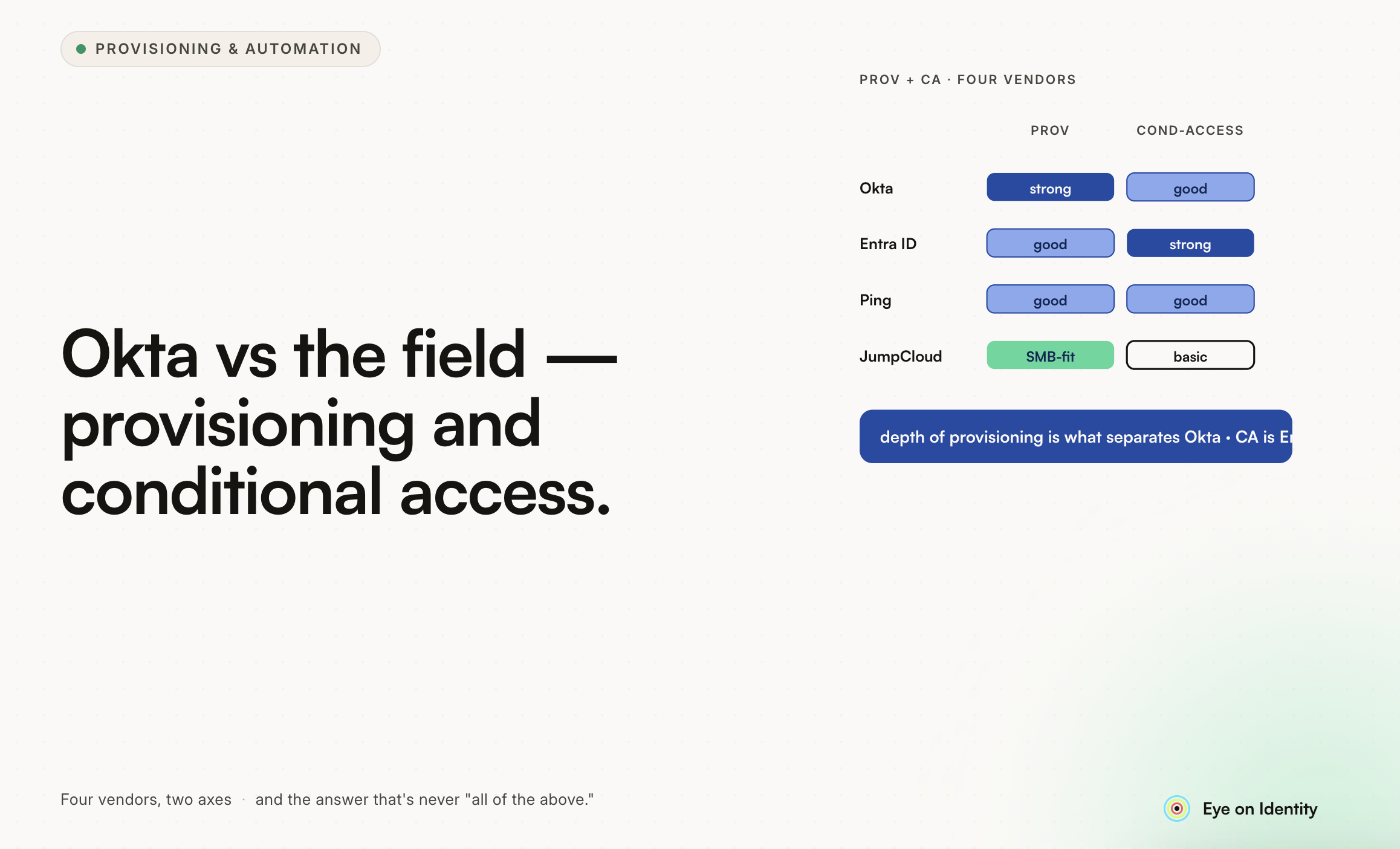


Okta is one of the strongest options for the core requirements you're describing — user provisioning and device-based conditional access for SaaS applications. But whether competitors are worth considering depends on what "streamline user provisioning" means for your full application estate, and how tight you need your device enforcement to be.
Here's an honest breakdown of what Okta covers well, where the architectural gaps are, and what alternatives or complements actually address them.
What Okta Does Well
For the stated requirements, Okta is legitimately well-suited:
User provisioning for SSO-connected applications is Okta's core strength. Applications that support SCIM provisioning get automated account creation and deprovisioning driven by Okta lifecycle events — a new hire in your directory triggers account creation across connected applications, and a departure triggers deprovisioning. For organizations with a primarily modern SaaS application estate, this covers a substantial portion of the provisioning workload.
Conditional access based on device compliance is available through Okta's Adaptive MFA and Device Trust features. You can configure policies that require device enrollment and compliance before granting access to applications — so a user on a personal device gets blocked while a user on an enrolled company device gets access. This is a core Okta capability and works well for applications in the Okta SSO catalog.
Implementation speed is one of Okta's genuine advantages over legacy IGA platforms. Getting core SSO and provisioning functional for your primary applications is typically measured in weeks, not months.
Where Okta Has Gaps
Provisioning for Non-SSO Applications
Okta provisions applications that are connected to Okta. Applications that don't support SAML or SCIM, legacy tools with local authentication, department-purchased SaaS tools that bypass IT, and AI tools employees are using independently — none of these appear in Okta's provisioning scope.
In most environments, this unmanaged application tail is larger than it initially appears. Employees adopt tools without going through IT, departments purchase subscriptions on corporate cards, and legacy applications remain on local auth because migration hasn't been prioritized. These applications retain active accounts for departing employees because Okta's offboarding workflow doesn't reach them.
If "streamline provisioning" means covering the full application estate including shadow IT, Okta alone doesn't solve that. The solution is either a separate discovery and governance layer that surfaces non-SSO applications, or accepting that Okta-driven provisioning has a defined scope that excludes the unmanaged estate.
Device-Based Access for Non-SSO Applications
Conditional access in Okta enforces at the Okta authentication boundary. Applications that users access without going through Okta SSO — direct URL access, mobile apps with stored credentials, applications with local login pages — bypass the Okta conditional access policy entirely.
If your device enforcement requirement extends to all SaaS applications including those not routed through Okta, you need either MDM enforcement at the network or endpoint level (blocking access from non-enrolled devices regardless of application) or a browser security tool that enforces policies at the session level. Okta's conditional access is robust for Okta-authenticated applications; it has no reach into applications that don't authenticate through Okta.
Access Governance Independence
This is more of an architectural consideration than a gap in Okta's features, but it matters for compliance: the system that grants access and the system that periodically certifies whether that access remains appropriate should be independent. When Okta is both the provisioning system and the governance platform for access certifications, the same system is reviewing its own decisions.
For internal operational purposes this is fine. For compliance frameworks like SOC 2 Type II or SOX where auditors evaluate access review independence, having an independent governance layer that certifies Okta-provisioned access separately from Okta itself provides better audit evidence. This is one of the arguments for a dedicated IGA platform alongside Okta rather than relying solely on Okta's native governance features.
The Main Alternatives to Okta
Microsoft Entra ID
If your organization uses Microsoft 365 significantly, Entra ID (formerly Azure AD) is the most direct alternative to Okta and is worth evaluating as a first comparison. It provides SSO, SCIM provisioning, and conditional access policies — including device compliance requirements through integration with Intune (Microsoft's MDM). The Microsoft ecosystem integration is tighter than Okta's for organizations already on Microsoft infrastructure.
The practical difference: Okta has broader SSO support and typically integrates with more applications out of the box, while Entra ID has deeper Microsoft ecosystem integration and a more unified licensing model if you're already paying for Microsoft 365.
Google Workspace
For organizations already on Google Workspace as their productivity suite, Google is the IdP and SSO platform. Less commonly used as a standalone IAM choice for organizations not already in the Google ecosystem, but worth noting if Google is your primary productivity platform.
Dedicated IGA Platforms (SailPoint, Saviynt, Next-Gen Options)
If your requirements include deep governance beyond provisioning — role mining at the application entitlement level, cross-application SoD detection, access certifications that produce non-editable audit evidence, lifecycle management for non-SSO applications — dedicated IGA platforms go further than Okta in the governance layer.
The common pattern for mature IAM programs is Okta (or Entra ID) as the IdP handling authentication and SSO, paired with a dedicated IGA platform handling governance: access reviews, entitlement visibility, and coverage for the applications outside SSO.
SailPoint is the established enterprise choice for complex environments with deep role mining requirements and a tolerance for 6-12 month implementation timelines. Next-generation alternatives (Zluri, Trelica, BetterCloud, and others depending on your environment) target faster implementation with no-code approaches, at the cost of potentially shallower depth for very complex legacy entitlement structures.
The Architecture That Covers Your Requirements
For the requirements you've described — user provisioning and device-based conditional access — the architecture that fully covers both is:
IdP (Okta or Entra ID) for SSO, SCIM provisioning to connected applications, and conditional access enforcement at the authentication boundary. This is where device compliance requirements are enforced for Okta-authenticated applications.
MDM (Intune, Jamf, Kandji) for device enrollment and compliance posture. The conditional access policies in Okta reference MDM compliance state, so the two work together: the MDM determines whether a device is compliant, Okta enforces access based on that compliance state.
Optional: IGA platform or discovery layer if your application estate has a significant shadow IT tail, if you need access certifications with independent audit evidence, or if you need lifecycle management for applications outside SSO. This becomes more important as your compliance requirements mature.
For an initial deployment focused on getting SSO, provisioning, and device-based access control working for your primary applications, Okta plus an MDM is a functional architecture. The IGA governance layer becomes relevant as the scope of applications in scope grows and compliance requirements increase.
What to Evaluate During the Process
If you're actively evaluating Okta, the specific questions worth testing:
- Which of your current applications support SCIM provisioning via Okta? (Determines how much of your provisioning can be automated versus remaining manual)
- What percentage of your application usage goes through SSO today, and what's in the unmanaged tail?
- Which MDM are you using or planning to use, and how does it integrate with Okta's device trust policies?
- Do you have access review or audit requirements that would benefit from an independent governance layer?
The answers determine whether Okta alone satisfies your requirements or whether a complementary IGA layer is justified from the start.


.svg)