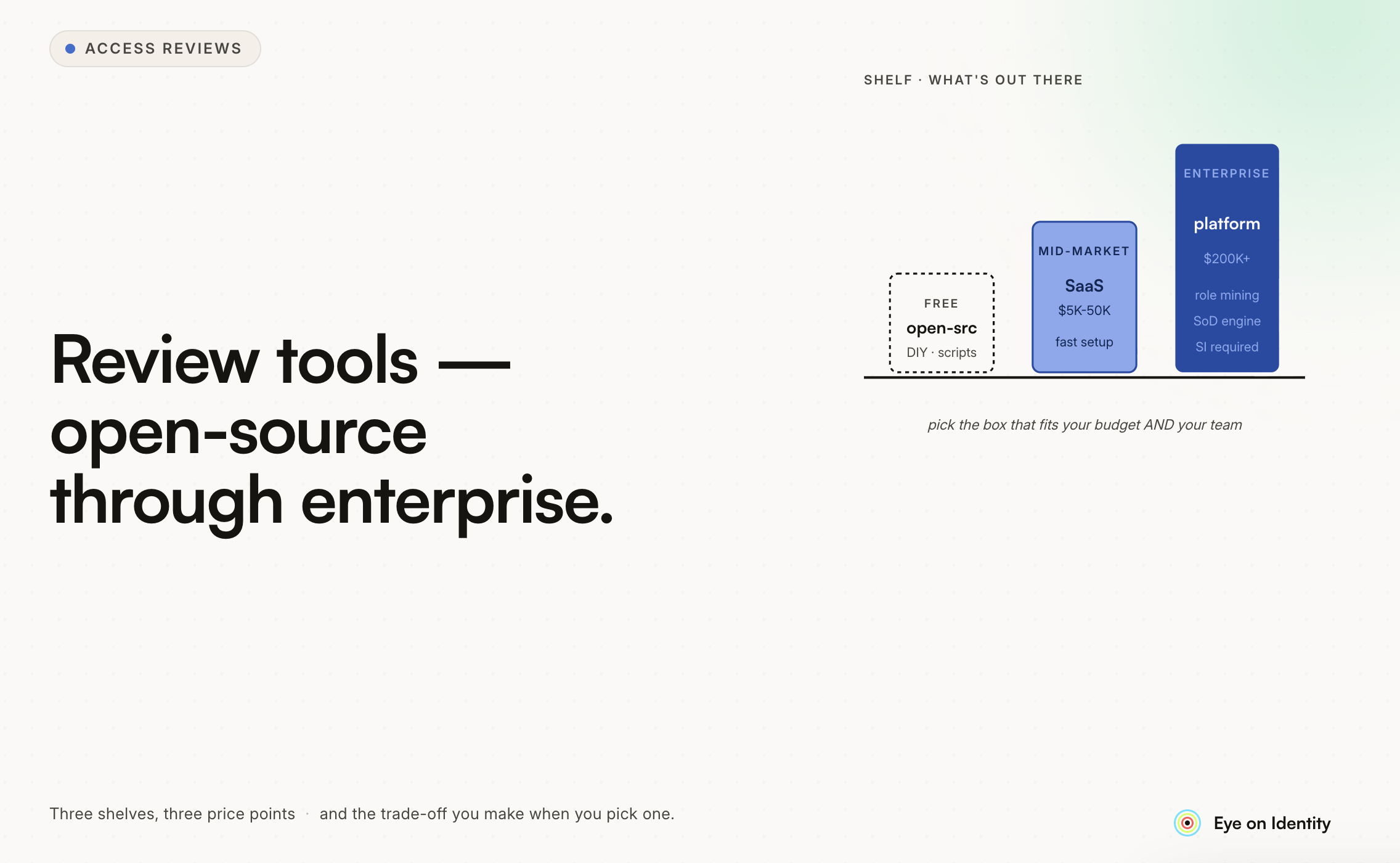


The short answer on open source user access review tools: there isn't a mature, purpose-built open source option that covers the full access certification lifecycle — reviewer workflows, decision tracking, audit evidence generation, and remediation — the way enterprise platforms do.
That's worth knowing upfront, because the instinct to look for open source in this space is understandable (licensing costs for enterprise IGA platforms are significant), but the search often leads to disappointment or to tools that address adjacent problems rather than access reviews specifically.
Here's what actually exists across the open source, mid-market, and enterprise categories, and how specific platforms you may be evaluating fit into that landscape.
Why True Open Source Access Review Tooling Is Rare
Access reviews aren't a technically complex problem in isolation — you're collecting data from applications, routing it to reviewers, recording decisions, and tracking remediation. The individual components are buildable. The challenge is that a useful access review platform needs to do all of these things together, with the reliability and evidence quality that compliance audits require.
Open source identity projects tend to focus on provisioning and authentication — Apache Syncope, Keycloak, WSO2 Identity Server — rather than governance and certification workflows. These are legitimate and capable projects for their intended purposes, but they weren't designed to run access certification campaigns, and adapting them to do so requires significant custom development.
The honest assessment: if you have strong development resources and specific customization requirements that commercial platforms can't meet, building access review workflows on top of an open source identity platform is feasible. It's a substantial project rather than a quick implementation, and the ongoing maintenance of custom-built certification workflows is a real operational cost that's easy to underestimate.
SailPoint: Enterprise Standard, Not Open Source
SailPoint is a proprietary enterprise IGA platform — specifically one of the market leaders in the category — not an open source project. Both of its main products (IdentityIQ, the on-premises platform, and Identity Security Cloud, the SaaS offering) are commercial software with enterprise licensing.
SailPoint is relevant to the access review conversation because it's one of the most widely deployed IGA platforms in large organizations, particularly those with complex on-premises infrastructure and deep role mining requirements. Its access certification capabilities are mature and comprehensive.
The tradeoffs that practitioners consistently report: implementation timelines of six to twelve months for IdentityIQ, significant dependence on implementation partners to configure and maintain the platform, and the need to define static access profiles for each application before the governance features can operate. For large enterprises with dedicated IGA teams and the budget for a long implementation, these are acceptable tradeoffs for the depth the platform provides. For smaller organizations or those with tighter timelines, they're often prohibitive.
SailPoint Identity Security Cloud (ISC) is the more modern, cloud-native offering with a shorter implementation timeline, and it's where SailPoint is investing most of its current development — worth considering over IIQ for new implementations.
Zilla Security: SaaS, Not Open Source
Zilla Security is a SaaS-based identity security platform positioned in the next-generation IGA category — not an open source project. It's commercial software with enterprise licensing, similar in category to other next-gen IGA platforms like Zluri, ConductorOne, and Lumos.
Zilla Security's focus is on making access reviews more automated and less manual, with particular emphasis on cloud-native application coverage, automated reviewer assignment, and faster implementation timelines compared to legacy IGA platforms. The "open" in how some of these newer platforms are described refers to their connector frameworks (ability to build custom integrations for non-standard applications) rather than open source licensing.
If you're evaluating Zilla Security, the relevant questions for your specific environment are: which of your applications are natively supported, how deep is the integration (user presence vs. role and entitlement data), what does the reviewer experience look like, and what evidence is generated at campaign close.
The "Open Connector" Framework: What It Actually Means
Several next-generation IGA platforms — including Zilla Security and Zluri — describe their connector frameworks as "open" or "universal." This refers to the ability for organizations to build custom integrations for applications that aren't in the platform's pre-built connector library, using a standardized SDK or API framework rather than building entirely from scratch.
For organizations with internally developed applications, legacy systems without standard APIs, or niche tools that commercial connector libraries don't cover, this is meaningfully useful. It brings those applications into the governance and review cycle without requiring a full custom development project. But it's important to distinguish this from open source licensing — these frameworks are typically proprietary APIs with commercial support, not open source software.
What Alternatives Exist for Cost-Sensitive Environments
If cost is the primary driver behind looking for open source options, a few alternatives are worth considering:
Microsoft Entra ID access reviews are included with Entra ID P2 licensing (part of Microsoft 365 E5 or available as an add-on). If your organization is already using Microsoft 365 and has P2 licensing, the access review features are available without additional platform cost. Coverage is limited to Entra ID-connected applications, but for Microsoft-centric environments this covers a significant portion of the application estate.
Compliance automation platforms like Vanta and Drata include access review features as part of their broader compliance automation offerings. The access review capabilities are lighter than dedicated IGA platforms but may be sufficient for organizations in early compliance maturity. Licensing is typically per-user or per-application rather than the enterprise contracts of full IGA platforms.
Dedicated access review tools like SecurEnds occupy the mid-market between compliance automation platforms and full IGA suites — more focused on access reviews specifically, with broader application coverage than compliance automation tools, at lower cost than full IGA platforms.
Building on existing infrastructure — if your organization has Okta or Entra ID and a service desk like Jira or ServiceNow, you can construct a basic access review workflow using these tools without a dedicated platform: scheduled exports from the IdP, structured Jira review templates, and manual remediation tracking. This is labor-intensive compared to a purpose-built platform but avoids additional licensing costs for organizations with very limited budgets or small user populations.
The Key Questions Before Choosing
Regardless of which tooling direction you pursue, the questions that most determine fit:
What systems are in scope? The more your review needs to cover systems outside your SSO perimeter — legacy applications, on-premises systems, non-standard SaaS tools — the more important the connector breadth and custom integration capability becomes.
What evidence format do your auditors require? For SOC 2, ISO 27001, or SOX, the evidence needs to demonstrate individual reviewer decisions with timestamps, justifications for any changes, and confirmation that revoked access was actually removed. Evaluate whether your tooling produces this or whether you'd be supplementing it with manual documentation.
What's your timeline? If you need a functioning access review before an audit in six weeks, that determines which options are realistically in play regardless of their feature depth.
What's your internal resource capacity? Both building on open source and implementing legacy enterprise platforms require significant internal time and expertise. Next-generation SaaS platforms require less, but still require configuration, integration work, and ongoing administration.
The open source path is viable if you have the development resources and specific requirements that commercial platforms don't meet. For most organizations running access reviews for compliance purposes, the faster path is a commercial platform sized appropriately for your environment — which may not mean the largest enterprise platform in the market.


.svg)