

SailPoint provisioning into CyberArk Privilege Cloud is a well-established pattern in large enterprises — the combination of a full IGA platform governing who gets privileged access and a PAM tool controlling how that access is used is the architecture most security-mature organizations end up in. Using SailPoint as the governance layer that manages CyberArk user provisioning follows a logical division of responsibilities.
Here's what the integration actually involves, the challenges practitioners encounter, and what to watch for with the group-to-safe limitation you've already spotted.
How the SailPoint-CyberArk Integration Works
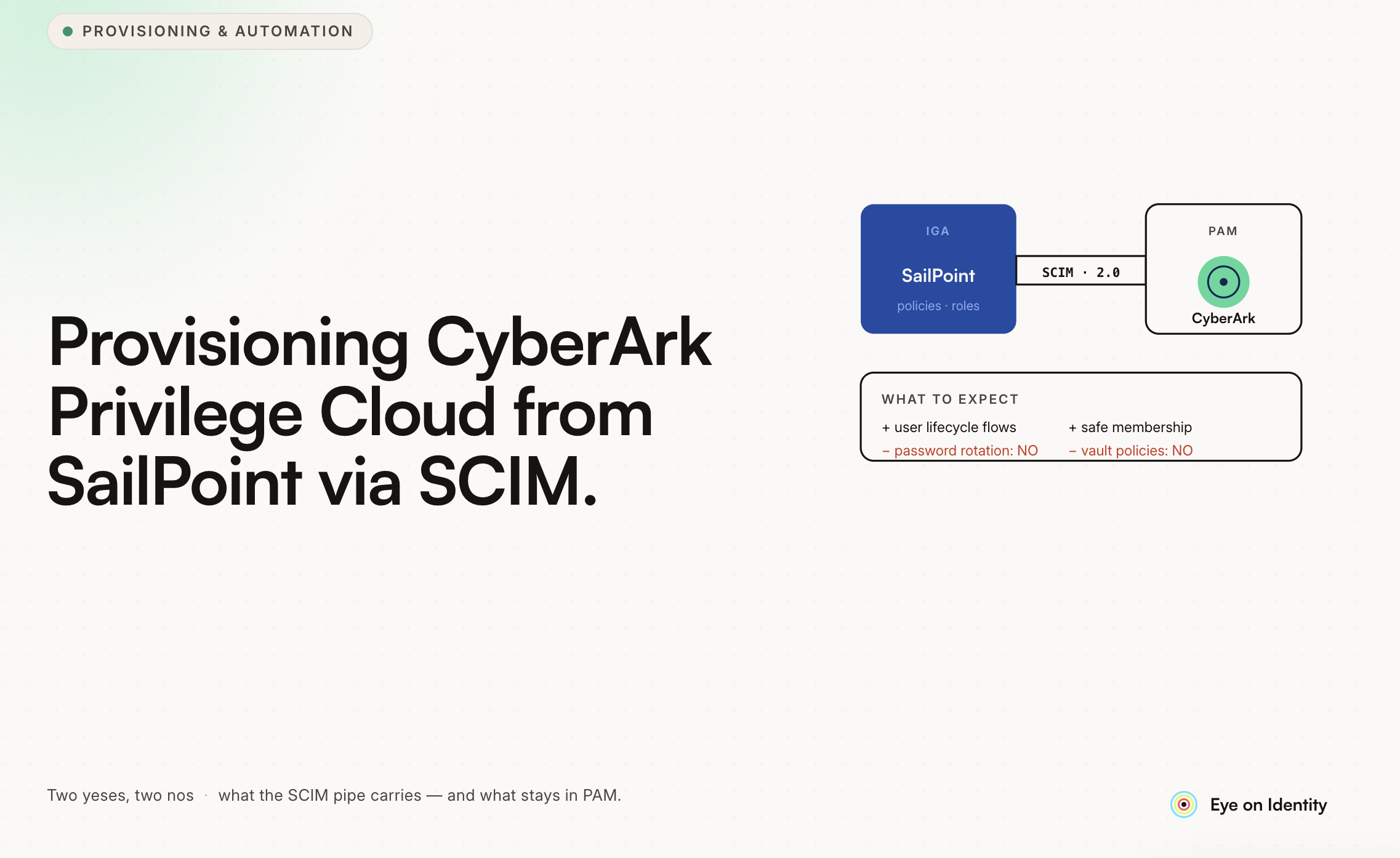
The CyberArk documentation you referenced uses SCIM (System for Cross-domain Identity Management) as the provisioning protocol. SailPoint connects to CyberArk Identity as a SCIM-enabled application, which allows SailPoint to manage CyberArk user accounts — creating users, updating attributes, and deprovisioning — through CyberArk's SCIM endpoint.
The integration establishes SailPoint as the authoritative source for CyberArk user lifecycle: when a user is onboarded in SailPoint, the connector pushes a user record to CyberArk Identity. When the user leaves and is deprovisioned in SailPoint, the deprovisioning action reaches the CyberArk account.
In the broader architecture, SailPoint governs who has CyberArk accounts and what CyberArk roles they're assigned to. CyberArk then governs what those users can actually do — which vaults, safes, and privileged accounts they can access during PAM sessions. This is the correct division: SailPoint manages the identity and access lifecycle, CyberArk manages the privileged session itself.
Known Challenges and Limitations
SCIM Granularity at the Resource Level
The SCIM protocol manages users and groups within the target application. Where it gets limited is in managing resource-level objects within CyberArk — specifically safes.
CyberArk safes are the containers where privileged credentials are stored. Access to a safe is controlled either through direct user membership or through group membership. The SCIM interface manages user accounts and group assignments in the CyberArk Identity directory, but it doesn't extend to managing safe membership directly.
This is the issue you've noticed: you can provision a user to CyberArk via SCIM, and you can assign them to a CyberArk directory group via SCIM, but adding that group to a safe is a CyberArk Privilege Cloud configuration action that the SCIM connector doesn't reach. Safe membership for groups is managed directly in the Privilege Cloud admin interface or via CyberArk's own APIs, not through the SCIM endpoint.
The practical implication: your SailPoint integration handles user existence and group assignment in the CyberArk directory. The mapping from those groups to specific safes is a configuration decision you manage in CyberArk independently. If you change which safes a group has access to in CyberArk, SailPoint doesn't know about it and won't surface it in access reviews — the SailPoint view is of the user's group membership, not the downstream safe access that group membership enables.
This is a significant governance consideration. If your access reviews in SailPoint certify that a user belongs to the "Vault Administrators" group, but what you actually need to certify is which safes that group provides access to, the SCIM-level review is reviewing the proxy (group membership) rather than the actual access (safe access). Whether this is acceptable depends on how stable your group-to-safe mapping is and how granular your audit requirements are.
Static Access Profile Maintenance
SailPoint's provisioning model for CyberArk (like other applications) relies on Access Profiles that define what should be provisioned to different user populations. When your CyberArk safe structure changes — new safes created, groups reorganized, role structure modified — the SailPoint Access Profiles don't update automatically. Someone needs to maintain the alignment between the CyberArk configuration and the SailPoint access profiles that govern who gets what.
In environments where the CyberArk safe structure is relatively stable (defined once, modified infrequently), this maintenance burden is manageable. In environments where safes are created frequently or the group structure evolves regularly, keeping SailPoint's access profiles synchronized with the actual CyberArk configuration is ongoing administrative work.
Implementation Complexity
The SailPoint-CyberArk SCIM integration is straightforward to establish at a basic level — the CyberArk documentation walks through the SCIM token setup and SailPoint connector configuration. Where complexity accumulates is in extending the default connector behavior: custom attribute mapping beyond what the standard SCIM schema covers, handling edge cases in the provisioning logic, building the access profiles and roles in SailPoint that map to your actual CyberArk role structure.
If your CyberArk deployment has a complex safe structure with many groups and roles, modeling that in SailPoint's access profiles takes significant design work. Budget for this before the integration goes into production — the connector setup itself is the easy part.
The Group-to-Safe Limitation in Practice
The observation that groups can't be added to safes via the CyberArk cloud directory (through the SCIM interface) is worth understanding clearly.
CyberArk's architecture separates identity management (who the users and groups are) from privilege management (what those users and groups can access). The SCIM interface operates at the identity layer — managing user accounts and directory group memberships. The privilege layer — which groups have access to which safes, at what permission level — is managed in the Privilege Cloud admin interface.
When you provision a user to CyberArk via SailPoint and assign them to a directory group, CyberArk knows they belong to that group. If that group has been granted access to specific safes in the Privilege Cloud configuration, the user inherits that safe access through group membership. But the group's safe permissions were configured directly in Privilege Cloud, not through SailPoint.
This creates a governance gap: SailPoint can certify "does this user belong to the Vault Administrators group?" but not "does the Vault Administrators group still have the appropriate safe access?" The second question requires either manual review of the Privilege Cloud configuration or a separate governance process for safe-level permissions that SailPoint doesn't drive.
For many organizations, this gap is acceptable: the group structures are defined and maintained as a deliberate architectural decision, and the user-to-group assignments (which SailPoint does manage) are the dynamic variable that needs regular review. For organizations with strict requirements to certify safe-level access specifically, this is a gap that requires either additional tooling or a compensating control.
Lessons Learned From Practitioners
Based on what organizations implementing this integration have encountered:
Define your safe and group structure before building Access Profiles. The SailPoint access profiles that govern CyberArk provisioning are most maintainable when the CyberArk group structure is stable. Implementing the SailPoint integration before the CyberArk architecture is finalized means rebuilding access profiles when the structure changes.
Establish a process for safe permission reviews separately from user access reviews. Since SailPoint reviews user group membership, not safe permissions, you need a separate process — even if manual — to periodically validate that your group-to-safe mappings in Privilege Cloud remain appropriate.
Test deprovisioning carefully. Confirm that SailPoint deprovisioning removes the CyberArk account and group memberships as expected, and validate that this works correctly for the offboarding scenarios in your environment — including users who may be in multiple groups with different safe access.
Document attribute mapping. The SCIM connector maps attributes between SailPoint's identity model and CyberArk's user model. Document which SailPoint attributes drive which CyberArk attributes (roles, groups, department) so that as your HR data or identity profiles change, the downstream impact on CyberArk provisioning is understood.
Plan for the CyberArk-native API for anything SCIM can't reach. For automation requirements that the SCIM connector doesn't cover — including safe permission management — CyberArk's REST API provides more granular control. If you eventually need to automate safe membership as part of a provisioning workflow, that path exists through the CyberArk API directly, though it requires separate integration work.
Is This a Common Pattern?
Yes — SailPoint governing CyberArk user provisioning is an established enterprise pattern, particularly in regulated industries where both a mature IGA platform and PAM are standard components. Active Directory is more common as the provisioning source for lower-complexity environments, but SailPoint makes sense when you need the governance capabilities (access reviews, SoD enforcement, role-based provisioning) that AD provisioning alone doesn't provide.
The SCIM integration is the right starting point for most implementations. The limitations described above — safe-level granularity and static profile maintenance — are known constraints to design around rather than blockers.


.svg)