

Ending an RFP process with SailPoint and Saviynt looking nearly equivalent from the demo stage is the normal experience — both platforms are capable at enterprise IGA, both address similar use cases in similar ways, and both sales teams are trained to close gaps that show up during evaluation. The differentiation that matters usually isn't in the feature checklist but in the operational reality of living with each platform.
One important context note for your situation: you mentioned currently using SailPoint Imprivata (which reaches end-of-life). This is a different product from SailPoint IdentityIQ (IIQ) or SailPoint Identity Security Cloud (ISC). Confirm which SailPoint product is being proposed in your RFP — IIQ and ISC are meaningfully different platforms with different implementation timelines, maintenance profiles, and future investment trajectories.
Implementation Reality
SailPoint (ISC). SailPoint's cloud platform (ISC) has faster implementation timelines than IIQ — practitioners with recent ISC implementations describe going live in 3-6 months for a focused initial scope. The platform is more configuration-driven than IIQ's BeanShell/XML model, which reduces custom development requirements. However, complex use cases (non-standard connectors, complex role structures, custom approval workflows) still require significant configuration investment.
SailPoint (IIQ). If your RFP includes IIQ, implementation timelines are typically longer — 6-12 months is the realistic range for a production deployment. IIQ's Java-based customization (BeanShell) is powerful but creates implementation complexity that requires specialized expertise. SailPoint's strategic investment is shifting to ISC; new IIQ implementations should understand what the ISC migration path looks like before committing.
Saviynt. Saviynt's implementation timeline is comparable to SailPoint at similar complexity. The configuration model is different — more wizard-driven in some areas, which some implementers find faster for standard use cases. For non-standard requirements, the flexibility ceiling appears earlier than in SailPoint according to some practitioners. Saviynt has invested in a cloud-native architecture longer than IIQ, which can be an advantage for organizations moving away from on-premises.
The shared implementation reality. Both platforms require a significant discovery phase before configuration begins — understanding your role structure, mapping your application access patterns, and establishing the source of truth hierarchy. This upfront work is where most implementations underestimate timeline. Your Imprivata experience (losing functionality on version upgrades) suggests Imprivata's architecture is different from what either SailPoint or Saviynt will require — plan for a meaningful implementation investment rather than a migration.
Operations and Daily Support
The 20-minute archived account reactivation problem. This is a specific symptom worth examining before choosing either platform: is the 20-minute timeline a configuration issue, an Imprivata architecture limitation, or a fundamental consequence of how that system handles archived accounts? If it's architecture-specific to Imprivata, either SailPoint or Saviynt will resolve it by default. If it's a configuration pattern you've built around workflows and approvals, ensure the new platform's equivalent reactivation path is specifically demonstrated against your process before signing.
SailPoint operational overhead. SailPoint (particularly IIQ) is routinely cited as requiring dedicated operational resources — practitioners typically report 1-2 FTE for platform administration in complex environments. Connector maintenance when downstream applications change their APIs is the most common ongoing burden. Support model matters: ensure you understand whether connector maintenance for your specific application stack falls on your team, SailPoint, or your implementation partner.
Saviynt operational overhead. Comparable to SailPoint. The Saviynt community has persistent practitioner mentions of uptime reliability concerns that don't appear with the same frequency for SailPoint. When evaluating Saviynt specifically, ask for direct references from customers who've had production incidents and understand the response model.
Post-go-live support model. Both vendors offer support tiers. The practical question is response SLA for production issues and escalation path when a connector breaks or a provisioning workflow fails during a critical onboarding period. Ask specifically: what is the average resolution time for P1 issues in your support tier? Who maintains connectors for your specific applications when they break?
Connectors
SailPoint's connector catalog. The broadest in the enterprise IGA market. For standard enterprise SaaS applications, the connector library is comprehensive. For non-standard, legacy, or custom applications, SailPoint provides an ECMA (Extended Connector Framework) for custom connector development, and a larger professional services and partner ecosystem for building them.
Saviynt's connector catalog. Competitive with SailPoint for major enterprise SaaS but somewhat smaller than SailPoint's catalog. Saviynt has invested in cloud-native connectors for AWS, Azure, and major cloud infrastructure.
The non-API application question. Both platforms have limitations with applications that don't expose APIs — the traditional approach is custom scripting or manual task workflows. If you have a significant number of legacy or non-API applications, verify specifically how each platform's proposal addresses those connectors. Neither platform's native answer for non-API apps is as clean as browser-agent-based automation that newer IGA platforms have built.
For your evaluation: List your 20 most important applications and ask both vendors to demonstrate their connector for each specifically, not just confirm it's in the catalog. For your 5 most problematic applications (legacy systems, non-API tools, custom internal tools), ask both vendors to show exactly how provisioning and deprovisioning works — including what breaks when the application changes.
Lifecycle Management
SailPoint lifecycle capabilities. JML automation through lifecycle events and policies is mature in both IIQ and ISC. Role-based provisioning using access profiles (defining what access each role entails) is the foundational model. Role mining — analyzing actual usage patterns to identify and refine role definitions — is an area where SailPoint has invested and where ISC's AI capabilities are growing.
Saviynt lifecycle capabilities. Comparable JML lifecycle management. Saviynt has historically positioned strongly for complex compliance rules at the provisioning level (SOX SoD checks at provisioning time rather than at certification time). For organizations where preventing SoD violations before they occur (rather than detecting them in reviews) is a priority, Saviynt's approach is worth evaluating specifically.
The static profile limitation both share. Both platforms use access profile/role models that define access based on role definitions rather than observed behavior. This means access that's appropriate at provisioning time but becomes inactive over months doesn't automatically flag for removal — it surfaces through access review campaigns. If real-time usage-based governance (automatic flagging of dormant accounts or unused entitlements) is a priority, this is a gap in both platforms that requires either additional tooling or acceptance of the certification-cycle-based approach.
Role Management
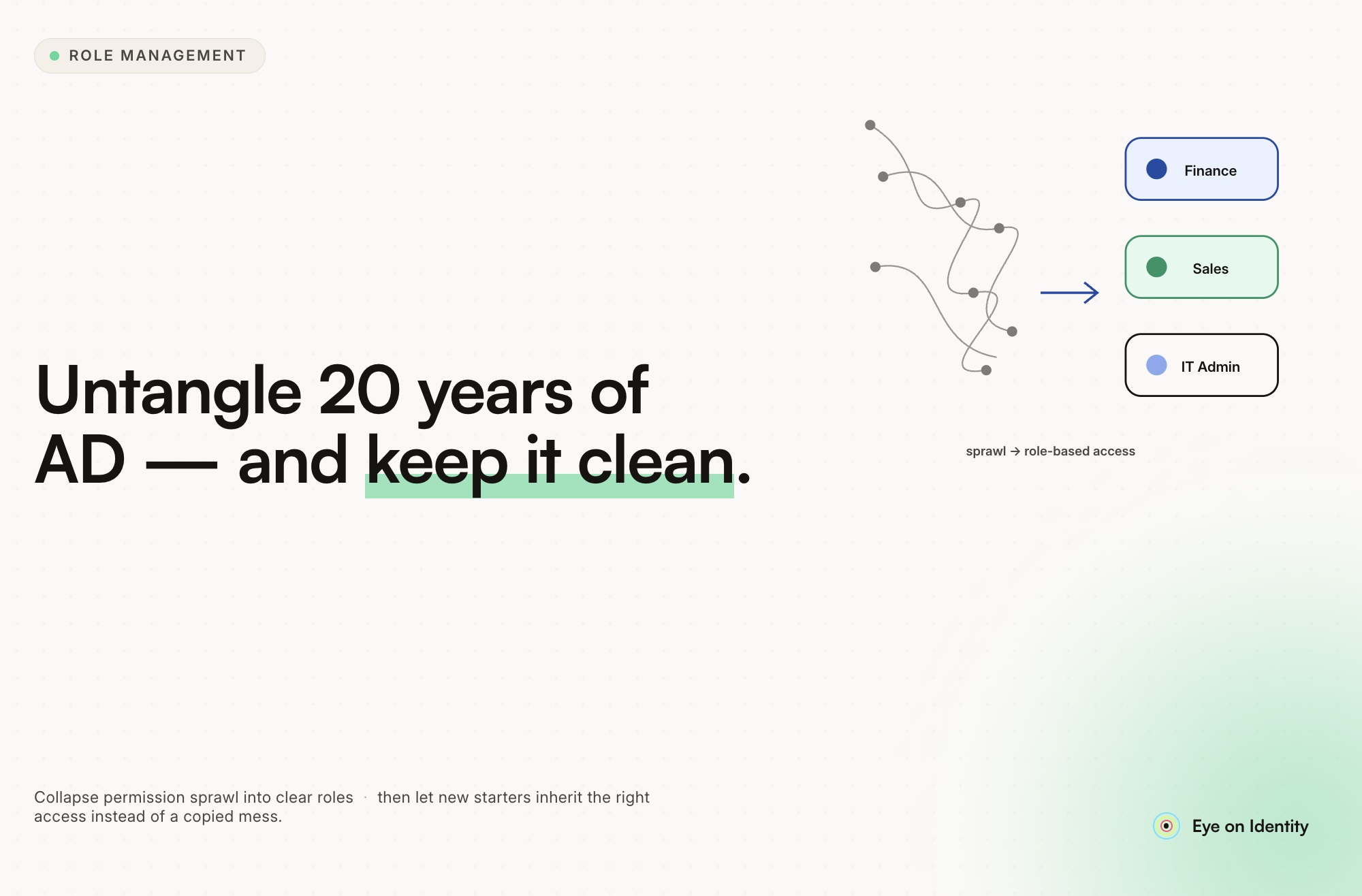
SailPoint's role management depth. Mature role mining, role definition, and entitlement mapping. The complexity of role management in SailPoint IIQ is one of the reasons implementations take time — defining a complete role structure requires organizational analysis that often surfaces disagreements about what each role should include. ISC has streamlined some of this, but the fundamental requirement to define roles upfront remains.
Saviynt's identity attribute limitation. The most specific differentiator in practitioner evaluations: Saviynt has a ceiling on custom identity attributes (approximately 65 extra attributes plus 40 defaults). For organizations where identities hold multiple concurrent positions with position-specific attributes (start date, end date, department, role for each position), this ceiling can become a constraint. If your environment has employees with complex multi-position data models — healthcare staff with multiple department appointments, academic staff with faculty-staff dual roles — test this specifically in the Saviynt POC.
Training and Certification
SailPoint. SailPoint offers IIQ-specific certifications and ISC-specific certifications through their training portal. The IIQ Engineer and ISC Engineer certifications are distinct — which one your team pursues should match which product you're implementing. If you're implementing ISC, ISC Engineer certification is the relevant path. Given SailPoint's strategic shift toward ISC, ISC certification is the more future-proof investment.
Saviynt. Saviynt offers administrator and implementation training. The certification path is less prominently established in the practitioner community compared to SailPoint. Partner with your implementation firm to ensure training coverage is included in the statement of work, as post-go-live operational capability depends on it.
Costs and Add-Ons
Neither platform publishes pricing sheets, and pricing is negotiated based on identity count, modules, and negotiating leverage. General practitioner guidance:
Both platforms will present a lower base price than the true cost of ownership. Professional services for implementation, annual maintenance for connectors, support tier upgrade costs, and add-on modules for advanced features all contribute to the real number. Get the full implementation scope estimate from the vendor or implementation partner before comparing total first-year costs.
Saviynt's connector costs. Multiple practitioners in this batch's evaluation discussions mentioned that Saviynt's quotes came in over budget before required connectors were included in the base price. Verify explicitly which connectors for your application stack are included in the base license versus additional cost.
SailPoint's module structure. SailPoint's IGA capabilities are increasingly modular (governance, compliance, AI features). Understand which modules are included in your proposal versus what requires additional licensing.
Implementation partner cost. Both platforms are typically implemented by consulting partners (Accenture, Deloitte, Optiv, and specialized identity firms). Get implementation partner cost estimates from multiple firms rather than accepting the vendor's professional services estimate as the only option.
The Third Option Worth Considering
Your current situation — Imprivata end-of-life, functionality loss on upgrades, a 20-minute archived account reactivation — suggests that some of your pain comes from an aging product rather than from the IGA category itself. Both SailPoint and Saviynt will solve some of these problems. The question is whether the implementation overhead and operational model they require is the right fit for your team's capacity.
If your primary goals are lifecycle automation, access reviews for SOC 2 or similar compliance, and shadow IT visibility — without the overhead of an enterprise IGA implementation — modern mid-market platforms like Zluri are worth adding to your evaluation. The deployment timeline (weeks rather than months), lower total cost of ownership, real-time usage monitoring, and shadow AI discovery capabilities address specific gaps in the SailPoint/Saviynt model.
Whether that's the right choice depends on your specific complexity — regulated industry requirements, significant on-premises infrastructure, and very large identity populations tend to favor the enterprise platforms despite the overhead. Cloud-first environments with mid-market scale often find the modern platforms deliver better value.
Frequently Asked Questions
What are the main differences between SailPoint and Saviynt for enterprise IGA?
The most specific technical differentiator is Saviynt's identity attribute limit — approximately 65 extra plus 40 default attributes, which constrains environments where identities hold complex multi-position data. SailPoint has a larger connector catalog and implementation partner ecosystem. Saviynt has been cited as stronger for SAP environments and SOX SoD at provisioning time. Both have comparable implementation overhead and ongoing maintenance requirements. Practitioner communities have more persistent negative reliability mentions for Saviynt than for SailPoint.
Should you choose SailPoint IIQ or ISC for a new implementation?
For new implementations, ISC is the better choice — it's where SailPoint's development investment is concentrated, it deploys faster than IIQ, and it's the platform where AI-enhanced capabilities (role mining, AI-assisted reviews) are being developed. IIQ's maintenance complexity and the upcoming migration requirement to ISC make it a less future-proof choice for new implementations.
What should you verify in a Saviynt or SailPoint POC before signing?
Test the 20 most important applications against both vendors' actual connectors, not demo environments. Test the 5 most problematic applications (legacy, non-API) specifically. Test the archived account reactivation workflow against your specific process. Verify Saviynt's identity attribute limit against your actual identity data model. Request references from customers who've had P1 production incidents and understand the resolution timeline.


.svg)