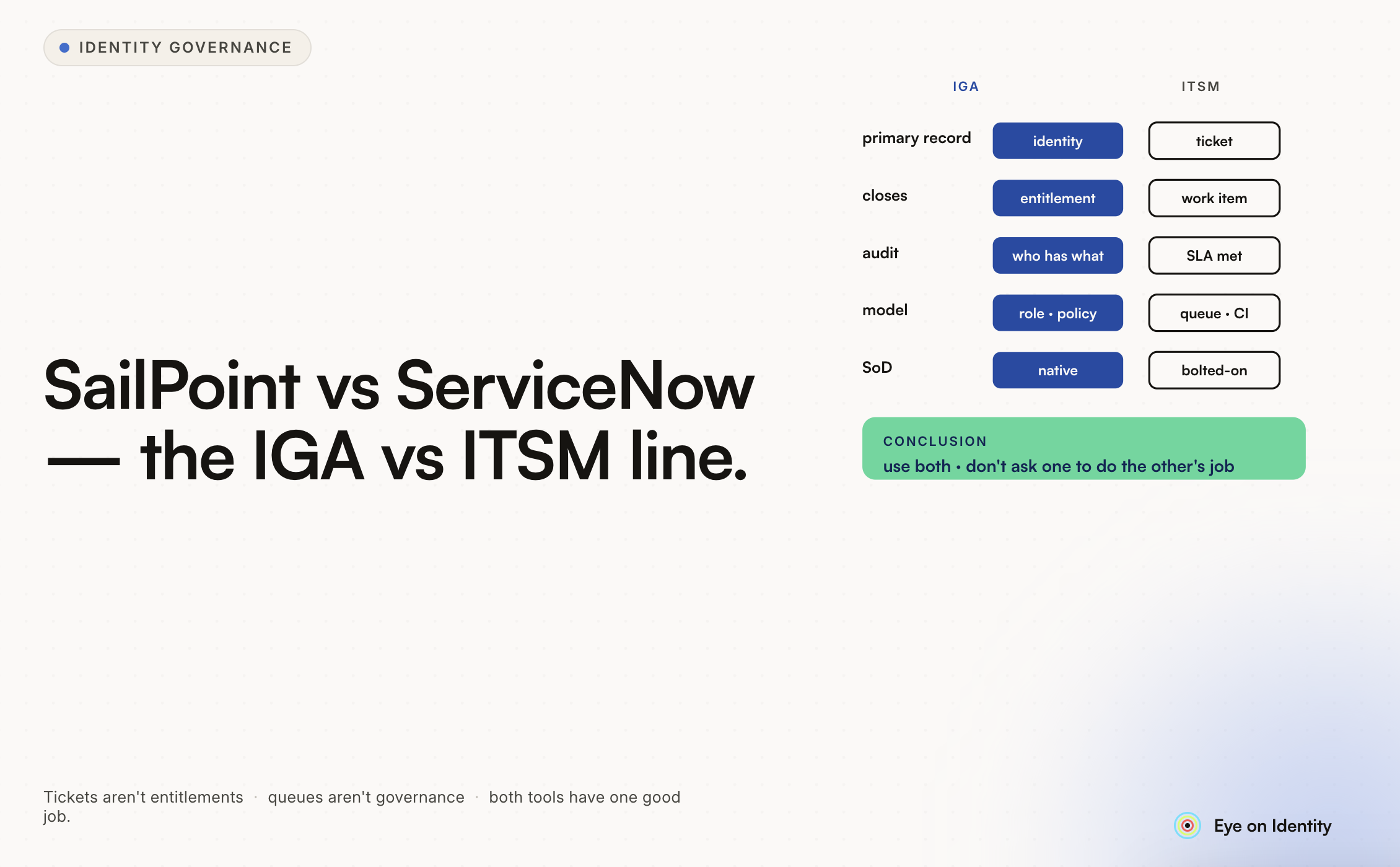


The confusion between ServiceNow and SailPoint is one of the more common questions that comes up when organizations start their IAM journey, and it's understandable — ServiceNow is highly extensible, has access management modules, and can be configured to manage a lot of what looks like identity governance. The distinction is architectural rather than feature-by-feature, and it explains why organizations with mature IAM programs typically run both rather than choosing one.
The short version: ServiceNow is a request and fulfillment platform. SailPoint is an identity governance platform. They solve adjacent problems and are designed to work together, not to replace each other.
What ServiceNow Is Designed to Do
ServiceNow excels at managing the lifecycle of a request. An employee submits an access request, ServiceNow routes it through an approval chain, assigns the fulfillment task to the appropriate team, tracks whether the task was completed, and closes the ticket. It does this exceptionally well at enterprise scale, and it integrates with the systems and workflows that IT teams already use.
ServiceNow also has a service catalog for access requests, integration with directory systems for provisioning, and a CMDB that tracks the applications and services in your environment. For organizations using ServiceNow heavily, there's an understandable intuition that you could build most of what IAM requires on top of it.
The limitation shows up when you examine what ServiceNow doesn't natively do: it doesn't manage identity lifecycle autonomously, it doesn't deeply understand entitlements within applications, it doesn't detect when access has drifted from policy without being told, and it doesn't generate the specific evidence format that access review audits require.
The Five Specific Things SailPoint Adds
1. Identity-Centric Lifecycle Management
ServiceNow manages tickets. SailPoint manages identities. The distinction matters when lifecycle events happen — a new hire, a role change, an employee departure.
In a ServiceNow-only model, lifecycle management happens through tickets: someone creates a request, it goes through approval, IT provisions the access. This works, but it means every lifecycle event requires a human to initiate a ticket and track it to completion.
SailPoint is built around the identity as the core object. When an employee's record changes in the HR system — new hire, department transfer, termination — SailPoint detects the change and triggers the appropriate lifecycle workflow automatically, without requiring a ticket to be created first. Birthright access (the standard access package for a role) gets provisioned on day one. When someone changes departments, old access gets revoked and new access gets provisioned in the same workflow. When someone leaves, deprovisioning happens automatically on their exit date.
ServiceNow can be configured to do pieces of this, but SailPoint is designed for it — the HR system integration, the identity correlation, and the lifecycle automation are the core of what it does.
2. Deep Entitlement Visibility and Role Mining
ServiceNow knows that a user has access to Salesforce. SailPoint knows what the user can do within Salesforce — which profiles they hold, which permission sets are active, which data they can read or modify.
This depth matters because access reviews that only evaluate "does this user have access to this application?" are presence reviews, not access reviews. The compliance frameworks that require access certifications — SOC 2, ISO 27001, SOX — require evaluating whether the level of access is appropriate, not just whether access exists.
Role mining — SailPoint's capability to analyze entitlement patterns across a user population and identify role structures that reflect how access is actually used — is a core IGA function that ServiceNow's native capabilities don't replicate. Building an accurate role model (what access should a Finance Analyst have? a Sales Manager?) from the raw entitlement data across your application estate is a specific IGA function that SailPoint provides and ServiceNow doesn't.
3. Segregation of Duties Enforcement
SoD violations — users holding combinations of access that create control risks, like the ability to both create and approve financial transactions — are a specific governance requirement for regulated industries and a common audit finding.
Detecting these requires understanding entitlements across multiple applications simultaneously and comparing them against defined conflict rules. SailPoint can define SoD policies, scan your entire identity population against those policies, detect violations, and flag them for remediation. It can also simulate whether granting a new access request would create a new SoD violation before the access is provisioned.
ServiceNow doesn't do this natively. It can track that an access request was approved, but it doesn't understand whether the combination of access the user will now hold, across all their applications, creates a control risk.
4. Access Certification with Audit-Ready Evidence
Access reviews — periodic certifications where managers or application owners confirm that existing access is still appropriate — are required by virtually every major compliance framework. The evidence these reviews generate needs to satisfy auditors, not just internal stakeholders.
SailPoint runs structured certification campaigns: defined scope, automated reviewer assignment, tracked decisions with timestamps and mandatory justifications, automated remediation triggered by revocation decisions, and a non-editable PDF report generated at campaign close. The report documents who reviewed which access, what decision was made for each record, what justification was provided, and confirmation that any revoked access was actually removed.
ServiceNow generates ticket logs, which document that a process ran. SailPoint generates certification reports, which document what was decided and what happened as a result. For SOC 2 Type II or SOX audits, the difference between these two evidence formats is significant — auditors reviewing access review controls are looking for certification reports, not ticket histories.
5. Continuous Discovery Beyond the Service Catalog
ServiceNow's CMDB and service catalog contain the applications that have been formally onboarded — the ones IT knows about and has configured in ServiceNow. Applications that employees are using independently, tools purchased by departments outside IT procurement, AI tools accessed through personal accounts — these don't appear in ServiceNow unless someone adds them.
Modern IGA platforms include discovery mechanisms that surface applications beyond the formal catalog: browser activity monitoring, financial data ingestion, SSO log analysis. This gives governance a picture of the actual application estate rather than just the formally managed portion.
For access reviews and offboarding workflows specifically, governing only the applications in the service catalog means leaving a significant portion of actual access outside the governance perimeter.
How the Integration With ServiceNow Actually Works
In the architecture you've described — ServiceNow integrating with SailPoint via DataFabric — the intended design is a division of labor:
ServiceNow handles the request interface and ticket workflow. Employees submit access requests through the ServiceNow service catalog. Managers approve through ServiceNow workflows. The ticket is tracked in ServiceNow.
SailPoint handles the provisioning execution and governance. When the ServiceNow ticket is approved, SailPoint receives the request and provisions the access through its connector to the target system. SailPoint then maintains the identity record — what the user has access to, when it was granted, and when it should be reviewed.
This means ServiceNow remains the ITSM layer that your organization already uses for request management, while SailPoint provides the identity governance layer that ServiceNow isn't designed to be. The integration between them is what allows the request workflow (ServiceNow) and the provisioning and governance (SailPoint) to work as a coherent system.
The "Couldn't We Just Use ServiceNow for All of This?" Question
You can build identity governance workflows in ServiceNow, and many organizations have. The honest assessment of what you get:
You get a ticketing workflow that tracks access requests and fulfillment. You get ServiceNow's reporting on ticket status and volume. You get whatever integrations your team builds to connected systems.
What you don't get without significant custom development: automated identity lifecycle management triggered from HRMS events, role mining and SoD policy enforcement across your entitlement landscape, structured access certification campaigns with audit-grade evidence, or deep entitlement visibility beyond what the connectors your team built happen to pull.
Building all of that in ServiceNow is technically possible. It requires significant custom development effort and ongoing maintenance, and the result is a custom identity governance solution built on an ITSM platform rather than a purpose-built identity governance platform. For organizations with complex governance requirements, this rarely ends up being the lower-cost or lower-effort path when the total development and maintenance investment is accounted for.
SailPoint was built specifically to solve the identity governance problem. ServiceNow was built specifically to solve the service management problem. Running them together, with each doing what it's designed for, is the architecture that produces the best outcome for most enterprises with mature IAM requirements.


.svg)