

Not every organization needs a full-scale IAM stack. If you're not running Active Directory, don't need MFA enforcement, and aren't trying to automate provisioning workflows — and you just want a reliable, auditable answer to “who has access to which applications” — the enterprise identity tools built for 10,000-person organizations are more than you need and more than you'll use.
What you're describing is a governance problem, not an authentication problem. You need visibility, not a front door. Those are different tools, and understanding the difference saves you from buying something far more complex than your actual requirement.
What Is the Difference Between Authentication and Governance?
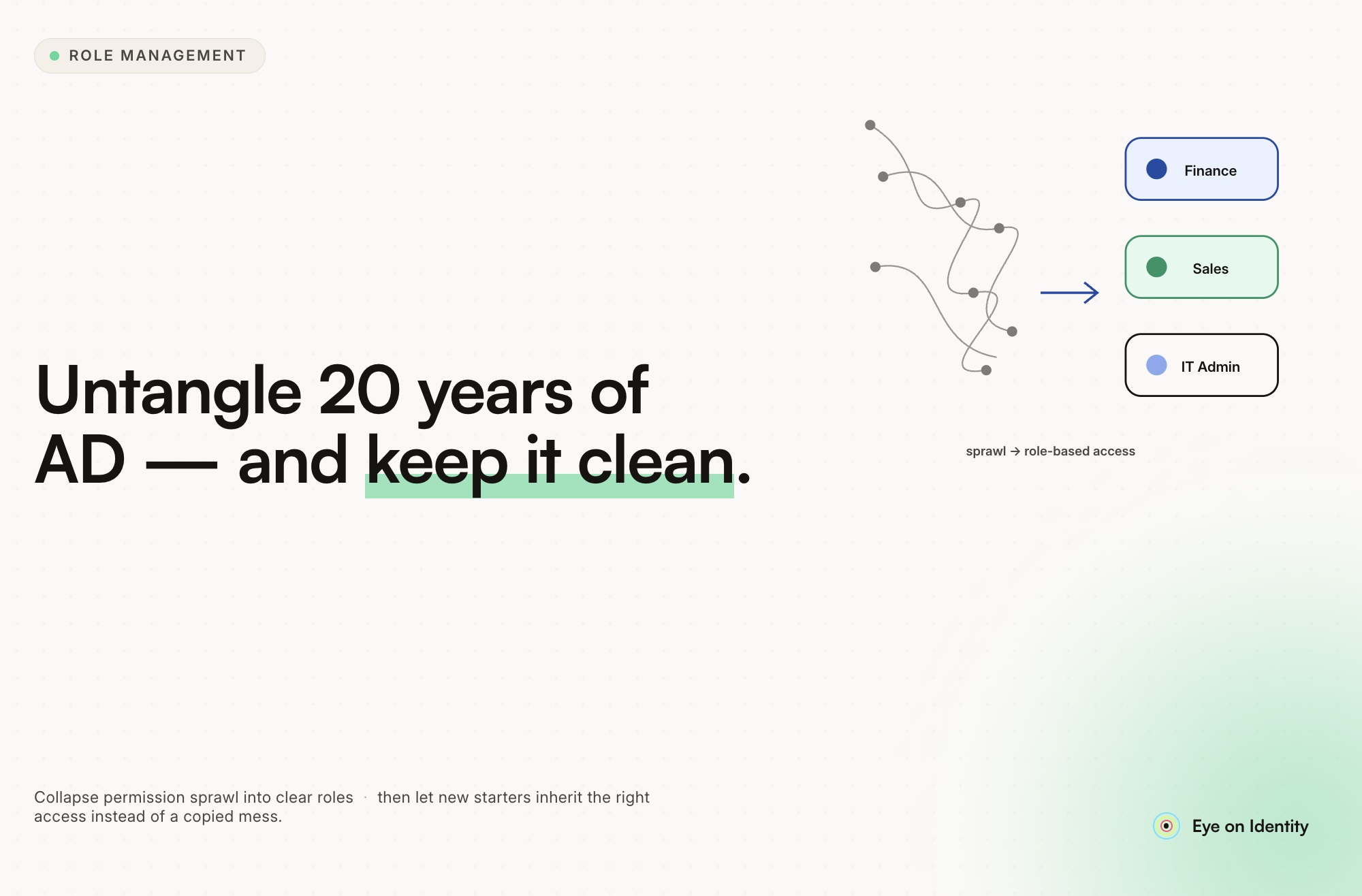
Most IAM tools lead with authentication: SSO, MFA, directory sync, conditional access policies. These are the “maker” functions — controlling how users prove who they are and granting them access to applications. They're valuable, but they're also the source of the complexity you're trying to avoid: AD sync requirements, MFA configuration, protocol support (SAML, OIDC), connector setup for every application.
Governance is a different function. It's the “checker” — observing and reporting on the access that exists, regardless of how it was granted. Which applications does your organization use? Who has access to each one? Are there accounts for people who have already left? Are you paying for licenses that nobody is using?
A governance-focused tool doesn't touch authentication. It doesn't handle login or MFA. It maps what already exists and keeps that map current. For smaller or less complex environments, this is often exactly what's needed — and it's achievable without any of the infrastructure overhead that full IAM platforms require.
What Does a Simple "Who Has Access to What" Solution Look Like?
The baseline capability you need has three components: an application inventory, a user-to-application mapping, and a way to keep both current without requiring constant manual updates.
Application Inventory
A central catalog of every application in use across your organization, organized in a way that distinguishes between formally managed tools (applications IT knows about and has approved), unmanaged tools (applications employees are using independently), and restricted tools (applications that have been flagged or blocked). This replaces the spreadsheet with a governed, searchable interface that can be filtered, exported, and shared.
User-to-Application Mapping
For any given application, the ability to see every user who currently has access. For any given user, the ability to see every application they currently have access to. This bidirectional view is what makes access reviews tractable — instead of cross-referencing multiple spreadsheets, you start from either the application or the person and get the complete picture directly.
Discovery That Doesn't Require AD Sync
For organizations that don't run Active Directory or don't want to set up a directory integration, there are lighter discovery mechanisms that surface application usage without requiring infrastructure-level access.
Browser agents — lightweight extensions installed on managed devices — track which web applications users are actively launching. This surfaces both formally provisioned tools and applications employees have adopted independently, without requiring any connection to a directory service.
Financial and expense data is a complementary signal. Corporate card transactions and procurement records identify paid application subscriptions — including tools that bypassed IT oversight entirely and therefore appear in spend data but not in any application catalog.
Manual entry is also a legitimate option for smaller environments. If you'd rather maintain control of what goes into the system rather than relying on automated scanning, most governance tools support manual application and user entry. The difference from a spreadsheet is the governed interface: access records are tracked with timestamps, exports are audit-ready, and the data lives somewhere with proper access controls rather than in a shared Google Sheet.
What Does This Approach Add Beyond a Spreadsheet?
A spreadsheet that lists who has access to what is a point-in-time record. It's accurate when it's created and drifts from reality as people join, leave, and change roles. Keeping it current requires manual effort, and the more applications and users it covers, the more effort it requires.
A governance tool adds two things that a spreadsheet can't provide.
The first is continuous accuracy. When integrated with an HRMS or connected via browser agents, the access map updates as the underlying reality changes — new hires appear, departed employees' accounts get flagged, unused licenses surface without anyone having to run a quarterly reconciliation. The list stays current because it's derived from live signals rather than maintained manually.
The second is intelligence that a static list doesn't contain. Orphaned accounts — active access for people who have already left — don't show up in a spreadsheet until someone checks. A governance tool flags them automatically because it can cross-reference application access against employment status. Dormant licenses — paid subscriptions that nobody is actively using — are invisible in a list of who has access but immediately visible when access is correlated with usage data.
Is This Useful for Compliance Without a Full Audit Program?
Even without a formal compliance program, the ability to produce a clean, non-editable export of your user access records on demand has practical value. If you're ever asked by a customer, a partner, or an internal stakeholder to demonstrate that you know who has access to sensitive tools — or if you eventually do face a SOC 2 or similar audit — an audit-ready access report is significantly more credible evidence than a spreadsheet.
It's also just useful operationally. When someone leaves, knowing immediately which applications they had access to — rather than reconstructing it from memory or email history — makes offboarding faster and more complete. When you're evaluating whether to renew a software subscription, knowing exactly how many people are using it and how frequently is better information than a headcount guess.
What to Look for in a Lightweight Governance Tool
If you're evaluating options in this category, the questions that differentiate genuinely lightweight tools from scaled-down versions of complex enterprise platforms:
Does it require AD or LDAP integration to function? If yes, it's not designed for your environment.
Can it discover applications through browser agents or financial data without directory access? This determines whether it can map your real application estate or only the portion that's formally integrated.
Does it support manual application and user entry as a first-class option? For environments that want control over what's in the system rather than automated scanning, this matters.
How long does implementation take? Lightweight governance tools should deploy in weeks. If the answer involves a professional services engagement measured in months, the tool is more complex than your use case requires.
Can it export audit-ready reports without additional configuration? The export capability should be a standard feature, not a reporting add-on.
The goal is a tool that gives you the visibility you need without the infrastructure overhead of tools built for problems you don't have. That exists — it just requires looking past the enterprise IAM platforms that lead with authentication and AD sync, because that's not what you're buying.


.svg)