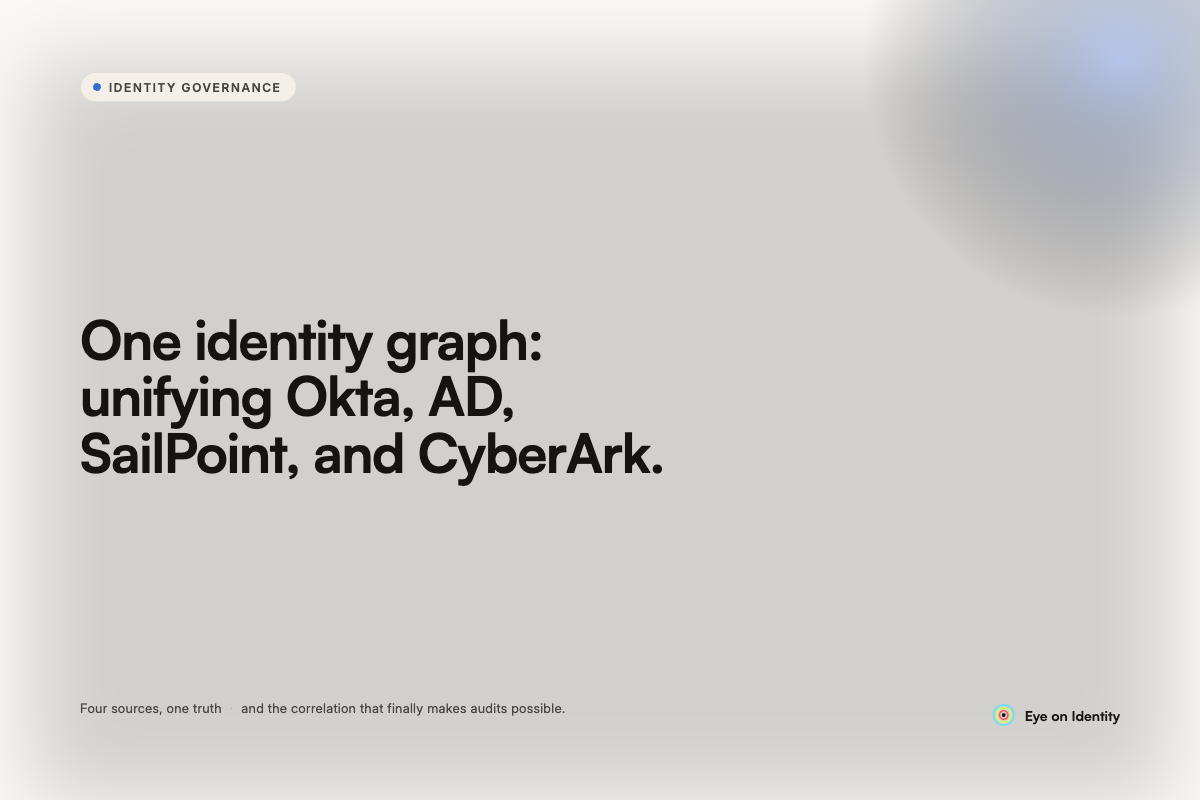


Each of your four tools is doing its job. Okta controls authentication and SSO. AD manages on-prem directory and group memberships. SailPoint governs access lifecycle and certifications for the entitlements it can see. CyberArk vaults and monitors privileged account activity. The problem isn't that any individual tool is failing — it's that their visibility is siloed, and the security team needs to reason across all four simultaneously to answer questions like: who has access to what, including privileged accounts, and does the access that Okta allows align with what SailPoint certified and what CyberArk is monitoring?
This is the "unified identity fabric" problem, and it's common at organizations that have built a mature IAM stack tool by tool rather than from a single vendor.
Why SIEM and Custom Data Lakes Fall Short
The instinct to use a SIEM or build a custom data lake to unify these logs is understandable — you already have the data flowing into the SIEM, and a data lake gives you query flexibility. Both approaches have a ceiling that matters for identity governance specifically.
SIEMs are built for detection, not actioning. A SIEM aggregates logs and generates alerts when something looks anomalous. It's excellent at telling your security team that something happened. What it lacks is the actioning layer: when the SIEM surfaces a risk — a privileged account that's been inactive for 90 days in CyberArk, or an orphaned account in AD that wasn't in SailPoint's last certification — executing remediation requires going back into each tool individually. The SIEM sees the problem; fixing it requires manual work across four separate consoles.
Custom data lakes require ongoing maintenance you don't want to own. Building a unified identity data model from scratch means normalizing user identifiers across Okta, AD, SailPoint, and CyberArk (which may use different unique IDs for the same person), maintaining pipelines as each tool updates its API or data schema, and building the query layer on top of it. This is a real engineering project with ongoing maintenance, and it produces reporting without remediation — you can answer questions about the data but can't act on the answers from within the unified view.
The Architecture That Actually Unifies These Four Tools
The unification layer that security teams in this situation typically adopt is a platform that sits above all four tools — not replacing any of them, but connecting their identity data into a coherent access graph while adding the actioning layer that SIEM doesn't have.
The architectural requirements for this to work:
A shared identity resolution layer. Before you can reason about a user's access across four systems, you need a consistent way to match the same person's records in all four. This means mapping a shared attribute — typically email address, employee ID, or a combination — as the primary key for identity matching. When the same person appears as jsmith@company.com in Okta, CORP\jsmith in AD, a GUID in SailPoint, and a separate vault account in CyberArk, the unification platform needs to reconcile these as the same identity before any cross-tool analysis is meaningful.
Attribute precedence for conflicting metadata. When the four tools hold overlapping user metadata — department, job title, manager — they won't always agree. A unification platform that supports attribute-level source configuration lets you specify that "Department" comes from AD (which syncs from your authoritative HRIS), while "Last Login" comes from Okta (which sees authentication events), while "Privileged Account Status" comes from CyberArk. Each attribute has a defined authoritative source rather than a merge conflict.
User categorization that works across all four. Employees, contractors, service accounts, and bot accounts need to be classified consistently across the stack. What CyberArk tracks as a service account may appear in AD as a regular user account and may not exist in Okta at all. The unification layer needs to apply consistent categorization logic regardless of which tool surfaces each identity.
How Each Tool Connects Into the Unified View
Okta provides the authentication event stream and SSO application access data. Connecting Okta to a unification platform gives you visibility into what applications each user has accessed, when, and from where — visibility that Okta logs have but that SailPoint and CyberArk don't directly consume. Importantly, Okta knows about authenticated app access but not about what the user does inside those apps. The unification layer can extend this with direct application integrations for in-app usage data.
Active Directory requires an agent-based integration for on-prem infrastructure. The practical architecture for this is an outbound-only agent deployed within your internal network — a Docker container that polls the cloud platform for tasks and syncs AD users, groups, and OUs without requiring inbound firewall ports. This gives the unification layer visibility into AD group memberships and local accounts that Okta and SailPoint may not have complete visibility into.
SailPoint provides the authoritative access governance record — what access was granted, through what workflow, and when it was last certified. Integrating SailPoint into a unification layer doesn't replace SailPoint's IGA function; it makes SailPoint's access records visible alongside Okta's authentication data and CyberArk's privileged account activity in the same interface. The gaps between "what SailPoint thinks is provisioned" and "what Okta shows as active" and "what CyberArk shows as being used" are exactly the risk surface you want to surface.
CyberArk integration allows the security team to see privileged account activity — vault access, session recordings, credential checkout events — in the same dashboard as standard user access from Okta and AD. Non-human identities (service accounts, bots, API keys) that CyberArk manages can be cross-referenced with their AD counterparts and their appearance (or absence) in SailPoint's governance scope.
What a Unified View Actually Enables
Cross-tool orphaned account detection. An account that Okta deactivated but AD never updated, or that SailPoint's last certification marked as approved but CyberArk still shows active — these cross-tool discrepancies are the access gaps that attackers exploit. A unified view surfaces them automatically rather than requiring manual correlation.
Privileged account lifecycle in governance context. CyberArk knows which privileged accounts exist and what they're doing. SailPoint knows whether those accounts were provisioned through a governed process and when they were last certified. The question of "which privileged accounts in CyberArk have never been through a SailPoint certification" is answerable in a unified view and requires manual cross-referencing without one.
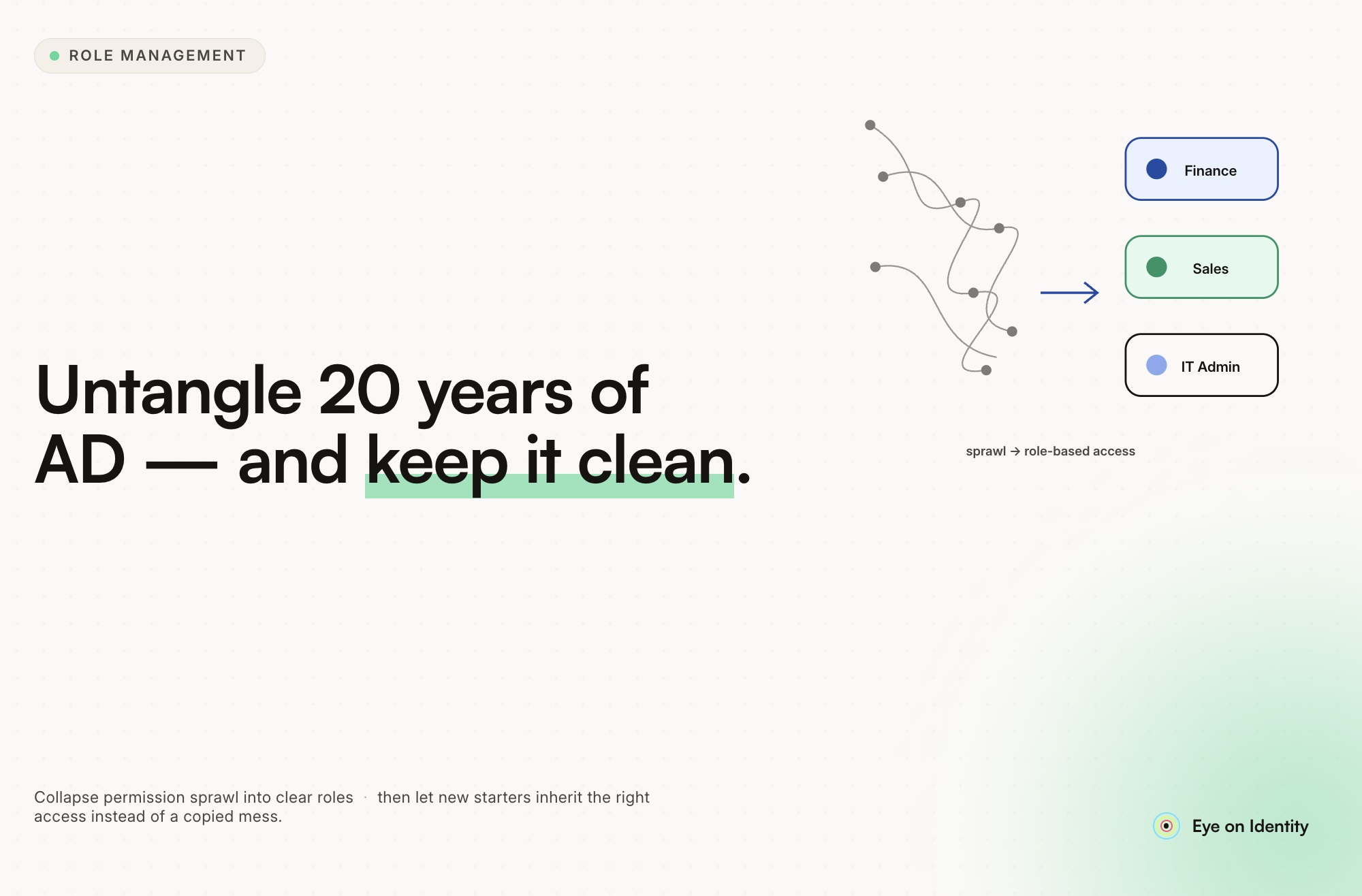
Non-human identity governance. Service accounts, bot accounts, and API keys are distributed across all four tools and typically fall outside access review scope because they don't have managers or HR records. A unification platform that classifies and tracks NHIs can include them in governance workflows — ownership assignment, periodic review, and decommission triggers — rather than leaving them as ungoverned persistent credentials.
Unified offboarding verification. When someone leaves the company, offboarding needs to close accounts in Okta (SSO), AD (on-prem groups and local accounts), SailPoint (governance record), and CyberArk (vault accounts and shared credentials). A unified offboarding record shows the status across all connected tools from one place.
Zluri as the Unification Layer
Zluri's IVIP (Identity Visibility and Intelligence Platform) module is designed specifically for this architecture — connecting existing IAM, IGA, and PAM tools into a unified access graph rather than replacing them. Pre-built connectors for Okta, AD (via outbound-only Directory Agent), SailPoint, and CyberArk bring their identity data into a single interface with the attribute resolution, user categorization, and actioning layer that SIEM and custom data lakes don't provide.
The complementary positioning relative to SailPoint is worth clarifying: SailPoint handles the deep IGA workflows your team has built — provisioning connectors, certification campaigns, access request workflows. Zluri's unification layer adds real-time activity and usage insights that SailPoint's static access profiles don't carry, plus cross-tool visibility that makes the security team's analytical work possible without manually correlating across four consoles.
Frequently Asked Questions
How do you get a unified view of identity access across Okta, Active Directory, SailPoint, and CyberArk?
The practical approach is a unification platform that integrates with all four tools via pre-built connectors or APIs, resolves user identities across different systems into a single coherent record, and adds an actioning layer so security teams can act on what they see rather than just reporting on it. Key architectural requirements are shared identity resolution across different user ID formats, attribute precedence configuration for overlapping metadata, and user categorization that covers both human and non-human identities across all four systems.
Why doesn't a SIEM work for unified identity visibility?
A SIEM aggregates logs and generates alerts effectively, but it lacks the actioning layer for identity governance. When a SIEM surfaces a risk — an orphaned account, a stale privileged credential, an access certification gap — remediation requires going back into each individual tool. A unified IGA/IVIP layer connects detection to remediation within the same interface, and generates the compliance-grade timestamped evidence artifacts that SOC 2 and ISO 27001 auditors require.
How do you integrate on-premises Active Directory with cloud identity tools?
The standard approach for organizations that need outbound-only connectivity is an agent deployed within the internal network — typically a Docker container — that polls cloud platform servers for tasks and syncs AD data (users, groups, OUs) without requiring inbound firewall ports. This allows on-prem AD to participate in cloud-coordinated identity governance workflows without network architecture changes.
What is the difference between SailPoint IGA and a unified identity visibility platform?
SailPoint provides deep IGA workflows: provisioning connectors, access certification campaigns, access request approvals, and lifecycle management. A unified identity visibility platform adds the cross-tool view that SailPoint doesn't natively provide: correlating SailPoint's governed access records with Okta's authentication activity, AD's group memberships, and CyberArk's privileged account data into a single access graph. The two are complementary — SailPoint handles the governance depth, the unified layer handles the cross-tool visibility and actioning.


.svg)