

User access reviews are one of the most universally required controls across compliance frameworks — SOC 2, ISO 27001, SOX, HIPAA, GDPR all mandate some version of periodic access certification. They’re also one of the most consistently failed controls in audits. Not because organizations don’t conduct reviews, but because the reviews they conduct don’t produce the evidence auditors require, don’t cover the full application estate, and don’t result in meaningful remediation. Here are the best practices that distinguish reviews that satisfy auditors from reviews that generate findings.
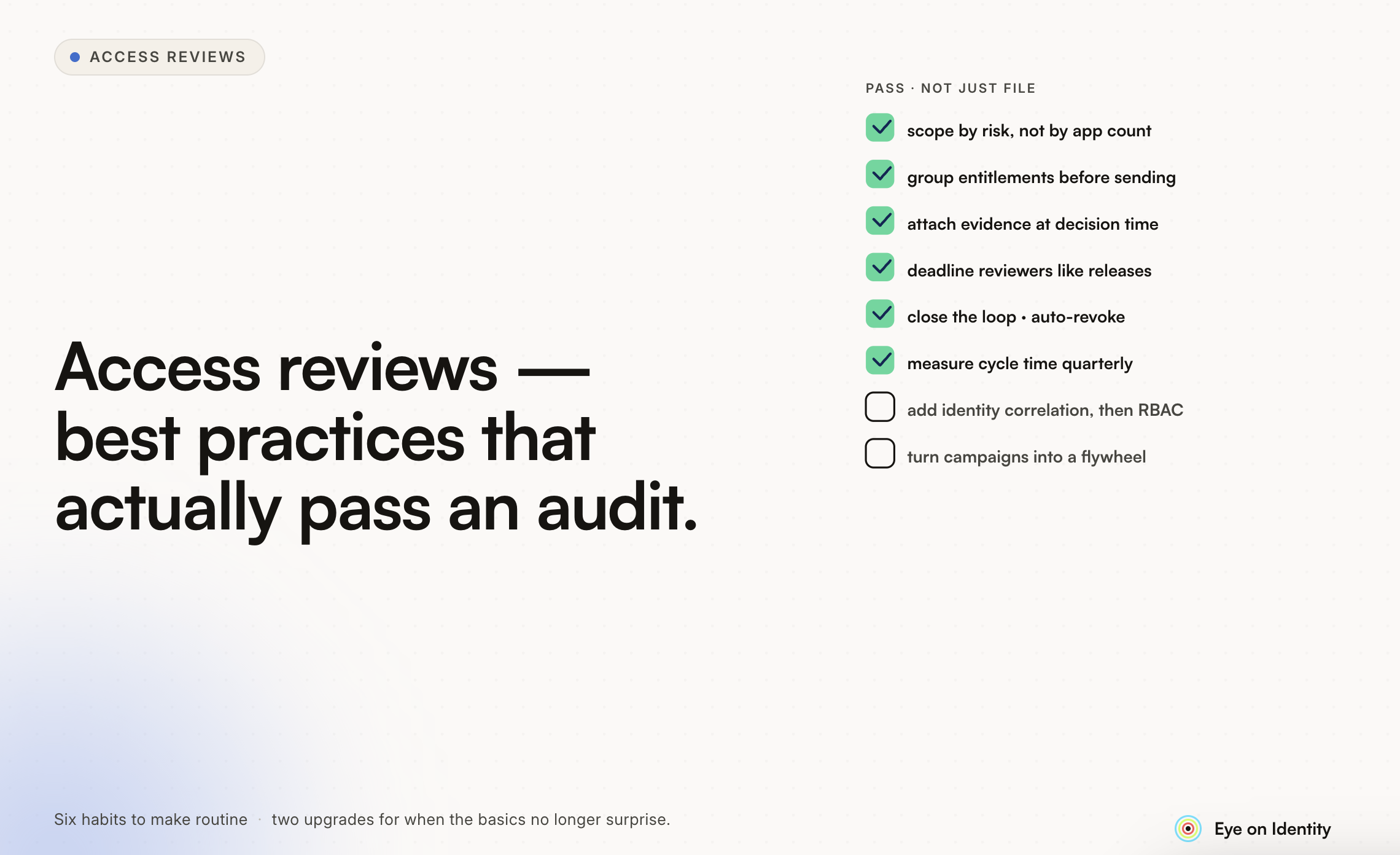
Define Scope Before the Campaign Starts The most common scoping failure in access reviews is defaulting to “what’s in our SSO.” SSO-scoped reviews cover the applications that went through formal IT onboarding. They systematically exclude the applications that employees adopted independently, the vendor portals with local authentication, the legacy systems that predate SSO integration, and the AI tools connecting to company data through personal accounts. Estimates for the share of enterprise applications outside formal IT oversight consistently run above 60%. A review scoped to SSO is reviewing less than half of the real access estate. Complete scope definition before a review campaign starts should include: All SSO-connected applications in the identity provider. Applications discovered through browser agents, financial data, or direct queries to known SaaS platforms. External guest accounts across collaboration tools. Service accounts, API tokens, and non-human identities. Privileged accounts — local admin rights, elevated permissions, domain admin access. The scope document is part of your audit evidence. Auditors will ask which applications were included and why. Having a documented, defensible scope is significantly better than an undocumented one that happens to match whatever the SSO export contains.
Assign Formal Ownership for Every Application in Scope A review without a designated owner for each application is an accountability gap waiting to become a finding. Every application in your review scope should have a named owner — the person responsible for knowing who has access, why they have it, and whether it’s still appropriate. Application ownership does two things in the context of access reviews. First, it routes reviewer tasks to the right people. The application owner is far better positioned to evaluate whether a specific user’s access is appropriate than an IT administrator reviewing a list of names. Second, it creates accountability for decisions. When an application owner formally approves or revokes access, that decision is attributed to them with a timestamp. The accountability structure that results is what gives access reviews their evidential value. For applications without a designated owner, assign the responsibility to a default — typically the security team or IT — and flag the ownership gap as a remediation item. Running a review against an unowned application is better than skipping it, but getting ownership assigned should be treated as a parallel action item.
Use Activity Data to Drive Meaningful Reviewer Decisions The rubber-stamping problem — reviewers approving every access record without actually evaluating it — is the most pervasive quality problem in access reviews. A reviewer looking at a list of 200 names with no supporting context is not in a position to make a meaningful decision. They’re in a position to click approve and get back to their actual work. Usage data changes this dynamic. When a reviewer can see that a user holds an elevated permission level and hasn’t accessed the application in 60 days, they have a basis for a real decision. When they can see that an external contractor’s access was provisioned for a project that ended six months ago, the revocation decision is clear. When every user on the list logged in within the past week, the approval decision is equally clear. Providing usage context alongside each access record doesn’t just improve review quality — it reduces reviewer burden by making the decision obvious in the cases where it is obvious, and flagging the cases that warrant actual scrutiny. The practical implementation: surface last login date and login frequency for each user in each application alongside the access record. For applications with permission levels, include the assigned role. For applications with usage depth metrics, include active feature usage where available.
Require Justifications for Material Decisions Approval decisions without justifications are not meaningless — they represent a reviewer confirming that access is appropriate. But revocation decisions, modification decisions, and approval decisions for high-risk or unusual access should require a written justification. The justification creates an auditable record of why the decision was made, which serves two purposes. For the current audit, it demonstrates that the review involved actual evaluation rather than rubber-stamping. For future audits, it provides context for access that might otherwise appear anomalous — an explanation for why a specific user has elevated access, or why a dormant account was retained. The justification requirement also has a behavioral effect: when reviewers know they’ll have to explain their decisions, they’re more likely to actually make them rather than defaulting to approve. Self-certifications — cases where a reviewer would be evaluating their own access — should be automatically reassigned to the reviewer’s manager or an alternate. ISO 27001 explicitly requires objectivity in access reviews, and auditors specifically look for this control. Auto-reassignment handles it without requiring manual oversight of every campaign.
Close the Remediation Loop Before the Campaign Closes A review that produces revocation decisions but doesn’t verify their execution is incomplete from an audit perspective. The auditor will ask not just whether access was reviewed, but whether access flagged for removal was actually removed — and when. For SSO-connected applications with API access, automated deprovisioning closes this loop immediately: when a reviewer marks access for revocation, the governance platform executes the deprovisioning action and records the completion timestamp. The audit report includes both the review decision and the confirmation of execution. For applications without API access, the remediation step requires a manual action by an IT administrator. The governance platform should generate a task with the application, the user, the required action, the deadline, and a required completion confirmation. The completed task record provides the audit evidence that the manual remediation happened. The worst outcome for a remediation loop is an untracked manual step — a list of revocations emailed to an IT admin with no tracking of whether they were executed. This is where most review processes fail the audit test: the review happened, the decisions were made, and the remediation was assumed rather than confirmed.
Generate Non-Editable Reports at Campaign Close The evidence format matters as much as the underlying activity. A spreadsheet that could have been modified after the fact doesn’t carry the same evidentiary weight as a system-generated report with a timestamp. Non-editable PDF reports generated at the close of a review campaign — containing the reviewer’s decisions, their justifications, the completion timestamps, and the remediation confirmations — are the format that most auditors require and that most manual review processes fail to produce. The report should capture: campaign scope (which applications, which users, which reviewers), reviewer decisions for each access record with timestamps, justifications for material decisions, remediation actions taken and confirmation of completion, and any access that required escalation or secondary review. This is the evidence package that satisfies auditors for SOC 2, ISO 27001, SOX, HIPAA, and GDPR access review controls. The specific requirements vary by framework, but the underlying standard — documented, evidenced, non-editable proof of who reviewed what and what happened as a result — is consistent across all of them.
Run Reviews on a Cadence That Matches Your Framework Requirements The frequency requirement for access reviews varies by framework and by application risk level. SOC 2 Type II auditors typically expect at least annual reviews for all applications, with quarterly reviews for high-risk systems. ISO 27001 requires regular reviews at intervals commensurate with the risk. SOX requires documented evidence of access reviews for financially significant systems, typically on an annual basis at minimum. HIPAA requires periodic review of access to ePHI systems. The practical recommendation: quarterly reviews for high-risk applications (financial systems, HR platforms, systems with privileged access, applications containing regulated data), annual reviews for lower-risk applications, and continuous monitoring — real-time flagging of inactive accounts, unusual privilege levels, and access policy violations — as a complement to periodic review cycles. Organizations that run access reviews only when audits require them are in a permanently reactive posture: the review happens, the evidence is produced, the audit passes, and the access estate drifts until the next cycle. Organizations that build continuous monitoring alongside periodic reviews compress the window between a problem emerging and someone being aware of it — which is what “timely identification and remediation” means in practice.
The Underlying Pattern Every best practice above addresses the same structural problem: access reviews that happen on paper but don’t produce real accountability, real remediation, or real evidence. The organizations that consistently pass access review audits aren’t doing dramatically more work than the ones that get findings. They’ve built a process that produces the right outputs automatically — complete scope, attributed decisions, justified choices, confirmed remediation, non-editable evidence — rather than assembling those outputs manually under audit pressure. The manual assembly approach works once, under scrutiny, with significant effort. The automated approach works every quarter, as a matter of routine, without a crisis before each audit window.


.svg)