

Identity sprawl is the predictable outcome of organizational growth without centralized identity governance. Users accumulate credentials across Windows endpoints, SaaS applications, VPNs, and internal tools. Access is provisioned when people join and rarely cleaned up when they move roles or leave. No single system knows the complete answer to "who has access to what." And every incomplete answer to that question is a security gap waiting to be exploited.
Identity and Access Management is the framework and toolset that solves this — not just by controlling who can log in, but by governing the entire lifecycle of identity across every system in the environment.
What IAM Actually Covers
IAM is frequently described as two capabilities — authentication and authorization — that together form the access control layer for every system an organization operates.
Authentication is identity verification: confirming that the person (or system) attempting access is who they claim to be. Passwords are the baseline; multi-factor authentication adds a second verification layer. Modern authentication has evolved toward passwordless methods — hardware keys, biometrics, device-bound passkeys — that eliminate the most commonly exploited authentication weakness.
Authorization is access control: determining what an authenticated identity is permitted to do. This is where roles, groups, policies, and access conditions are enforced. An employee authenticated as themselves may be authorized to access HR applications but not financial systems. An administrator authenticated at standard trust level may only be authorized to access privileged systems after additional verification steps.
These two capabilities operate at the moment of access — real-time decisions about whether a specific identity can perform a specific action right now. IAM enforces the access that exists; it doesn't inherently answer whether that access is still appropriate or whether it was granted through a documented process. That governance layer is Identity Governance and Administration (IGA), which modern platforms have incorporated alongside the core IAM capabilities.
How Identity Sprawl Develops
Identity sprawl develops through four predictable patterns:
Fragmented provisioning. Every new SaaS application, internal tool, or infrastructure resource added to the environment potentially creates new identities. If these provisioning events aren't centrally tracked and governed, users accumulate accounts across dozens of systems with no single inventory of what exists.
Incomplete offboarding. When someone leaves the organization, the accounts that get disabled are typically the ones connected to the primary IdP through SSO. The accounts in tools that were never federated — SaaS applications departments adopted independently, tools employees signed up for with their work email, legacy systems without SSO support — often remain active indefinitely.
Role change without cleanup. When someone changes roles or departments, new access is provisioned for the new role but access from the previous role is rarely systematically revoked. Over time, employees accumulate access from every role they've held, regardless of whether it's still relevant to their current function. This is privilege creep — and it creates access that can be exploited if credentials are compromised.
Shadow IT. Applications adopted outside formal IT procurement don't appear in the central identity inventory. They generate authentication events and hold company data, but no governance process tracks them, reviews them, or deprovisions users from them.
Centralized Identity Control: The Source of Truth
The foundation for solving identity sprawl is a single authoritative source for employee identity data. Every automated decision — who gets provisioned when they join, what access is adjusted when they change roles, whose accounts are revoked when they leave — is only as reliable as the data driving it.
The authoritative source is typically an HRMS: Workday, BambooHR, Personio, or similar. When a new employee is added to the HRMS with a start date, that event triggers downstream provisioning. When termination is recorded, that event triggers offboarding. The HRMS doesn't have to do any of the identity management itself — it's the source from which identity events flow into the IAM and IGA layers.
Directory services (Active Directory, Entra ID, Okta) sit above the HRMS as the identity store that connected applications authenticate against. The IAM platform synchronizes HRMS data into the directory, ensuring that department, role, manager, and employment status attributes are consistent across all connected systems. A promotion updated in the HRMS flows through to the directory and from there to all applications that make authorization decisions based on those attributes.
SSO and MFA: Solving Inconsistent Authentication
Fragmented identity creates inconsistent authentication — some applications are protected by strong MFA and SSO, others rely on weak local passwords. SSO addresses this by centralizing authentication: users authenticate once to the identity provider and access multiple applications through trusted tokens rather than separate credentials per application.
The security benefit of SSO is often misunderstood: it's not just convenience, it's control surface reduction. When every application authenticates through the IdP, the IdP becomes the single point where MFA can be enforced, where Conditional Access policies can be applied, and where deprovisioning a user cuts off access to every SSO-connected application simultaneously. Without SSO, each application has its own credentials, MFA policies, and deprovisioning requirements — which is what creates the sprawl.
MFA addresses the most commonly exploited authentication weakness: credential compromise. A password alone, regardless of complexity, can be phished, brute-forced, or leaked. MFA (TOTP codes, push notifications with number matching, hardware keys) requires an attacker to compromise not just the password but also the second factor — significantly raising the attack cost. Phishing-resistant MFA (hardware keys, FIDO2) eliminates even the social engineering vector that defeats push notification MFA.
Policy-Based Access and Least Privilege
The authorization layer determines not just whether an identity can access a system but what they can do within it. Two access control models are foundational:
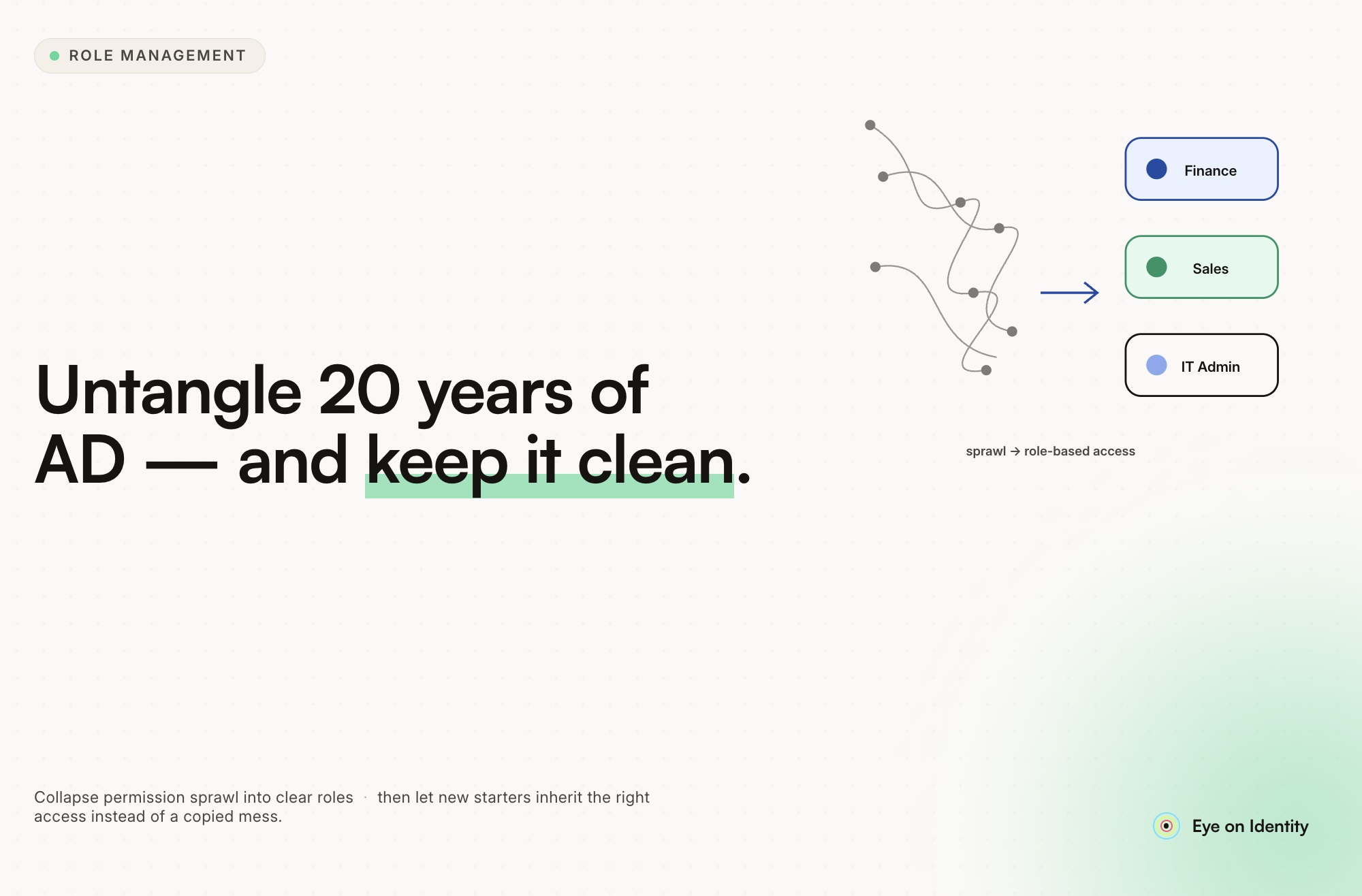
Role-Based Access Control (RBAC) assigns access based on job function. All Software Engineers get a standard set of access appropriate for that role; all Finance Analysts get a different standard set. When someone is provisioned into a role, they automatically receive the access associated with that role. When they change roles, the previous role's access is removed and the new role's access is granted. RBAC is operationally efficient and auditable: it's clear what access a given role entails, and access reviews can be conducted at the role level rather than the individual level.
Attribute-Based Access Control (ABAC) adds contextual conditions to authorization decisions. A doctor can access patient records, but only during scheduled shifts and only from hospital network locations. A contractor has access to a specific project repository, but only until the project end date. ABAC allows access policy to incorporate dynamic context — time, location, device compliance state, risk signals — that static role definitions can't capture.
The Principle of Least Privilege operationalizes both models: grant the minimum access necessary for the current function, and no more. In practice, enforcing least privilege requires both the policy framework (RBAC/ABAC) to define appropriate access and the governance process (access reviews, mover workflows) to ensure that access doesn't drift above the defined minimum over time.
Automated Lifecycle Management: The JML Framework
The Joiner-Mover-Leaver framework maps the three identity lifecycle events that occur continuously in every organization and connects them to automated access changes.
Joiners. When a new employee is added to the HRMS, the IAM/IGA platform detects the event and provisions birthright access — the standard set of applications and permissions appropriate for the employee's role and department. Day one access is ready before the employee starts, without requiring IT to manually provision each application.
Movers. When an employee changes roles or departments, the platform detects the attribute change in the HRMS and runs a mover workflow: simultaneously deprovisioning the access specific to the previous role and provisioning the access appropriate for the new role. This is the critical step that prevents privilege creep from accumulating — without it, departing access from the old role is simply added to access from the new role.
Leavers. When employment ends and the HRMS is updated, the offboarding workflow revokes access across every application in the employee's access profile — including shadow IT applications discovered through browser agents and financial transaction analysis, not just the SSO-connected applications. Every license is reclaimed, every session is terminated, and the audit trail documents the completion of each revocation.
Full Visibility: Discovery and the Access Graph
The question "who has access to what" requires more than a directory query. It requires discovery — surfacing the full access landscape including applications IT didn't provision and identities IT didn't create.
Modern discovery engines pull from multiple signal sources that together reveal the complete picture:
- SSO and IdP logs show every application a user has authenticated to via SSO. This covers the formally federated application stack.
- Financial and expense system integrations reveal SaaS subscriptions purchased outside IT procurement. A recurring charge in Expensify for a tool no one in IT knows about is discovery data.
- Browser and desktop agents track actual application usage at the endpoint level, regardless of whether the application was provisioned through IT or accessed from the corporate network. This is how shadow IT applications surface.
- HRMS cross-referencing converts active employee status into an access anomaly detector. Any application account associated with an HR record showing a past termination date is an orphaned account, visible without manual audit.
The Access Graph synthesizes these signals into a unified map: which identities (human and non-human) connect to which applications, what entitlements they hold, and where the gaps exist between what should be governed and what is actually being governed. This visibility is the prerequisite for both proactive governance and incident response.
Frequently Asked Questions
What is identity sprawl and why is it a security risk?
Identity sprawl occurs when users accumulate fragmented credentials across multiple systems — SaaS applications, endpoints, VPNs, and internal tools — without centralized tracking or governance. The security risks are: orphaned accounts (active credentials for former employees), over-provisioned access (permissions accumulated across role changes that were never cleaned up), inconsistent authentication policies (some applications protected, others not), and limited visibility (no single system knows the complete answer to "who has access to what"). Each of these creates exploitable gaps.
How does SSO help with identity sprawl?
SSO (Single Sign-On) centralizes authentication — users authenticate once to an identity provider and access multiple applications through trusted tokens. This reduces the credential surface (fewer passwords to compromise), allows MFA to be applied uniformly rather than application by application, and makes deprovisioning a single action (disabling the IdP account cuts off access to every SSO-connected application). Without SSO, each application has its own credentials, its own security policies, and its own deprovisioning requirement — which is the structural source of authentication sprawl.
What is the Joiner-Mover-Leaver (JML) framework in IAM?
JML describes the three identity lifecycle events: a new employee joining (account creation and birthright access provisioning), an existing employee changing roles or departments (simultaneous access adjustment — removing old role access and adding new role access), and an employee leaving (complete access revocation across all systems). Automating all three from a single HRMS source of truth is the core objective of lifecycle management in IAM and IGA platforms. JML automation prevents orphaned accounts (missed leavers), privilege creep (missed movers), and onboarding delays (unautomated joiners).
What is the difference between IAM and IGA?
IAM covers authentication and authorization — the real-time enforcement layer that controls who can log in and what they can access. IGA covers governance — the long-term management of whether access is still appropriate, whether it was granted through a documented process, and whether periodic reviews have verified its continued appropriateness. Modern platforms increasingly incorporate both, but the distinction matters: IAM enforces access that exists, IGA governs whether that access should exist.


.svg)