.png)




Zluri wasn't built as a smaller version of an enterprise IGA suite. It was built from a different starting assumption: that the buyer has no dedicated identity team, no seven-figure budget, and no patience for a year-long rollout, and still needs governance that actually holds up to an audit.
Most identity governance platforms were designed around a specific buyer: a large enterprise with a standing identity function, a multi-quarter implementation budget, and the internal engineering capacity to build and maintain custom integrations.
That buyer profile shaped everything about how the category works, and it left a real gap for the much larger number of companies that carry the same governance risk without any of that infrastructure.
Zluri starts from a different premise: build the platform around what a lean, mid-market team actually has, not around what a Fortune 500 identity department has always had, and see how much of the traditional resourcing requirement can be architected away rather than just discounted.
Here's what that looks like in practice, mechanism by mechanism.
The Starting Point: What Traditional IGA Assumes vs. What Zluri Assumes
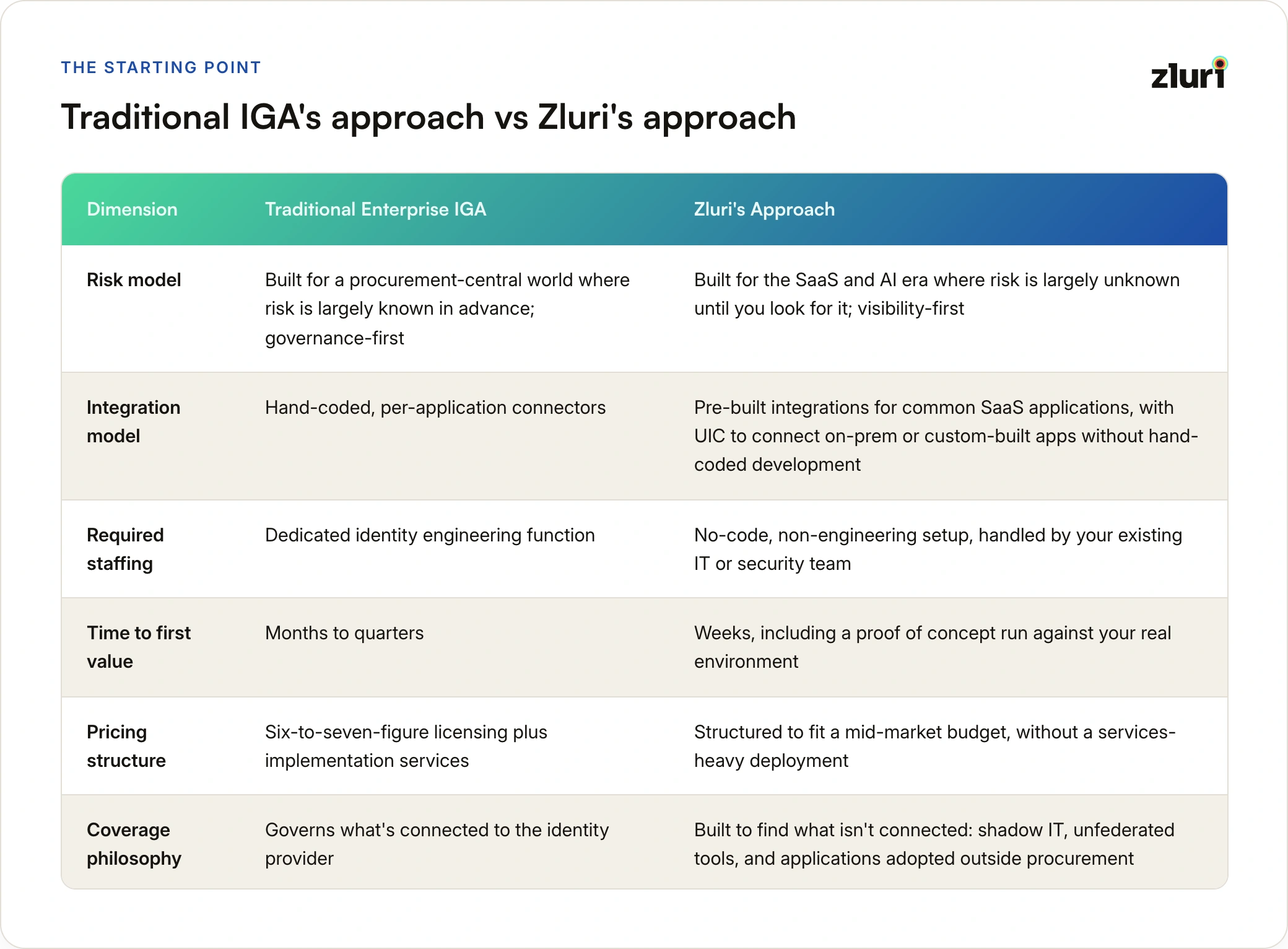
Each row on the right side reflects a specific decision, not a smaller version of the left side. Here's the reasoning behind each one.
Built for Unknown Risk, Not Just Known Risk
The old way: Traditional enterprise IGA was designed for a procurement-central world, one where applications entered the company through a controlled process, IT approved them, and the resulting environment was stable enough to model in advance. Governance-first was a reasonable design choice in that world: define roles and policies first, because the population of applications and access being governed was largely knowable before you started.
What Zluri does instead: The SaaS and AI era doesn't work that way. Procurement is decentralized, and a meaningful share of risk is unknown until you actually go looking for it:
- A new AI assistant connected to email through an OAuth grant
- A free-tier tool signed up for with a personal card
- A browser extension nobody in IT approved
There's no stable, knowable population to design governance against in advance anymore. Zluri is built visibility-first instead: continuously see what actually exists, including the unapproved AI tools and shadow applications a procurement-first model was never designed to catch, and build governance on top of that real picture rather than an assumed one.
Why it matters for mid-market specifically: Mid-market and growth-stage companies are where procurement centralization tends to be weakest and AI tool adoption often moves fastest, since there's rarely a formal gate stopping an employee from connecting a new tool to their inbox or documents. A governance-first model built for a known, procurement-gated world misses exactly this population by design. Visibility-first is built to catch it, which is where mid-market's real exposure increasingly sits.
Visibility Without the Connector Tax
The old way: Enterprise suites integrate application by application, with each new connector effectively a small, hand-coded software project. Standard applications get covered by a pre-built connector; anything else requires custom development that commonly costs tens of thousands of dollars and takes months to complete.
What Zluri does instead: Coverage starts with pre-built integrations across common SaaS applications, combined with several other signals to build a single picture of the environment:
- SSO and identity provider data
- Finance and expense records
- Browser and desktop agents
For on-premises systems or custom-built internal applications that fall outside standard coverage, Zluri's UIC lets you connect them directly without waiting on hand-coded, vendor-built development.
Why it matters for mid-market specifically: Mid-market environments tend to carry proportionally more of this ungoverned surface, since procurement discipline is often looser and SaaS adoption happens faster than a small IT team can track manually. Pre-built coverage for the common case, with a self-serve path for the exception, closes the gap without requiring a custom development project every time something falls outside the standard connector list.
No-Code Governance, Run by the Team You Already Have
The old way: Enterprise platforms assume a dedicated identity engineer configures and maintains the system: managing the connector framework, building workflow logic, and troubleshooting integration issues as part of a full-time, engineering-level role.
What Zluri does instead: Workflow configuration, provisioning rules, review campaigns, policy definitions, is built no-code, so it doesn't require engineering skills to set up or maintain. It's designed to be run by whoever already handles IT or security at a mid-market company, without needing to build out a new function or bring on specialized identity engineering headcount.
Why it matters for mid-market specifically: A mid-market company was never going to build a new team for this. A platform that requires one doesn't fail because the existing team lacks skill, it fails because the platform assumed a role, and a headcount line, that structurally doesn't exist at this company size. No-code configuration isn't a simplified version of the real thing, it's what actually lets the team you already have run this without hiring anyone new.
Value in Weeks, Not Quarters
The old way: Enterprise implementations are commonly measured in quarters to years, with professional services engagements structured around a multi-phase rollout that assumes the buyer can sustain a long runway before seeing operational value.
What Zluri does instead:
- A proof of concept runs against your actual environment, real applications, real data, not a guided demo tenant, within the first couple of weeks.
- A working governance workflow, covering a meaningful first set of applications, is achievable within the first month rather than treated as a distant milestone.
Why it matters for mid-market specifically: A lean team doesn't have the bandwidth to sustain a project for a year before it produces anything usable. Fast time-to-value isn't just a convenience here, it's what makes the project survivable internally, since a mid-market implementation that doesn't show results quickly tends to lose momentum and stall, the same pattern that derails enterprise-scale tools when they're deployed into under-resourced environments.
A Platform That Partially Pays for Itself
The old way: IGA is typically budgeted as a pure cost center, competing against every other security and IT line item for a limited mid-market budget, with no direct financial offset built into the platform itself.
What Zluri does instead: Because the same discovery work that powers governance also tracks application usage, the platform surfaces unused licenses, duplicate tools, and SaaS spend that isn't tied to any active user, as a byproduct of the governance work rather than a separate initiative.
Why it matters for mid-market specifically: For a company with real budget constraints, that visibility routinely offsets a meaningful share of the platform's own cost, and it changes who's in the room advocating for the project. Finance moves from a gatekeeper who has to be convinced to a stakeholder who benefits directly, since the same visibility that governs access also finds the SaaS waste they've likely been trying to track down separately for years.
Coverage Built for How Mid-Market Companies Actually Add Applications
The old way: Most discovery, even on faster, more modern platforms, runs as a one-time or infrequent scan: connect the environment, get a picture of it, and treat that picture as current going forward.
What Zluri does instead: Visibility is treated as an ongoing capability rather than a single onboarding event, continuing to surface new applications, including those adopted through free-tier sign-ups or OAuth grants that never touch a formal procurement process, as they appear rather than only at initial setup.
Why it matters for mid-market specifically: Mid-market and growth-stage companies frequently have even less procurement friction than large enterprises between an employee and a new SaaS tool. An environment that looked complete in week one can be measurably incomplete by month three if visibility only ran once. Continuous coverage matters more here, not less, because the rate of unmanaged change is often higher.
What This Adds Up To
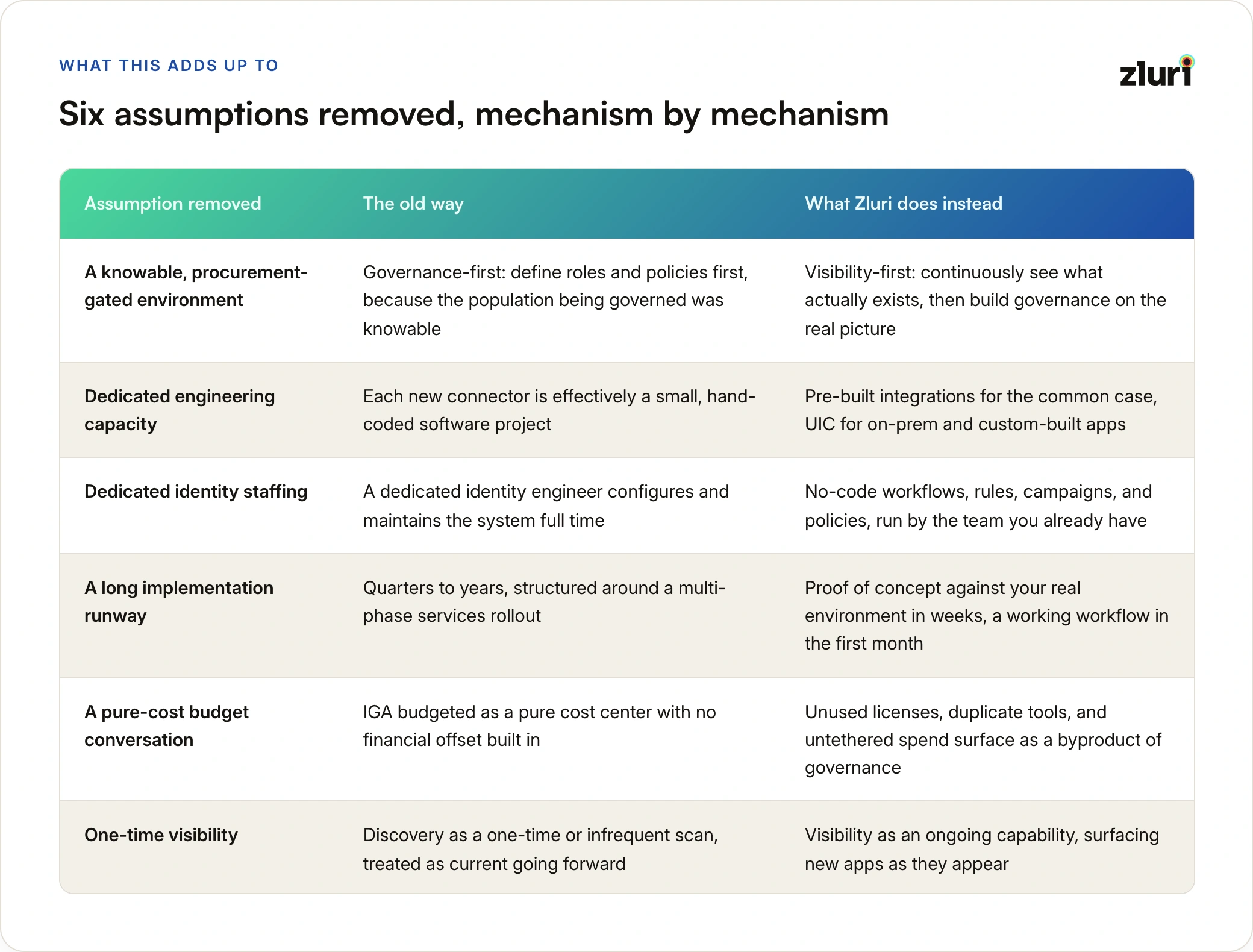
None of these six mechanisms is a discount on enterprise IGA. Each one removes a specific assumption that made the traditional category structurally unavailable to this segment:
- A knowable, procurement-gated environment
- Dedicated engineering capacity
- Dedicated identity staffing
- A long implementation runway
- A pure-cost budget conversation
- One-time visibility
Put together, the result is a platform that can deliver the same underlying governance outcomes, complete access reviews, enforced policy, real audit evidence, without requiring the enterprise infrastructure that used to be a precondition for getting any of it.
Where This Approach Has Real Limits
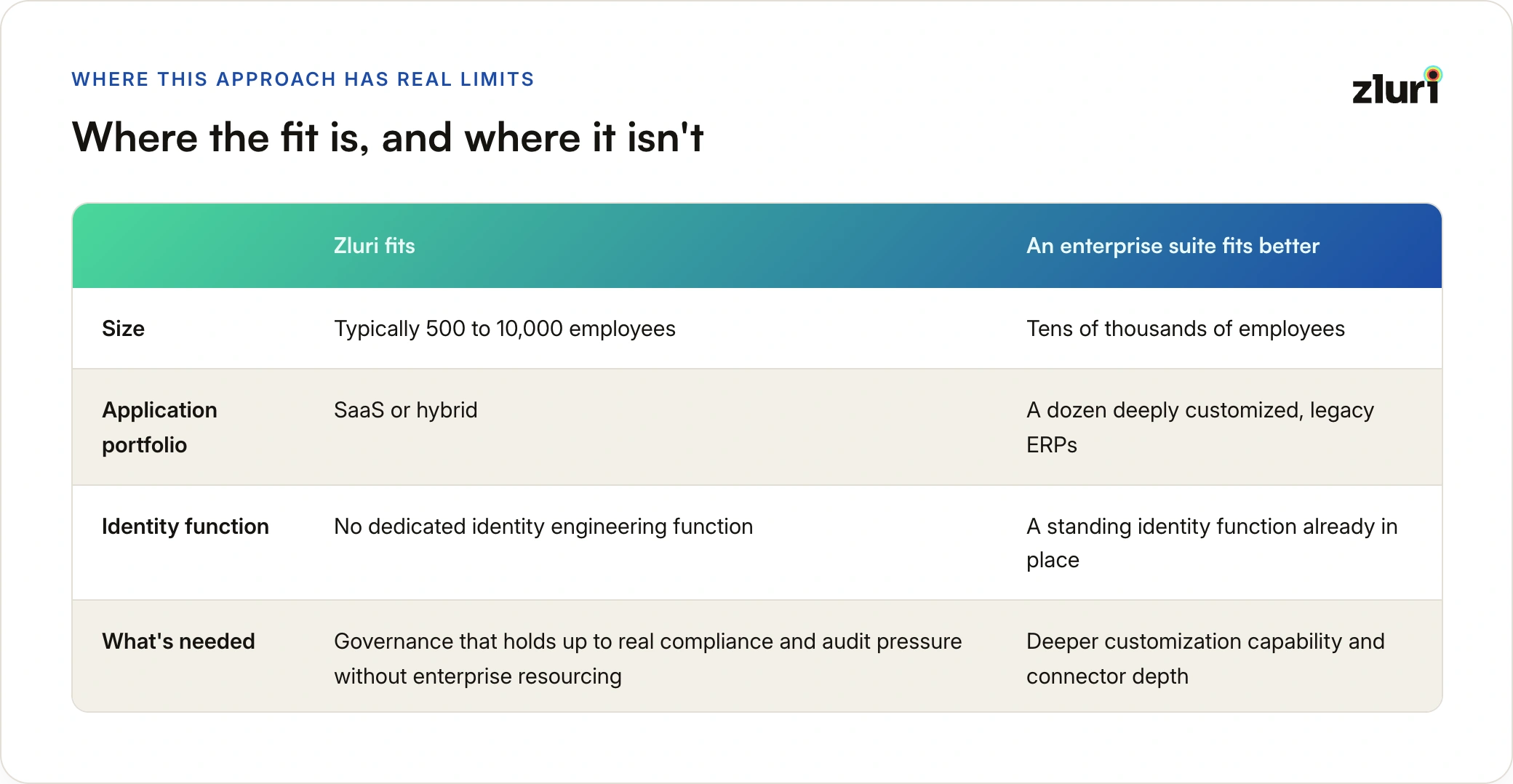
Worth stating plainly, since the point isn't that this approach is right for every company.
An organization running a dozen deeply customized, legacy ERPs, with tens of thousands of employees and a standing identity function already in place, has requirements that a platform built for lean mid-market teams isn't the right tool for.
That complexity is exactly what enterprise suites, with their deeper customization capability and connector depth, were built to handle, and no amount of mid-market-focused architecture changes that calculus for a genuinely enterprise-scale, enterprise-complex environment.
The fit here is specific: organizations, typically in the 500 to 10,000 employee range, running a mostly SaaS application portfolio or a hybrid environment, without a dedicated identity engineering function, that need governance to hold up to real compliance and audit pressure without the resourcing an enterprise buyer would bring to the table.
Frequently Asked Questions
Does a faster, no-code implementation mean weaker governance capability?
No. The speed comes from a different integration and configuration approach, not from a thinner feature set. Access reviews, policy enforcement, segregation of duties checks, and audit evidence generation are built to satisfy the same compliance frameworks a larger company answers to, since the underlying governance requirements don't get smaller for a smaller company.
What happens to applications that genuinely don't have an API, like older internal or on-premises systems?
These are handled through UIC, which lets you connect on-premises or custom-built applications directly rather than waiting on a hand-coded, vendor-built connector. It's still a targeted effort for the specific systems that need it, rather than the default experience across an entire SaaS-heavy portfolio, which is what made legacy connector-by-connector integration so expensive at scale.
If our company grows significantly, do we outgrow this approach?
The more relevant question is usually environment complexity rather than headcount alone. A company that grows in employee count while remaining largely SaaS-native, without accumulating a dozen deeply customized legacy systems, tends to scale well within this architecture, since multi-method discovery and no-code configuration don't require proportionally more engineering effort as application count grows.
How is the SaaS spend visibility different from a separate SaaS management tool?
It's built on the same underlying discovery and usage data that powers governance, rather than a bolted-on second product. Because the platform is already tracking every application and who's actively using it in order to govern access, surfacing unused licenses and duplicate spend is a natural extension of that same data, not a separate initiative requiring its own setup.