.png)



A SaaS management platform can tell you a license hasn't been touched in 90 days. An identity governance platform can tell you whether revoking that license is safe. Ask either platform what it needs to start working, and you get the same answer: who has access, to what system, and why. Two categories, one question underneath, and a handoff between them that usually consists of a person, a spreadsheet, and however much time they have that week.
Identity governance and SaaS management get compared as if they're solving two different problems. Look closer and the comparison is stranger than that: they start from the same questions, chase the same goal, and frequently want the same action taken.
The real difference isn't the work. It's which team's problem the answer gets routed to, and which ledger records the win.
And that's exactly why the failure mode isn't picking the wrong one. It's buying both, running them as separate systems, and discovering that the moment where one platform's answer should become the other's input is where nothing happens automatically.
We build and operate both sides of this comparison, a full SaaS management platform and a full IGA, on one data model. Very few platforms do, and having run both in production across hundreds of customers, we've seen exactly where the two disciplines converge and where the handoff between them breaks.
The Biases Worth Naming
Both sides of this market carry one, and it's worth naming before going further:
- IGA-only vendors dismiss SaaS management as "just dashboards", spend reporting for finance, nothing to do with real security.
- SMP-only vendors return the favor, painting IGA as a heavyweight compliance bureaucracy: slow, over-engineered, a checkbox exercise that gets in everyone's way.
Both critiques are self-serving in the same way: each vendor is dismissing precisely the capability it doesn't have and can't easily build. The IGA vendor can't see your portfolio's spend and usage, so spend visibility becomes "not a security concern." The SMP vendor can't enforce policy or run certifications, so governance becomes "bureaucracy."
We sell both, so we have no incentive to dismiss either, and having operated both in production, we can tell you neither caricature survives contact with reality. That vantage point, not a category preference, is what this article is written from.
What each platform is built to answer
Start with the honest division of labor, because it's real.
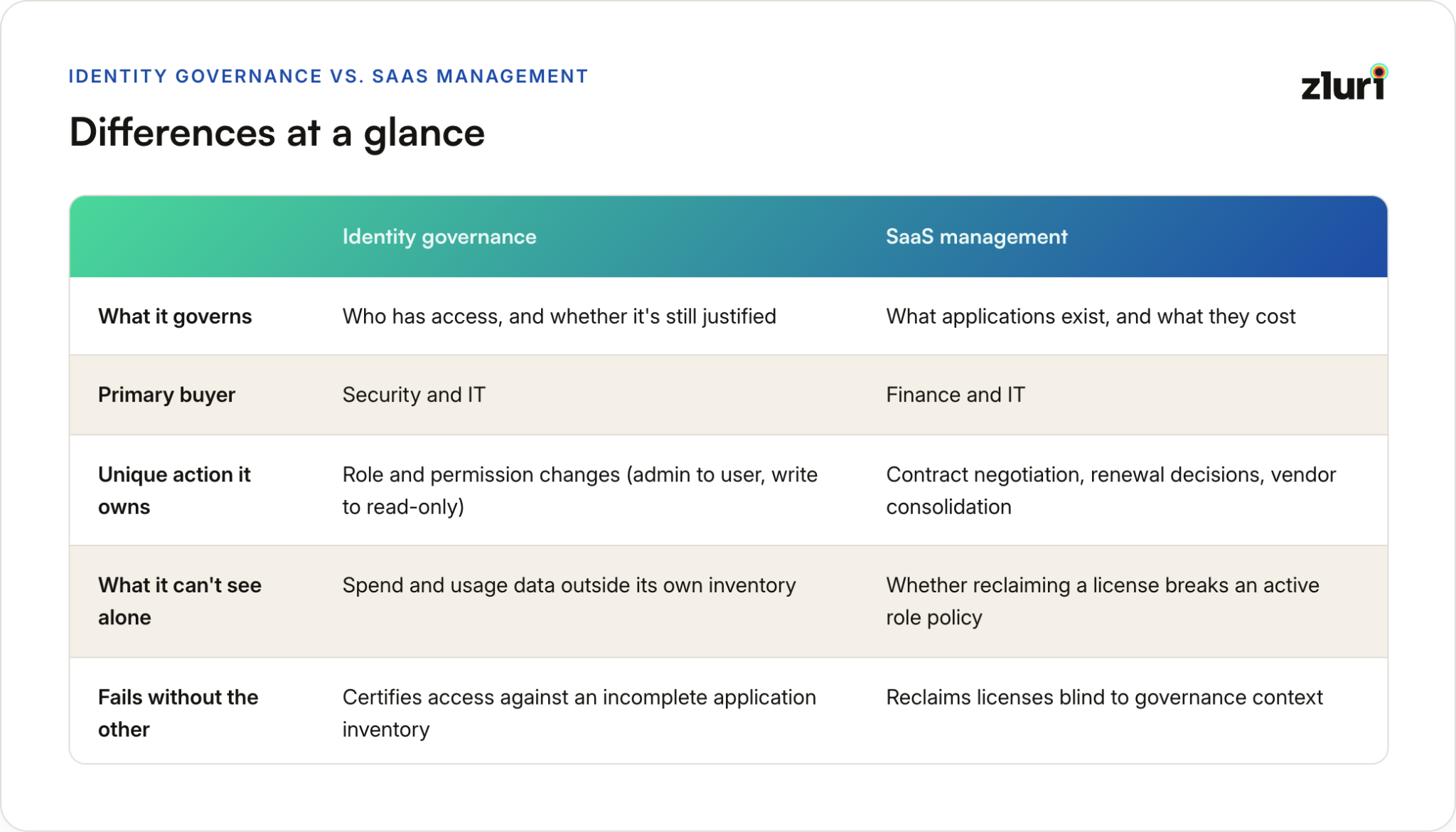
Identity governance governs the full lifecycle of access once it exists: provisioning tied to role rather than blanket group membership, automated deprovisioning that reaches every system a person actually touched, self-service requests routed through real approval policy, and certification that can be scoped to an application, a group, or a specific person depending on the question being asked.
SaaS management answers the inventory question underneath all of that: which applications are in use, who's using them, what they cost, and where spend is going to waste through unused seats, over-provisioned tiers, or redundant purchases nobody noticed.
One governs who should touch what. The other knows what exists and what it costs. Different jobs, and neither does the other's well.
Differences at a Glance
But both start with the same three questions
Before either platform can do anything it's sold to do, it has to answer an identical set of questions:
- Who has access?
- To what system, application, or tier?
- Why, and is that reason still valid?
The data required is the same data: an inventory of applications, the identities attached to each, the level of access or license each identity holds, and some signal of whether it's actually being used. What differs is only what happens to the answer next.
Both chase the same goal: reduce access to what's required
The overlap runs deeper than shared data. Both disciplines exist to shrink the same gap: the distance between what people have and what they need.
IT and security call that gap least privilege. Every entitlement beyond what a role requires is attack surface: more accounts to compromise, more damage a compromised account can do, more findings when the auditor arrives.
Finance and IT call the same gap overpayment. Every license beyond what usage justifies is waste: seats paid for and untouched, premium tiers priced for capabilities nobody exercises, renewals negotiated against inflated counts.
Least privilege and license optimization are the same discipline wearing two badges. Both mean: nobody holds more than the job requires.
The consequence of failing is identical too. Incomplete visibility breaks both programs the same way:
- For IT and security, the blind spot is a security issue. Ungoverned access in unseen apps is where former-employee accounts linger and audit findings originate.
- For finance and IT, the same blind spot is a spend issue. Unseen subscriptions are unmanaged renewals, duplicate purchases, and costs no one owns.
One blind spot, two bills.
Similarities at a Glance
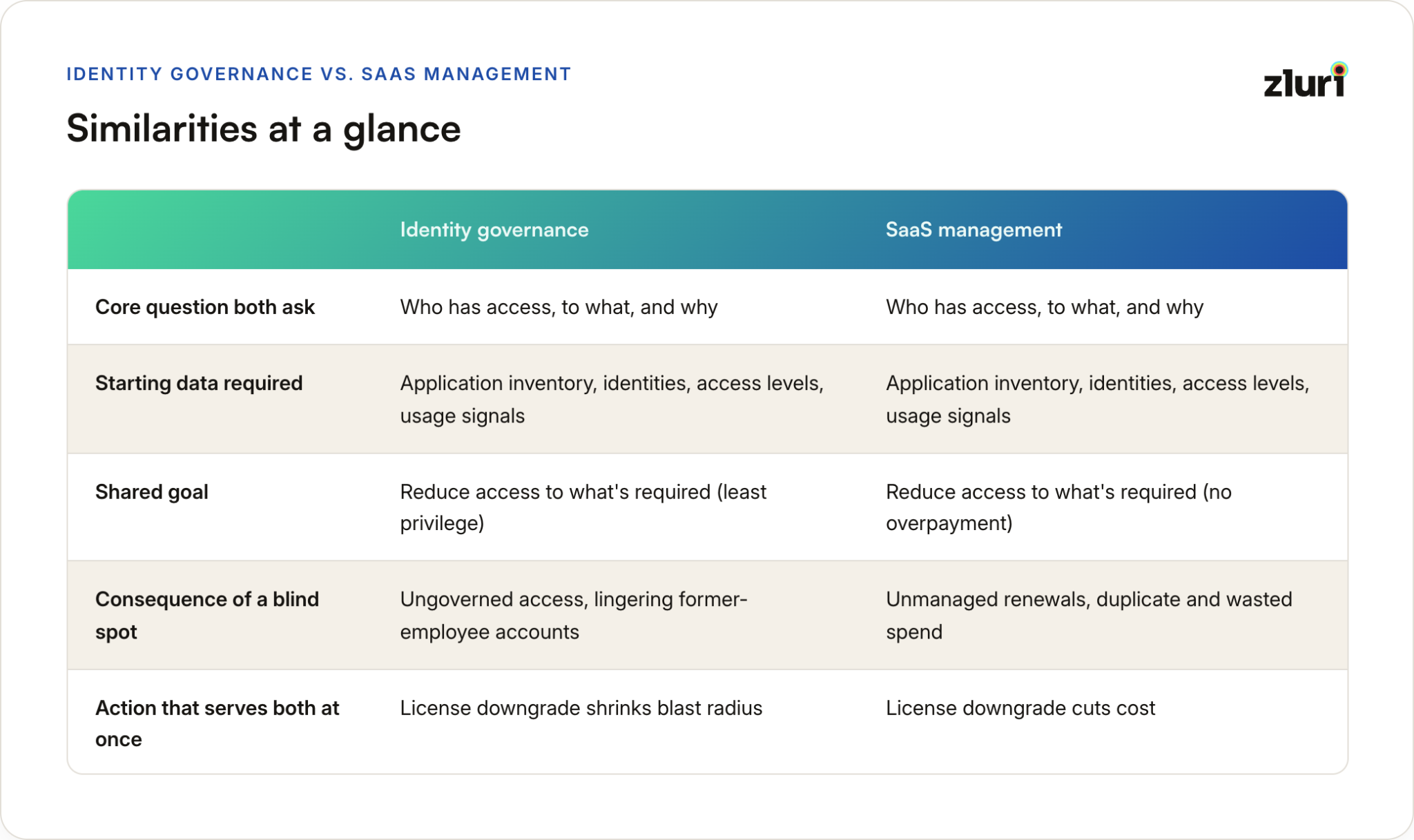
The actions that serve both sides, and the two that don't
Follow either discipline to its operational conclusion and they converge on the same verb: access that isn't justified should be revoked. For security, standing unused access is pure risk. For finance, an untouched seat is pure cost. The same revocation closes both books at once.
The more interesting territory is between full access and no access. Two actions mark the boundary and the overlap precisely.
Role changes are the one genuinely IGA-only action. Moving someone from admin to user, or write to read-only, is pure governance: no invoice attaches to a role, so no spend platform has any reason to see it or any mechanism to change it.
License tier downgrades are the opposite: the action where both disciplines win at once, and most people only see one of the wins. The finance win is the price difference, booked immediately. The security win is the one that gets missed:
A higher license tier isn't just a higher price. It's a bigger blast radius. Premium tiers bundle more capability: API access, bulk export, admin consoles, broader integration scopes, elevated data permissions. Every user sitting on a tier above their actual usage is an account that can do more damage than their job ever required, priced at a premium for the privilege.
Downgrading that user is a cost decision and a least-privilege decision in the same click, part of the measurable value that's easy to underestimate when the two disciplines are tracked as separate line items.
So why does the handoff between them break?
If the two disciplines share this much, running them as two tools should work fine, in theory. In practice, each platform's output is the other's required input, and that dependency is exactly what two separate data models can't honor automatically. This is the disparate model problem showing up between categories, not just within one.
Identity governance can only certify access as complete if the application inventory feeding it is complete. An SMP that just discovered forty apps nobody knew existed is only useful once something governs the access inside them. Run the two as separate purchases, and the dependency doesn't disappear, it becomes manual: someone has to notice the discovery, decide it needs a review, and go configure one in a different tool. Someone has to see the unused license and separately confirm revoking it doesn't break a role policy elsewhere.
Three things break at that seam, predictably:
Reviews run against an inventory nobody cross-checked. An access review is only as trustworthy as the list of applications it covers. If SaaS management discovers an application today and identity governance doesn't learn about it until someone manually adds it to review scope, weeks or months later, every review run in between was complete by the old, wrong definition of complete.
License optimization executes blind to governance policy. A platform that only sees spend will flag an unused license and may even offer to reclaim it, with no visibility into whether that access ties to a role-based policy, a pending request, or a compliance requirement. Reclaiming without that context is how legitimate access gets accidentally revoked, or how the reclaim gets skipped entirely because nobody wants to risk it.
Shadow IT gets discovered and then just sits there. Finding shadow IT is the easy part; plenty of tools do it well. The harder part is what happens next: whether the discovery automatically becomes something governed, with a policy, a review cycle, and an owner, or just becomes a longer list on a dashboard nobody acted on. Discovery without a governance layer attached is visibility with no consequence, the same gap that makes IGA implementations fail in SaaS-first environments even when discovery itself works fine.
The gap isn't in either tool's feature set. It's in the handoff, where one platform's answer was supposed to become the other's input and a person with a spreadsheet is the integration.
The full financial picture of running them separately, the two stacks, the integration you own without a vendor, the reconciliation headcount, the errors drift produces, is its own analysis: the real TCO of running them as separate tools.
How we've closed that handoff at Zluri
The breakage points above aren't hypotheticals to us; they're the design problems we've spent years building against, as one of the few platforms operating both categories at once. We didn't build governance and SaaS management as two products that sync. Both sit on IVIP, the same discovery and intelligence layer, which means there's one application and identity inventory, not two lists maintained separately. For a fuller walkthrough of the governance side specifically, see inside Zluri's IGA platform.
The practical difference shows up exactly at the seam:
- A newly discovered application doesn't wait for someone to notice it. It's already part of the same inventory Access Reviews and Access Management operate against.
- A license flagged as unused isn't reclaimed blind. The platform seeing the usage data also knows whether the access ties to an active role policy, so one decision accounts for both.
- Shadow IT discovery is the start of a process, not the end of one. Anything newly found enters the same governed lifecycle as everything else.
- The dual-win actions actually execute. The tier downgrade that saves finance money and shrinks security's blast radius is one workflow with two beneficiaries, because usage, pricing, and entitlement data face the same action at the same moment.
Why we've kept both sides in one platform, including the savings math that makes the IGA self-funding, is a story of its own.
Frequently Asked Questions
Do I need both an IGA platform and a SaaS management platform?
Functionally, yes: one answers what exists and the other governs access to it, and neither does the other's job well. The real decision isn't whether you need both capabilities. It's whether you run them as one connected system or as two tools with a manual handoff between them.
If IGA and SaaS management are this similar, why are they separate categories at all?
History, mostly. IGA grew out of enterprise compliance and was bought by security teams; SaaS management grew out of cloud spend sprawl and was bought by finance and IT. Different buyers meant separate vendors, analyst categories, and budget lines, even though the underlying work, inventory access, justify it, reduce what isn't justified, was always shared. The categories are converging now precisely because the overlap was baked into the work itself.
Is a license tier downgrade really a security action, not just a cost one?
Genuinely both. Higher tiers bundle elevated capabilities: API access, bulk data export, admin functionality, wider integration permissions. A user on a premium tier their usage doesn't justify holds capabilities their role doesn't require, which is a least-privilege violation that happens to carry a monthly invoice. Downgrading reduces the blast radius of that account being compromised and books the price difference at the same time.
Which actions belong to only one side?
Role and permission changes inside an application, admin to user, write to read-only, are IGA-only: no invoice attached to a role, so spend tooling can't see or change it. Contract-level work like renewal negotiation and vendor consolidation is SaaS-management-only: no access decision is involved. Nearly everything else in the lifecycle serves both.
What's the most common failure mode when the two are purchased separately?
Reviews and access decisions running against an inventory that's already out of date, because new discoveries in the SaaS management tool don't automatically become governed in the IGA tool. The gap isn't visible on either dashboard individually. It only shows up when someone asks a question that needs both answers.
Can a SaaS management platform's license optimization replace access governance?
No. Reclaiming an unused license is a spend decision; confirming the reclaim doesn't break a role policy or an active approval is a governance decision. A platform that only sees usage data can make the first call safely. It can't make the second one without a governance context.
What should I check during evaluation to confirm a platform is actually converged, not just "integrated"?
Ask what happens the moment SaaS management discovers a new application: does someone have to manually configure governance for it, or does it enter the same inventory Access Reviews and Access Management already operate against automatically? That answer tells you whether you're looking at one shared data model or two products with a sync job between them, the same question our guide on choosing IGA software walks through in more depth.
Does the shared starting point mean one team should own both programs?
Ownership can stay split, security owning governance, finance owning spend, as long as the data underneath doesn't. The failures come from two teams answering "who has access to what" from two separately maintained inventories. One shared inventory with two lenses works. Two inventories reconciled by a person and a spreadsheet is where both programs quietly develop the same blind spot.