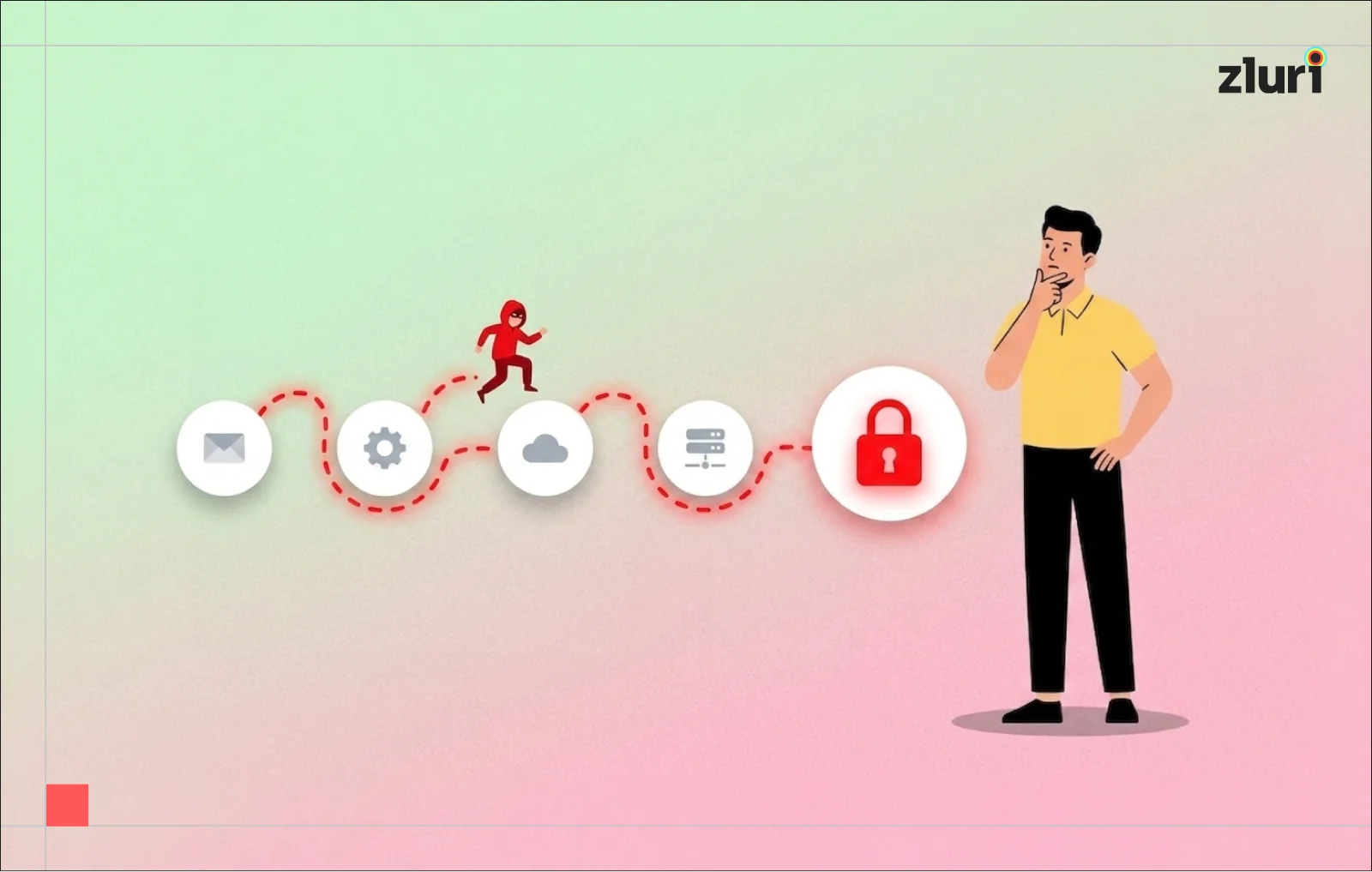

Attackers rarely go straight for the crown jewels. They start somewhere low-value, find an ungoverned path to something higher, and move again. Your identity governance program is what determines how many of those paths exist.
The moment an attacker gains their first foothold in an enterprise environment, the breach has already entered its most dangerous phase. Not because the initial compromise was catastrophic, but because what comes next is determined by the environment they have just entered, not by the security team that is trying to stop them.
That first foothold is rarely impressive. A phished credential belonging to a junior employee. An orphaned account from someone who left six months ago. A service account with a default password that nobody changed during a migration.
The initial access is low-value almost by design: attackers know that the easiest credentials to steal belong to regular users, not administrators.
What happens next is lateral movement. The attacker uses that initial access to discover what else they can reach, finds a path to something more valuable, moves there, and repeats the process. Each step takes them closer to the data, systems, or credentials that represent the actual target of the breach.
And at every step, the paths they use are not vulnerabilities in the traditional sense. They are access rights that your organization provisioned, approved, and then forgot to revisit.
What this article covers:
- What identity-based lateral movement is and how it differs from network-layer traversal
- Why ungoverned access turns an enterprise environment into a ready-made attacker's map
- How a real lateral movement attack unfolds step by step through legitimate provisioning decisions
- Why role changes and SaaS sprawl build movement pathways over time without anyone noticing
- Why behavioral detection misses most of it
- What it actually takes to prevent lateral movement before it starts
What Lateral Movement Actually Is
Lateral movement is the set of techniques an attacker uses to progressively expand their access through an environment after gaining an initial foothold. It is distinct from privilege escalation, which addresses vertical movement toward higher-privilege access. The term comes from the direction of travel: not up but across, from one system or identity to another at a similar privilege level, building a map of the environment and identifying pathways toward higher-value targets.
In identity security, lateral movement has a specific character: it happens through legitimate credentials and access rights, not through exploited vulnerabilities. The attacker is not breaking through access controls. They are using access controls that exist exactly as designed, because the design left more pathways open than it should have.
This distinction matters enormously for detection and prevention. Network-layer lateral movement leaves signatures: unusual protocols, unexpected connection patterns, traffic to systems that shouldn't be communicating.
Identity-based lateral movement, when it uses legitimate credentials to access systems the compromised account is genuinely authorized to reach, looks indistinguishable from normal user behavior. The attacker is not anomalous. They are, from the perspective of your access control system, exactly who they are claiming to be.
The controls that prevent network-layer lateral movement (segmentation, firewall rules, intrusion detection) do not address identity-based lateral movement. The controls that address identity-based lateral movement are access governance controls: what access exists, how broadly it is scoped, how many cross-system connections any single identity carries, and how recently those access rights were reviewed against current need.
How Ungoverned Access Creates Lateral Movement Highways
The access landscape of a modern enterprise is not a series of isolated systems. It is the product of years of identity governance decisions made without a complete view of their cumulative effect. It is a network of connected entitlements, where access to one application often implies access to others, where service accounts connect systems that were never meant to be bridgeable by a human attacker, and where years of provisioning decisions have created pathways that nobody designed intentionally.
Lateral movement exploits this network. The attacker's job, after initial access, is to map it: find what the compromised identity can reach, identify which of those resources connect to other resources, and trace a path through the entitlement graph toward the target.
In environments with strong access governance, this graph is sparse: each identity's access is tightly scoped, cross-system connections are minimized, and stale access has been removed. The attacker who compromises a low-privilege account finds a small foothold with limited reach, and the paths from that foothold to anything valuable are few and visible.
In environments with weak access governance, the graph is dense. Identities carry access accumulated over years of role changes. Shared credentials connect systems across team boundaries. Service accounts have broad permissions granted during initial setup and never narrowed. Shadow SaaS applications connect to core systems via OAuth grants that nobody is tracking. The attacker who compromises a low-privilege account finds themselves at the entrance to a network of pathways, most of which were created by legitimate provisioning decisions and none of which are being monitored as lateral movement vectors.
Most enterprise environments are closer to the second description than the first.
The Attacker's Journey: How Lateral Movement Actually Unfolds
Walking through how identity-based lateral movement works in practice makes the governance failures concrete.
The attacker starts with a compromised credential. A developer's account, obtained through a phishing email that bypassed the organization's email security controls. The developer has been at the organization for four years. Their access reflects that tenure.
The attacker's first action is reconnaissance: what can this account reach? They find the developer's direct application access: a Jira instance, a GitHub organization, a Confluence workspace, a Slack account. Standard developer tools. Low value on their own.
But the developer has also been added to a shared AWS credential over the course of a project eighteen months ago, when the team needed quick access to a sandbox environment. The project ended. The access didn't. The attacker now has AWS access.
In the AWS environment, the developer's account has permissions that were scoped for the sandbox but were never narrowed after the project moved to production. The attacker finds an S3 bucket with broader access than it should have, containing configuration files for other internal services. Inside those configuration files are credentials for a database connection.
The database connection leads to a customer data store. The attacker now has what they came for, and they got there entirely through access that your organization provisioned through legitimate processes and never cleaned up.
This is not a sophisticated attack. There are no zero-days, no custom malware, no advanced tradecraft. It is a walk through a network of ungoverned access paths that accumulated over four years of normal organizational operation. The attacker's skill was not technical. It was patience and the ability to follow a map that your provisioning process drew for them.
Access Fragmentation as the Lateral Movement Enabler
The specific governance failure that creates lateral movement highways in SaaS-heavy environments is access fragmentation, which is what SaaS sprawl looks like as a security problem rather than a procurement one: a pattern where individual identities have access to many applications, those applications connect to each other through integrations and shared credentials, and no single governance function has visibility into the full entitlement graph.
Access fragmentation is a natural consequence of how SaaS environments grow. Teams adopt tools independently. Integrations between tools are set up for productivity reasons without security review. Service accounts are created to connect systems and granted whatever permissions make the integration work. OAuth grants connect applications in ways that are invisible to identity governance tools that rely on SSO as their primary data source.
The result is an environment where the actual connectivity between systems (the real map that an attacker would use for lateral movement) is not visible to the security team. IT sees the applications it manages. It does not see the integrations, OAuth connections, and shared credentials that link those applications to each other and to the shadow SaaS tools outside the governed perimeter.
An attacker doing lateral movement reconnaissance is discovering the actual entitlement graph of the environment.They are mapping connections that exist but were never documented. In many cases, they are finding pathways that even the compromised identity's owner was not fully aware of.
This informational asymmetry is one of the most dangerous aspects of identity-based lateral movement: the attacker may understand the organization's access landscape better than the organization's security team does, because the attacker is discovering it empirically while the security team is relying on governance documentation that is incomplete by design.
The Role Change Problem: How Lateral Movement Paths Get Built Over Time
Role changes create blast radius through access accumulation. The same dynamic builds lateral movement pathways.It is driven by how the joiner-mover-leaver cycle is handled. For lateral movement, role changes create something more specific: they build cross-domain access that no single identity should hold, because each role adds its own access without the previous role's access being removed.
An employee who moves from engineering to product management to a customer success role over five years accumulates access across all three domains, building lateral movement infrastructure over time through privilege creep.
They retain their GitHub access from engineering, their product analytics tools from product management, and they add CRM access and customer data tools from customer success. No individual access grant is unreasonable. The combination creates a cross-domain footprint that, if compromised, gives an attacker simultaneous access to engineering systems, product intelligence, and customer data.
The attacker who compromises this identity does not need to do lateral movement in the traditional sense. The lateral reach is already embedded in the identity's access footprint. The "movement" happened during years of provisioning decisions. The attacker just needs to find it.
This is the access accumulation problem from a lateral movement perspective: the paths are not created by the attacker. They are inherited from the identity's history. The attacker's job is reconnaissance, not movement. And reconnaissance, against an identity with a rich access history, yields a very detailed map.
Why SaaS and AI Sprawl Make Lateral Movement Harder to Detect
Identity-based lateral movement in a well-governed environment is at least theoretically detectable: unusual application access, login patterns that don't match the user's history, access to systems outside the identity's documented role. These are the signals that behavioral analytics and UEBA tools are designed to surface.
SaaS sprawl and AI sprawl break this detection model by creating access paths that are outside the monitoring perimeter entirely.
When an attacker uses a compromised identity to access a shadow SaaS application (one that was adopted outside IT governance and is not in the SSO catalog) that access event does not appear in any identity security monitoring tool. It does not trigger any behavioral analytics. It does not generate an alert. From the perspective of your security monitoring infrastructure, it did not happen.
If that shadow SaaS application connects to other systems via OAuth, those connections are also outside the monitoring perimeter. The attacker can traverse the shadow access graph of the compromised identity without generating any observable signal in the governed environment.
AI tools compound this further. An employee who has connected an AI coding assistant to their GitHub repositories and internal documentation has created a pathway from that AI tool to the organization's codebase and knowledge base. If an attacker compromises the employee's account and accesses the AI tool's OAuth connection, they gain access to the repositories and documentation through a pathway that bypasses every access control the organization has implemented around those systems directly.
The lateral movement happens in the shadow. The detection tools are watching the light.
What Effective Lateral Movement Prevention Actually Requires
Preventing lateral movement requires addressing the governance conditions that create pathways, not just improving detection after they form. The foundation is least privilege enforcement at scale.
This means several things in practice.
Access scope must match current function, not historical function. Every identity's access should reflect what they need to do today, not what they have accumulated over their tenure. This requires systematic access reviews that identify and remediate excess access on a schedule that reflects how quickly access accumulates, not on an annual compliance schedule that reflects how quickly audit requirements must be satisfied.
Cross-system connections must be governed, not just discovered. The OAuth grants, service account permissions, and integration credentials that connect applications to each other are lateral movement infrastructure. They need to be inventoried, reviewed, and scoped to minimum necessary permissions with the same rigor applied to human identity access.
Shadow access must be brought into the governed perimeter. Lateral movement that happens through shadow SaaS and AI tool access cannot be prevented or detected if those applications are outside the identity governance scope. Discovery that covers the full application footprint (not just SSO-connected applications) is the precondition for governing the access that those applications carry.
Separation of duties must limit cross-domain access concentration. Identities should not hold simultaneous access across multiple high-value domains unless their current role specifically requires it. Role changes should trigger access reviews that remove cross-domain access that no longer reflects current function, not just add the new role's access on top of the old.
Access path visibility must be a deliberate capability. Understanding which identities can reach which systems, and through how many degrees of connection, is the organizational equivalent of the attacker's reconnaissance map. Security teams that have this visibility can identify high-risk lateral movement pathways proactively. Those that don't are discovering them reactively, during incident response, after the attacker has already traversed them.
Why Behavioral Detection Misses Most Identity-Based Lateral Movement
Behavioral analytics tools are the primary technology response to lateral movement. The promise is that unusual access patterns, anomalous login behavior, or unexpected system access will surface a lateral movement event in progress and trigger containment before significant damage occurs.
This capability is valuable. Detecting lateral movement in progress is better than discovering it post-breach. But it carries two limitations that are worth examining directly.
The first is the shadow access problem already described: behavioral analytics can only detect movement through systems they monitor. Access through shadow SaaS applications, AI tool OAuth connections, and ungoverned integration pathways is invisible to these tools. The attacker can traverse the ungoverned portion of the access graph without generating any behavioral signal.
The second is the legitimate credential problem: identity-based lateral movement using legitimate credentials to access systems the compromised account is genuinely authorized to reach does not look anomalous. The attacker is doing what the account is allowed to do. The behavioral pattern is normal user behavior. Detection tools calibrated on normal access patterns will not flag it.
Intelligence, in this context, is solving for a subset of the lateral movement problem: unusual behavior in monitored systems. The larger subset (normal-looking behavior in monitored systems, and any behavior in unmonitored systems) is not addressable through behavioral intelligence alone. It requires reducing the pathways that make lateral movement possible in the first place.
Visibility into the full access graph. Governance of the full access footprint. Discovery of the shadow applications that create unmonitored pathways. These are the controls that address lateral movement at its source rather than trying to detect it in motion.
How Zluri Addresses Identity-Based Lateral Movement
Zluri is an identity security platform built on the understanding that lateral movement prevention is a governance problem before it is a detection problem. Its layered architecture (IVIP, ISPM, and IGA) addresses lateral movement at every level where pathways form and accumulate.
IVIP: mapping the access graph an attacker would use for reconnaissance. Zluri's Identity Visibility and Intelligence Platform discovers every application and identity through five pathways via the Universal Integration Connector (UIC): SSO integration, HRMS sync, finance and expense data, browser extension, and direct API connections. The full access graph (shadow SaaS, AI tools, OAuth-connected integrations, service account connections) is visible to Zluri before an attacker discovers it through reconnaissance. Security teams see the lateral movement map first.
ISPM: identifying the access configurations that make traversal possible. Zluri's Identity Security Posture Management layer continuously evaluates the security posture of every discovered identity, surfacing the specific configurations that create lateral movement pathways: cross-domain access accumulations, identities with access spanning multiple high-value domains, dormant accounts with broad reach, and OAuth grants that connect applications across the governed and ungoverned perimeter. ISPM makes lateral movement risk visible as a posture metric, not a post-breach discovery.
Least privilege enforcement that keeps the access graph sparse. Zluri provisions access using role- and attribute-based templates tied to pre-defined, policy-aligned permission sets. Access is scoped to what the current role requires, not what a previous holder of a similar role happened to have. The result: even if an account is compromised, it cannot traverse apps or systems beyond its defined boundary. The lateral movement graph starts sparse and stays that way.
Auto-deprovisioning on role and status change. Zluri integrates directly with HR systems so that role changes trigger a single automation rule that deprovisions old access and provisions new access simultaneously, following the automated provisioning model that prevents accumulation at the source., with a configurable delay to allow for transition. When someone goes inactive or leaves, access is revoked across the full discovered footprint, including the shadow SaaS and AI tools that standard offboarding workflows miss. Orphaned accounts and cross-domain access accumulation (the most exploitable lateral movement starting points) are closed at the point of the lifecycle event, not discovered years later.
Access reviews that surface cross-domain concentration, not just individual permissions. Zluri's Access Reviewsmodule covers the full discovered entitlement landscape and gives reviewers login frequency, app activity, and access change history alongside the permission list. Cross-domain access concentrations (the five-year employee with simultaneous reach into engineering, product, and customer domains) surface as reviewable risk items, not as background noise in a quarterly spreadsheet.
SoD enforcement that prevents multi-domain access concentration from forming. Zluri's SoD controls flag conflicting access rights and cross-domain concentrations in real time, at provisioning and during reviews. The kind of broad multi-domain footprint that makes a single compromised identity a comprehensive lateral movement platform is prevented from accumulating in the first place.
A note on cost. The same discovery infrastructure that maps the lateral movement graph also maps your full SaaS spend. Redundant licenses, unused subscriptions, and duplicate tool sprawl surface alongside the access risk. Organizations that deploy Zluri for identity security routinely find meaningful SaaS cost savings that offset a significant portion of the investment. Identity security that closes lateral movement pathways also closes budget waste, making the finance case as straightforward as the security case.
The result is an environment where the access graph is too sparse to traverse productively. The attacker who compromises a low-privilege account finds limited reach, no cross-domain pathways built up through years of unreviewed role changes, and no ungoverned shadow applications to move through undetected.
The CISO Question Worth Asking
If an attacker compromised your most average user account today, how many systems could they reach by following the access that account has accumulated?
Not the access that account was provisioned with at hire. The actual current footprint: every application, every integration, every OAuth grant, every shared credential, including the ones in shadow SaaS tools your governance program has never seen.
Now ask the harder question: how many of those systems connect to other systems that the account was not directly provisioned for, through service accounts, integrations, or OAuth connections that were set up for productivity reasons and never reviewed for security implications?
That second-order connectivity is the lateral movement map. Attackers discover it through reconnaissance. Your security team should discover it first, through governance.
The difference between a breach that is contained at the initial foothold and one that traverses your environment for weeks is not primarily a detection difference. It is a governance difference. The paths either exist or they don't. Governance determines which.
Frequently Asked Questions
What is lateral movement in cybersecurity?
Lateral movement refers to techniques attackers use to expand their access through an environment after gaining an initial foothold. Rather than targeting high-value systems directly, they move horizontally from one system or identity to another, mapping the environment toward higher-value targets. In identity security, lateral movement typically occurs through legitimate credentials and access rights rather than exploited vulnerabilities, making it harder to detect through traditional controls.
How does identity governance prevent lateral movement?
Identity governance prevents lateral movement by reducing the access pathways that make it possible. The modern identity strategy framing places this as the core function of a mature access governance program. When access is scoped tightly to current function and excess access is removed through regular reviews, the graph of pathways available to an attacker is sparse. When access accumulates through unchecked role changes and ungoverned SaaS adoption, that graph becomes dense, giving attackers many routes from a low-value foothold to a high-value target.
Why is identity-based lateral movement harder to detect than network-based lateral movement?
Network-based lateral movement leaves distinctive signatures: unusual protocols, unexpected connection patterns, systems that shouldn't be communicating. Identity-based lateral movement using legitimate credentials to access authorized systems looks indistinguishable from normal user behavior. Access through shadow SaaS and ungoverned integrations is outside monitoring scope entirely, and normal-looking access to authorized systems does not trigger anomaly detection regardless of who is doing it.
What is the connection between SaaS sprawl and lateral movement?
SaaS sprawl creates unmonitored lateral movement pathways. Applications adopted outside IT governance are not in the SSO catalog, not covered by identity governance tools, and not monitored by behavioral analytics. When an attacker compromises an identity with shadow SaaS access, they can traverse those applications and their integrations without generating any observable signal in the governed environment.
How do role changes create lateral movement risk?
When employees change roles without having previous access removed, they accumulate access across multiple functional domains. Over time, a long-tenured employee carries simultaneous reach into engineering, product, customer, and financial domains their current role doesn't require. A compromised identity with this cross-domain footprint gives an attacker immediate lateral reach without needing to move at all. The reach is already embedded in the accumulated access history.
What is the difference between lateral movement and privilege escalation?
Lateral movement is horizontal: moving across systems at a similar privilege level, building breadth and mapping the environment. Privilege escalation is vertical: moving from lower-privilege to higher-privilege access. In practice they occur together: an attacker moves laterally to find a pathway to elevated credentials, then escalates. Lateral movement determines the range of pathways available; privilege escalation determines what the attacker can do once they find one.
How does separation of duties help prevent lateral movement?
SoD limits the concentration of cross-domain access in single identities. When SoD controls are enforced, no single identity holds simultaneous access across multiple sensitive domains. Instead of finding cross-domain access already embedded in a compromised account's footprint, an attacker must compromise multiple accounts with complementary access, significantly increasing the difficulty of a broad lateral movement campaign.
What role does offboarding play in lateral movement prevention?
Incomplete offboarding creates orphaned accounts, which are among the most attractive lateral movement starting points for attackers. A complete identity lifecycle management program closes this gap. These accounts belong to former employees who are no longer monitoring them, so credential compromise may go undetected indefinitely. If the former employee accumulated cross-domain access during their tenure, the orphaned account carries all of it. Complete offboarding covering the full discovered access footprint is a foundational lateral movement control.
.webp)


.svg)