

The network perimeter is gone. Users log in from anywhere, data lives across hundreds of apps, and the one control point left is identity. This piece covers what identity-first security actually means, why authentication alone (IAM, SSO, MFA) was never built to govern access, and how identity governance and administration (IGA) became the operational core of modern cyber strategy.
When someone leaves your company, how many systems actually notice?
Your identity provider disables them in seconds. But the contractor tool they used last quarter, the Slack workspace their manager invited them into, the finance dashboard someone shared a login for, none of that is watching. That gap, invisible until an auditor or an attacker finds it, is what identity-first security exists to close.
The Old Perimeter Is Gone
Perimeter-based security assumed a shape that no longer exists: users on office networks, apps hosted on-prem, IT controlling every layer. Firewalls and VPNs defended that shape well.
Then SaaS adoption exploded, work went remote and distributed, and teams started adopting tools IT never approved. The perimeter didn't shrink. It disappeared. What replaced it is a single control point that follows every user, every machine, and every integration wherever they go: identity.
The number that makes this concrete: stolen or compromised credentials remain the leading cause of data breaches, averaging $4.9 million per incident, per IBM's 2024 Cost of a Data Breach report, up 10% year over year and the highest figure on record.
Why IAM Alone Isn't Enough
IAM tools, SSO, and MFA solved authentication: proving who someone is, quickly and securely, across applications. They were never built to govern what happens after login. That's the exact split covered in IAM vs IGA: authentication proves identity, governance decides whether that identity should still have what it's got.

Without governance, access gets provisioned and never re-evaluated, no time-bound expiry, no contextual adjustment, nothing. Former employees and contractors keep entitlements. Reviews become spreadsheet exercises with no real context behind them. This is also where identity governance and identity management get used as synonyms when they shouldn't be, one authenticates, the other governs.
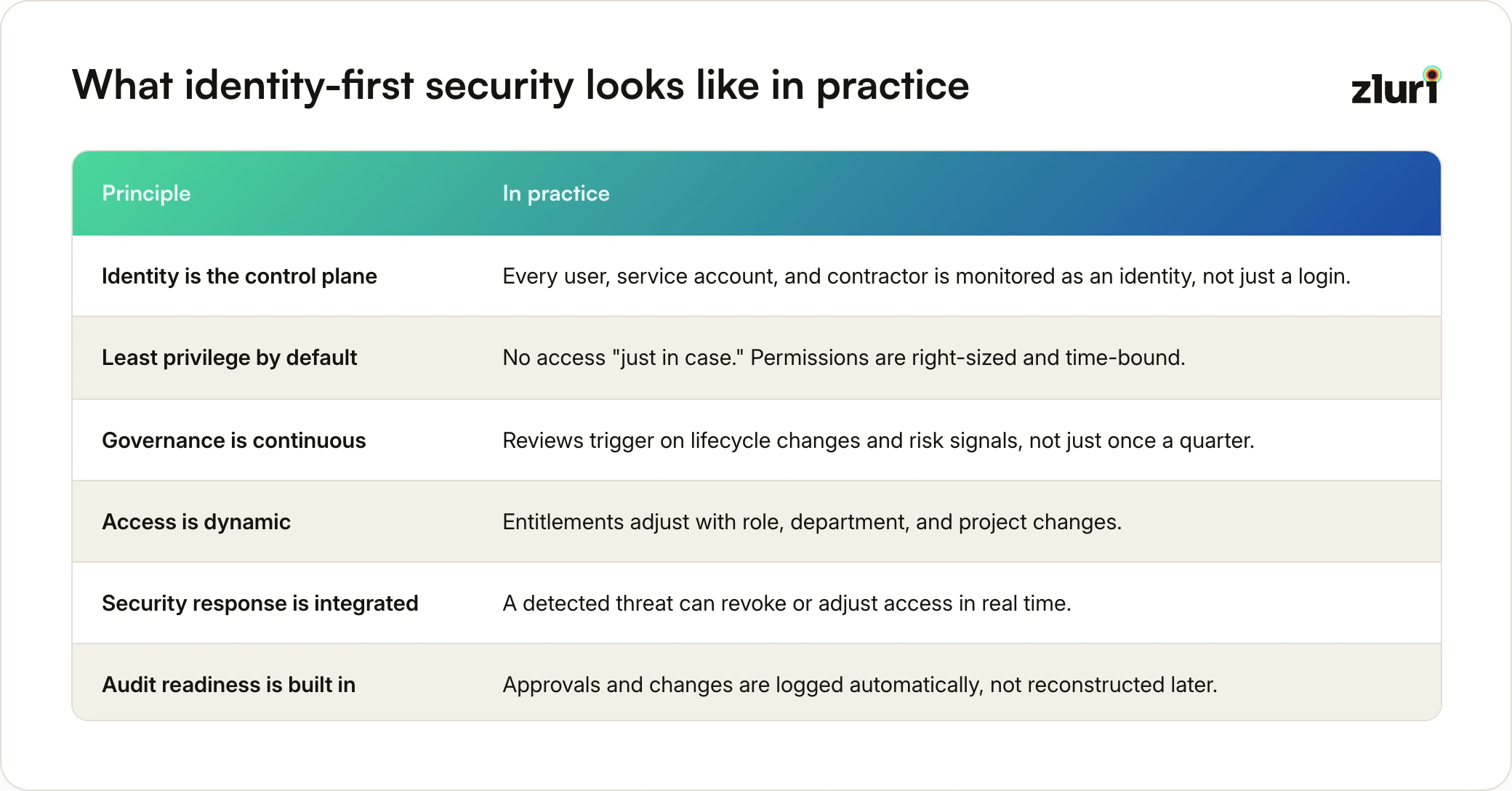
What Identity-First Security Looks Like in Practice
Identity-first security flips the old model. Instead of building protections around infrastructure, you build them around who's accessing it. Every user, service account, and integration becomes an identity, and every identity is a potential attack surface. Here's where it fits in a layered security approach alongside your other controls.
How IGA Became the Strategic Layer
IGA started as a compliance function: prove who has access, prove it gets revoked on exit. Siloed in IT or GRC, treated as a periodic checkbox.
As identity became the perimeter, that changed. IGA now does the work IAM was never designed for:
- Sees past authentication. Full visibility into who has access to what, across every SaaS app, service account, and non-human identity, catching access sprawl before it becomes risk.
- Governs continuously, not annually. Modern platforms automate access reviews and trigger remediation from risk signals instead of a once-a-year calendar reminder.
- Bridges IT and security. One set of governance policies both teams work from, instead of two teams reconciling separate spreadsheets.
- Shrinks the attack surface. Fewer standing entitlements means less for a compromised account or a careless insider to exploit.
- Builds the audit trail as it goes. Approvals and remediations are logged automatically, so compliance reporting isn't a fire drill.
That shift is also where identity governance starts producing measurable value that holds up in a budget conversation, not just a security one.
The Old Way vs. the IGA Way
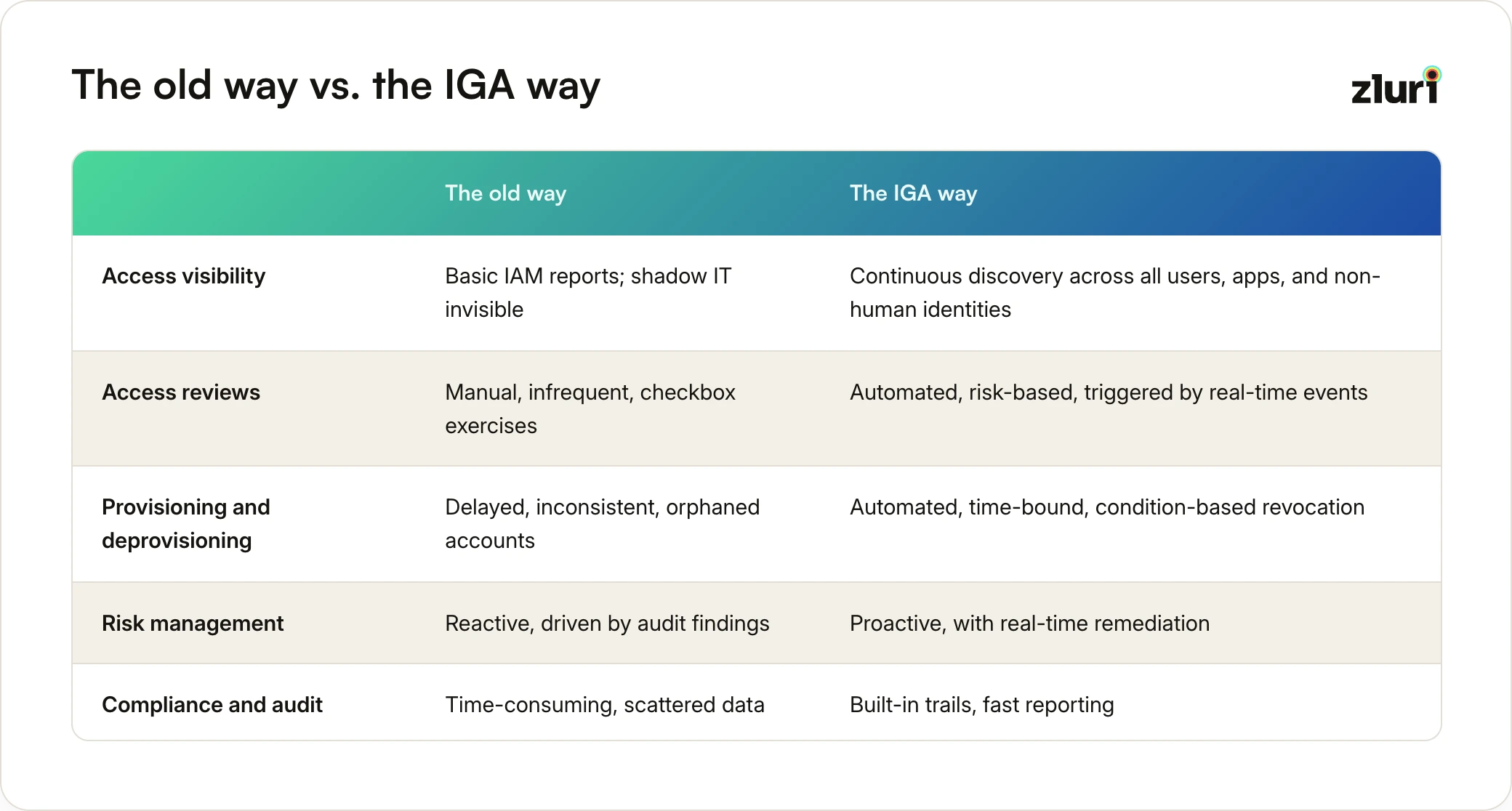
This is also the shift covered in legacy vs next-gen IGA: older platforms assumed IT controlled procurement and applications changed slowly. Neither assumption holds in a SaaS-first environment, and that mismatch is exactly why identity governance and administration itself is worth understanding from the ground up before evaluating any platform, our full guide covers what IGA involves end to end.
What This Looks Like Running
Identity-first IGA in practice comes down to four things working together, not four separate tools:
- Complete visibility first. You can't govern what you can't see, including shadow IT, AI tools, unfederated apps, and service accounts. Our position on where this is heading as AI multiplies access patterns is in the manifesto on AI-first identity governance.
- Policy-driven access control. Rules that route access by department, role, and context, not manual grants that outlive their reason for existing.
- Reviews that catch anomalies. Not a rubber stamp, an actual check for inactive users, former employees, and permissions nobody remembers granting.
- Automated remediation. When a review flags something, the fix should happen without a ticket, not wait for someone to get to it.
This is the model behind Zluri's IGA platform, and it's what enforces least privilege and the zero-trust principle without turning governance into a compliance chore.
The Real Value of Putting Identity First
Identity-first security isn't about blocking threats at the edge. It's about giving your team the clarity to move fast without putting the business at risk.
Every access decision, who gets in, for how long, and why, becomes intentional instead of accidental. Gaps get caught before they become incidents. And as your company adds more apps, more users, and more complexity, governance is what keeps that growth from outrunning your control.
That's the case for identity-first security. Not as a checkbox, but as the layer everything else in your security program now depends on.
Frequently Asked Questions
What's the difference between identity-first security and zero trust?
Zero trust is the principle: never trust, always verify. Identity-first security is how you operationalize it when identity, not network location, is the thing being verified. IGA is what makes continuous verification possible at scale, through reviews, policy enforcement, and automated remediation.
Do we need IGA if we already have strong IAM and MFA?
Yes. IAM and MFA answer "can this person log in." They don't answer "should this person still have this access," "who approved it," or "has it been reviewed since." That gap is exactly where lingering access and audit findings come from.
Is identity-first security only relevant for large enterprises?
No. Any organization running SaaS applications with remote or hybrid teams has already lost the network perimeter, regardless of size. The gap between what IAM sees and what actually needs governing shows up earlier than most companies expect.


.svg)