Plenty of organizations with flawless IAM still fail their access audits. IAM controls who gets in and what they can touch. It doesn't prove that access was right, reviewed, or should still exist.
Here's how the confusion usually surfaces. An organization rolls out Okta or Entra ID, connects a hundred apps to SSO, enforces MFA everywhere, and reasonably concludes its identity program is in good shape.
Then an auditor asks a different kind of question: can you prove that only the right people had access to your financial systems all year, that departed employees lost access everywhere on their last day, and that someone reviewed and certified all of it?
- SSO logs can't answer that.
- Authentication records show who logged in.
They say nothing about whether that person should still have had the access, who approved it, or whether anyone ever checked. That gap between "we control logins" and "we can prove access is right" is exactly the gap between IAM and IGA.
The two terms get used interchangeably. This article untangles both: what each one actually does, where they hand off to each other, and how to tell which gap your organization actually has.
What is IAM?
Identity and access management (IAM) is the set of policies and technologies that control whether someone can get into your systems. Its core jobs are authentication (verifying you are who you claim to be) and authorization (letting you into the things you're permitted to enter).
In practice, IAM is the layer you interact with every day: single sign-on, multi-factor authentication, password policies, session management, and the directory or identity provider (Okta, Microsoft Entra ID, Google Workspace) that sits behind them. When you badge into the building, IAM is the badge reader.
IAM answers the question: is this really you, and are you allowed in?
Identity management vs access management: the two halves inside IAM
IAM is itself a compound of two disciplines, and "identity management vs access management" is its own frequently searched confusion, so it's worth splitting cleanly.
Identity management is the identity half: creating, maintaining, and eventually deleting the digital identities themselves. When someone joins, an identity gets created with attributes (name, role, department, employment status). When they change roles, the attributes update. When they leave, the identity is deactivated. Identity management is also where authentication lives, since verifying "who is this" is a property of the identity.
Access management is the permissions half: deciding and enforcing what each authenticated identity is allowed to touch. Role-based access control, least-privilege policies, and authorization decisions at the point of entry all live here. Where identity management asks "who are you," access management asks "what are you allowed to do."
The clean way to hold the distinction: identity management manages the nouns (the identities and their attributes), access management manages the verbs (what those identities can do). Authentication belongs to the first, authorization to the second, and IAM is the umbrella over both.
One note on terminology that matters on this blog specifically: Zluri's IGA suite includes a module named Access Management. That module covers lifecycle provisioning and deprovisioning, a broader scope than the generic authorization sense of "access management" described above. Where we mean our module, we'll say so explicitly.
What is IGA?
Identity governance and administration (IGA) operates one level above all of this. It doesn't verify logins or evaluate a single authorization request; it governs whether the access behind those logins should exist at all, and produces the evidence to prove it.
IGA covers the full lifecycle of access: provisioning the right access when someone joins, adjusting it when they change roles, revoking all of it when they leave, letting employees request access through governed approval workflows, periodically reviewing and certifying who has access to what, and enforcing policies like segregation of duties so that no one accumulates a toxic combination of permissions.
If IAM is the badge reader, IGA is the system that decides who gets a badge, which doors each badge opens, reviews the badge list every quarter, and revokes badges the day people leave.
IGA answers the question: should this person have this access, who approved it, and can we prove it?
IAM vs IGA: the differences that matter
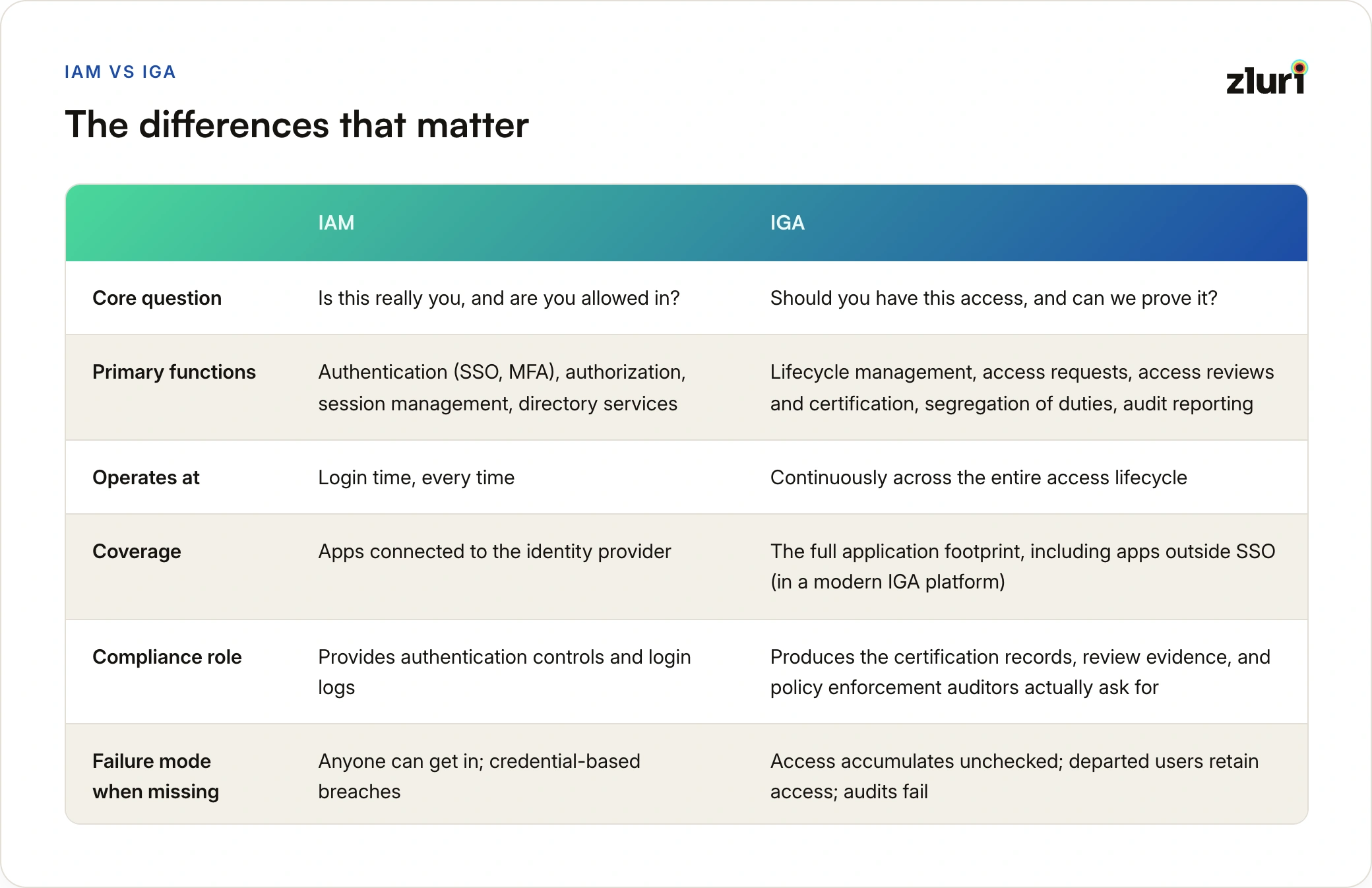
Scope: IAM governs the door, IGA governs the floor plan. IAM is concerned with the moment of entry into each connected system. IGA is concerned with the overall map of who holds what access across the organization, whether that access still matches their role, and whether the map itself complies with policy. An organization can have flawless authentication and a floor plan that's a compliance disaster: over-provisioned roles, orphaned accounts, contractors with standing admin rights nobody remembers granting.
Lifecycle: IAM sees events, IGA sees the arc. IAM processes each login as an event. IGA tracks the journey from the day someone joins to the day they leave, and this is where the most common real-world failures live. A marketer moves to sales and keeps both departments' access, because nothing in the authentication layer is responsible for noticing. An engineer leaves, their SSO account is disabled, and the six tools their team signed up for directly, outside SSO, never hear about it. Both failures happen in organizations with excellent IAM, because neither failure is an authentication problem.
Compliance: login logs are not governance evidence. Frameworks like SOC 2, SOX, ISO 27001, and HIPAA don't just ask whether you control logins. They ask for evidence that access was appropriate, reviewed, and certified: who has access to which systems, who approved it, when it was last reviewed, and what happened to access when people left. That evidence is generated by IGA processes, access reviews, certification campaigns, provisioning records, and no amount of authentication logging substitutes for it.
Coverage: IAM ends where federation ends. An identity provider governs the applications connected to it. In most organizations that's 30 to 40 percent of the actual application footprint. The rest, the team-purchasied tools, the AI apps nobody registered, the departmental subscriptions on a corporate card, are invisible to IAM entirely. Traditional IGA inherited this blind spot by building on top of the identity provider's app list. Modern IGA platforms treat discovering that unfederated majority as the starting point, which is the single biggest practical difference between the two generations of governance tools.
Do you need IAM or IGA? (Usually: both, but check which gap is yours)
The two aren't competitors, and buying one doesn't cover for the other. A practical way to locate your gap:
Your gap is IAM if: employees juggle separate passwords for every tool, there's no MFA on critical systems, or you have no central place where authentication happens. This is increasingly rare; most organizations past a few dozen people have an IdP.
Your gap is IGA if: you have an IdP humming along, but access reviews are a quarterly spreadsheet scramble, offboarding is a checklist someone follows from memory, nobody can say with confidence what a specific contractor can touch, or your last audit surfaced access that shouldn't have existed. This is by far the more common gap, precisely because IAM adoption came first and created the sense that identity was handled.
Organizations looking to close these governance gaps often adopt dedicated Identity Governance and Administration (IGA) solutions that automate user lifecycle management, access requests, certifications, and compliance reporting. For example, Hire2Retire helps enterprises streamline joiner, mover, and leaver processes while ensuring users receive the right access at the right time, reducing manual effort and strengthening security throughout the workforce lifecycle.
Your gap is both, at once, if: your organization grew fast, tooling sprawled, and identity was never anyone's explicit job. In that case the sequencing still matters: an IdP gives IGA a foundation to govern, but don't let the IdP rollout convince you the governance half happened too.
How we handle the IGA half at Zluri
Zluri is an identity security platform whose IGA suite (Access Management, Access Requests, Access Reviews, and Segregation of Duties) is built to sit on top of whatever IAM layer you already run, Okta, Entra ID, Google Workspace, and govern the access behind it.
The design decision most relevant to this article's distinction: our picture of your environment isn't bounded by your identity provider's app list. Zluri's discovery engine uses eight discovery methods, your SSO and IdP among them, alongside HR systems, finance and expense tools, browser and desktop agents, and direct API integrations, and cross-references them into one inventory. The IdP is a rich signal source, so we use it; it's just not the only lens, which means governance extends to the 60 to 70 percent of apps that federation alone never sees.
Lifecycle workflows then run against that complete picture: provisioning with granular in-app actions on day one, access adjustments on role changes, and offboarding that revokes everything a person actually touched, not just what was federated.
Access reviews can be scoped by application, access group, or individual user, and when a review flags access for removal, remediation fires automatically through the same workflows, so the governance layer and the administration layer are one connected loop rather than two tools passing spreadsheets.
Keep your IAM, it's doing its job. What we add is the half of the identity program that authentication was never designed to do.
Frequently Asked Questions
Is IGA a part of IAM?
Depends on whose diagram you're reading. Analysts often draw IGA as a segment within the broader IAM market, alongside access management and PAM. In practice, though, the products are distinct: your identity provider (the IAM product) handles authentication, and an IGA platform handles lifecycle governance, reviews, and compliance evidence. Owning one does not give you the other.
What's the difference between identity management and access management?
Identity management handles the identities themselves: creating user profiles with the right attributes, updating them through role changes, and deactivating them at departure, along with authenticating that a user is who they claim to be. Access management handles what those authenticated identities are permitted to do: authorization, role-based access control, and permission enforcement. Identity management manages who you are; access management manages what you can touch. Together they make up IAM.
Can Okta or Microsoft Entra ID do IGA?
Both have added governance modules (Okta Identity Governance, Microsoft Entra ID Governance) that layer reviews and lifecycle workflows onto their platforms. They work best for organizations whose app footprint lives almost entirely inside that vendor's ecosystem. Their structural limit is coverage: they govern what's connected to the identity provider, and most organizations run far more applications than are federated to their IdP.
What's the difference between IGA and identity management?
Identity management is the administrative plumbing: creating, maintaining, and removing user accounts and directory records. IGA includes that administration but adds the governance layer on top: policy enforcement, access certification, segregation of duties, and audit reporting. The "G" is the difference.
Do small companies need IGA?
Below a certain size, governance can genuinely be handled manually: a spreadsheet, a disciplined offboarding checklist, a founder who knows every tool in use. The transition point is usually the first compliance requirement (a SOC 2 audit, an enterprise customer's security questionnaire) or the point where app count and headcount make manual tracking unreliable, typically somewhere in the low hundreds of employees.
Does IGA replace my identity provider?
No. IGA platforms govern access; identity providers authenticate it. They're complementary layers, and an IGA platform typically integrates with your IdP as one of its data sources and enforcement points rather than replacing it.
.webp)


.svg)