
Rubber-stamping is not a reviewer discipline problem. It's the predictable output of a manual process that hands people too many decisions, too little context, and no safe way to act on what they find.
A rubber-stamped access review is worse than no review at all.
That sounds like an exaggeration until you think about what each one produces. An organization that skips reviews knows it has an unverified access landscape. An organization that rubber-stamps its reviews has the same unverified access landscape, plus a stack of signed attestations claiming everything was checked. The risk is identical. The false confidence is new. And when an auditor or an incident responder eventually pulls the thread, the signatures make it worse, because now the failure is documented as a functioning control.
Rubber-stamping is the most common way user access reviews fail, and it's overwhelmingly a manual-process disease. Understanding exactly why it happens is the difference between fixing it and just yelling at reviewers to "take it seriously," which has never worked anywhere.
What Rubber-Stamping Actually Looks Like
The symptoms are consistent across organizations, and most teams recognize at least three of these:
- Approval rates above 95 percent. Cycle after cycle, virtually every line item is approved. Statistically, in any organization with normal turnover and role changes, that number is impossible if reviews are genuine.
- Completion times that don't add up. A reviewer signs off on 400 line items in 25 minutes. That's under four seconds per access decision, which is the time it takes to click, not to think.
- Last-day completion spikes. Nothing happens for three weeks, then 80 percent of certifications land in the final 48 hours before the deadline, done in bulk-select batches.
- Zero findings from entire departments. Some managers have never once flagged an access item, across years of quarterly cycles.
- Findings that never become changes. The rare revocation that does get flagged sits in a ticket queue and quietly ages out, so even genuine scrutiny produces no correction.
If your approval rate is 98 percent and your reviewers average five seconds per decision, you don't have an access review process. You have an attestation-generation process.
Why Manual Reviews Rubber-Stamp: The Root Causes
None of these symptoms come from lazy reviewers. They come from the mechanics of running a review manually, and each mechanic pushes rational people toward the same behavior.
The volume math is impossible. Manual reviews mean spreadsheets: IT exports user-permission lists from dozens of apps, merges them, and mails department heads a tab with hundreds of rows. Survey data on review effort backs up how heavy this is: fully manual programs burn around 149 person-days per review cycle, nearly three times the effort of fully automated ones. A manager given 400 rows and a two-week window alongside a full-time job does the only thing the math allows: bulk approval.
Reviewers decide with zero context. A spreadsheet row says "jsmith@company, Salesforce, System Administrator." It doesn't say when Jane last logged in, what she actually does with admin rights, whether her role changed since last quarter, or what she was granted at hire versus what accumulated since. Asked to judge appropriateness with none of the information appropriateness depends on, reviewers substitute the one question they can answer: "Will removing this cause a problem for me?" The answer is always maybe, so the click is always approve.
Revoking is risky and approving is free. The incentive asymmetry does the rest. A wrong approval is invisible: nothing breaks, nobody complains, and if it ever surfaces it surfaces years later as someone else's incident. A wrong revocation is loud and immediate: broken workflows, an angry colleague, a re-provisioning ticket with the reviewer's name on it. Manual processes amplify this because the only actions on offer are usually keep or kill; we covered why that binary itself drives over-approval in our piece on right-sized review actions.
Deadlines collide with day jobs. Reviews are nobody's primary responsibility. In the manual segment specifically, 41 percent of organizations report missing review deadlines, and the standard response to a slipping deadline is not an extension request. It's faster clicking. Deadline pressure converts whatever genuine scrutiny existed at the start of the cycle into bulk approval by the end of it.
Nobody measures decision quality. Manual programs track one metric: completion. Did every reviewer sign off before the deadline? Yes? Control passed. No one tracks approval rates per reviewer, time per decision, or whether flagged items were ever remediated, so rubber-stamping is not just unpunished, it's indistinguishable from diligence in every report the program produces.
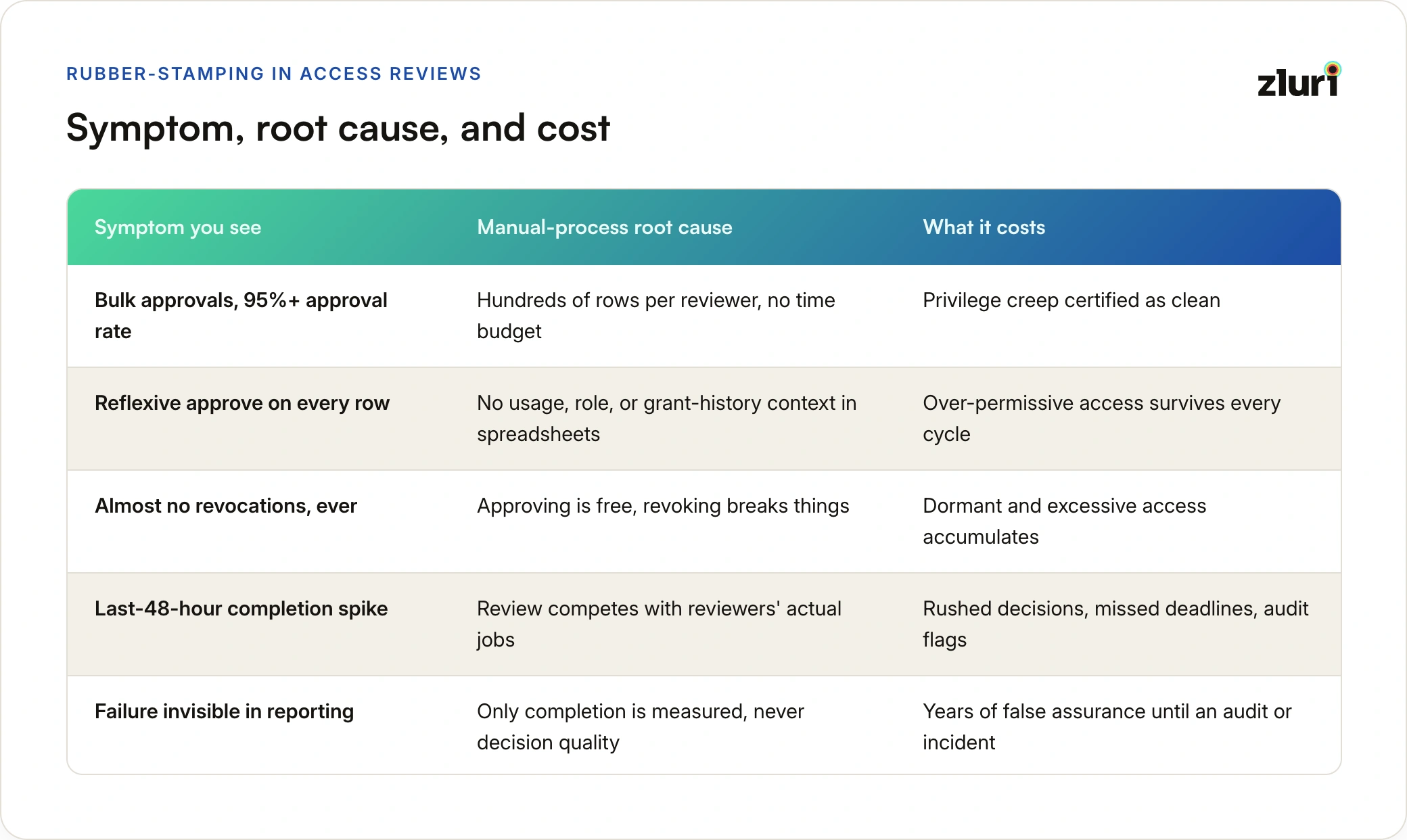
Each visible symptom traces back to a specific manual-process mechanic, and each carries its own cost: impossible volume produces bulk approvals and normalizes privilege creep, missing context produces reflexive approvals and lets over-permissioned access persist, incentive asymmetry produces near-zero revocation rates and leaves dormant and excessive access standing, deadline pressure produces last-minute completion spikes and audit findings on review quality, and the absence of quality metrics means the whole failure runs undetected for years.
Why This Is More Dangerous Than It Feels
Rubber-stamping doesn't feel like a crisis because every cycle "completes." The danger compounds quietly, in three directions at once.
The security exposure is exactly the kind that causes breaches. The access that rubber-stamping preserves (excessive permissions, unused accounts, access carried over from old roles) is not a theoretical risk category. Security leaders link breaches to over-permissive access at a rate of 92 percent, higher than any other access-related factor. A rubber-stamped review doesn't just fail to reduce this exposure. It re-certifies it, quarterly, with signatures.
The audit exposure is sharper than for missing reviews. Auditors have seen enough review programs to test for rubber-stamping specifically: they sample decision timestamps, compare approval rates against turnover data, and trace flagged items to remediation evidence. A program that completes on time but shows four-second decisions and zero findings doesn't pass as a weak control. It gets written up as a control that exists on paper and doesn't operate, which is a worse finding, because it implicates the attestations themselves.
The cultural damage is self-reinforcing. Once reviewers learn that the review is a formality, it stays a formality. Every cycle of consequence-free bulk approval teaches the organization that this control is fake, and that lesson leaks into how people treat the access request process, the offboarding checklist, and every other control adjacent to it.
Certified-but-wrong is the most expensive state an access landscape can be in: all the risk of unreviewed access, plus documented false assurance, plus an organization trained to treat the control as fake.
Breaking the Cycle
Because rubber-stamping is produced by process mechanics, exhortation doesn't fix it. Changing the mechanics does. Four changes matter most, roughly in order of impact.
Cut the volume with risk-based scoping. Reviewers rubber-stamp 400 rows; they'll genuinely review 40. Scope full-depth review to what deserves it (privileged roles, critical apps, recent role-changers, dormant accounts) and let low-risk, unchanged access flow through lighter-touch certification. The point of the review is judgment, and judgment is a budget you have to spend where it matters.
Put context on every line item. A reviewer who can see last-login date, usage frequency, role history, and how the access was granted can make a real decision in seconds. This is the single change that converts reflexive approval into actual judgment, and it's impossible in a spreadsheet, which is why context-rich reviews and automation arrive together in practice.
Give reviewers actions between keep and kill. When downgrading a role or a license is on the menu, acting on a finding no longer risks breaking someone's work, and the rational default shifts away from approve-everything.
Automate the pipeline and measure decision quality. Automating access reviews collapses the effort that makes bulk approval rational (the 149 person-days drops to roughly a third) and, just as importantly, makes quality measurable: approval rates per reviewer, time per decision, flagged-to-remediated conversion. Once those numbers are visible, rubber-stamping stops being invisible, and what gets measured gets fixed. The metrics themselves are worth designing deliberately; our guide to access review metrics covers the five that expose review quality rather than just completion.
Frequently Asked Questions
What is rubber-stamping in access reviews?
Rubber-stamping is when reviewers approve access line items without genuinely evaluating them, typically in bulk, producing near-100 percent approval rates and completed attestations that don't reflect any real scrutiny. The review completes on paper while the access landscape goes uncorrected.
How can you detect rubber-stamping in your review process?
Four signals are reliable: approval rates consistently above 95 percent, average decision times of a few seconds per line item, completion clustered in the final hours before deadlines, and reviewers or departments with zero findings across multiple cycles. Any one is suspicious; together they're conclusive.
Why is a rubber-stamped review worse than no review?
Both leave the same unverified access in place, but the rubber-stamped review adds signed attestations claiming the access was checked. That false assurance misleads leadership, weakens incident response assumptions, and turns an audit gap into an audit finding about a control that exists on paper but doesn't operate.
Do auditors actually catch rubber-stamping?
Increasingly, yes. Auditors sample decision timestamps, compare approval rates against known turnover and role-change data, and trace flagged items through to remediation evidence. A review program with implausibly fast decisions and no findings is tested as a design-only control, which is a more serious finding than a late review.
What's the fastest way to reduce rubber-stamping?
Cut reviewer volume through risk-based scoping and add context (usage, last login, role history) to every line item. Those two changes attack the core causes: impossible volume and information-free decisions. Automation then locks the fix in by making decision quality measurable cycle over cycle.