
Reviewer fatigue is the decline in decision quality that sets in when access reviews ask people for more judgment than the process gives them time, information, or incentive to apply.
Reviewer fatigue is what happens between row one and row four hundred of a user access review.
The first few decisions get real attention. Somewhere in the middle, attention becomes pattern-matching. By the end, it's clicking. The reviewer finishes, the certification completes, and the access landscape looks almost exactly like it did before the review started.
This isn't a character flaw in reviewers. It's a predictable response to how most reviews are designed, and understanding it properly is the first step toward the low-fatigue review design that actually fixes it. In this article, we cover a working definition of reviewer fatigue, how it develops across a review cycle, the warning signs, its four root causes, what it costs, and how it differs from the related problems it's often confused with.
A Working Definition
Reviewer fatigue is the progressive decline in the quality of access decisions as a reviewer works through a review, driven by the volume of decisions, the lack of context behind each one, and the absence of safe ways to act on what they find.
Three parts of that definition matter.
It's progressive. Fatigue isn't present or absent; it builds across a session and across a cycle. The same reviewer who scrutinizes the first twenty records bulk-approves the last two hundred.
It's about quality, not completion. A fatigued reviewer usually finishes. The problem is what the finished review contains: approvals that weren't judgments.
It's caused by the process, not the person. Volume, context, and incentives are design choices made by whoever set up the review. Reviewers respond to those choices in predictable ways.
Reviewer fatigue is not reviewers getting lazy. It's reviewers behaving rationally inside a process that makes careful review irrational.
How Fatigue Develops Across a Review Cycle
Fatigue follows a recognizable arc, both inside a single session and across the review window. The prose version, then the table: early in a cycle, reviewers apply real scrutiny and ask questions. As the volume registers, they shift to pattern-matching by name or department. As the deadline approaches, decisions become bulk actions, and the last stretch is clearing the queue so the reminders stop.
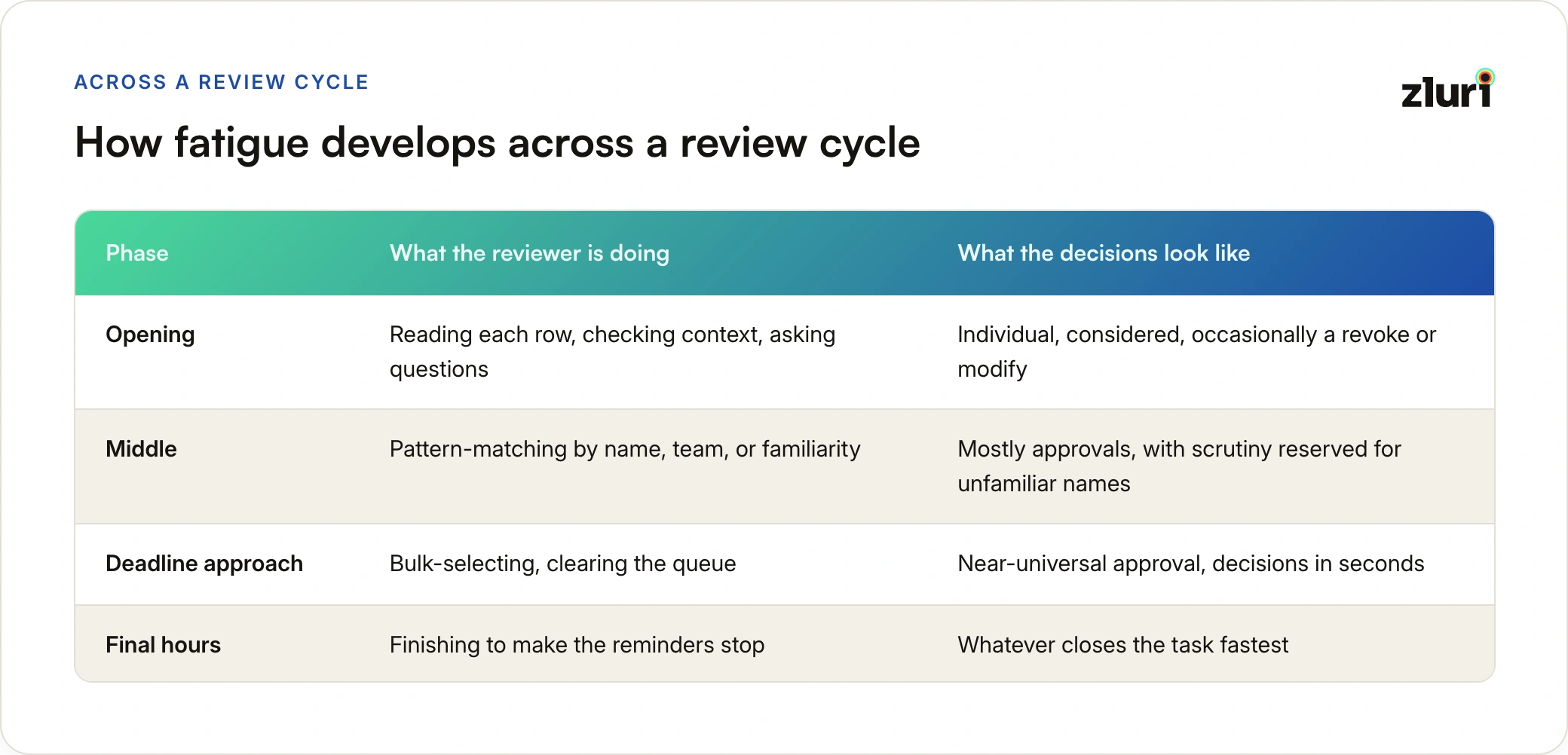
The arc is why the same review can look rigorous in a sample of early decisions and hollow in the aggregate. Anyone measuring quality has to look at the whole distribution, not the first page.
The Warning Signs
Fatigue leaves fingerprints in review data. Most programs recognize at least three of these:
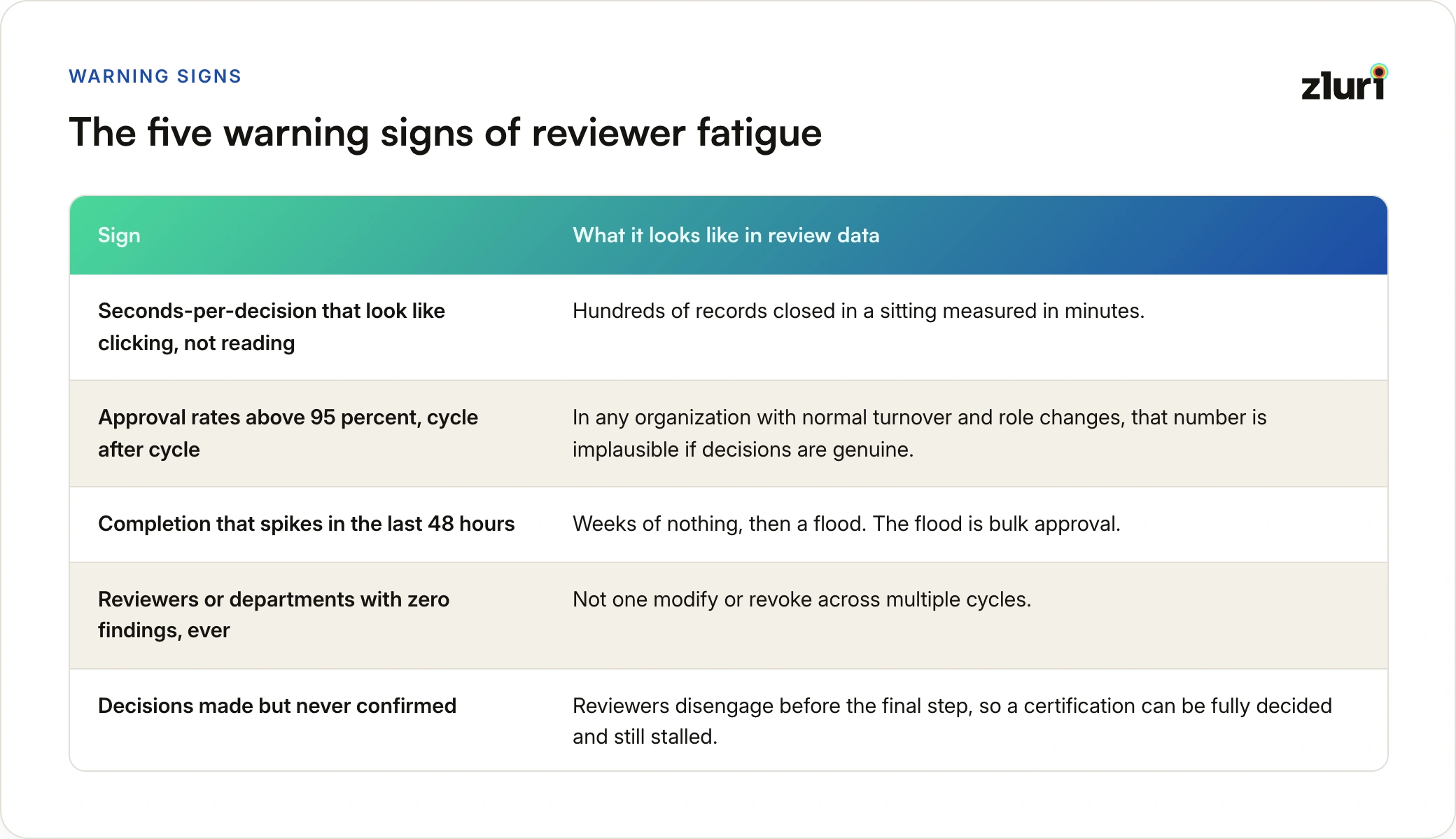
- Seconds-per-decision that look like clicking, not reading. Hundreds of records closed in a sitting measured in minutes.
- Approval rates above 95 percent, cycle after cycle. In any organization with normal turnover and role changes, that number is implausible if decisions are genuine.
- Completion that spikes in the last 48 hours. Weeks of nothing, then a flood. The flood is bulk approval.
- Reviewers or departments with zero findings, ever. Not one modify or revoke across multiple cycles.
- Decisions made but never confirmed. Reviewers disengage before the final step, so a certification can be fully decided and still stalled. We cover that specific gap in reviewed vs signed off.
Any one of these is suspicious. Together they describe a review where the people stopped deciding well before they stopped clicking, which is the pattern behind most rubber-stamping.
The Four Root Causes
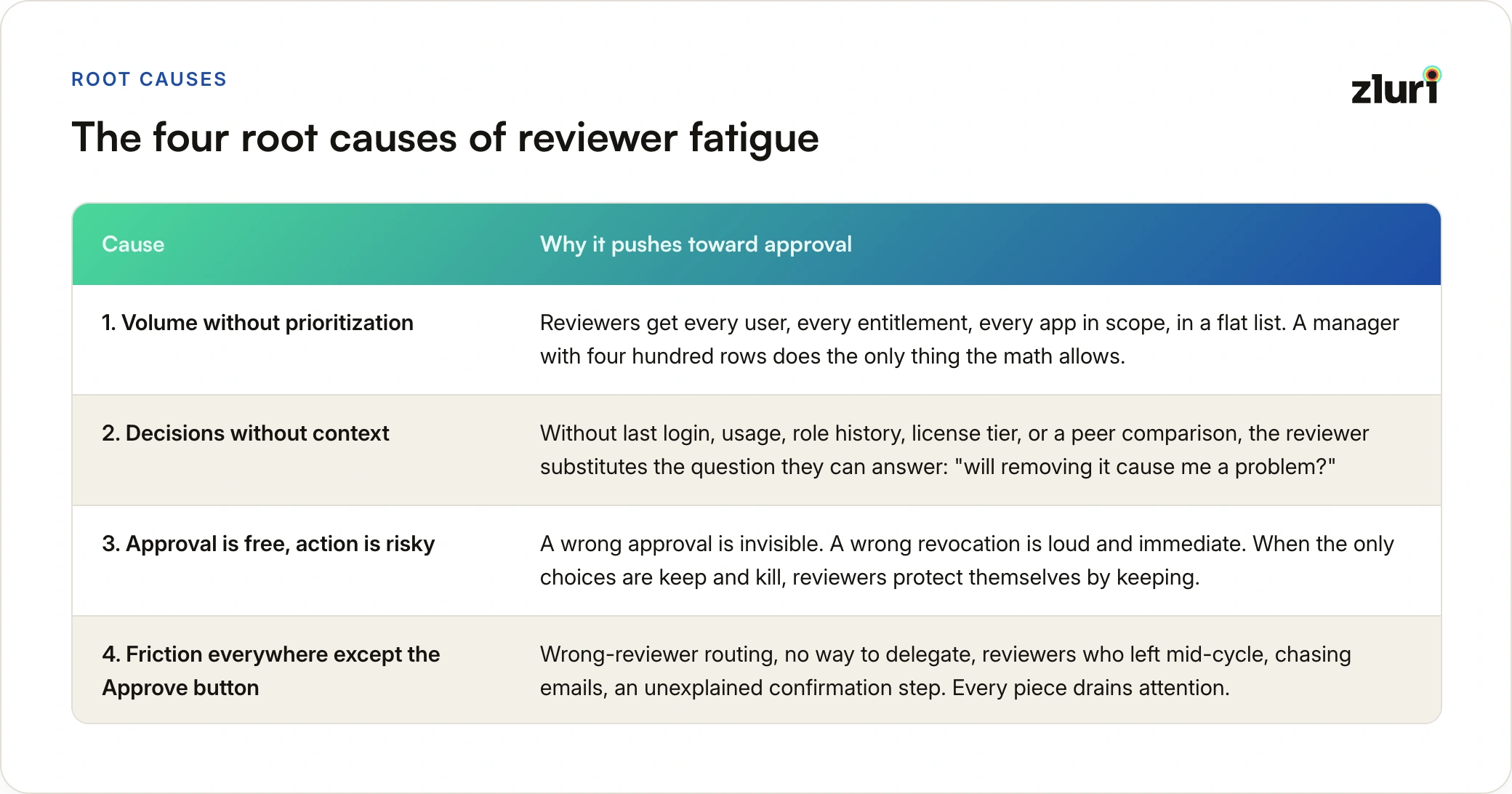
Each cause pushes toward the same behavior, and each needs a different fix.
1. Volume Without Prioritization
Most reviews hand reviewers everything: every user, every entitlement, every app in scope, in a flat list. A manager with a full-time job and four hundred rows does the only thing the math allows. The effort numbers bear this out: survey data on access review effort puts fully manual programs at roughly 149 person-days per cycle, and resources and time are the two most-cited challenges. Volume isn't a side issue. It's the main one.
2. Decisions Without Context
A row that reads "jsmith, Salesforce, System Administrator" is not a decision. It's a prompt for research the reviewer has no time to do. Without last login, usage, role history, license tier, or a comparison against peers, the reviewer can't answer "does this person still need this at this level?" So they substitute the question they can answer: "will removing it cause me a problem?" That question always resolves to approve.
3. Approval Is Free, Action Is Risky
The incentive asymmetry does most of the damage. A wrong approval is invisible: nothing breaks, no one complains, and if it ever surfaces, it's years later as someone else's incident. A wrong revocation is loud and immediate: a broken workflow, an angry colleague, a ticket with the reviewer's name on it. When the only choices are keep and kill, reviewers protect themselves by keeping. We covered why that binary is the wrong decision model in access reviews are not a binary.
4. Friction Everywhere Except the Approve Button
Routing to the wrong reviewer, no way to delegate, reviewers who left mid-cycle, chasing emails, a separate confirmation step no one explained. Every piece of friction drains attention that should have gone into decisions. Program owners feel this as a second kind of fatigue, and it's why owners under pressure quietly shrink scope and stretch cadence.
What Reviewer Fatigue Costs
Fatigue is easy to dismiss as a soft problem because every cycle still completes. The costs are concrete, and they land in three places.
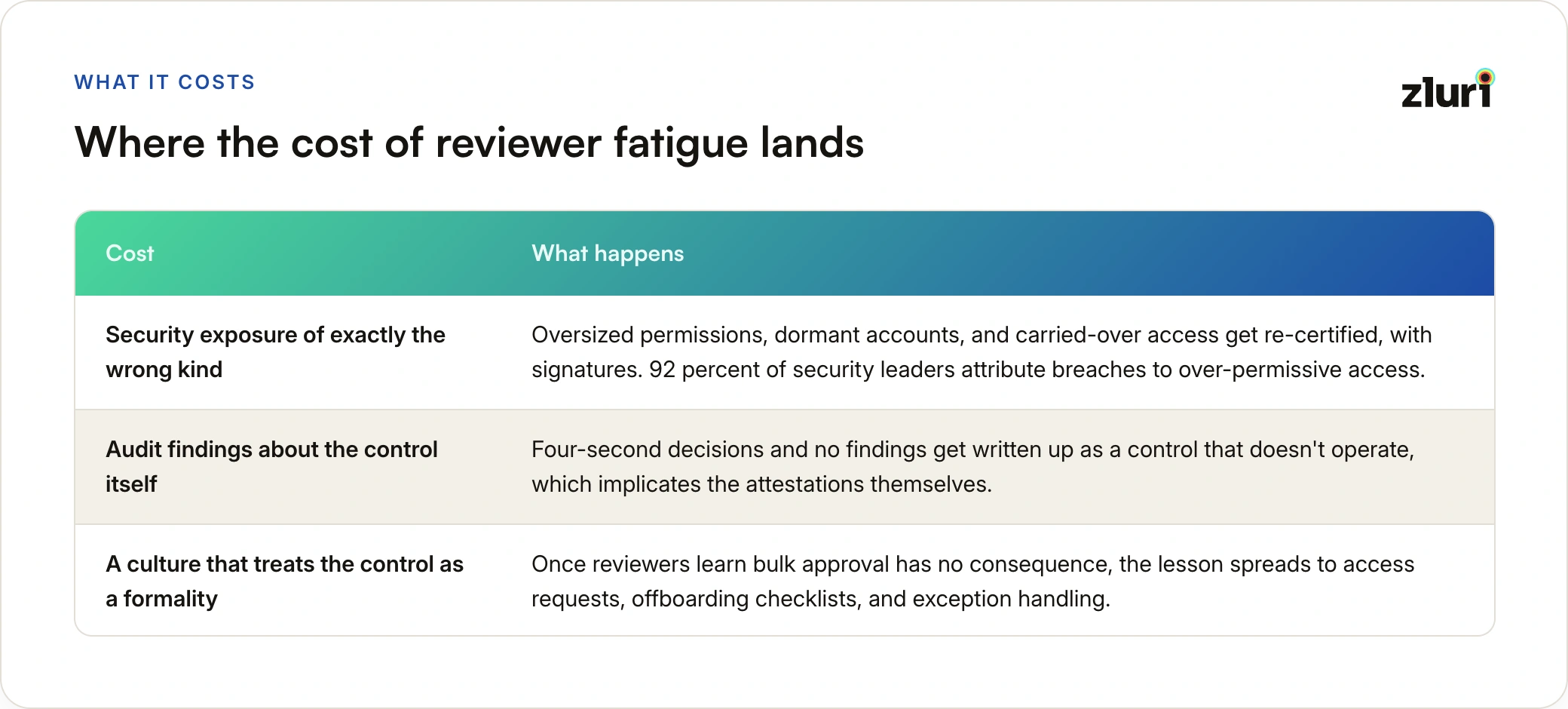
Security exposure of exactly the wrong kind. The access that fatigued reviews preserve (oversized permissions, dormant accounts, access carried over from previous roles) is the category security leaders link to breaches most often: 92 percent attribute breaches to over-permissive access. A fatigued review doesn't just fail to reduce that exposure. It re-certifies it, with signatures.
Audit findings about the control itself. Auditors test for fatigue even if they don't call it that. They sample decision timestamps, compare approval rates to turnover, and trace revoke decisions to remediation evidence. A review that completed on time but shows four-second decisions and no findings isn't written up as a weak control. It's written up as a control that doesn't operate, which implicates the attestations themselves. Our guide to what auditors test in access reviews walks through those tests.
A culture that treats the control as a formality. Once reviewers learn that bulk approval has no consequence, the lesson sticks, and it spreads to adjacent controls: access requests, offboarding checklists, exception handling. Rebuilding credibility is far harder than preventing the loss.
A fatigued review produces the same risk as no review, plus a signed record claiming the risk was checked.
Reviewer Fatigue vs the Problems It Gets Confused With
Three related terms get used interchangeably, and they're not the same thing. Fatigue is the cause: the decay in decision quality under volume, missing context, and bad incentives. Rubber-stamping is the visible symptom: approvals made without judgment. Alert fatigue is a cousin from security operations: desensitization to a stream of notifications, which matters for event-driven reviews but describes a different mechanism.
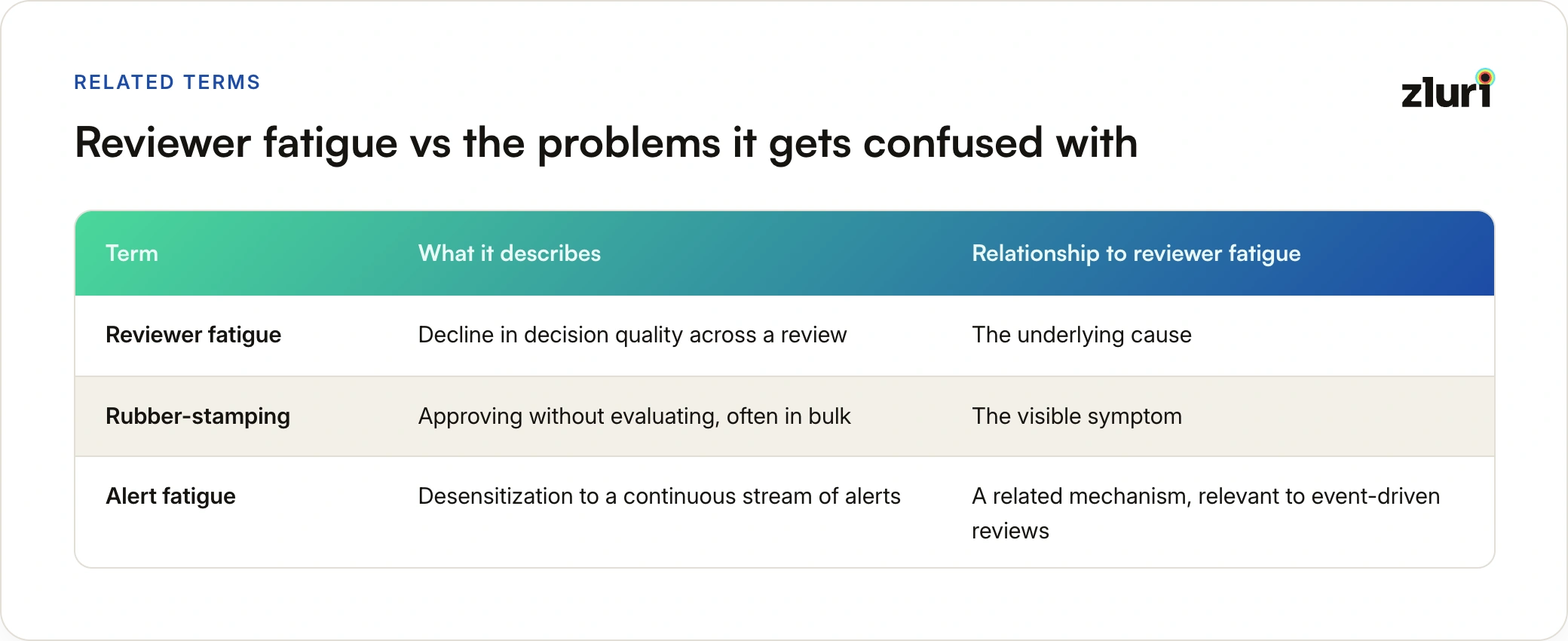
The distinction matters for the fix. Lecturing reviewers about rubber-stamping treats the symptom. Changing the volume, context, and incentives treats the cause.
Who Is Most Exposed
Fatigue hits hardest where the gap between review load and review context is widest:
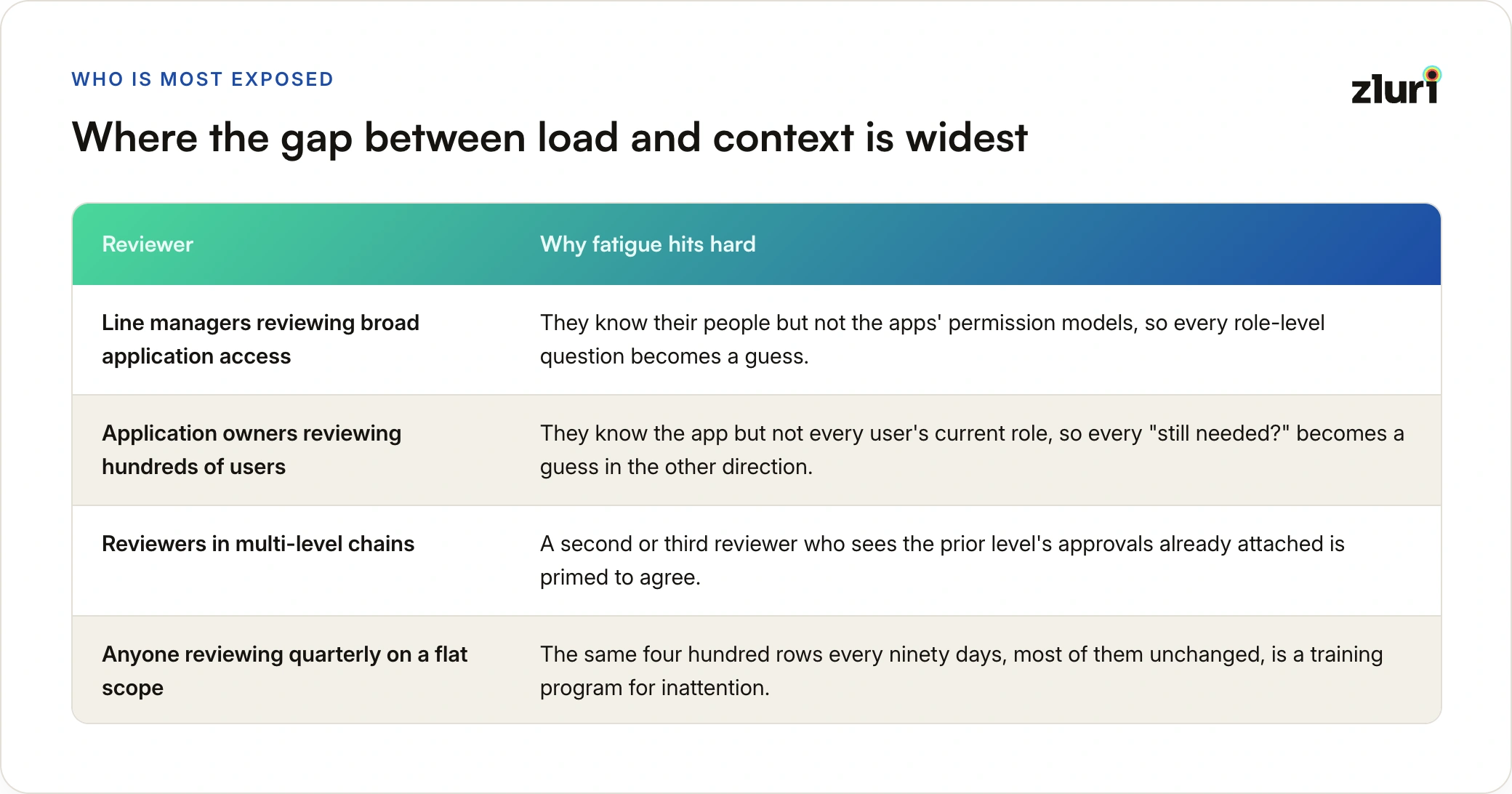
- Line managers reviewing broad application access. They know their people but not the apps' permission models, so every role-level question becomes a guess.
- Application owners reviewing hundreds of users. They know the app but not every user's current role, so every "still needed?" becomes a guess in the other direction.
- Reviewers in multi-level chains. A second or third reviewer who sees the same records with the prior level's approvals already attached is primed to agree. Multi-level review is the right control for high-risk access, and the wrong default for everything.
- Anyone reviewing quarterly on a flat scope. The same four hundred rows every ninety days, most of them unchanged, is a training program for inattention. How often to review, and at what depth, deserves its own decision; we cover it in how often access reviews should happen.
Where to Start Reducing It
Fatigue is a design output, so the fixes are design inputs. The full treatment is in our low-fatigue guide, but the first moves are consistent:
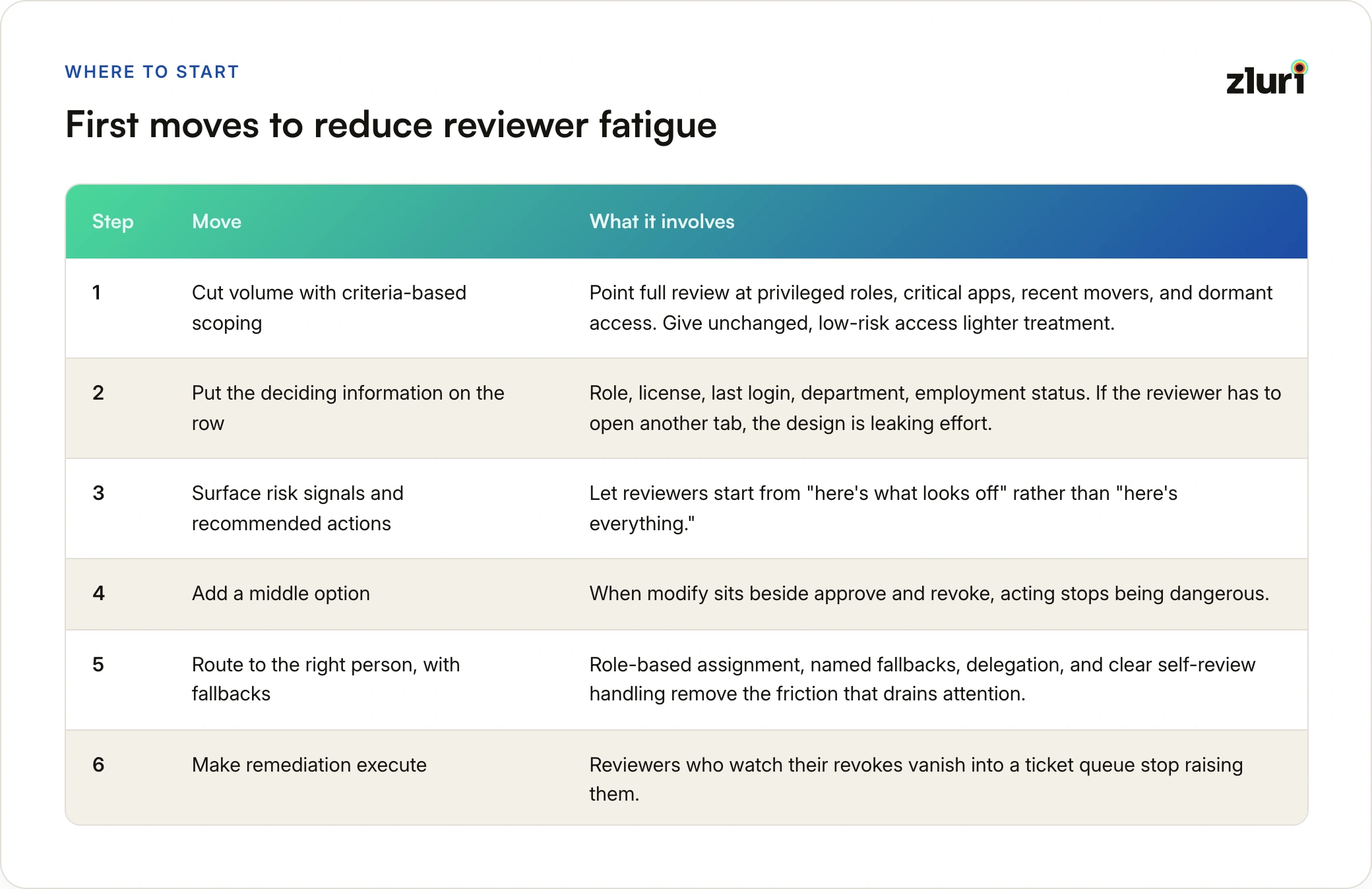
- Cut volume with criteria-based scoping. Point full review at privileged roles, critical apps, recent movers, and dormant access. Give unchanged, low-risk access lighter treatment.
- Put the deciding information on the row. Role, license, last login, department, employment status. If the reviewer has to open another tab, the design is leaking effort.
- Surface risk signals and recommended actions. Let reviewers start from "here's what looks off" rather than "here's everything."
- Add a middle option. When modify (downgrade a role or a license) sits beside approve and revoke, acting stops being dangerous.
- Route to the right person, with fallbacks. Role-based assignment, named fallbacks, delegation, and clear self-review handling remove the friction that drains attention.
- Make remediation execute. Reviewers who watch their revokes vanish into a ticket queue stop raising them. Closed-loop remediation keeps the feedback loop honest.
Each of these maps onto how a certification is configured in Zluri's Access Reviews module: criteria scoping with a preview, configurable data columns per review, built-in insights with recommended actions, approve-modify-revoke with mandatory comments and bulk edit, role-based and fallback reviewers with auto-reassignment, and playbook-driven remediation. For the setup walkthrough, see how access reviews work in Zluri.
Frequently Asked Questions
What is reviewer fatigue in access reviews?
Reviewer fatigue is the progressive decline in the quality of access decisions as a reviewer works through a review. It's driven by high decision volume, missing context on each record, and incentives that make approving safer than acting, and it typically shows up as bulk approvals late in the cycle.
What causes reviewer fatigue?
Four things: too many records per reviewer with no prioritization, records that lack the information needed to decide (usage, role, last login), an incentive structure where approving is free and revoking is risky, and process friction such as wrong-reviewer routing and unclear confirmation steps.
How do you detect reviewer fatigue?
Look for seconds-per-decision that indicate clicking rather than reading, approval rates consistently above 95 percent, completion spikes in the final 48 hours before the deadline, reviewers with zero findings across cycles, and records that are decided but never signed off.
Is reviewer fatigue the same as rubber-stamping?
No. Rubber-stamping is the visible symptom: approvals made without evaluation. Reviewer fatigue is the underlying cause: the decay in attention and judgment that leads to it. Fixing the symptom means lecturing reviewers; fixing the cause means changing the review's volume, context, and incentives.
Why is reviewer fatigue a security risk?
Because the access it preserves is the kind that causes breaches: oversized permissions, dormant accounts, and access carried over from old roles. A fatigued review doesn't just fail to correct that exposure; it certifies it, producing a signed record that the risk was checked when it wasn't.
Does automation eliminate reviewer fatigue?
Automation removes the mechanical causes: data gathering, routing, reminders, and remediation execution. It also makes fatigue measurable through time-per-decision and action-mix metrics. The judgment still belongs to a human, so scoping, context, and decision options matter as much as the automation around them.