
The right access review frequency is not one number. It's a tiered schedule where cadence follows risk, frameworks set the floor, and change events fill the gaps between cycles.
The short answer is quarterly for most access, more often for privileged access, and immediately when something changes.
The longer answer is that "how often" is the wrong first question. The frequency that works depends on what's being reviewed, which frameworks apply, how much the access changes between cycles, and how much review your reviewers can absorb before quality collapses. Get those four inputs right and the cadence follows. Pick a cadence first and you end up reviewing low-risk productivity tools at the same depth as production admin roles, which exhausts everyone and protects little.
This is a foundational decision in any user access review program. In this guide, we cover what the major frameworks actually require, the four inputs that should drive cadence, a risk-tiered frequency model, how event-driven triggers complement periodic cycles, and the signs that your current frequency is wrong in either direction.
What the Frameworks Actually Require
Most organizations inherit their review frequency from a compliance framework, and most inherit it imprecisely. Few frameworks name a number. Here's the prose summary, then the table: SOX doesn't specify a frequency but auditors have made quarterly the practical standard for in-scope financial systems. PCI DSS v4.0 is the one framework with an explicit interval, requiring reviews at least every six months. ISO 27001, SOC 2, and HIPAA all require periodic review without naming a cadence, leaving the organization to define and justify one.
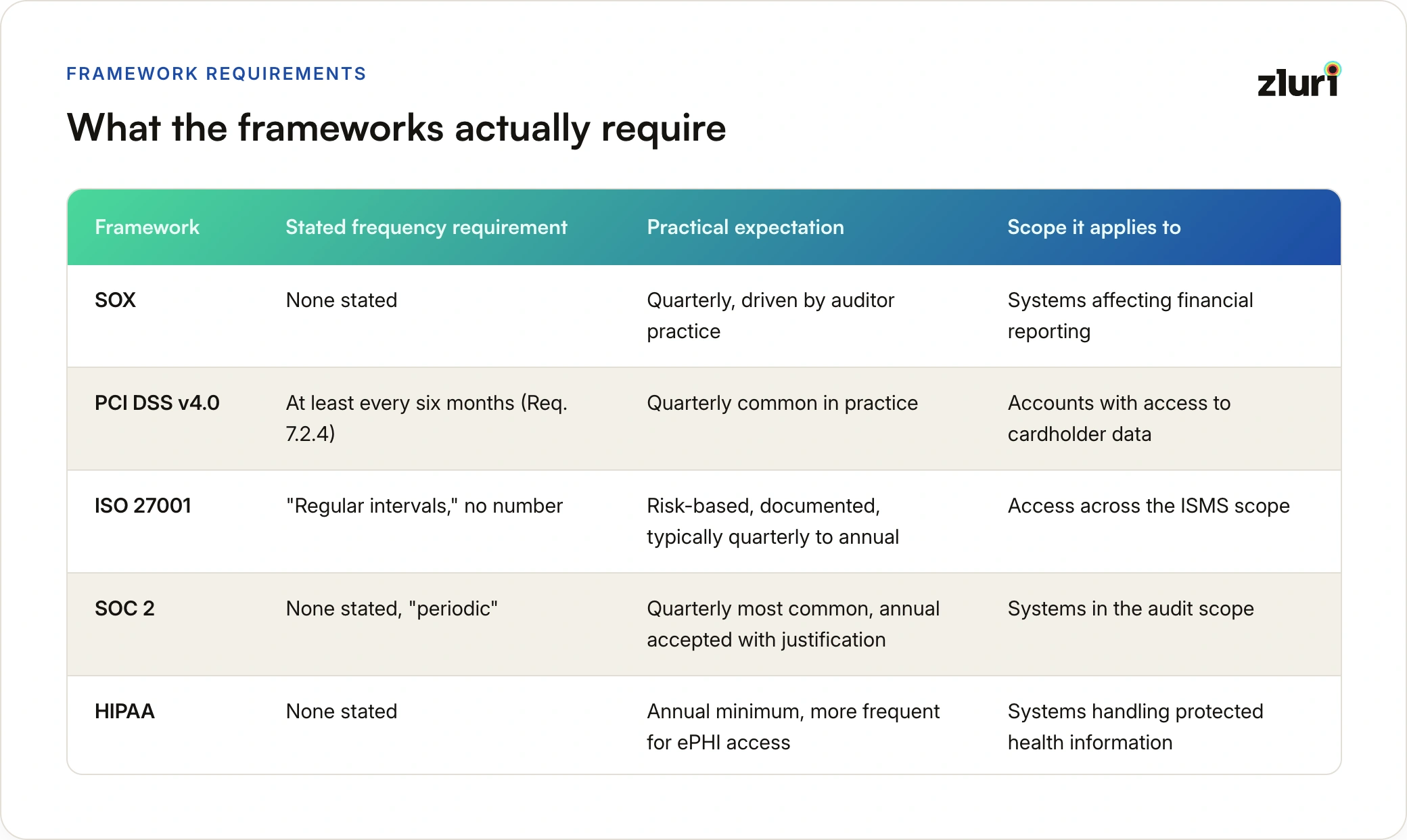
Three things follow from this. First, the frameworks set a floor, not a target. Meeting PCI's six-month interval doesn't make six months the right cadence for admin access to the cardholder environment. Second, every framework except PCI expects you to define and defend your own frequency, so "we review quarterly because the auditor said so" is a weaker position than "we review this tier quarterly and that tier monthly because here's the risk assessment." Third, the frameworks overlap heavily in scope, so a single tiered policy usually satisfies all of them at once.
For framework-specific detail: SOX reviews are effectively quarterly by auditor convention, PCI DSS sets a six-month minimum with quarterly as the de facto norm, ISO 27001 doesn't mandate a specific frequency, SOC 2 expects periodic review you can evidence, and HIPAA ties review to ePHI access without naming an interval.
Compliance frameworks tell you how often you must review at minimum. They don't tell you how often you should.
The Four Inputs That Should Drive Cadence
Once the floor is known, four factors decide where to set each tier.
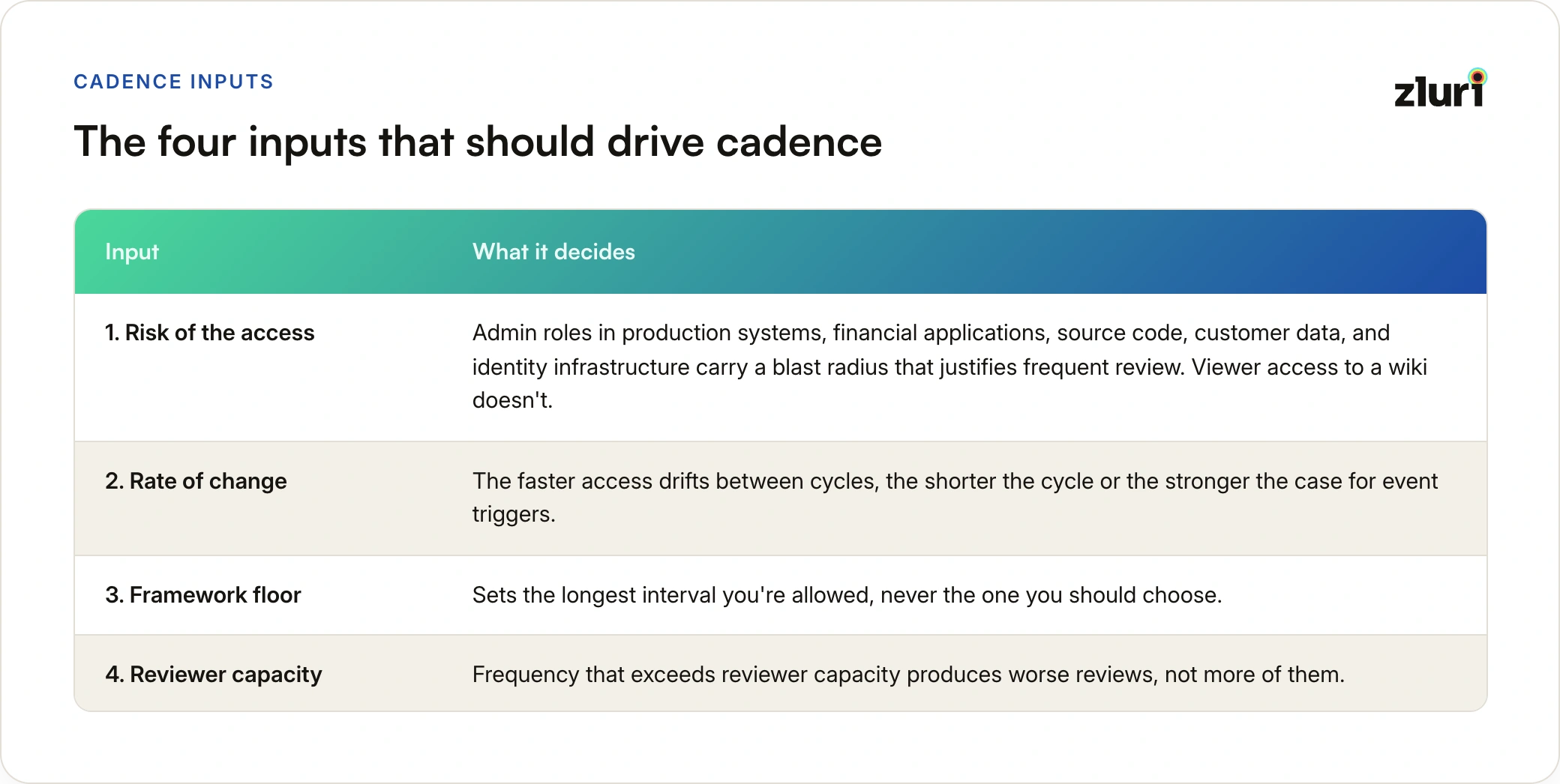
1. Risk of the access. Admin roles in production systems, financial applications, source code, customer data, and identity infrastructure carry a blast radius that justifies frequent review. Viewer access to a wiki doesn't. Privileged access is the clearest case: a small fraction of access that carries most of the risk, and the tier that should be reviewed most often.
2. Rate of change. Access that changes constantly (fast-growing teams, heavy contractor use, frequent reorgs) drifts further between cycles than access in stable functions. The faster the drift, the shorter the cycle or the stronger the case for event triggers.
3. Framework floor. Whatever the applicable frameworks require, as above. This sets the longest interval you're allowed, never the one you should choose.
4. Reviewer capacity. The constraint everyone ignores until it bites. Reviewing everything monthly sounds rigorous until the same managers get the same four hundred rows every thirty days and start bulk-approving in week one. Frequency that exceeds reviewer capacity produces worse reviews, not more of them. Survey data shows 47 percent of organizations review quarterly and 27 percent monthly, and the monthly group isn't uniformly more effective; what predicts effectiveness is automation level, not cadence alone.
The interaction between inputs one and four is the whole game. You can afford frequent review of high-risk access precisely because it's a small population. You can't afford frequent review of everything, and trying produces the fatigue that makes every review worse.
A Risk-Tiered Frequency Model
Here's a model that holds up across most mid-size and enterprise environments. It's a starting point to adjust, not a prescription. The prose first: the highest tier (privileged and critical access) runs monthly or continuously, supplemented by immediate triggers on any change. The standard tier (business-critical apps and regulated data) runs quarterly, which satisfies every framework floor. The low-risk tier (productivity tools and viewer-level access) runs semi-annually or annually, with event triggers catching the changes between cycles. Non-human identities get their own tier because they're invisible to user-based reviews.
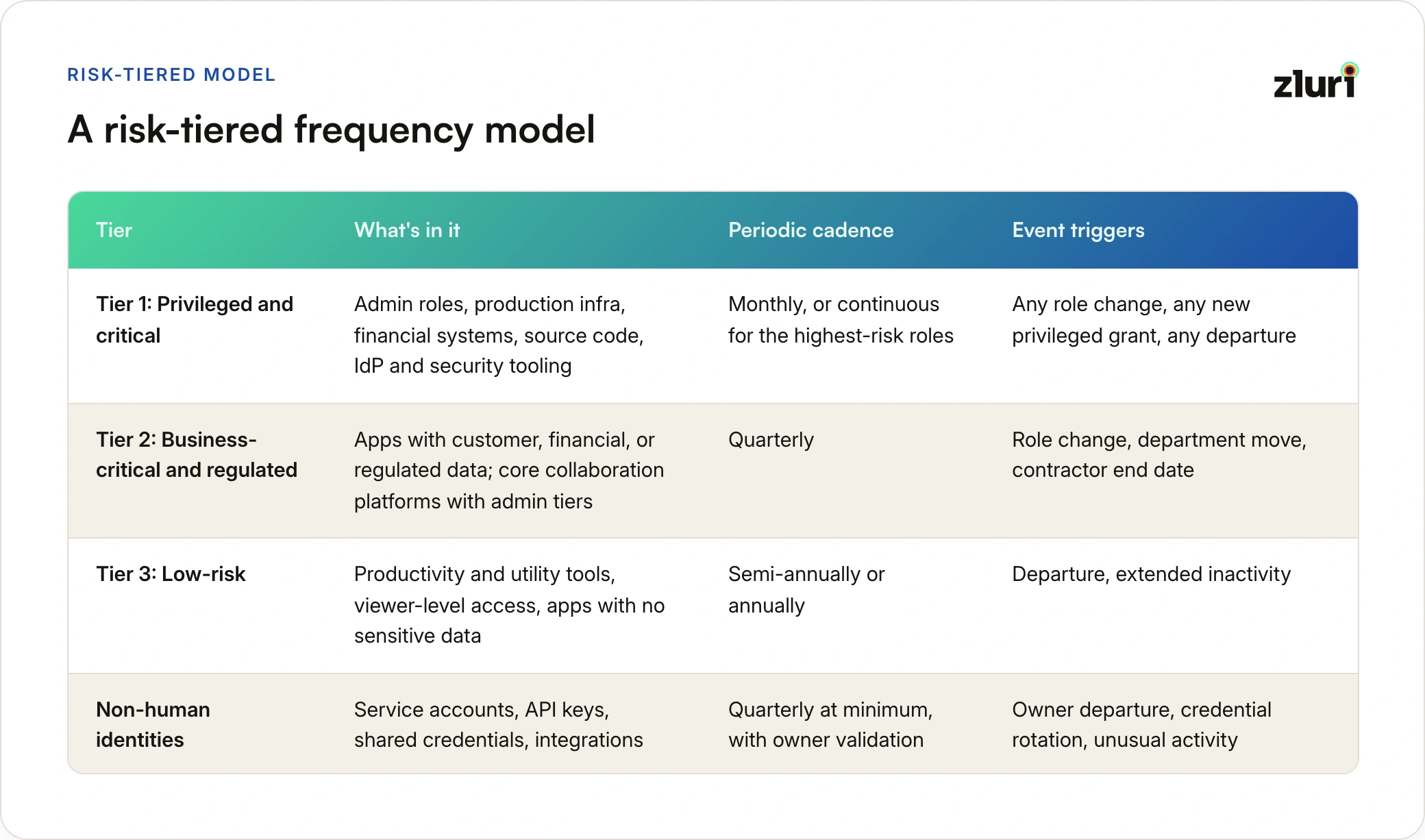
A few notes on applying it:
- Tier membership is a decision, not a default. The exercise of placing each app and role into a tier is itself valuable; it forces the scoping conversation most programs skip.
- Review depth should track tier too. Tier 1 justifies multi-level sign-off and full context on every row. Tier 3 can run as a lighter certification focused on departures and dormancy.
- Tier 2 is where most of the volume sits, so it's where review design matters most for fatigue. A quarterly Tier 2 review scoped by criteria (admins, premium licenses, no login in 90 days, recent movers) is sustainable. The same review scoped as "every user of every app" isn't.
- Non-human identities need a named owner before they can be reviewed at all. The first cycle for this tier is often an ownership assignment exercise more than an access decision.
For a deeper look at why one-size-fits-all cadence fails, and how to think about periodic reviews by population, our periodic review guide goes further. And if quarterly is your Tier 2 baseline, our guide to quarterly access reviews covers how to run them without burning out the team.
Periodic Plus Event-Driven: Why You Need Both
A calendar-based review has a built-in blind spot: everything that happens between cycles. A user promoted in week two of a quarter holds two roles' worth of access for eleven weeks before anyone looks. A contractor whose end date passed in month one keeps access until the next scheduled review.
Event-driven triggers close that gap. The highest-value triggers are the lifecycle events that reliably change what access should exist:
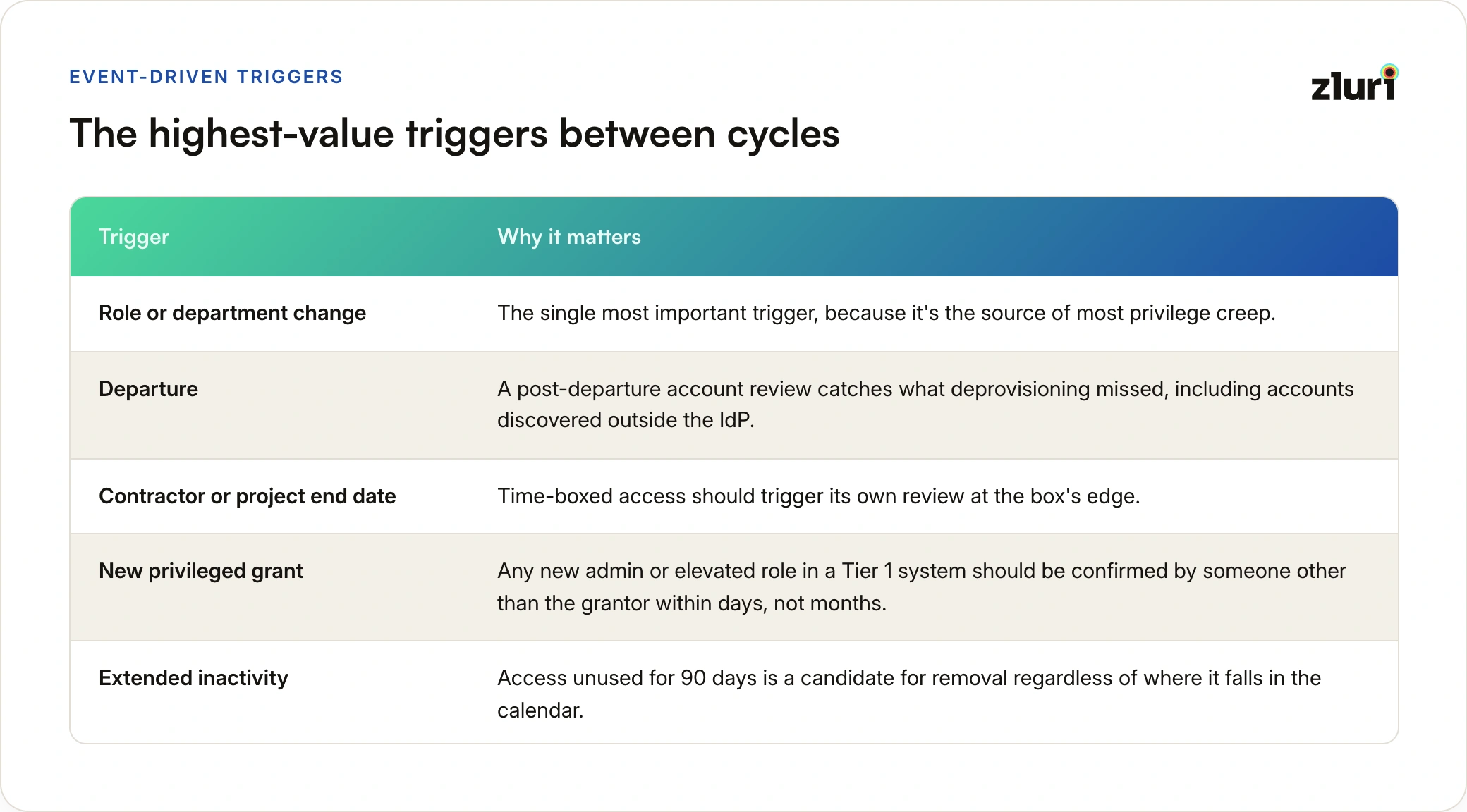
- Role or department change. The single most important trigger, because it's the source of most privilege creep. A focused user-based review of the mover's access, launched on the HR event, catches the old-role access before it fossilizes.
- Departure. Deprovisioning should handle the bulk, but a post-departure account review catches what deprovisioning missed, including accounts discovered outside the IdP.
- Contractor or project end date. Time-boxed access should trigger its own review at the box's edge.
- New privileged grant. Any new admin or elevated role in a Tier 1 system should be confirmed by someone other than the grantor within days, not months.
- Extended inactivity. Access unused for 90 days is a candidate for removal regardless of where it falls in the calendar.
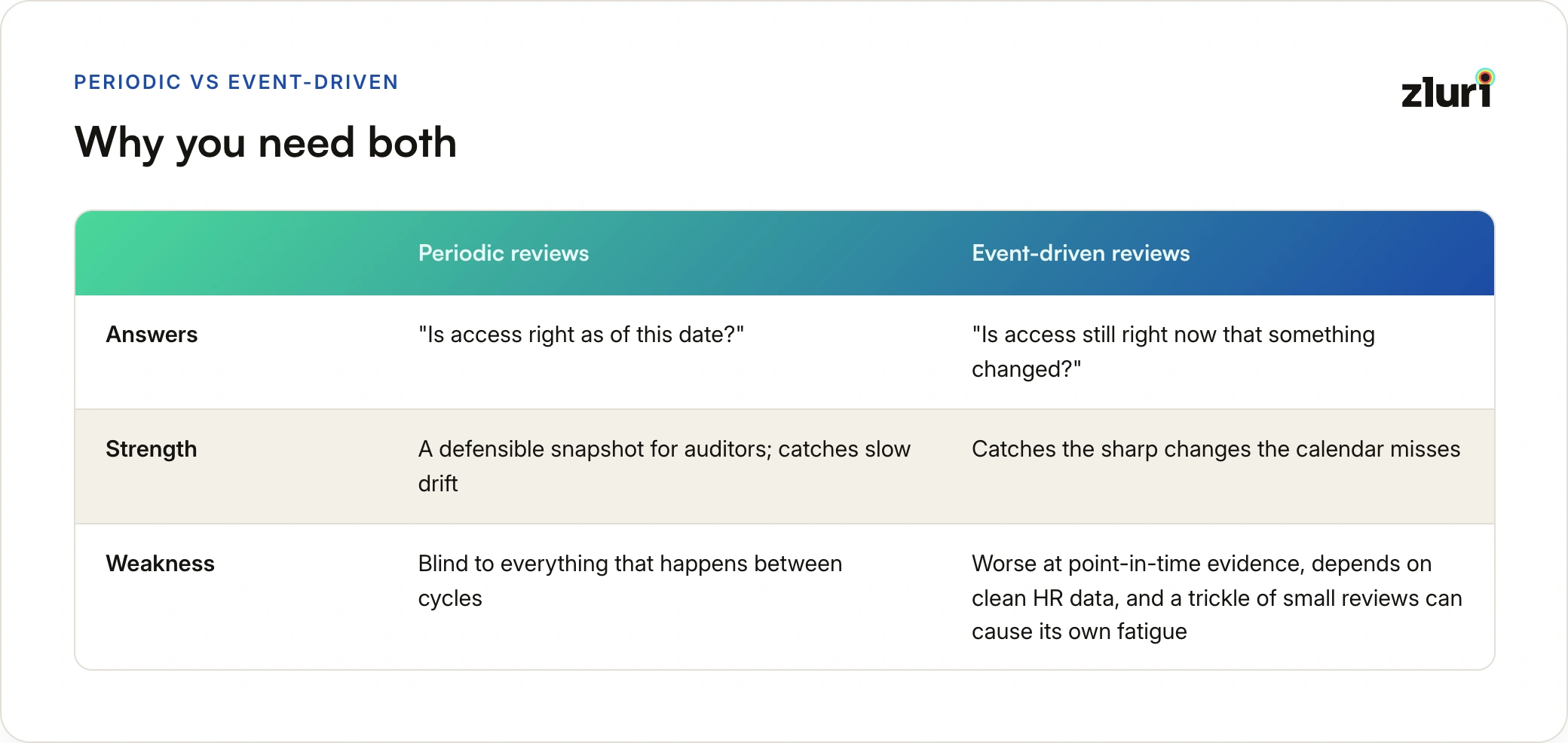
Event-driven review isn't a replacement for the periodic cycle. It's worse at point-in-time audit evidence, it depends on clean HR data to fire correctly, and a trickle of small reviews can generate its own kind of fatigue. The two models cover each other's gaps: periodic reviews give auditors a defensible snapshot and catch slow drift; event triggers catch the sharp changes the calendar misses. We compare the two in depth in our guide to event-driven access reviews.
Periodic reviews answer "is access right as of this date?" Event-driven reviews answer "is access still right now that something changed?" A program needs both answers.
Signs Your Frequency Is Wrong
Frequency can be wrong in either direction, and the symptoms differ.
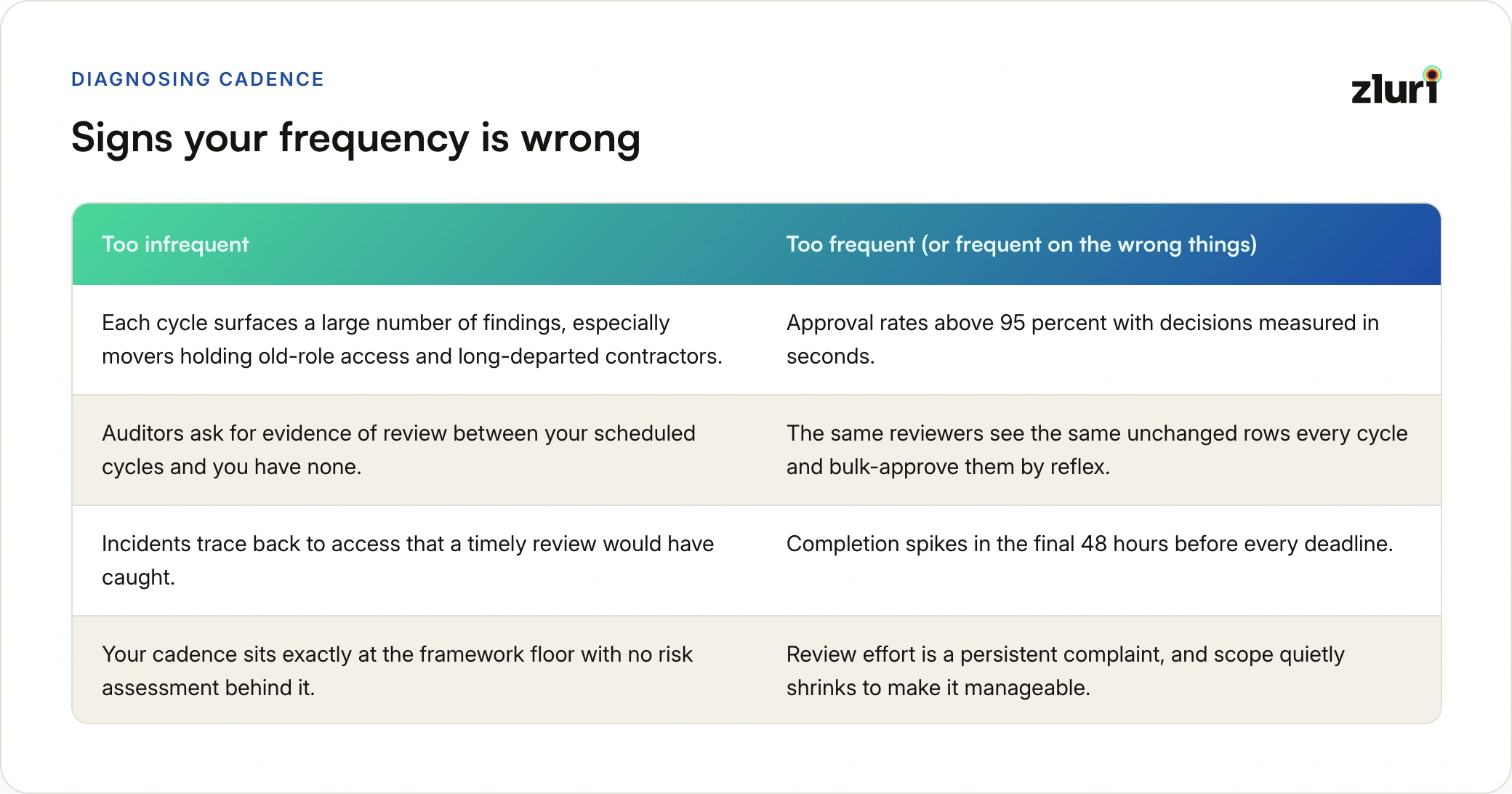
Too infrequent:
- Each cycle surfaces a large number of findings, especially movers holding old-role access and long-departed contractors.
- Auditors ask for evidence of review between your scheduled cycles and you have none.
- Incidents trace back to access that a timely review would have caught.
- Your cadence sits exactly at the framework floor with no risk assessment behind it.
Too frequent (or frequent on the wrong things):
- Approval rates above 95 percent with decisions measured in seconds, which signals reviewers have stopped engaging.
- The same reviewers see the same unchanged rows every cycle and bulk-approve them by reflex.
- Completion spikes in the final 48 hours before every deadline.
- Review effort is a persistent complaint, and scope quietly shrinks to make it manageable.
The second list is reviewer fatigue, and the fix is rarely "review less often." It's "review less, more often, where it matters." Shrinking Tier 2 scope to the criteria that carry risk and moving Tier 3 to annual usually frees enough capacity to review Tier 1 monthly. Our guide to low-fatigue access reviews covers how to make the frequent reviews sustainable.
Recertification: Why One Review Is Never Enough
Whatever cadence you choose, the principle underneath it is that access certification expires. A review proves access was appropriate on a date; it says nothing about the following quarter. That's why the discipline is called access recertification: the same access is re-examined on a schedule because the conditions that justified it change.
Practically, this means recurrence should be automatic. A review program that depends on someone remembering to launch next quarter's certification will, eventually, skip one. The schedule should regenerate itself with the same scope and timelines, anchored to the first cycle so the review-to-remediation interval stays consistent, and the only manual decision should be whether to change the scope.
How This Works in Zluri
In Zluri's Access Reviews module, tiered frequency is a scoping and scheduling exercise rather than a separate process per tier.
Scope each tier as its own certification. A Tier 1 certification scoped to users holding admin or privileged roles in critical apps; a Tier 2 certification scoped by criteria across business-critical apps; a Tier 3 certification focused on departures and inactivity; and account-level certifications for service accounts and API keys scoped by account type and ownership. Each gets its own reviewers, data columns, and remediation playbooks.
Set recurrence per certification. Monthly, quarterly, or a custom interval up to twelve months, configured in the certification itself. Future instances inherit the same scope and reviewer configuration, anchored to the first instance's start date so the review-to-remediation gap stays fixed. The upcoming schedule is visible before launch, and archiving a recurring certification stops future instances without touching historical records.
Launch event-driven reviews as targeted user-based certifications. A mover, a flagged user, or a contractor cohort can be scoped as a user-based review across the relevant apps and groups, launched immediately, and routed to the right reviewer, which covers the gaps between periodic cycles without waiting for the next one.
Keep the evidence consistent across tiers. Every certification, whatever its cadence, produces the same timestamped record of decisions, justifications, and remediation, so the audit story is one story regardless of how many schedules sit behind it.
For the configuration walkthrough, including recurrence setup and schedule preview, see our guide to setting up certifications in Zluri.
Frequently Asked Questions
How often should user access reviews be conducted?
Quarterly is the most common cadence and satisfies every major framework's floor. The better answer is tiered: monthly or continuous for privileged and critical access, quarterly for business-critical and regulated systems, semi-annual or annual for low-risk access, with event-driven reviews triggered by role changes, departures, and new privileged grants in between.
Which compliance frameworks specify an access review frequency?
PCI DSS v4.0 is the only major framework with an explicit interval: at least every six months under requirement 7.2.4. SOX, ISO 27001, SOC 2, and HIPAA all require periodic review without naming a frequency, leaving the organization to define and justify its own cadence.
Is quarterly access review enough?
For most business-critical access, yes, provided it's supplemented by event-driven reviews when roles change or people leave. For privileged access in production, financial, or identity systems, quarterly leaves too long a window; monthly or continuous review is the safer standard.
Can reviewing too often be a problem?
Yes. Frequency that exceeds reviewer capacity produces rubber-stamping: near-universal approvals made in seconds. The fix is usually to narrow scope rather than lengthen the cycle, so that frequent reviews cover only the access that carries risk.
What's the difference between periodic and event-driven access reviews?
Periodic reviews run on a calendar and give a defensible point-in-time snapshot for audits. Event-driven reviews launch when something changes, such as a role change or departure, and catch access drift the calendar would miss. Mature programs run both.
How often should service accounts and API keys be reviewed?
At least quarterly, with ownership validation as part of every cycle, since non-human identities are invisible to user-based reviews and frequently have no accountable owner. Credential rotation, owner departure, or unusual activity should trigger an out-of-cycle review.