.png)



HR wants a single flow that handles onboarding and offboarding for employees in Mexico, Canada, and the Philippines without IT running manual scripts every time someone joins or leaves. That's a reasonable ask. The harder question is whether consolidating everything into one HR platform — replacing Jamf, Okta, and your Google Workspace automation — is actually the right architectural move, or whether an orchestration layer that connects your existing tools is a better fit. When an employee quits in another country, the last thing you want is to find out the answer to that question on a Friday afternoon.
What Rippling Actually Does (And Where Its Limits Show Up)
Rippling comes up in every conversation about consolidated HR and IT provisioning, and the honest picture from people who use it is more nuanced than the sales pitch suggests.
The positive reviews in the thread are real: one commenter described it working across three countries, killing Google Workspace, Slack, and Notion access at termination once everything is mapped. Another noted it's been stable for a year with no issues. The Rippling admin who commented put it clearly: offboarding and onboarding are genuinely good once configured, and the device return logistics (sending a box to collect hardware, warehousing or returning it) are a specific operational advantage for distributed teams.
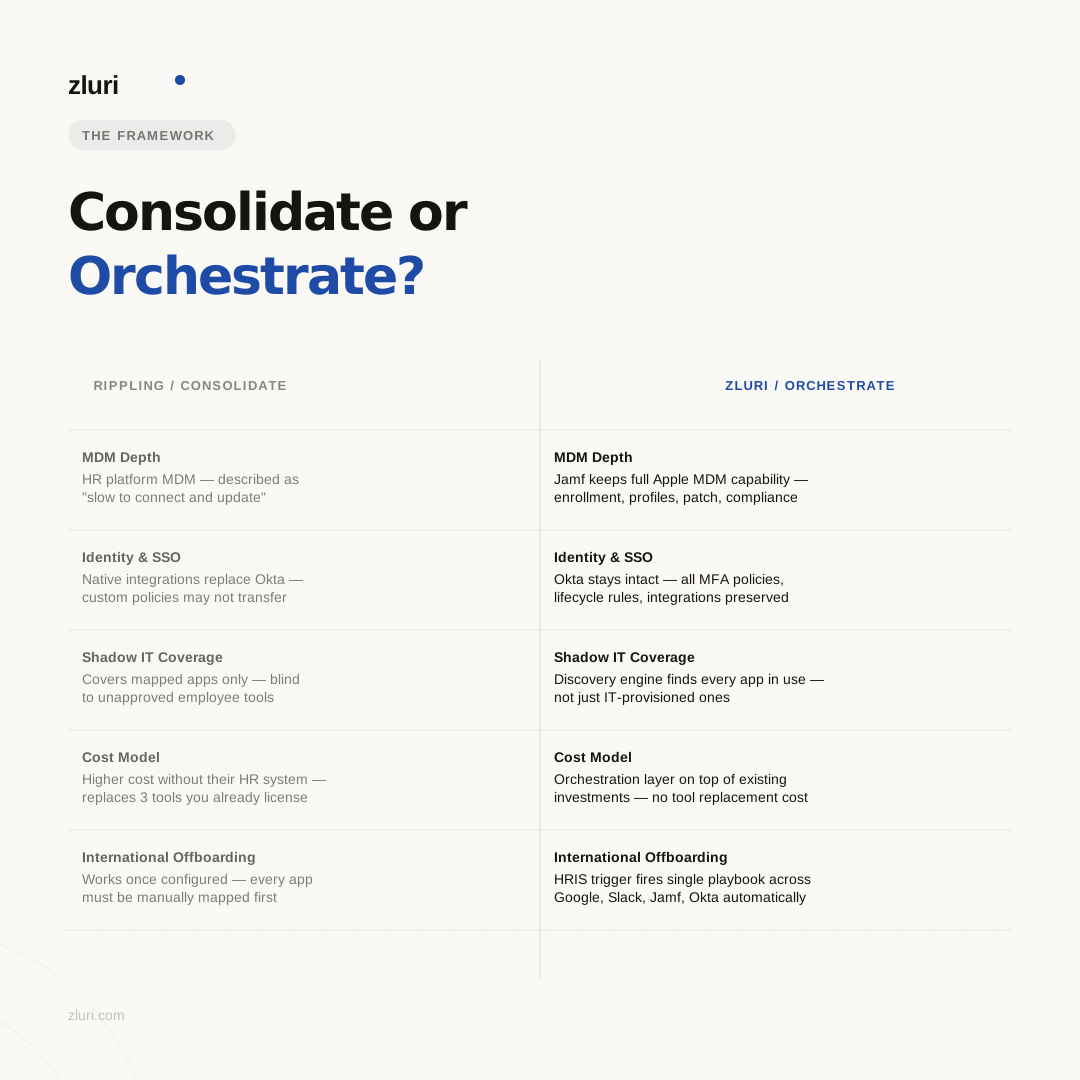
The limitations are also consistently reported. MDM is described as slow to connect and update. One commenter noted that Rippling is fundamentally an HR company with IT capabilities bolted on — functional, but limited compared to purpose-built IT tools. The pricing model matters here too: if you're not already using Rippling's HR system, the cost for IT-only features increases significantly. For a company that has existing HR infrastructure it wants to keep, Rippling's value proposition weakens.
The more structural question is whether replacing Jamf and Okta with Rippling's MDM and identity capabilities is actually an upgrade, a lateral move, or a downgrade depending on your complexity. Jamf is purpose-built for Apple device management at a level of depth that no generalist platform matches. Okta's SSO and access management capabilities cover edge cases and integrations that an HR-first platform may not. Killing three tools sounds like simplification — and sometimes it is — but it can also mean trading specialized capability for consolidation, and discovering the gaps at exactly the moment you need the functionality.
Why International Offboarding Is Where Manual Processes Break Down First
The geographic expansion scenario — NYC office today, remote hires in Mexico, Canada, and the Philippines over the next 12 months — is where the gaps in manual provisioning processes become visible fastest.
When everyone is in one office and on the same IT team's radar, manual offboarding can be made to work through coordination. When an employee quits in the Philippines and the IT team is in New York, the coordination overhead multiplies. Timezones, local employment regulations, and the absence of physical presence for device collection all make the "someone sends a ticket, IT runs a script" model increasingly fragile. The question of whether deprovisioning happens automatically or depends on a human chain of notifications and follow-through is not a minor operational detail when the answer is tested by an employee who leaves with access intact across time zones.
The commenters who recommended Deel for international workers were pointing at a real consideration — international employment compliance, payroll, and contractor management are their own domain, separate from IT provisioning. But provisioning and offboarding still need to work regardless of whether the worker is a direct hire or an EOR arrangement.
The specific concern about Google Workspace and Slack is also worth taking seriously. These are the tools where active sessions, shared drives, and channel memberships can persist after an offboarding event if the deprovisioning sequence isn't comprehensive. Disabling the Google account doesn't automatically transfer Drive data, set email forwarding, or revoke active device sessions. Removing a Slack user from channels is a separate action from deactivating their Enterprise Grid account. A manual process that remembers to disable the account may miss the downstream steps that matter for data security and compliance.
How to Automate App Provisioning and Offboarding Without Replacing Your Existing Tools
The alternative to replacing Jamf, Okta, and your Google Workspace scripts is connecting them to an orchestration layer that coordinates the full provisioning and offboarding sequence — so HR gets the single flow they want and IT keeps the purpose-built tools that handle device management and identity at depth.
This is the architecture Zluri is built for. Rather than replacing Jamf or Okta, Zluri sits above them and coordinates their actions as part of a unified provisioning and offboarding workflow. HR updates the termination date in the HRIS. That event triggers an offboarding playbook that runs across the full stack — Google Workspace, Slack, Jamf, Okta, and every other connected application — without requiring IT to manually run scripts or notify each system owner.
For Google Workspace specifically, the offboarding playbook signs the user out of all web and device sessions, transfers their Drive data to their manager or a designated service account, sets up email forwarding, moves them to a suspended OU, and revokes their license — all automatically. For Slack, the same playbook removes the user from channels and deactivates their Enterprise Grid account. For Jamf, the termination trigger can automatically delete the device account and initiate a remote wipe to prevent data leakage from the departing employee's Mac or mobile device. For Okta, the playbook removes the user from all Okta groups or disables their profile, cutting access to every app federated through SSO in a single step.
The same logic runs in reverse for new international hires. When HR adds a new hire for the Mexico or Philippines office, the onboarding playbook triggers birthright access: Okta identity created, Google Workspace groups provisioned for their specific role, Slack channels assigned, Jamf device profiles applied based on country and role. Before their first day, the access they need is in place — without IT manually executing each step across four separate tools.
The upfront configuration requirement that Rippling users consistently mentioned — you have to map every app manually before the automation works — applies here too. That's not unique to any platform; it's inherent to the problem. The difference is that mapping through an orchestration layer preserves the full capability of Jamf, Okta, and Google Workspace rather than trading it for whatever the HR platform's native integrations provide.
What to Think Through Before the Decision
A few questions worth working through before committing to either path:
What does your Apple device management actually require? If Jamf's advanced MDM capabilities — automated enrollment, configuration profiles, patch management, compliance reporting — are actively used, replacing it with an HR platform's MDM means evaluating whether that platform's device management depth is sufficient. The commenter who noted Rippling's MDM is "slow to connect and update" is describing something worth investigating for a distributed international fleet.
Is your Okta integration surface complex? Okta's value grows with the number of applications connected to it and the complexity of the access policies configured. If your Okta environment has extensive custom integrations, MFA policies, or lifecycle management rules, migrating that to a consolidated platform is a project, not a switch.
What happens to non-standard applications? Both Rippling and an orchestration platform like Zluri handle standard SaaS apps well. The divergence is at the edges: internal tools, legacy applications, systems with limited APIs, and the "shadow IT" applications that employees adopt without IT involvement. A discovery engine that identifies every application an employee is actually using — not just the ones IT provisioned — matters significantly for offboarding completeness, especially for international employees whose tool adoption IT may have less visibility into.
What is the actual cost comparison? Rippling's pricing for IT features without their HR system is a relevant data point. An orchestration layer that preserves existing tool investments has a different cost profile than replacing three tools entirely.
Frequently Asked Questions
Does Rippling automatically deprovision Google Workspace and Slack when someone quits internationally?
Yes, once configured. Users in the thread confirmed it works across multiple countries for Google Workspace, Slack, and Notion. The consistent caveat is that every app needs to be manually mapped initially, and MDM (device management) is described as slower and less capable than purpose-built tools like Jamf.
Can you automate offboarding across international remote teams without replacing Jamf and Okta?
Yes. An orchestration platform like Zluri connects your existing tools — Jamf, Okta, Google Workspace, Slack — into a single offboarding workflow triggered by the HRIS termination event. HR gets the single flow they want; IT keeps the purpose-built tools. Each system executes its part of the offboarding sequence automatically rather than waiting for manual coordination.
What is the right architecture for app provisioning across multiple countries?
The core decision is between a consolidated HR-IT platform (Rippling) and an orchestration layer over specialized tools (Jamf, Okta, Zluri). Consolidation simplifies the vendor landscape but may reduce capability depth. Orchestration preserves existing tool investments and capabilities but requires integration configuration. The right choice depends on how much you rely on Jamf's advanced MDM features and Okta's identity management depth.
How do you handle device offboarding for international employees who can't return hardware in person?
Rippling specifically supports physical device collection logistics — sending a box, warehousing, or returning hardware. For remote wipe and account deletion, both Rippling and Jamf-integrated workflows can trigger remote device wipe as part of the offboarding sequence, preventing data access regardless of physical device location.
See How Zluri Connects Your Existing Stack for International Offboarding
Most companies expanding internationally discover that their offboarding process was more manual than they realized — until someone quits in another time zone and access doesn't get revoked. See how Zluri orchestrates Google Workspace, Slack, Jamf, and Okta offboarding from a single HR trigger — without replacing the tools your IT team already depends on.