
IGA projects rarely die at vendor selection. They die six months later, when the reviewers stop reviewing, the app owners stop responding, and the platform quietly becomes shelfware with a renewal date.
Who owns access in your organization? If the answer is only "IT" or "Security," your IGA program is already at risk.
IGA is not a tool IT or security deploys. It's a change in how access is granted, reviewed, and revoked across every team that touches software, which is every team:
- Security's review campaigns depend on app owners actually certifying.
- Lifecycle automation depends on HR's system being wired in as the trigger.
- Business units have to request access through the new path instead of around it.
That's why executive approval and real adoption are two different problems. The executive signs once. The other teams have to cooperate every week, indefinitely. If they anticipate added responsibility, slower processes, or a system that makes their work harder, they'll push back, disengage, or deprioritize it until the program stalls.
And the cost of that stall is worse than never starting: you're now paying for a platform, you've spent your political capital, and access risk is exactly where it was.
This guide is the playbook for avoiding that outcome: show the gaps with evidence, win each stakeholder in their own language, prove value with a deliberately small first rollout, and add just enough structure to scale.
Start with evidence, not opinions
If you're asking teams to change how they manage access, the case has to start with what's actually broken. Shown, not asserted. Opinions invite debate. Data creates urgency.
You don't need an IGA platform to gather it. Logs, internal audits, and a shadow IT scan can produce a snapshot that's usually uncomfortable enough to move the conversation:
- How many orphaned accounts exist right now, from employees who left months ago?
- How many users hold standing or excessive privileges nobody has reviewed?
- How long does access revocation actually take after someone leaves? Measured, not estimated.
- What did the last audit flag about access controls, and what did remediation cost in hours?
This evidence does two jobs: it builds urgency with stakeholders who don't think of identity governance as their problem, and it establishes the baseline you'll report progress against later.
One thing to resist at this stage: leading with product features or framework names. Nobody outside security cares about IGA as a category. They care about the specific risk or friction the data just showed them they own.
For a deeper look at why evidence, specifically a shared inventory everyone can see, is what actually dissolves cross-team disagreement rather than just softening it, see how starting with visibility drives IGA stakeholder alignment.
Win each stakeholder in their own language
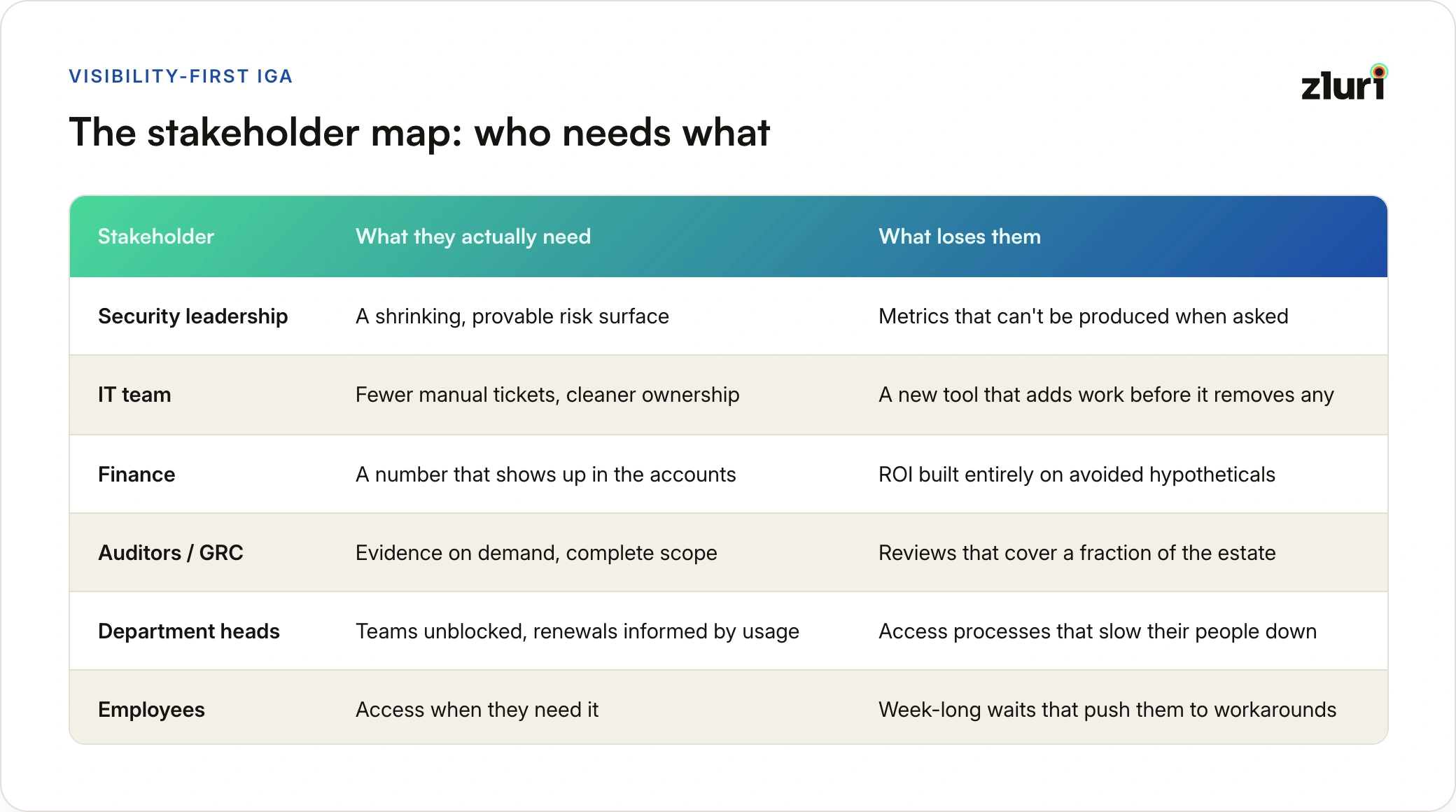
IGA touches more teams than almost any other security initiative, and each one hears a different pitch. The mistake is giving all of them the security pitch.
Map who's affected, what they're struggling with today, and what IGA sounds like when it's framed as a solution to their problem rather than yours.
Security and GRC
Usually your earliest allies, but only if the program gives them control without new blind spots.
Their daily reality: fragmented access logs, manual review campaigns, reactive audit prep. Least privilege is a policy on paper they can't actually verify.
The pitch that lands: continuous, provable compliance instead of quarterly evidence-chasing, and enforcement of the access controls they've been flagging in risk registers for years.
IT teams
The group most likely to hear "IGA" as "more work for us." Any pitch that sounds like a new system to administer will meet quiet resistance.
Their daily reality: drowning in provisioning tickets, offboarding checklists, and spreadsheet reviews.
The pitch that lands: subtraction. Automated joiner-mover-leaver workflows, access handled by policy instead of by exception, and the end of ticket-chasing for routine requests. You're not asking IT to do more. You're showing them how to do visibly less.
HR teams
HR rarely thinks of itself as an identity stakeholder, but its system is the source of truth for every lifecycle event, which makes it structurally central.
Their daily reality: role changes that don't trigger access updates, onboarding timelines that slip because IT didn't know someone was starting.
The pitch that lands: their HRIS becomes the trigger. Joiners have what they need on day one, leavers lose everything on their last day, and HR never files a ticket for either.
Business units and app owners
The most skeptical audience, because their prior experience of security programs is being slowed down.
Their daily reality: new team members waiting days for access, zero visibility into who can touch their sensitive apps, audit-time scrambles to justify grants nobody remembers approving.
The pitch that lands: speed plus clarity. Policy-based approvals that move faster than the old back-and-forth, and one-glance visibility when the auditor comes asking.
Once you've made these four cases in their four languages, something important has changed: you're no longer selling a platform. You're aligning a program with problems each team was already trying to solve. That's where resistance turns into sponsorship.
Prove it with a small, meaningful first rollout
Deploying IGA across the whole organization at once is the fastest way to lose the support you just built. The stronger play: pick a deliberately small scope where the risk is real, deliver a visible result, and let the result do the persuading.
Also Read: How to Implement IGA: A Phase-by-Phase Strategy
Pick a scope that matters but doesn't sprawl
Good candidates:
- Offboarding automation in a high-turnover department like sales or support
- A user access review on the finance or engineering apps holding your most sensitive data
- Privileged access mapping across AWS, GitHub, or core tools like Salesforce
The common thread: high enough stakes that success is meaningful, contained enough that you can execute in weeks. A low-risk, low-visibility system proves nothing to anyone.
Define success metrics before you start, not after
Use the numbers stakeholders already care about:
- Orphaned and overprivileged accounts revoked
- Review completion rates
- Hours of manual effort eliminated
- Time-to-revocation after departure
- Approval delays reduced
When you return to the table with this data against your baseline, expansion stops being a pitch and becomes the obvious next step.
Also Read: The Five Ways Identity Governance Creates Measurable Value
Make the affected teams co-authors, not recipients
- IT designs the workflows it will operate
- Security validates policies and risk thresholds
- HR aligns lifecycle triggers with real identity events
- App owners sanity-check that access flows match how their teams actually work
Teams that shaped the process defend it. Teams that had it announced to them find its flaws.
Add just enough structure to scale
The pilot worked, so the instinct is "roll it out everywhere." Without a minimum of structure, that's where programs drift: responsibilities blur, reviews slip, and momentum quietly dies.
You don't need a formal steering committee. You need two things written down and one habit.
Written down: ownership
- Who owns access policy per system or department
- Who signs off on reviews, and on what cadence
- Who handles exceptions, escalations, and audit requests
- Who ensures HR system changes trigger the right identity actions
None of this needs heavy documentation, but all of it needs a name attached. Unowned responsibilities are how a working program decays.
The habit: a short, data-driven check-in
Monthly or quarterly, not weekly, and focused on three questions:
- Are any reviews falling behind?
- Are new apps being onboarded with policies attached?
- Are any approval workflows creating delays?
Ground the discussion in outcomes (revocation speed, orphaned accounts closed, audit-readiness) rather than platform activity metrics, which nobody outside the program cares about.
That's the whole apparatus. Governance of the governance program shouldn't itself become overhead; it exists so decisions don't get stuck as more teams and apps come aboard.
How we built Zluri around the buy-in problem
Most of what blocks IGA adoption isn't philosophical, it's friction. Several of our design decisions exist specifically to remove the friction that kills buy-in:
- The evidence step takes days, not a quarter. Connect Zluri and our discovery engine surfaces the orphaned accounts, shadow IT, and standing privileges across your real environment, exactly the data this playbook's first step calls for, without the log archaeology.
- The IT pitch holds because automation genuinely subtracts work. Lifecycle workflows with 1,500+ granular in-app actions, policy-routed approvals, and closed-loop remediation after reviews.
- The business-unit pitch holds because there's no new portal to learn. Employees request access in Slack, Teams, or email, approvers approve there too, and the audit trail writes itself.
- The pilot pays off inside one budget cycle. Organizations typically run their first completed access review within 2 to 3 months, fast enough to show results while the stakeholders you convinced still remember agreeing.
If you're building the case internally, we're happy to arm you: a discovery run against your environment produces exactly the evidence this playbook's first step calls for, before you've committed to anything. If you want the fuller argument for why a shared discovery run does more of this persuasion work than any pitch deck, that's the subject of our visibility-first stakeholder alignment piece.
Frequently Asked Questions
Who should own the IGA buy-in effort?
Usually the leader closest to the pain that's funding the project: the CISO or security lead for risk-driven programs, the IT director for efficiency-driven ones, or a GRC lead when an audit deadline is the forcing function. What matters more than the title is that one person owns the stakeholder map and the pilot metrics, because distributed ownership at this stage means no ownership.
How long does it take to get cross-functional buy-in for IGA?
The evidence-gathering and stakeholder conversations typically take two to four weeks. The real timeline driver is the pilot: scope it to something you can execute and measure in six to eight weeks, because a result delivered inside one quarter keeps momentum in a way that a six-month pilot never does.
What's the most common reason IGA rollouts lose support after launch?
Reviewer fatigue and unclear ownership. If access reviews feel like rubber-stamp exercises on data reviewers don't trust, completion rates collapse and the program's credibility goes with them. The fixes are contextual review data (usage, last login, peer comparison) so decisions feel informed, and named ownership per system so nothing depends on goodwill.
Should we get executive sponsorship first or team buy-in first?
Executive sponsorship first, but spend it carefully. The executive signature gets you the mandate and the budget; the team-level work in this guide is what converts the mandate into adoption. Programs that stop at the executive yes are the ones that become shelfware, because a mandate can compel deployment but it can't compel app owners to certify reviews on time.
How do we keep buy-in as the program expands?
Report against the baseline you captured at the start, in the metrics each stakeholder cares about, on the same check-in cadence you established during the pilot. Buy-in decays when results stop being visible, not when they stop happening.


.svg)