

Your IAM, PAM, and IGA tools are securing the access they know about. The access they don't know about is where attackers go first.
Most identity security programs are built around a comfortable assumption: that the access you've provisioned through your identity tools represents the access that actually exists in your environment.
It doesn't.
The average enterprise has dozens, sometimes hundreds, of SaaS applications that were never routed through IT. Employees needed a tool, signed up with a corporate email, and moved on.
Now layer on top of that a second wave: AI tools. ChatGPT. Cursor. Perplexity. Notion AI. GitHub Copilot. Employees are adopting these the same way they adopted SaaS: independently, quickly, and entirely outside IT's line of sight.
These apps sit outside your SSO. They're invisible to your IGA platform. Your PAM solution has never touched them. And every one of them carries its own set of credentials, permissions, and access paths, with the added dimension that some of them are actively processing your organization's data.
That gap (between the access your identity security tools govern and the access that actually exists) is your identity attack surface. For most organizations, it is far larger than anyone has formally measured, and growing faster than it ever has.
This is not a failure of your security team. It is a structural limitation of how the identity security market has approached the problem for the past decade, designed for a world where IT controlled procurement, and employees waited.
What this article covers:
- How the identity attack surface is actually defined
- Why IAM, PAM, and IGA each leave a portion of it ungoverned by design
- How SaaS sprawl and AI sprawl are widening the gap faster than most programs can track
- Why the "intelligence over visibility" argument has the sequence backwards
- How a layered identity security architecture closes the gap that individual tools leave open
What "Identity Attack Surface" Actually Means
The term attack surface, in its classical definition, refers to the sum of all points where an attacker can attempt to enter or extract data from an environment. In network security, that means open ports, exposed services, unpatched endpoints. In application security, it means APIs, input fields, authentication endpoints.
In identity security, the attack surface is defined differently. And the definition matters.
Your identity attack surface is not the number of users you manage. It is not the number of applications in your SSO catalog. It is the total set of identities, access rights, entitlements, and access pathways that exist in your environment, regardless of whether they are governed, documented, or visible to any of your security tools.
That last qualifier is where most programs fall short.
An identity that exists but isn't managed is still part of your attack surface. An application that employees are using but isn't in your SSO catalog still has permissions attached to user accounts. A former employee's account that was deprovisioned from Active Directory but not from the six SaaS tools they used independently is still live. Every one of these is an exploitable path.
The question is not whether these paths exist in your environment. They almost certainly do. The question is whether you know about them, and whether your current security posture accounts for them.
Why Identity Security Tools Have a Visibility Problem
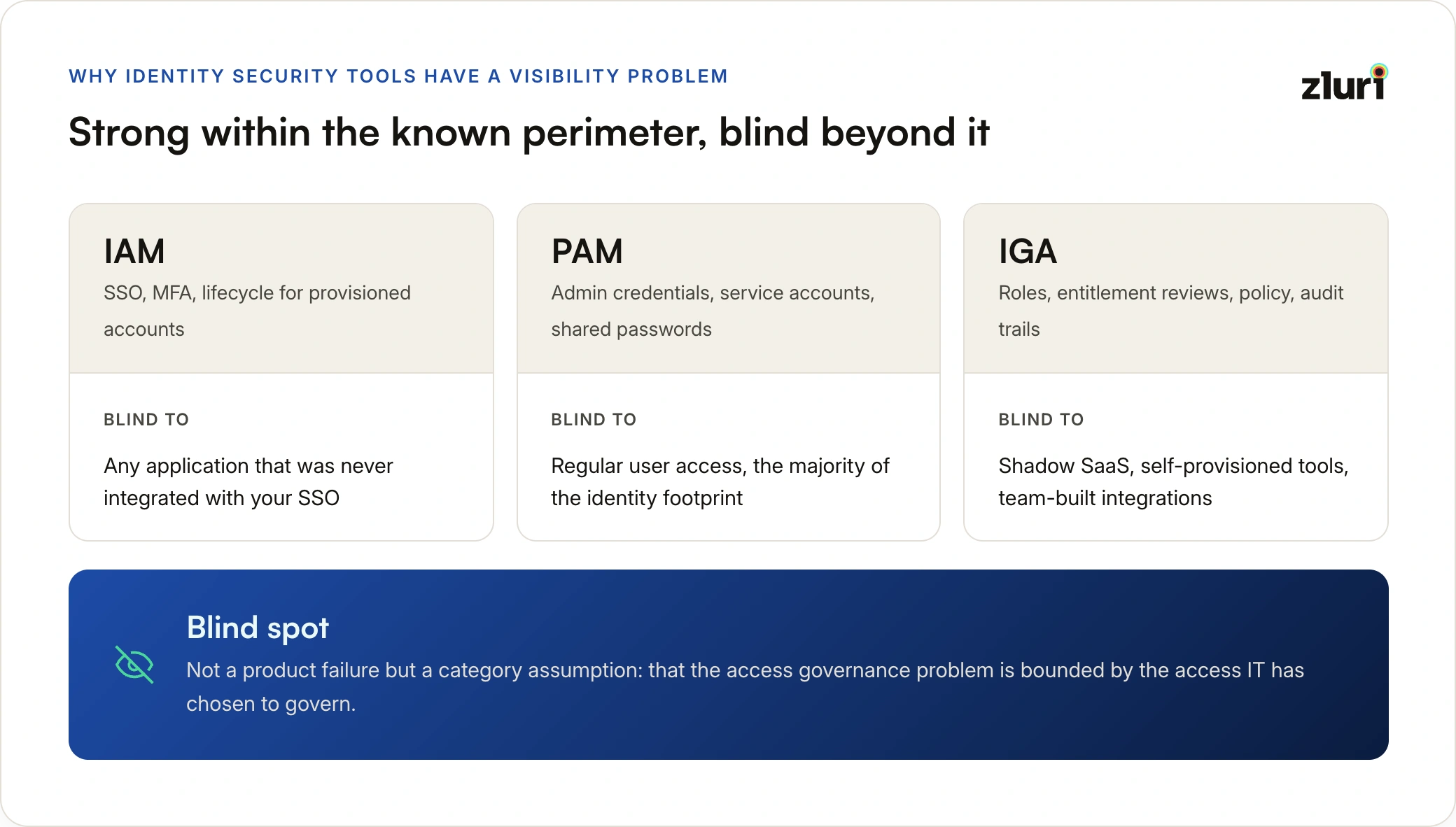
IAM, PAM, and IGA have each solved for specific, well-defined problems. The issue is not that these tools are inadequate. It is that together, they still leave a structural blind spot that the identity attack surface occupies.
IAM manages authentication and access for the identities that flow through it. SSO, MFA, lifecycle management for provisioned accounts: these are IAM's core functions. But IAM's visibility is bounded by what has been connected to it. An application that was never integrated with your SSO is outside IAM's governance scope entirely.
PAM secures privileged access: admin credentials, service accounts, shared passwords. It is the right tool for managing the high-risk access that, if compromised, enables the most damaging breaches. But PAM does not concern itself with the regular user access that constitutes the majority of your identity footprint. And it has no mechanism for discovering the access that was never routed through it in the first place.
IGA is built for access governance at scale: role management, entitlement reviews, policy enforcement, audit trails. But IGA systems, in most enterprise deployments, govern the identities and applications that IT has formally onboarded. The long tail of shadow SaaS, the self-provisioned tools, the integrations built by individual teams are typically outside the IGA perimeter.
The result is an identity security architecture that is genuinely strong within its known perimeter, and essentially blind beyond it.
This is not a product failure. It is a category assumption: that the access governance problem is bounded by the access IT has chosen to govern. That assumption made sense in the era of on-premise software and centralized IT procurement. It does not hold in an environment where any employee can evaluate, trial, and fully adopt a SaaS product in under an hour.
SaaS Sprawl, AI Sprawl, and the Identity Attack Surface
SaaS adoption outpaced IT's ability to track it years ago. Employees don't wait for procurement cycles. They find a tool that solves an immediate problem (a project management app, a communication platform, a design tool) and they adopt it. They sign in with their corporate email. They invite colleagues. The application grows within the organization without IT ever being involved.
That problem is not new. What is new is that AI sprawl has added a second, faster-moving layer on top of it.
In the past two years, employees across every function have independently adopted AI tools at a rate that makes SaaS sprawl look measured: coding assistants, writing tools, data analysis platforms, AI-powered research tools. The adoption friction for AI tools is even lower than for SaaS. Many are free to start, browser-based, and require nothing beyond a Google login. An engineer installs Cursor or GitHub Copilot. A marketing manager connects an AI writing tool to their Google Drive. A finance analyst pastes budget data into a large language model to speed up a report. None of these events pass through IT. None of them appear in your IGA system.
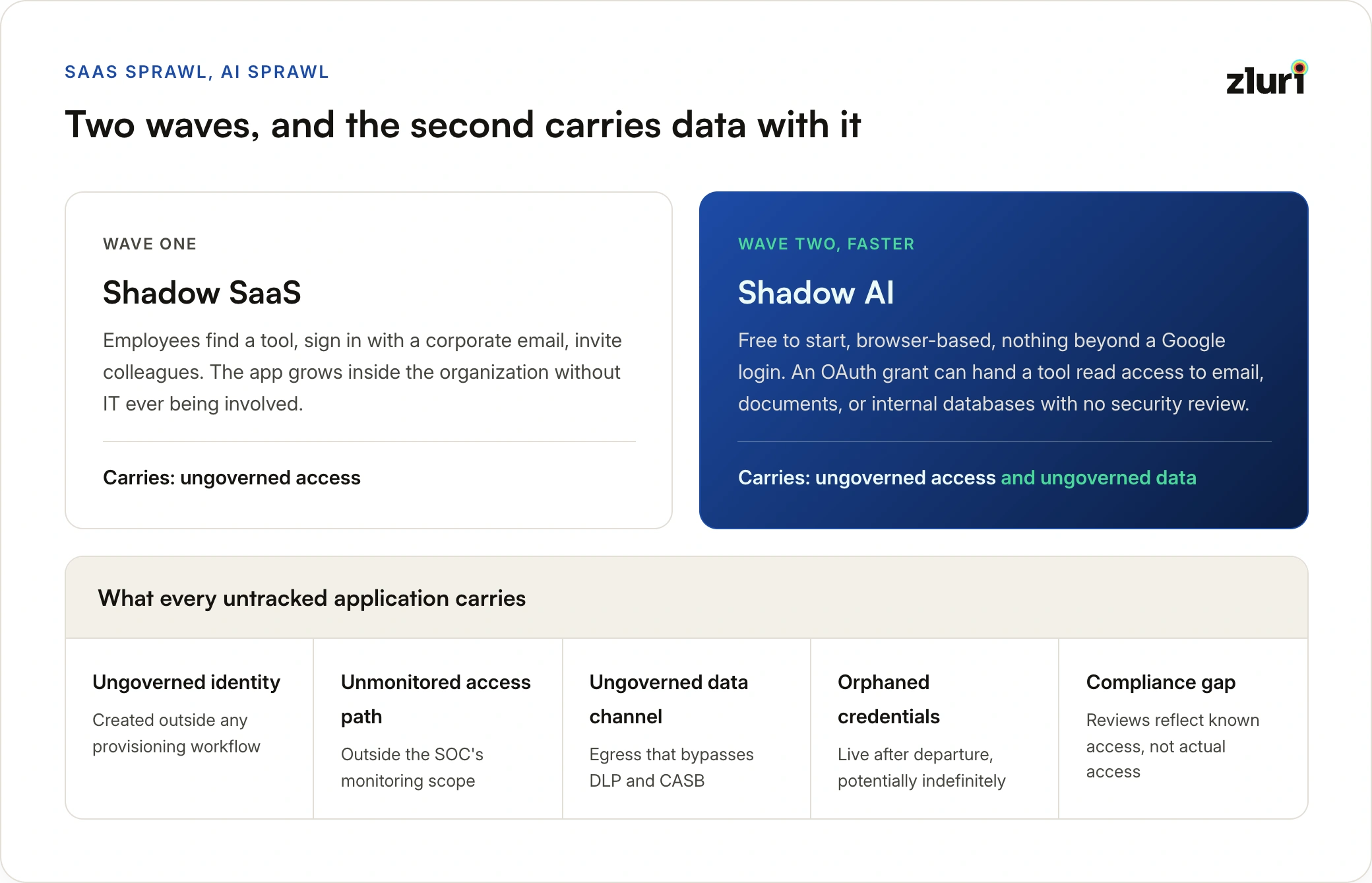
The difference between SaaS sprawl and AI sprawl is not just volume. It is the nature of the exposure. A shadow SaaS tool carries ungoverned access. A shadow AI tool carries ungoverned access and ungoverned data. When an employee connects an AI platform to corporate systems via OAuth, they may be granting that tool read access to email, documents, or internal databases, without any security review, without any visibility to IT, and without any mechanism to revoke that access when they leave.
Industry research consistently shows that the number of applications actually in use within an enterprise significantly exceeds the number IT officially manages. The inclusion of AI tools in that footprint has widened the gap further, and the gap is no longer growing linearly.
Each untracked application (SaaS or AI) represents the same core set of attack surface risks.
An ungoverned identity. The user's account was created outside any provisioning workflow. It may carry default permissions, admin access granted during a trial, or entitlements accumulated through informal team sharing. Nobody has reviewed it. Nobody knows it exists.
An unmonitored access path. If an attacker compromises those credentials through phishing, credential stuffing, or a breach at the vendor, they gain access to that application. Your SOC has no visibility into that access event because the application is not in your monitoring scope.
An ungoverned data channel. For AI tools specifically, the risk extends beyond identity. An employee who has connected an AI platform to corporate data sources has created a data egress path that bypasses DLP controls, is invisible to your CASB, and may persist long after the employee stops actively using the tool.
An orphaned credential risk. When that employee leaves the organization, their core accounts are deprovisioned through your standard offboarding workflow. The accounts in untracked SaaS and AI applications are not. Those credentials remain live, potentially indefinitely. In the case of OAuth-connected AI tools, the data access grant persists too.
A compliance gap. Any access review, audit, or regulatory control that relies on your IGA system's view of user entitlements is incomplete if that view doesn't include untracked applications. Your compliance posture reflects the access you know about, not the access that exists.
Multiply this across an enterprise of hundreds or thousands of employees, factor in the current rate of AI tool adoption, and the gap between your governed access footprint and your actual identity attack surface is not just substantial. It is accelerating.
Where PAM Falls Short of the Attack Surface Problem
The reflex in many security programs is to treat the identity attack surface as a privileged access problem, and therefore a PAM problem. This is understandable. Privileged accounts carry the highest risk per credential compromised, and PAM tools are well-established, mature, and effective at what they do.
But privileged access is not where most attacks begin.
The majority of breaches that use identity as an entry point start with a regular user account, not an admin credential. The attacker gains initial access through phishing, credential theft, or an orphaned account, establishes a foothold, and then works to escalate from there. The privileged access that PAM secures is the destination, not the entry point.
If your security posture focuses heavily on governing the 200 privileged accounts in your environment while leaving thousands of regular user accounts partially visible or fully ungoverned, you have inverted the priority.You have secured the vault and left the door to the building open.
This is not an argument against PAM. Privileged access absolutely requires strong controls. It is an argument for expanding the definition of the identity attack surface beyond privileged accounts, and building visibility that covers the full identity footprint: every user, every application, every entitlement, including the ones that never passed through an official provisioning workflow.
The Gartner Lens: Visibility, Observability, and Remediation
Gartner has formalized the connection between identity visibility and attack surface reduction. In the report Reduce Your IAM Attack Surface Using Visibility, Observability, and Remediation (Rebecca Archambault, October 2025), Gartner identified visibility into identity posture as a foundational requirement for attack surface management, not an optional enhancement to existing IAM programs.
The report's framing is significant: visibility is positioned not as a feature of individual IAM tools, but as a distinct capability that must be deliberately built. The implication is that organizations relying solely on their SSO, IGA, or PAM platforms for identity visibility have a structural gap, because none of those tools were designed to discover and govern the access that exists outside their own perimeter.
Zluri is named in this report, specifically in the context of providing the kind of deep, cross-environment visibility that closes this gap.
The shift this represents in the market is real. Identity security is moving from a tool-by-tool governance model (secure what you've connected) to an environment-wide visibility model (discover everything that exists, then govern it). The attack surface framing is what makes this shift legible: you cannot reduce an attack surface you haven't fully mapped.
What a Complete Identity Attack Surface Looks Like
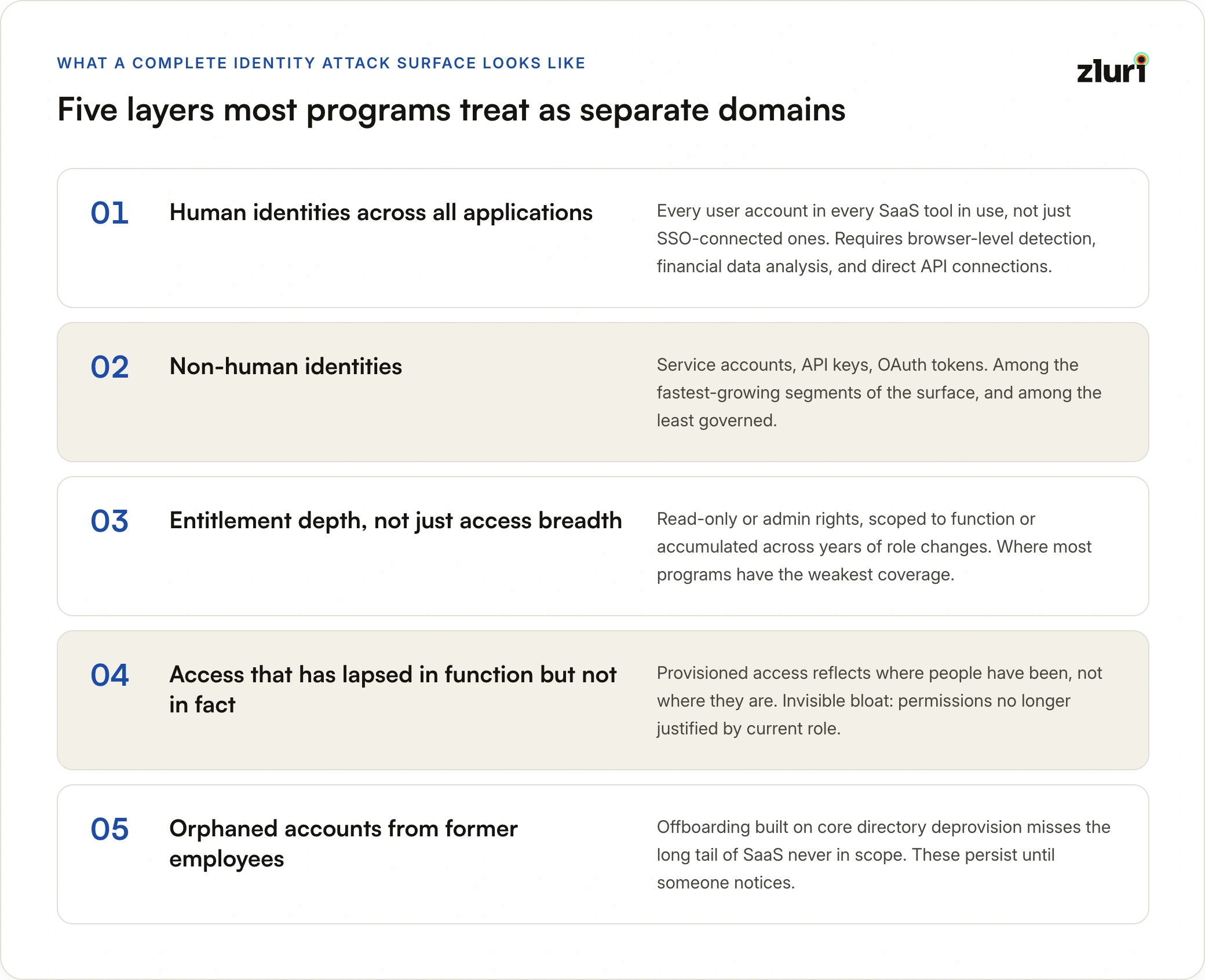
A rigorous view of the identity attack surface in a modern enterprise requires visibility across several layers that most identity programs treat as separate domains.
Human identities across all applications. Not just the users in your SSO-connected applications, but every user account in every SaaS tool in use, including the ones that were never formally sanctioned. This requires discovery that goes beyond SSO integration to include browser-level detection, financial data analysis, and direct API connections to SaaS platforms.
Non-human identities. Service accounts, API keys, OAuth tokens, and machine identities are among the fastest-growing segments of the identity attack surface, and among the least governed. A compromised OAuth token with excessive permissions can provide an attacker with persistent, hard-to-detect access that bypasses the authentication controls applied to human users.
Entitlement depth, not just access breadth. Knowing that a user has access to an application is the beginning of the visibility problem, not the end. The real risk lives in the entitlements within that application: whether a user has read-only access or admin rights, whether their permissions are scoped to their function or accumulated across years of role changes. Application-level entitlement visibility is where most identity programs have the weakest coverage.
Access that has lapsed in function but not in fact. Users who have changed roles, moved teams, or taken on new responsibilities accumulate access over time. Their provisioned access reflects where they've been, not where they are. Without systematic entitlement reviews, this accumulated access becomes invisible bloat on the attack surface: permissions that exist but are no longer justified by current role.
Orphaned accounts from former employees. Offboarding workflows built on core directory deprovision often miss the long tail of SaaS applications that were never in scope. The former employee's Slack workspace, their Figma account, their independent project management tool. All of these persist until someone notices, which in many organizations is never.
The Visibility Gap Is an Organizational Risk, Not a Technology Failure
It would be easy to frame this as a tooling problem. To say that better IAM, PAM, or IGA tooling would close the visibility gap. But the gap is not primarily a technology problem. It is an organizational one.
The tools that security teams deploy are generally capable. The issue is that they are deployed against a known scope: the applications IT has sanctioned, the users IT has provisioned, the access IT has formally granted. Everything outside that scope is invisible not because the tools can't see it, but because nobody ever pointed the tools at it.
And the scope problem is getting structurally harder. SaaS sprawl was already difficult to contain. AI sprawl introduces a category of tools with even lower adoption friction, even faster proliferation, and an additional data exposure dimension that pure identity governance tools were not built to address. The perimeter that IT is asked to govern keeps expanding. The discovery mechanisms most identity programs rely on (SSO integration, HRMS sync, formal provisioning workflows) were designed for a world where that perimeter was relatively stable.
Closing the identity attack surface gap requires a different starting point: instead of governing the access you've provisioned, start by discovering all the access that exists. A modern identity strategy starts here.
This means deploying discovery mechanisms that don't rely on SSO integration as their primary signal. It means treating shadow SaaS and shadow AI as a security problem, not a procurement inconvenience. It means building entitlement visibility at the application level, not just the access level (and for AI tools, understanding what data access those OAuth grants actually carry). And it means treating the identity attack surface as a living measurement, not a one-time audit, because in an environment where the application footprint changes daily, a static snapshot is already wrong by the time it's complete.
"Intelligence Over Visibility" Is the Wrong Sequencing
There is a counterargument worth addressing directly, because it comes from credible places. Several identity security vendors, and some respected analysts, have made the case that visibility is table stakes, and that what actually separates mature security programs from reactive ones is intelligence. Behavioral analytics. Risk scoring. Anomaly detection. AI-driven threat correlation. The argument is that raw visibility (knowing what exists) is less valuable than knowing what to act on.
This is not wrong. Intelligence matters enormously. The ability to surface a meaningful signal from a large and noisy access dataset is a real capability, and organizations that have it are better positioned than those that don't.
But the argument contains a hidden assumption that rarely gets examined: that the visibility feeding the intelligence engine is complete.
It isn't.
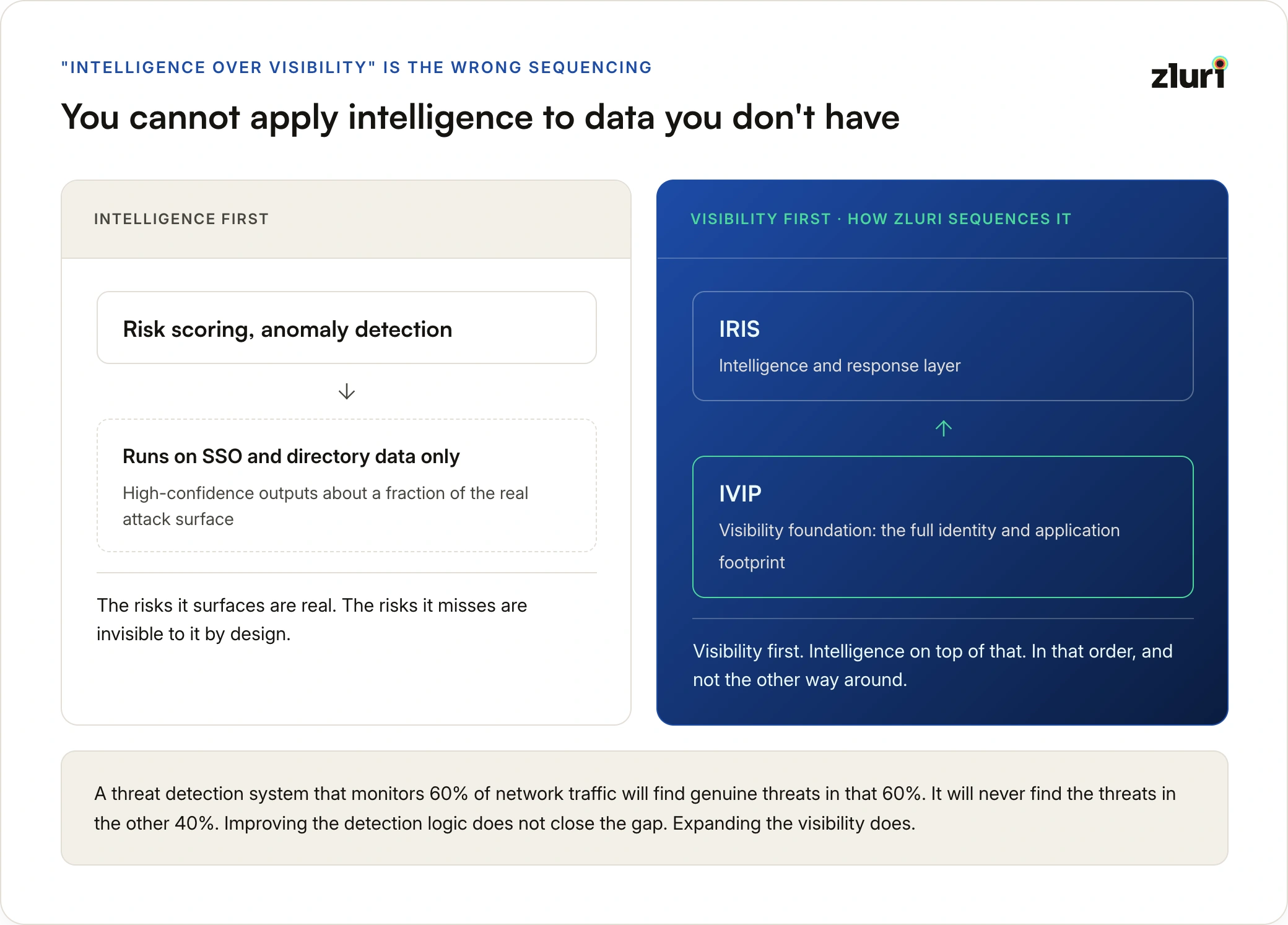
Intelligence systems operate on the data they receive. If your visibility layer is bounded by SSO-connected applications and formally provisioned identities, your intelligence engine (however sophisticated) is analyzing a subset of your actual environment. It is producing high-confidence outputs about a fraction of your real attack surface. The risks it surfaces are real. The risks it misses are invisible to it by design.
This is not a failure of the intelligence capability. It is a sequencing failure. You cannot apply intelligence to data you don't have.
The analogy holds in any domain. A threat detection system that monitors 60% of network traffic will find genuine threats in that 60%. It will never find the threats in the other 40%, not because its detection logic is wrong, but because it was never given the data to work with. Improving the detection logic does not close the gap. Expanding the visibility does.
The vendors advancing the "intelligence over visibility" position are, in most cases, working from identity data that originates in SSO, directory services, and formally connected applications. Their intelligence is genuinely useful within that perimeter. The perimeter is the problem.
This is precisely why Zluri built IRIS, its intelligence and response layer, on top of IVIP, its visibility foundation. The sequencing is not incidental. It reflects a deliberate architectural position: intelligence that operates on incomplete visibility is optimized for known risks. The majority of the identity attack surface, for most enterprises, lives in the unknown. Governing known risks well while unknown risks accumulate undetected is not a security program. It is a compliance exercise with a security label on it.
Visibility first. Intelligence on top of that. In that order, and not the other way around.
How Zluri Approaches Identity Attack Surface Visibility
Zluri is an identity security platform built around a layered architecture that addresses the attack surface problem at every level where it actually exists.
IVIP: visibility across the full identity and application footprint. Zluri's Identity Visibility and Intelligence Platform (IVIP) discovers applications and identities through five distinct pathways via the Universal Integration Connector (UIC): SSO integration, HRMS sync, finance and expense data, browser extension, and direct API connections. Discovery is not bounded by what has been formally connected to IT infrastructure. It surfaces the full SaaS and AI tool footprint (sanctioned and unsanctioned) including applications that were never in any IT catalog. Every human identity, every non-human identity, every entitlement across the environment is mapped continuously. This is the foundation on which everything else operates.
ISPM: continuous posture assessment against the discovered footprint. Zluri's Identity Security Posture Management layer sits between visibility and governance. It continuously evaluates the security posture of every discovered identity and entitlement, surfacing misconfigured access, excessive permissions, dormant accounts, and ungoverned SaaS and AI tool connections as active posture risks rather than audit findings. The attack surface that IVIP discovers, ISPM assesses, so that governance action is prioritized by actual risk, not by what happened to surface in the last quarterly review.
IGA: governance that acts on what visibility and posture assessment surface. Zluri's IGA layer (Access Management, Access Reviews, Access Requests, and SoD enforcement) operates across the full discovered footprint, not just the applications IT formally manages. JML lifecycle management is HRMS-driven: role changes trigger both deprovisioning of old access and provisioning of new access in a single automation rule, and offboarding workflows auto-populate from the actual discovered access footprint. Access reviews cover the full entitlement landscape, including shadow SaaS and AI tools. SoD enforcement flags conflicting access rights in real time. The result is governance that reflects what actually exists, not what IT thought it provisioned.
A note on SaaS spend. Zluri's SaaS Management Platform (SMP) is a natural byproduct of the same discovery infrastructure that powers identity security. When you have complete visibility into every application in use and every identity within it, you also have the data to identify redundant licenses, unused subscriptions, and duplicate tool spend. Organizations that deploy Zluri for identity security routinely find that the SaaS cost savings the platform surfaces offset a significant portion of its cost. The security program pays for itself, which means the finance team is rarely an obstacle to the investment.
The result is an identity attack surface that is not only visible but continuously assessed and actively governed, shrinking over time rather than silently expanding.
The CISO Question Worth Asking
Before the next board briefing, before the next red team exercise, before the next compliance audit: how large is your actual identity attack surface?
Not the access you've provisioned. Not the applications in your SSO catalog. Not the accounts under PAM governance. The actual surface: every identity, every entitlement, every access path, including the ones your current tools have never seen.
If you can't answer that question with precision, the gap between your answer and the real number is the part of your attack surface an attacker will use first.
Visibility is not a feature. It is the precondition for everything else identity security tries to do.
Frequently Asked Questions
What is an identity attack surface?
An identity attack surface is the total set of identities, entitlements, access rights, and access pathways that exist in an organization's environment, including those that are unmanaged, undiscovered, or outside the scope of current IAM, PAM, or IGA tools. The larger and less visible this surface is, the greater the organization's exposure to identity-based attacks.
Why can't IAM tools alone reduce the identity attack surface?
IAM tools govern the access they have been configured to manage. They rely on SSO integration, provisioning workflows, and formal onboarding processes as their primary visibility mechanisms. This means any application or identity that exists outside those workflows (shadow SaaS, self-provisioned tools, ungoverned service accounts) is invisible to IAM by design. Reducing the identity attack surface requires discovery mechanisms that operate independently of formal provisioning scope.
Is identity attack surface management the same as PAM?
No. PAM focuses specifically on high-privilege accounts (admins, service accounts, shared credentials) and is a critical layer of identity security. But most breaches begin with regular user accounts, not privileged ones. Identity attack surface management requires visibility across the full identity footprint, including non-privileged access, which falls outside the scope of PAM.
What is shadow SaaS and why does it matter for attack surface?
Shadow SaaS refers to applications adopted by employees without formal IT involvement or approval. These applications are typically not integrated with SSO, not governed by IGA, and not monitored by security tools. Each one represents an unmanaged identity, an unmonitored access path, and a potential orphaned credential risk when employees leave. At enterprise scale, shadow SaaS can represent a significant portion of the total identity attack surface.
What is AI sprawl and how does it differ from SaaS sprawl?
AI sprawl refers to the ungoverned adoption of AI tools (coding assistants, writing platforms, AI-powered research and analysis tools) by employees outside any IT procurement or security review process. It is structurally similar to SaaS sprawl, but carries an additional risk dimension: many AI tools are connected to corporate data sources via OAuth grants, meaning the exposure is not just ungoverned identity access but ungoverned data access. An employee who connects an AI tool to their email or document store may be creating a persistent data egress channel that bypasses DLP and CASB controls entirely, and that remains active long after they stop actively using the tool.
If intelligence matters more than visibility, why focus on visibility first?
Intelligence systems operate on the data they receive. A behavioral analytics engine or risk scoring system that draws from SSO-connected applications and formally provisioned identities produces accurate outputs about that subset of the environment. The access that exists outside that perimeter is invisible to the intelligence layer entirely. Improving detection logic does not close a visibility gap; expanding visibility does. Intelligence is essential, but it is the second step. Applied to incomplete visibility, it produces confident answers about an incomplete dataset, which is a more dangerous position than acknowledged ignorance, because it creates the appearance of comprehensive coverage where none exists.
What does Gartner say about IAM attack surface visibility?
In the October 2025 report Reduce Your IAM Attack Surface Using Visibility, Observability, and Remediation, Gartner identified identity visibility as a distinct, foundational capability for attack surface reduction, separate from the governance functions of IAM, PAM, and IGA tools. Gartner's position is that visibility must be deliberately built and cannot be assumed from existing identity tool deployments alone.
How is identity attack surface different from network attack surface?
Network attack surface refers to the exposed ports, services, and endpoints through which an attacker might gain access to infrastructure. Identity attack surface refers to the credentials, entitlements, and access pathways through which an attacker might compromise data or move through systems, often without triggering network-layer security controls at all. As enterprise environments shift to SaaS and cloud, identity attack surface has become the primary entry vector for most breaches, making it the more operationally relevant surface for security leaders to measure and reduce.



.svg)