
Every tool in the insider threat category shares one assumption: the insider's access is a given, so the job is to watch how it's used. That assumption is exactly the problem, because the size of what you're watching is set upstream, by access nobody governed.
Go shopping for insider threat tooling and you'll find a mature, crowded market with a strikingly uniform shape. Behavioral analytics platforms that baseline how users normally act and flag deviations. Data loss prevention tools that inspect content leaving through email, endpoints, and cloud channels. Insider risk management suites that record endpoint activity and correlate it with HR signals. Different mechanisms, same underlying design: the insider already has access, so the discipline is surveillance.
That design isn't wrong. It's incomplete in a specific, expensive way, and the incompleteness sits upstream of every tool in the category.
Here's the argument in one line: detection tools watch how access gets used, but the size, cost, and noise of that job is determined by how much access exists to misuse, and no tool in the category does anything about that number. An organization deploying behavioral analytics across ten thousand over-provisioned identities has bought a harder detection problem than the same organization watching ten thousand minimally provisioned ones. The tooling is identical. The threat surface is not, and the threat surface was decided before the detection tool was ever installed.
This piece maps what each tool family in the category genuinely does well, what the category as a whole structurally can't do, and why the buying order most organizations follow is backwards.
The Category, Mapped Fairly
Three tool families make up the traditional insider threat market, and each earns its place:
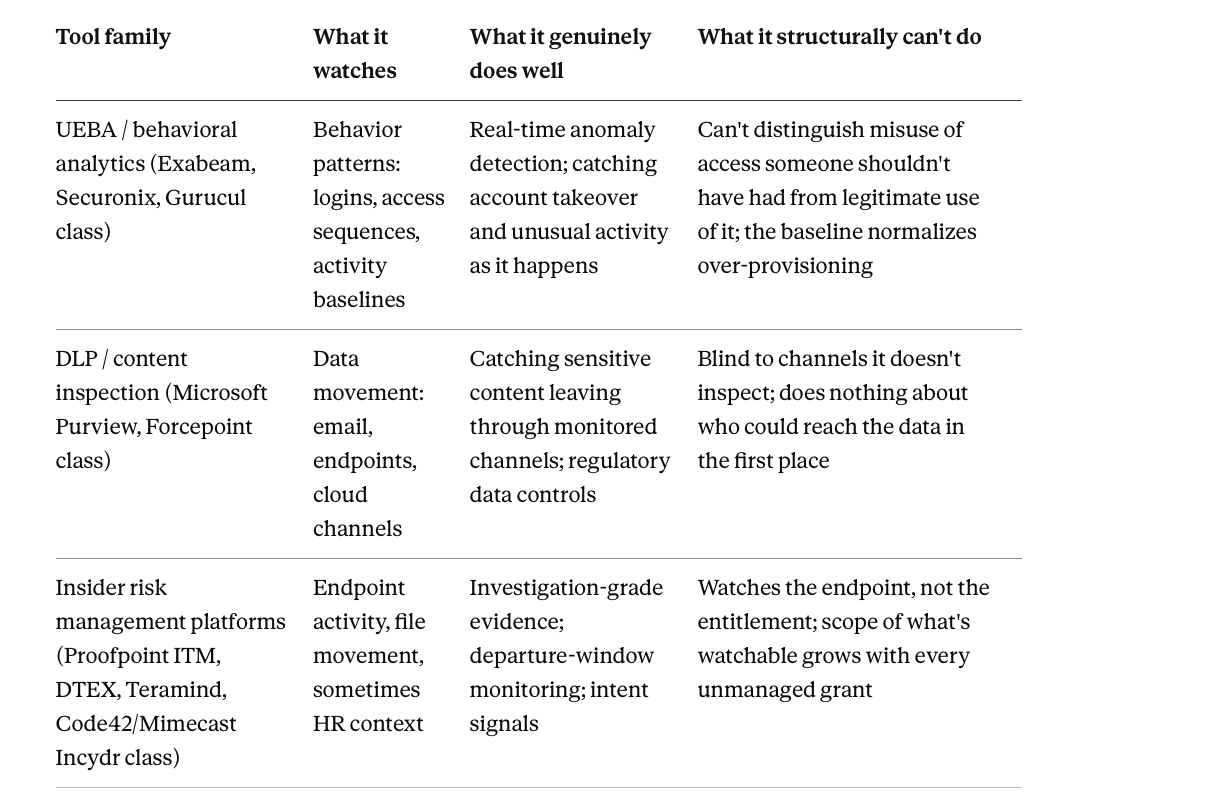
Nothing in this table is a criticism of these tools at their own jobs. A mature insider threat program at scale genuinely needs real-time behavioral signal and content controls, and nothing below argues otherwise.
The Shared Blind Spot
Look at the right-hand column and one pattern repeats: every family takes the insider's access footprint as an input it cannot change. That has three compounding consequences.
Detection scales in cost and noise with access sprawl. Every unnecessary permission is another behavior to baseline, another channel to inspect, another endpoint pattern that could be legitimate or could be exfiltration. Over-provisioned environments don't just carry more risk; they generate more alerts per unit of actual risk, because the surveillance layer can't tell over-provisioned-but-normal from minimal-and-normal. Alert fatigue in insider threat programs is often blamed on tuning. Much of it is access debt wearing a detection costume.
Baselines normalize what should have been revoked. Behavioral analytics learns what's normal for each identity. If an identity has quietly accumulated access from three finished projects, using that access is its normal. The tool isn't failing; it's faithfully modeling an environment where privilege creep already won. The anomaly engine can catch the insider who behaves strangely. It structurally cannot catch the insider who calmly uses excessive access they've held for a year.
The worst-case ceiling is untouched. Detection shortens the time between misuse and discovery. It does not change what a determined insider, or a careless one, can do in that interval. The damage ceiling is set by what the access permits: an account that can bulk-export customer data has the same worst case whether the SOC notices in four minutes or four days later than it should have. Only narrowing the access moves that ceiling.
The Inversion: Govern First, Then Watch
Flip the assumption and the program changes shape. Instead of "access is a given, watch its use," start from "access is the variable, and most insider risk is access that shouldn't exist anymore."
That's not a rhetorical reframe; it matches where insider incidents actually concentrate:
The departure window. Insider risk clusters around resignations and terminations, when motive meets remaining opportunity. Deprovisioning that fires on the exact last working day, across every application, closes that window structurally. No amount of monitoring substitutes for the access simply being gone.
Quiet accumulation. Most insider risk isn't a plot; it's opportunity. Access piles up across role changes and finished projects, and accumulated, unneeded access is the raw material opportunistic misuse draws on. Continuous comparison of held access against role, usage, and peers removes the raw material, which no baseline-learning tool can do, because to the baseline, the accumulation is normal.
Unilateral capability. The most damaging insider actions require an identity holding both halves of something no one person should complete alone: creating and approving the same transaction, granting and certifying the same access. Segregation of duties removes the capability itself, which works identically on the malicious insider and the honest mistake, because it never has to judge intent.
Non-human persistence. The recognized technique of a departing insider planting a service account or API key to retain access after their own account dies is invisible to endpoint monitoring, because nothing anomalous happens on an endpoint. It's an entitlement problem: an ownerless identity holding access nobody is accountable for reviewing, which only an access-layer inventory surfaces.
Each of these is prevention in the structural sense: the risk doesn't need to be detected because the capability was removed, expired, or never combined. And every one of them also makes the detection layer better at its own job, because what remains to watch is smaller, better justified, and more anomalous when it misbehaves.
Both Layers, Right Order
None of this argues for skipping detection. It argues for sequencing. An organization that buys behavioral analytics first is asking a surveillance layer to compensate for a governance layer that doesn't exist, and it will pay for that in licensing (per-identity, over an inflated identity count), in analyst hours (triaging alerts that access hygiene would have prevented), and in residual risk (the calm misuse of legitimate-looking excess that no anomaly engine flags).
The defensible order: first, shrink and govern the access surface through the prevention controls, so that what insiders cando maps tightly to what their current role requires, elevated access expires on its own, and no identity holds a toxic combination. Then deploy detection over what remains, where every alert now points at genuinely justified access being used in a genuinely unusual way, which is exactly the signal-rich environment those tools were designed for.
This is also where the honest vendor map matters. UEBA, DLP, and insider risk platforms compete with each other. The access layer doesn't compete with any of them; it sits upstream of all of them. Zluri operates at that layer: departure-day deprovisioning across every application, continuous detection of accumulated and outlier access, cross-application segregation of duties, ownership and review of non-human identities, and the forensic access trail an investigation needs. What it deliberately doesn't do is the surveillance half, no behavioral analytics, no content inspection, and the full breakdown of that boundary is worth reading before any evaluation, precisely because a vendor that claims both layers in one tool is usually doing one of them thinly.
Frequently Asked Questions
What are the main categories of insider threat detection solutions?
Three families dominate: UEBA or behavioral analytics platforms, which baseline user behavior and flag anomalies in real time; DLP tools, which inspect data leaving through email, endpoints, and cloud channels; and insider risk management platforms, which monitor endpoint activity and correlate it with contextual signals for investigation. All three operate at the surveillance layer, watching how existing access gets used. A fourth layer, access governance, sits upstream: it determines how much access exists to misuse in the first place.
Do access governance tools replace insider threat monitoring?
No, and the honest answer runs in both directions. Governance can't watch behavior in real time or inspect content leaving through an email attachment; monitoring can't revoke a departed contractor's access, expire an elevation, or break up a toxic combination of entitlements. Mature programs run both. The argument here is about order: governing first shrinks and cleans the surface that monitoring then watches, which lowers the cost and raises the signal quality of the detection layer.
Why do behavioral analytics tools struggle with privilege creep?
Because they learn what's normal per identity, and for an identity that has quietly accumulated access across role changes and finished projects, using that access is its statistical normal. The tool models the environment it's given. It can catch behavior that deviates from the baseline; it cannot flag that the baseline itself includes access the person should have lost a year ago. Catching that requires comparing held access against current role, usage, and peers, which is an access-layer capability, not a behavioral one.
Where does insider threat risk concentrate most?
Around departure. The days and weeks surrounding a resignation or termination combine remaining access with, in some cases, motive, which is why offboarding speed and completeness function as a direct security control rather than an administrative nicety. Monitoring tools watch this window; access-layer controls close it, by deprovisioning on the exact planned date across every application, including the ones outside SSO that manual offboarding routinely misses.


.svg)