You can't govern intent, and you can't screen your way out of mistakes. What you can govern is capability: what each insider can reach, for how long, and in what combinations. Prevention lives entirely in that word.
Most advice on preventing insider threats quietly assumes the problem is people: screen better, train harder, watch closer. That framing fails on contact with the incident data. The malicious insider passed the background check. The negligent one attended the training. The compromised one did nothing wrong at all.
What every insider type shares isn't a psychological profile; it's a mechanism. The harm flows through access, and access is the one variable the organization controls completely. Prevention, therefore, is not about predicting who will become a threat. It's about ensuring that whoever does, through malice, mistake, or compromise, finds as little capability as possible waiting for them.
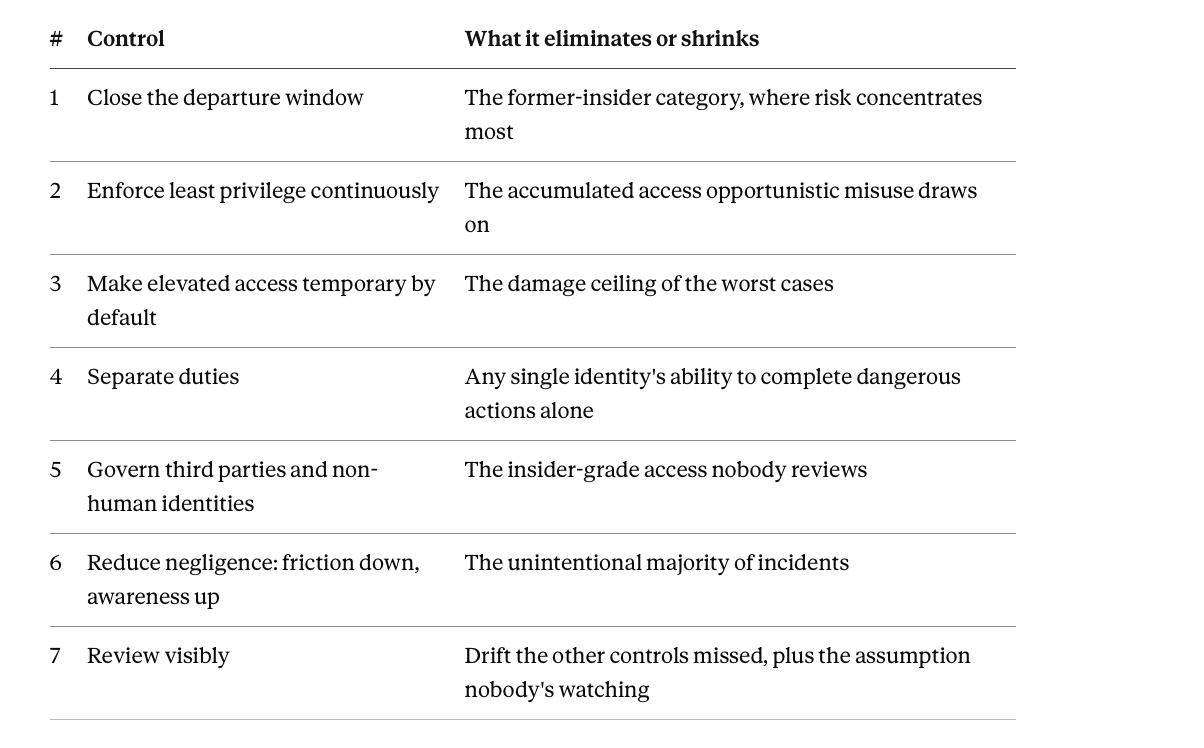
The controls below are ordered by impact, and the order is deliberate: the first three eliminate whole categories of incident before anything else has to work.
1. Close the Departure Window
If prevention had only one control, this would be it. Insider incidents concentrate overwhelmingly in the days and weeks around resignation or termination, when remaining access meets, in some cases, motive. Documented cases from unrevoked report access at fintechs to source-code downloads after a competitor's offer all live in this window.
Closing it means offboarding that is complete, immediate, and scheduled: every account and entitlement across every application (not just the ones behind SSO), revoked on the exact last working day rather than whenever an admin gets to the ticket. It also means treating notice periods as elevated-risk windows, with detection sensitivity raised accordingly.
An organization that does nothing else on this list but makes offboarding airtight has removed the single largest concentration of insider risk it has.
2. Enforce Least Privilege, Continuously
Accumulated, unnecessary access is the raw material of opportunistic insider incidents: nobody misuses a system they were never given a reason to touch. Least privilege removes the raw material, but only if it's enforced as a maintained state rather than a grant-time aspiration.
That means three things running together: roles that encode each function's minimum, access that moves with role changes (the old department's access removed, not just the new one added), and continuous comparison of held access against actual usage and role peers, so privilege creep gets caught and reversed as it happens.
Every permission stripped this way is an incident class that can no longer occur and a behavior stream nobody has to monitor.
3. Make Elevated Access Temporary by Default
Standing privileged access sets the damage ceiling for the worst insider cases: what the Ubiquiti-class incident can take is bounded only by what standing admin rights permit. Converting elevation from standing to summoned, requested for a task, granted for a bounded window, reverted automatically, means that at any random moment, most identities carry no elevated capability to misuse or to have hijacked. That's the just in time access pattern, and applied consistently it trends the environment toward zero standing privilege, which is insider damage-ceiling reduction as a structural property rather than a policy hope.
4. Separate What No One Person Should Complete Alone
Some insider harm requires capability no single identity should ever hold: creating and approving the same payment, granting and certifying the same access, changing a control and signing off on the change. Segregation of duties removes the combination itself, evaluated across applications rather than within one, so the conflict can't hide in the seams between systems.
Its distinctive property for insider prevention: it never has to judge intent. The malicious insider and the honest mistake hit the identical structural wall, because the dangerous combination simply doesn't exist on any one identity.
5. Govern the Insiders Nobody Reviews: Third Parties and Non-Human Identities
Two populations carry insider-grade access with a fraction of insider-grade scrutiny.
Third parties. Contractors and vendor personnel routinely escape HR-driven offboarding: an engagement ends and nothing fires. Keeping external identities separately visible, time-bounding their access to the engagement, and sweeping for their orphaned accounts closes that gap.
Non-human identities are the larger blind spot. Service accounts, API keys, and integration tokens hold broad, standing access with no person accountable for reviewing it, and they're the documented persistence vehicle for departing insiders arranging access that survives their own account's death.
Prevention here means ownership assigned to every non-human identity, scopes cut to function, credentials that expire, and inclusion in the same reviews human access gets.
6. Reduce the Negligent Majority: Friction Down, Awareness Up
Most insider incidents are unintentional, which makes the negligent type the volume play. Two levers work together.
Awareness up. Training genuinely helps when it's specific (recognizing phishing, handling data, reporting mistakes without fear), and a no-blame reporting culture converts near-misses into signal instead of secrets.
Friction down. Training alone overestimates humans; the stronger lever is removing the opportunities for error: sensible defaults, guardrails on risky configurations, sanctioned tools convenient enough that shadow alternatives lose their appeal, and access scoped so a mistake's blast radius is small. The Pegasus-class misconfiguration exposure isn't prevented by a slide deck; it's prevented by the permission model and the guardrail.
7. Review Visibly, Deter Quietly
Periodic access reviews with real consequences (revocations executed, justifications recorded) do double duty. They catch the drift the continuous controls missed, and they change the behavioral environment: an insider contemplating misuse of broad, never-reviewed access is operating on the assumption that nobody is watching. A visible, recurring review cadence removes that assumption, which is deterrence that costs nothing extra.
Preventing vs Mitigating Insider Threats
The two words get used interchangeably; they aren't. Prevention removes the possibility: the departed employee's access is gone, the toxic combination never existed, the elevation expired. Mitigation caps the damage when prevention wasn't complete: the incident happens, but scope limits, separation, and fast response contain what it can cost.
The controls above do both, which is why the distinction matters for sequencing rather than tooling. Least privilege prevents some incidents outright and mitigates every one it doesn't prevent, because the compromised or malicious identity holds less. Segregation of duties mitigates the worst cases by capping unilateral capability. Departure-day offboarding prevents the former-insider category entirely. And the layer prevention can't reach, active misuse of currently justified access, is where detection takes over, working across a surface these controls have already shrunk. A formal insider threat program is what holds the two layers, plus deterrence and response, in one governed structure.
Where Zluri Fits in Preventing Insider Threats
Zluri operationalizes the structural half of this list. Offboarding workflows revoke a departing person's full access footprint across every application on the scheduled last working day. Continuous least-privilege enforcement compares held access against role, usage, and peers, reversing accumulation as it happens. Time-bound access requests with automatic reversion make elevation temporary by default. Cross-application segregation of duties removes toxic combinations, with time-bound exemptions for genuine exceptions. And external and non-human identities get the same visibility, ownership, and review discipline as employees. The mechanism-by-mechanism breakdown, including what Zluri deliberately doesn't do on the monitoring side, covers each in depth.
Frequently Asked Questions
How do you prevent insider threats?
Structurally: close the departure window with complete, scheduled offboarding across every application; enforce least privilege continuously so access matches current roles; make elevated access time-bound by default; separate duties so no single identity can complete a dangerous action alone; govern contractor and non-human identities with the same discipline as employees; reduce negligent incidents through guardrails and specific training; and review access visibly on a recurring cadence. These controls remove capability rather than trying to predict intent.
What is the difference between preventing and mitigating insider threats?
Prevention removes the possibility of an incident: revoked access can't be misused, and a separated duty can't be completed alone. Mitigation caps the damage of incidents that still occur: minimal scopes, capped unilateral capability, and fast response limit what a live incident costs. Most access controls do both, preventing some incident classes outright and shrinking the impact of the rest.
What is the most important control for preventing insider threats?
Departure-window offboarding, by concentration of risk: insider incidents cluster around resignations and terminations, and complete, same-day deprovisioning across all applications eliminates the former-insider category entirely. Continuous least privilege runs a close second, because accumulated unnecessary access is the raw material most opportunistic incidents draw on.
Can security awareness training prevent insider threats?
It reduces the negligent category, which is the majority of incidents by volume, and it works best when paired with structural guardrails: sensible defaults, scoped permissions, and convenient sanctioned tools. It does little against malicious insiders (who know the policy) and nothing against compromised ones, which is why training complements access controls rather than substituting for them.



.svg)