
The standard answer is three verbs: insider threat programs deter, detect, and mitigate. The standard answer is correct and incomplete, because all three verbs operate on a variable the program has to govern first: how much access there is to misuse.
The direct answer first, because it's the right answer and the one the question deserves: insider threat programs defend against insider threats through three coordinated functions. They deter potential insiders by making misuse visibly likely to be noticed and consequential. They detect risky behavior and access early, before or while harm occurs, through monitoring and reporting channels. And they mitigate, containing the damage of incidents that happen anyway through prepared response, scoped access, and structural limits on what any one person can do. This deter-detect-mitigate model is the formulation used across US government insider threat guidance, and it's the correct skeleton of any serious program.
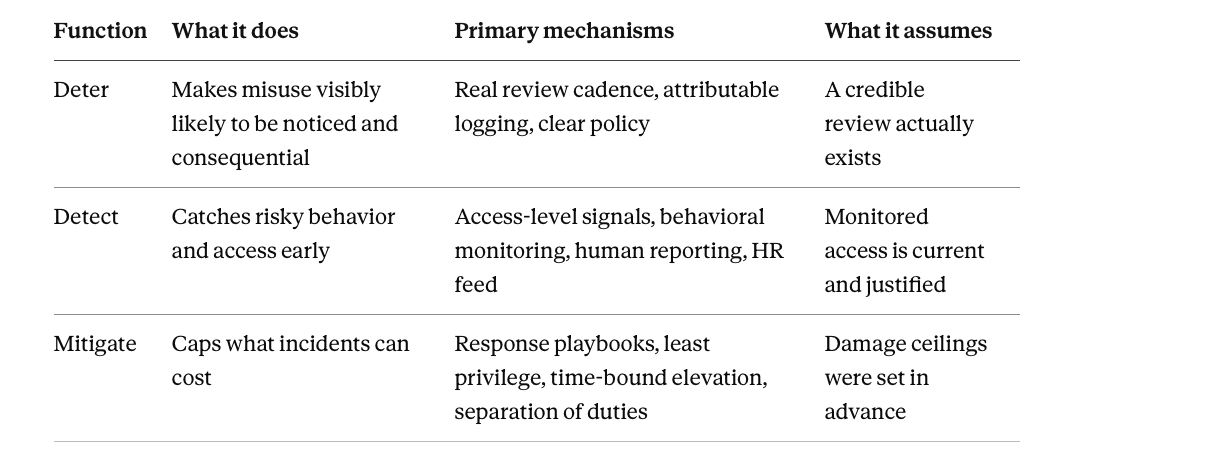
What the three verbs quietly assume is the interesting part. Deterrence assumes there's a credible review someone might fear. Detection assumes the access being monitored is current and justified, so anomalies mean something. Mitigation assumes damage ceilings were set before the incident, because they can't be set during it. All three functions perform exactly as well as the access foundation under them, which is the part most program descriptions skip and this one won't.
The Three Defensive Functions, Unpacked
Deterrence: Making Misuse a Bad Bet
Deterrence works on the calculating insider, the one weighing whether misuse would be noticed. A program deters when three things are visibly true: access is reviewed on a real cadence with real consequences, activity on sensitive systems is logged and attributable, and policies state clearly what's monitored and what happens on violation.
The mechanism is mundane and effective. An insider contemplating misuse of broad, never-reviewed access is operating on a reasonable assumption that nobody is watching. A recurring, well-evidenced review cycle, where access gets revoked and justifications get recorded, removes that assumption. Deterrence, unlike detection, costs almost nothing extra: it's the visibility of governance the program should be doing anyway.
Detection: Catching It Early
Programs detect through layered signals: access-level indicators (departed users with live accounts, dormant access waking, permission outliers, unowned service accounts), behavioral indicators (unusual timing, volume, or scope of activity, especially around departures), and human reporting channels, since coworkers notice what tooling can't and need a safe, defined way to say so. The full detection model, including what behavioral analytics can and can't catch, has its own guide; the program-level point is that detection is a function with multiple feeds, not a product you install.
One feed deserves singling out: HR events. Detection sensitivity should rise mechanically for anyone in a resignation or termination window, because that's where documented insider incidents concentrate. A program where security learns about departures from the org chart update has a structural blind spot in its highest-risk window.
Mitigation: Capping What Incidents Can Cost
Mitigation is everything that limits damage when deterrence and detection weren't enough.
Some of it is response: playbooks that define who investigates, what gets preserved, when access gets suspended, and how HR and legal participate.
But the larger share of mitigation is structural and happens in advance: access scoped to roles so a compromised or malicious identity holds little, elevated access that expires rather than stands, and separation of duties so no single identity can complete the most damaging actions alone. The prevention controls that implement this have their own guide; within the program, they're the mitigation function's foundation, built before any incident and paying off during every one.
What an Insider Threat Program Actually Contains
The three functions need an organizational container. A working program includes:
A charter and executive owner. Written scope (who counts as an insider, what assets are covered, what the program may and may not do), a named senior owner, and legal review of the monitoring boundaries. Programs without a charter drift into either toothlessness or overreach.
A cross-functional team. Insider threat is not a security-team problem alone. HR carries the departure and role-change signal, legal governs what's permissible and handles the employment consequences, IT operates the access layer, and security runs detection and investigation. The program is the standing coordination between them, with defined handoffs.
The access governance foundation. A live inventory of identities and access, least-privilege enforcement, scheduled offboarding, time-bound elevation, separation of duties, and coverage of contractors and non-human identities. This is the layer the three functions stand on.
Monitoring proportionate to risk. Detection tooling scaled to the environment's actual sensitivity, layered as the tool landscape warrants, rather than maximal surveillance by default, which erodes both trust and legal footing.
Response playbooks and evidence discipline. Pre-defined investigation steps, and the timestamped record of grants, approvals, reviews, and revocations that lets an investigation reconstruct fact rather than assemble recollection. Clean evidence matters equally for ruling insiders out.
Training and reporting culture. Awareness that's specific to the insider threat types people will actually encounter, and a no-blame channel for reporting mistakes and concerns, which converts the negligent majority of incidents into early signal.
Building the Program: A Realistic Sequence
- Charter first. Scope, owner, legal boundaries, and the definition of "insider" for your organization, including third parties and non-human identities.
- Baseline the access layer. Inventory who and what has access to which systems, find the departed-but-active accounts and unowned service accounts, and fix the offboarding pipeline. This is the highest-return work in the entire program and requires no new detection spend.
- Wire the HR feed. Departures, role changes, and terminations flowing to the access layer and the detection layer automatically.
- Stand up the review cadence. Recurring access reviews with executed revocations: the deterrence function and the drift-catcher in one.
- Add detection over the governed surface. Access-level signals first, behavioral monitoring where the risk justifies it, human reporting channels always.
- Write and rehearse the response playbooks. Including the evidence-preservation steps, before the first real case.
- Measure and iterate. Offboarding completeness and speed, review completion and revocation rates, time-to-detect on planted test cases, and incident post-mortems feeding back into controls.
Where Programs Fail
Three patterns account for most failed programs.
Surveillance-first sequencing. Buying monitoring before governing access produces expensive noise over an ungoverned surface, and a program that's all detection and no floor.
Paper programs. A policy document and an annual training module, with no offboarding discipline, no review cadence, and no HR integration, deters no one, because there's visibly nothing behind it.
Security-only ownership. A program without HR and legal at the table can't see the departure signal, can't act on findings, and eventually can't survive its first contested investigation.
Where Zluri Fits in an Insider Threat Program
Zluri operates the program's access governance foundation: the live identity-and-access inventory the baseline step requires, scheduled departure-day offboarding across every application, continuous least-privilege enforcement against role and usage, time-bound elevation, cross-application separation of duties, coverage of contractor and non-human identities, and the timestamped access record that investigations and reviews run on. It deliberately does not do the behavioral monitoring or content inspection layers. The mechanism-by-mechanism breakdown covers each capability and that boundary in depth.
Frequently Asked Questions
How do insider threat programs defend against insider threats?
Through three coordinated functions: deterrence (making misuse visibly likely to be noticed and consequential, primarily through real access reviews and attributable logging), detection (layered access-level, behavioral, and human-reported signals, with sensitivity raised around departures), and mitigation (prepared response plus structural limits, least privilege, time-bound elevation, and separation of duties, that cap what any incident can cost). All three depend on a governed access foundation: current, justified, reviewable access is what makes deterrence credible, detection meaningful, and damage ceilings low.
What are the key components of an insider threat program?
A written charter with an executive owner and legal boundaries; a cross-functional team spanning security, IT, HR, and legal; an access governance foundation (inventory, least privilege, offboarding, time-bound elevation, separation of duties); monitoring proportionate to risk; response playbooks with evidence discipline; and specific training plus a no-blame reporting channel.
Who should own an insider threat program?
A named senior owner, typically in security, with HR and legal as standing members rather than occasional consultees. HR carries the departure and role-change signal where insider risk concentrates; legal governs monitoring boundaries and employment consequences. Programs owned by security alone routinely fail at exactly those two seams.
What's the first step in building an insider threat program?
After chartering, baseline the access layer: inventory all identities and access, find departed-but-active accounts and unowned service accounts, and fix offboarding so departures revoke everything on the last working day. It's the highest-return step, requires no new monitoring spend, and every later function (deterrence, detection, mitigation) performs better on the governed surface it produces.


.svg)