MFA and SSO stop most unauthorized login attempts. Neither has any opinion about whether the access behind a successful login should still exist. That's not a flaw, it's a boundary, and layered security is what you build past it.
A layered approach to security means no single control is asked to do more than it's built for.
- Different layers cover different failure modes. Perimeter defenses, endpoint protection, authentication, and governance each guard against something the others don't.
- MFA and SSO are essential, but incomplete on their own. They're two of the strongest layers in the stack, not the whole stack.
- Governance is what closes the gap. It's the governance layer that sits on top of authentication, and understanding exactly where MFA and SSO stop is the case for it.
What MFA and SSO Actually Do Well
Multi-factor authentication requires more than a password to prove identity at login, something you know, something you have, something you are. Even a compromised password fails to grant access without the second factor, which is why MFA meaningfully raises the cost of credential-based attacks.
Single sign-on lets users authenticate once and access multiple connected applications with that single session, removing the password sprawl that pushes people toward weak or reused credentials, and giving IT one central point to enforce authentication policy across every federated app.
Together, they're the strongest authentication layer most organizations can deploy, and neither should be skipped. The limitation isn't in what they do. It's in what they were never designed to do.
Where MFA and SSO Stop
They verify identity at the moment of login, not access over time. MFA and SSO answer "is this really you, right now." Neither has a mechanism for asking whether the access granted six months ago is still appropriate today. A contractor's project ends, a role changes, an account goes dormant, none of that triggers anything in an authentication layer, because reassessing standing access was never its job.
Their coverage stops at what's connected. SSO secures the applications federated to it. Anything outside that boundary, an app purchased directly by a team, a tool adopted without IT's knowledge, is invisible to an authentication-first security model entirely. In most organizations that unfederated share of the real application footprint is substantial, and it's exactly where governance gaps concentrate, precisely because nothing there is being watched.
They don't distinguish appropriate access from convenient access. SSO makes it easy to reach many applications with one login. It has no concept of whether a given user should hold access to a given app, only whether they're authenticated. Least privilege, the idea that access should match actual need and nothing more, isn't something an authentication layer enforces; it's a governance decision made elsewhere, or not made at all.
Credential compromise doesn't require beating MFA. Credential stuffing, session hijacking, and social engineering can all succeed without ever defeating the second factor directly. And once a credential is compromised, MFA and SSO have no downstream control over what that access can still do or how quickly it gets shut off.
None of this is an argument against MFA or SSO. It's the argument for not stopping there.
Where Identity Governance Fits
Identity governance and administration picks up precisely where authentication leaves off: not verifying who's logging in, but governing whether the access behind that login should exist, for how long, and under what conditions.
- Automated lifecycle management. Access is granted based on role at the moment someone joins, adjusted automatically as roles change, and revoked the moment someone leaves, across every connected system rather than just the ones tied to SSO. This is what closes the standing-access gap that authentication alone leaves open.
- Segregation of duties. Governance enforces that no single person accumulates control over both sides of a sensitive process, someone who initiates a financial transaction shouldn't be the same person who approves it. That's a policy decision authentication has no mechanism to enforce, since SSO has no concept of what a role combination means. SoD is a distinct discipline for exactly this reason.
- Role-, attribute-, and policy-based access control. Access maps to job function, specific attributes, or defined policy conditions, not broad group membership, so a clinician sees patient records while administrative staff manage scheduling, without either inheriting the other's access by virtue of sharing a department. RBAC is the common starting model; ABAC and PBAC extend it once role alone stops being precise enough. This is also what makes the difference between "authenticated" and "appropriately authorized" visible and enforceable, rather than assumed.
- Access reviews. Authentication has no concept of periodically re-checking whether access still makes sense, it isn't built to ask that question at all. Governance closes that gap with recurring, evidence-backed reviews: who has access to what, whether it's still appropriate, and a documented decision either way. This is also where standing access from a completed project, a role someone left months ago, or a contractor whose engagement ended actually gets caught, rather than sitting untouched until an audit or an attacker finds it first.
MFA/SSO vs Identity Governance, Side by Side
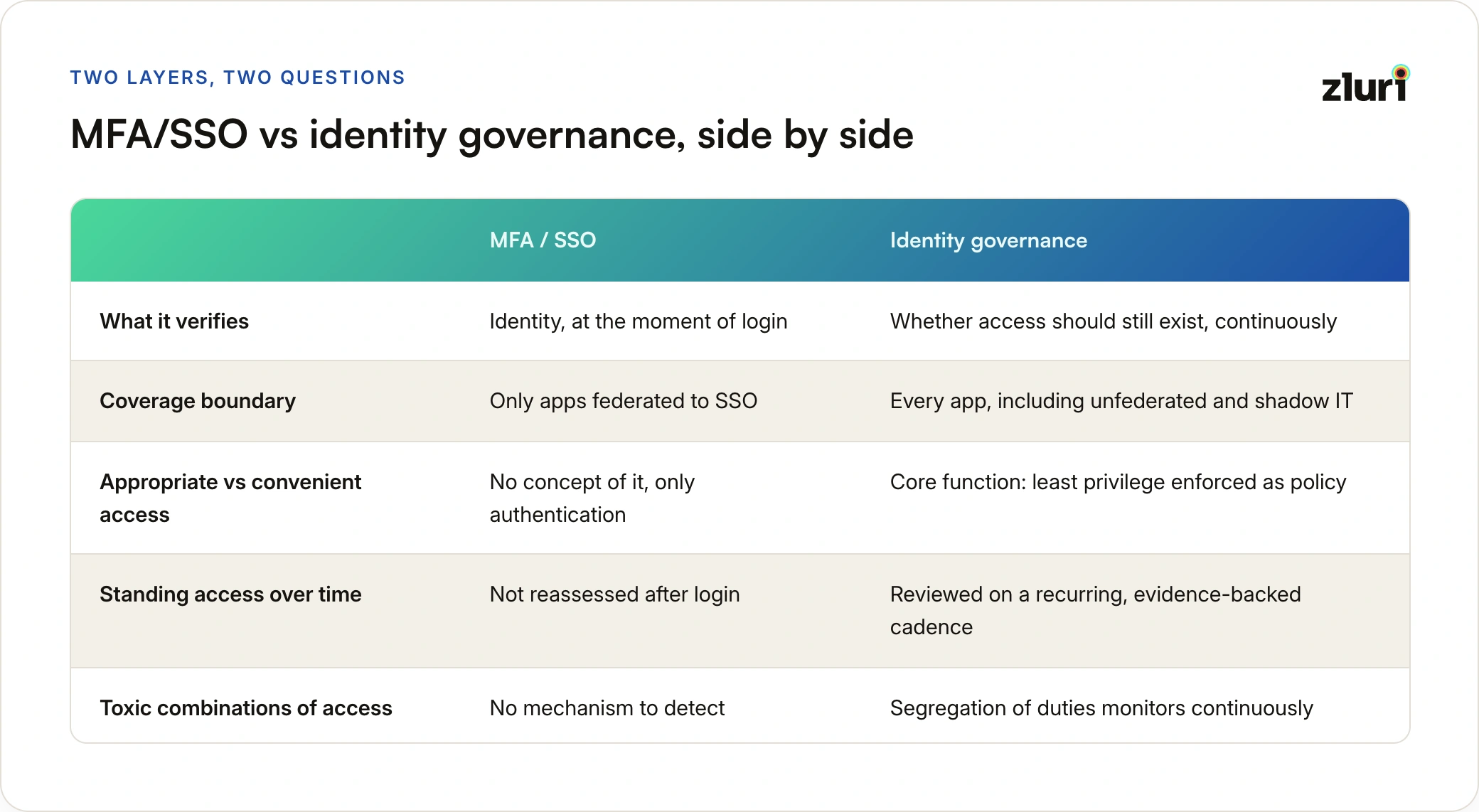
The two layers answer completely different questions, which is exactly why one can't substitute for the other. MFA and SSO confirm identity at a single moment and only within their federated boundary; they have no mechanism for reassessing standing access, catching unfederated apps, or judging whether access is appropriate rather than merely convenient. Identity governance picks up exactly there, continuously validating whether access should still exist, reaching beyond what's connected to SSO, and enforcing least privilege and segregation of duties as ongoing policy rather than one-time checks.
How We Approach the Governance Layer at Zluri
Zluri is built to sit on top of whatever authentication layer you already run, Okta, Entra ID, or another IdP, and govern the access behind it.
Our discovery engine builds an application and identity inventory across eight discovery methods, so governance isn't bound by what's federated to SSO: the unfederated apps, shadow IT, and non-human identities that sit outside an authentication-first view are part of the picture from the start.
On top of that inventory, Access Management handles the full joiner-mover-leaver lifecycle with granular, in-app actions rather than just account-level provisioning, Access Reviews let you certify access by application, group, or individual user depending on the question you're actually answering, and Segregation of Duties continuously monitors for toxic entitlement combinations across your real environment, not just the systems SSO happens to touch.
That review flexibility is worth calling out on its own: most platforms only support reviewing by application, which forces you to reconstruct answers to scoped questions, everyone with access to one system, one access group across five apps, a single contractor's full footprint, out of multiple overlapping campaigns. Zluri supports all three natively, so the review matches the actual question instead of the other way around. None of this replaces your authentication layer. It's the layer authentication was never meant to be.
Frequently Asked Questions
Does identity governance replace the need for MFA and SSO?
No. MFA and SSO remain essential for authentication, verifying that a login attempt is legitimate. Identity governance operates on a different layer entirely: it governs whether the access behind an authenticated session should exist, be reviewed, or be revoked. The two aren't competing controls; one without the other leaves a real gap.
If SSO is already enforcing access controls across connected apps, why do I need governance too?
SSO enforces authentication policy, not access appropriateness. It confirms a user is who they claim to be and lets them into apps they're already provisioned for. It has no mechanism for reviewing whether that provisioning is still correct, catching accumulated access from a role change, or reaching applications outside its federation. Governance is what actually answers those questions.
What's the difference between authentication and authorization in a layered security model?
Authentication (MFA, SSO) verifies identity at login. Authorization decides what an authenticated identity is permitted to do. Identity governance sits above both, continuously validating that current authorization is still appropriate, not just correctly enforced at the moment access was granted.
How does segregation of duties fit into a layered security strategy if MFA already restricts who can log in?
MFA restricts login to the right person. It says nothing about what that person is allowed to do once they're in, or whether their combined permissions create a conflict of interest. SoD is a governance control specifically because it evaluates the relationship between multiple entitlements, something no authentication layer is built to reason about.
Is a layered security approach only relevant for large enterprises?
No. The gap between authentication and governance exists at any size, smaller organizations just have less staff to manually cover it. If anything, the case for automating the governance layer is stronger for smaller IT teams, since they have the least capacity to catch what authentication alone misses.



.svg)