Most rejected access requests just disappear. A ticket gets closed, a Slack thread goes quiet, and the requester is left guessing whether it was ever actually reviewed. An auto-reject with a stated reason does something different: it turns a dead end into a record, one the requester can read immediately and one the organization can point back to the next time a similar request comes in.
Rejection tends to get treated as the boring outcome, the one that doesn't need explaining because nothing happens next. That's backwards. A rejection is a policy decision, the same as an approval is. It also doesn't have to be a blunt yes or no: right-sized review actions show how intermediate outcomes work in access reviews. It just doesn't get the same care put into how it's communicated or recorded, usually because the tooling around it wasn't built to bother.
Why Rejections Usually Disappear Without a Trace
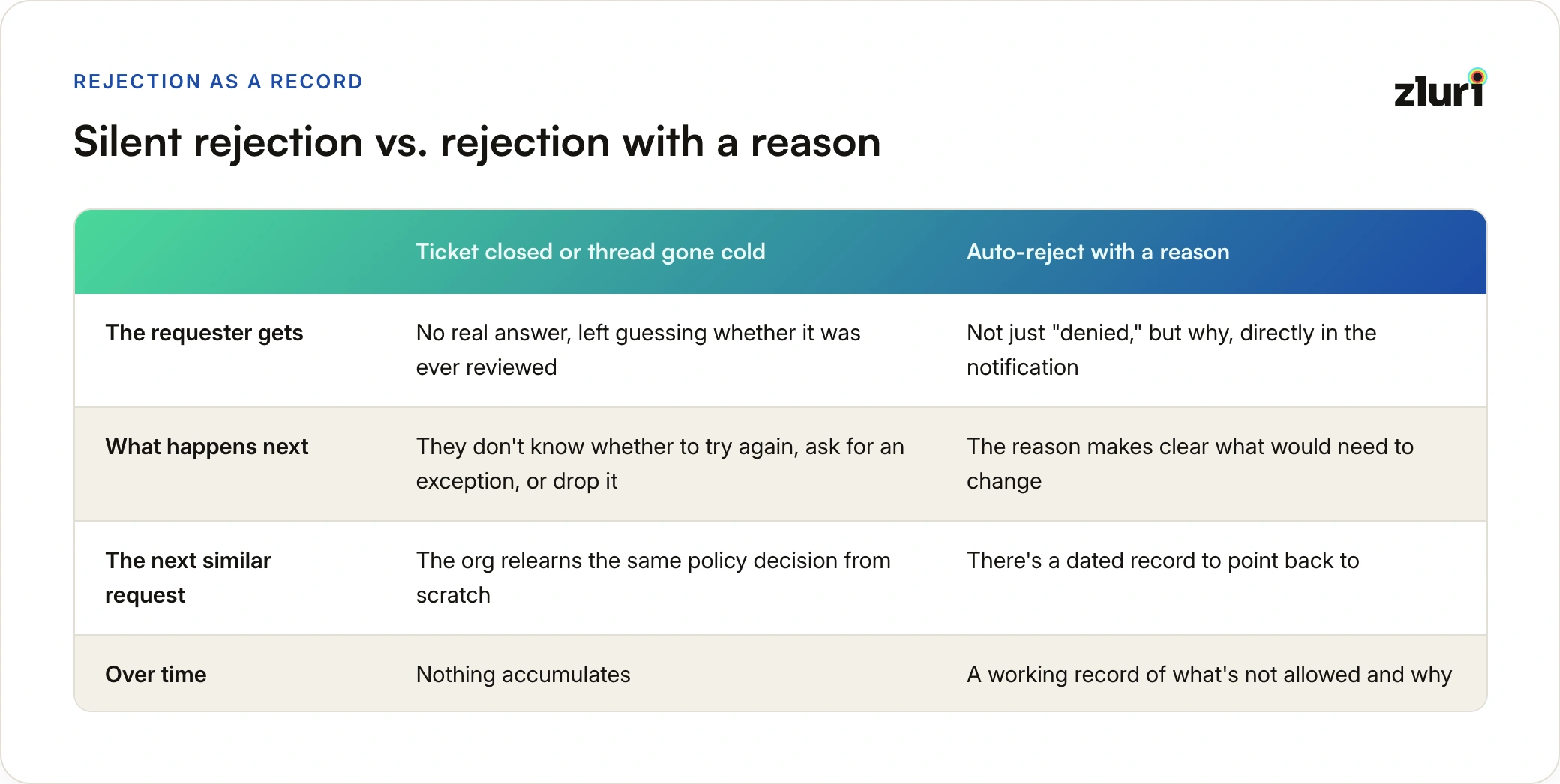
In a generic ticket queue (see access requests via tickets), a denied request often ends the same way an ignored one does: the ticket gets closed, sometimes with a one-line comment, sometimes with nothing at all. In a manual Slack or email exchange, a "no" might not even get a reply, the thread just goes cold. Either way, the requester is left without a real answer, and there's no record anyone else can check later to understand why that request didn't go through.
That gap matters more than it looks like it should. The requester doesn't know if they should try again, ask for an exception, or drop it entirely. And when someone else asks for the same thing three months later, there's nothing to point them to, the org relearns the same policy decision from scratch, or worse, approves something it already decided not to.
What an Explicit Rejection Reason Actually Buys You
Auto-reject, with a rejection reason attached, closes both of those gaps at once. The reason appears directly in the notification sent to the requester, so instead of silence, they get an actual answer: not just "denied," but why. That alone changes the interaction from a wall to a conversation, even if the conversation ends there.
The second effect is less obvious but compounds over time. Every rejection with a reason attached is a small, dated piece of policy documentation. It's not written up in a policy doc anywhere, but it exists, tied to a real request, explaining a real decision. Enough of these accumulate into something close to a working record of what's not allowed and why, without anyone having to maintain a separate document by hand. That record complements a written access control policy rather than replacing it.
A rejection without a reason is just a stop sign. A rejection with a reason is a stop sign that also tells you why the road is closed, which is the only version that actually helps the next person who reaches it.
When Auto-Reject Is the Right Tool, Not Just a Wall
Auto-reject isn't meant to catch everything uncertain, that's what the approval process is for. It's meant for requests where the answer is already known to be no.
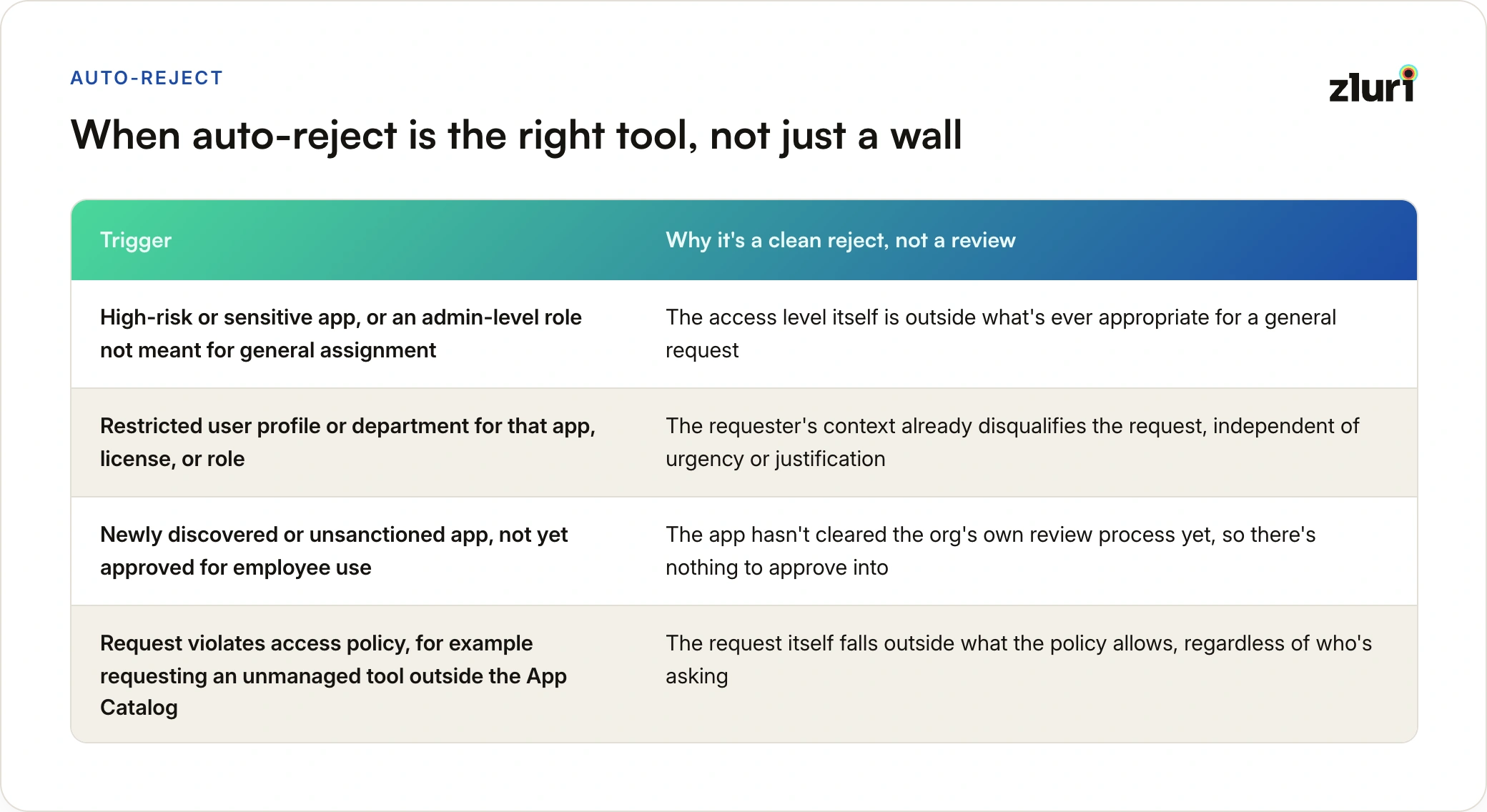
Each of these is a case where sending the request to a human reviewer wouldn't actually change the outcome, it would just delay a decision that's already made. That's the real test for whether something belongs in auto-reject: not "is this risky," but "is the answer already certain enough that a review adds delay without adding judgment."
The Rejected-Request Record Nobody Thinks to Build
There's a specific version of this worth calling out: rejections tied to unsanctioned or newly discovered apps. Each one is, in effect, a data point about shadow IT reaching the front door instead of staying invisible, someone tried to get access the right way, through the app catalog, for a tool that isn't approved yet. That's a meaningfully different signal than usage data alone, it's a documented request, with a name, a date, and a stated business reason attached. Treated as a record rather than noise, a pattern of rejected requests for the same unapproved tool is a strong argument for either sanctioning it properly or reinforcing why it stays out, tied directly into the broader shadow IT picture rather than sitting separately from it.
How This Works in Zluri
The same pattern is built into Zluri's access request management Automation Rules as the Auto-Reject Request action, configured with an optional Rejection Reason field. Whatever's entered there gets delivered directly in the notification Zluri sends the requester, so the reason doesn't require any separate follow-up to surface. The trigger conditions that route a request into this action, department, app role, or a general rule scoped to newly discovered applications, work the same way they do for auto-approve and approval routing, built from the same Add Attribute conditions with AND/OR logic. Rejections tied to an unsanctioned app specifically come from requests made through Zluri's App Catalog for a tool that hasn't been reviewed yet, which is what makes each one a genuine signal rather than background noise.
For how these auto-reject decisions fit into the full picture of how a request resolves in the first place, see automatic approvals and rejections.
Frequently Asked Questions
Is adding a rejection reason required when configuring an auto-reject rule?
It's optional, but skipping it gives up most of the value. Without a reason, the requester gets a denial with no explanation, and the rejection leaves nothing behind that helps with the next similar request.
What's the difference between auto-reject and just letting a request sit unresolved?
Auto-reject gives an immediate, explicit answer with a stated reason. A request that sits unresolved, whether in a ticket queue or a message thread, leaves the requester without any answer at all, which is a worse experience even than a clear no.
Should every risky request go through auto-reject instead of a review?
No. Auto-reject fits requests where the outcome is already certain, a restricted profile, an unsanctioned app, a role that's never appropriate to request generally. Anything genuinely uncertain still belongs in the approval process, where a human can weigh context auto-reject conditions can't capture.
Can a rejected request be reconsidered later?
The rejection stops that specific request, it doesn't permanently bar the requester from asking again if circumstances change, for example once an unsanctioned app gets formally reviewed and approved. The rejection reason is what makes it clear to the requester what would actually need to change.