Moving access requests off a ticket queue and out of email threads isn't a cosmetic change. Specific capabilities that never existed in either one get added, and it's worth being precise about which ones, what the switch actually requires, and what it doesn't magically fix on its own.
Organizations that still handle access requests through a general ITSM ticket, sometimes backed up by an email or Slack message when the ticket stalls, usually aren't unaware that it's clunky. The switch just hasn't happened yet, often because it's unclear what actually changes on the other side of it, and what work the switch itself requires.
Here's what's genuinely different in access request management (part of Zluri's Access Management module), capability by capability, along with what the move doesn't do automatically. The four capabilities covered:
- Entry points: one request, several natural starting places
- Triage: structured conditions instead of manual reading and forwarding
- Status: specific states instead of "Open"
- Record: one findable page instead of scattered threads
What a Ticket and an Email Thread Actually Provide Today
Give both their due. A ticket provides a record that something was requested and a status field, however uninformative. An email or Slack message provides speed and a direct line to a specific person, useful when the requester already knows exactly who to ask. Neither is nothing, and neither approach was chosen carelessly, they're usually just whatever tooling was already in place before access requests became frequent enough to need something dedicated. The problem is what's missing around them, not that they do nothing at all. The costs on the ticket side are covered in access requests via tickets, and where ITSM software falls short is its own topic.
Capability 1: A Single Entry Point Becomes Several, on Purpose
A ticket lives in one portal. An email or Slack message starts wherever the requester happens to think to send it, different every time. A dedicated flow replaces both with the same structured request reachable from more than one natural starting point, an application catalog, an overview page, or a dedicated requests screen, so the requester never has to guess which system they're supposed to use for this specific ask.
Capability 2: Structured Conditions Replace Manual Triage
A ticket's free-text field gets manually read and routed by whoever picks it up. An email gets manually forwarded to whoever the sender guesses is the right approver. A dedicated flow replaces that manual step with structured conditions evaluated automatically, department, role, access level, and more, deciding whether a request can resolve instantly or needs to go to a specific person, without anyone having to read and triage it by hand first.
Capability 3: Status Becomes Specific Instead of Generic
A ticket's "Open" status and an unanswered email both leave the requester unable to tell what's actually happening. A dedicated flow replaces that with a specific state, approved, rejected, awaiting approval, provisioning completed, or no rules matched, visible without adding a comment or sending a follow-up message.
Capability 4: The Record Becomes Findable
A ticket's history sits mixed in with hardware requests and password resets. An email thread's history sits in whoever's inbox it landed in, possibly split across more than one person if it got forwarded. A dedicated flow keeps the full record, who requested what, the approval sequence, and every status change, on one page, so finding out why a specific person has a specific access six months later doesn't depend on anyone's memory or inbox.
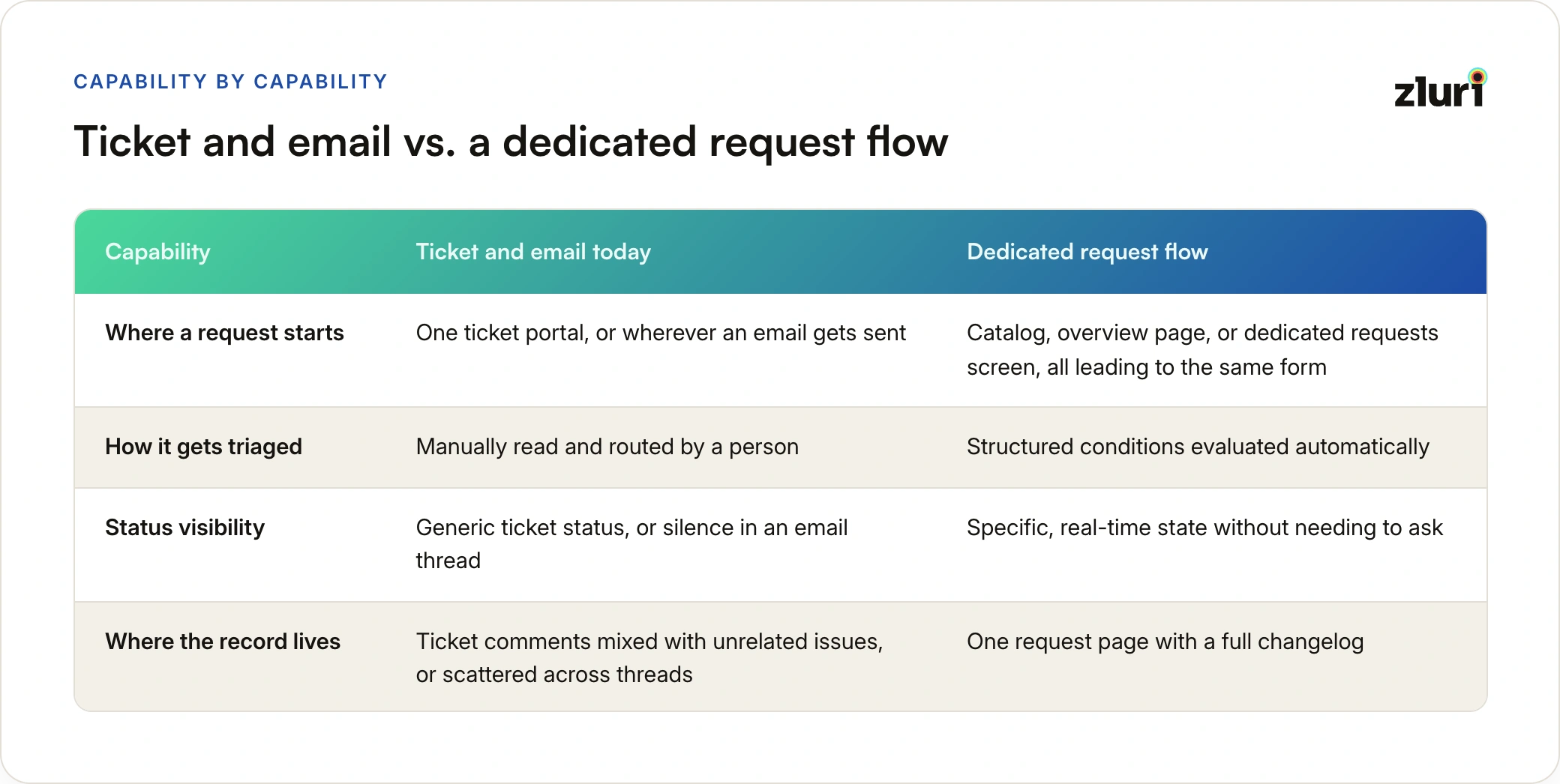
Taken together, the four capabilities line up like this. Where a request starts: a ticket or email means one portal or wherever the message gets sent, while a dedicated flow offers a catalog, overview page, or requests screen that all lead to the same form. How it gets triaged: a person manually reads and routes it today, versus structured conditions evaluated automatically. Status visibility: a generic ticket status or silence in an email thread today, versus a specific, real-time state. Where the record lives: ticket comments mixed with unrelated issues or scattered threads today, versus one request page with a full changelog.
What Doesn't Come for Free
None of these capabilities show up automatically the day tickets get turned off. A dedicated request flow only works as well as the conditions and routing configured inside it, which means someone still has to define which departments, roles, and access levels map to which outcome, and who the right approver is for each app. Skipping that setup work and expecting the new system to behave sensibly by default is the most common way a migration disappoints early on.
The apps themselves need attention too. A tool that's been informally requested via email for years might not have a clearly defined owner anywhere, which means the first real task in moving it into a structured flow is figuring out who that owner actually is, not just building the form. This is less a limitation of the new system and more an overdue piece of housekeeping the old process let organizations avoid, since a ticket queue never forced anyone to answer "who owns this app" in a structured, queryable way.
None of this is a reason to delay the switch. It's a reason to expect the first few weeks to involve real configuration work, not just flipping a setting, and to treat that setup as an investment that pays off on every request afterward rather than a one-time inconvenience.
Trying to migrate every app at once tends to make that setup work harder than it needs to be. A phased approach is more manageable:
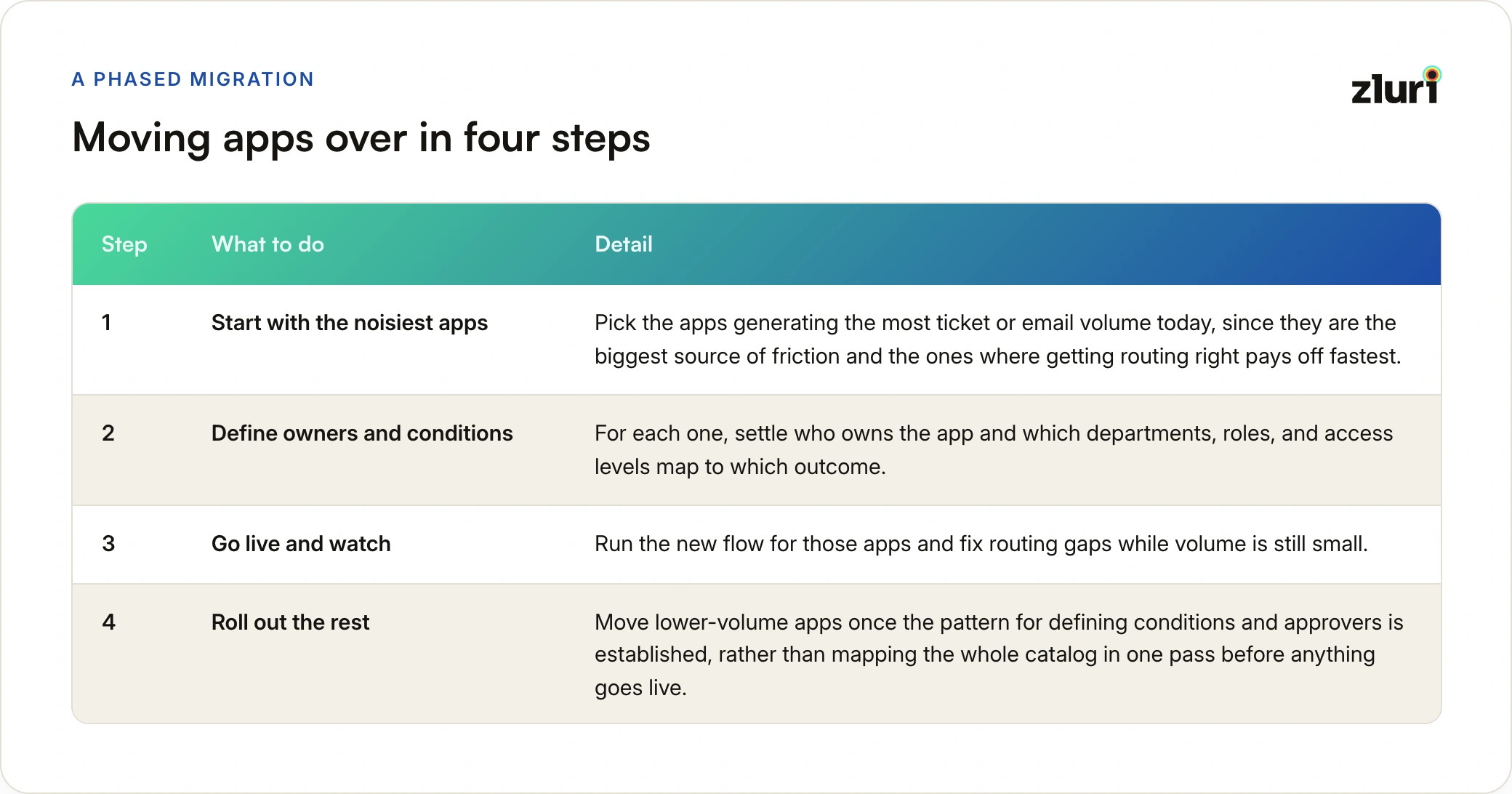
- Start with the noisiest apps: pick the apps generating the most ticket or email volume today, since they are the biggest source of friction and the ones where getting routing right pays off fastest.
- Define owners and conditions: for each one, settle who owns the app and which departments, roles, and access levels map to which outcome.
- Go live and watch: run the new flow for those apps and fix routing gaps while volume is still small.
- Roll out the rest: move lower-volume apps once the pattern for defining conditions and approvers is established, rather than mapping the whole catalog in one pass before anything goes live.
The first real task in a migration isn't building the form. It's finding out who actually owns each app.
How to Tell You're Ready to Make the Switch
A few signals tend to show up consistently in organizations where the old process has genuinely stopped working, rather than just being mildly annoying:
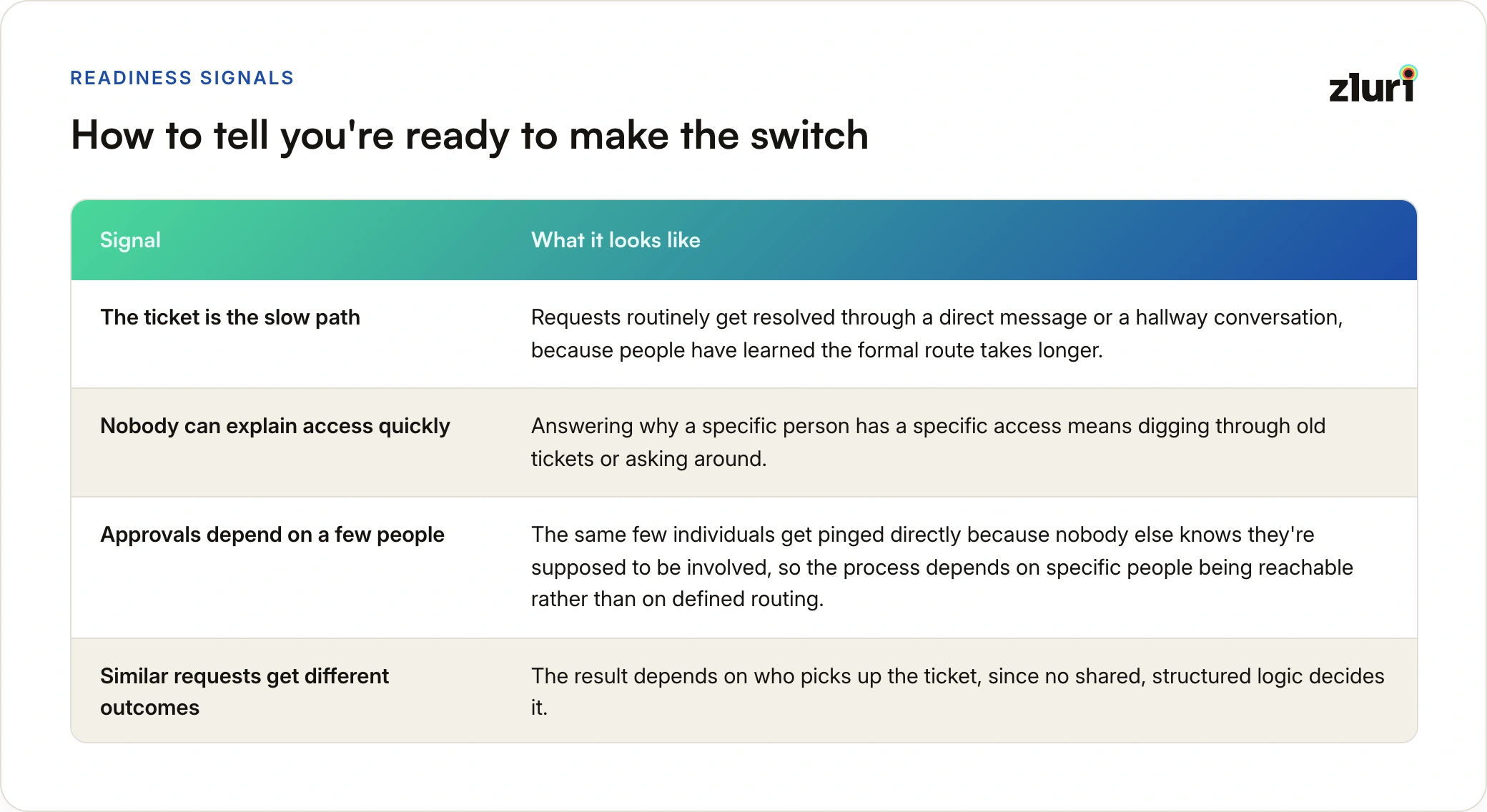
- The ticket is the slow path: requests routinely get resolved through a direct message or a hallway conversation, because people have learned the formal route takes longer.
- Nobody can explain access quickly: answering why a specific person has a specific access means digging through old tickets or asking around.
- Approvals depend on a few people: the same few individuals get pinged directly because nobody else knows they're supposed to be involved, so the process depends on specific people being reachable rather than on defined routing.
- Similar requests get different outcomes: the result depends on who picks up the ticket, since no shared, structured logic decides it.
Any one of these on its own might just be a rough week. All of them showing up regularly is a sign that the ticket-and-email approach has already broken down in practice, even if it technically still processes every request eventually. If that sounds familiar, comparing access request management tools is the natural next step.
What Doesn't Change
The judgment behind an access decision doesn't disappear in this switch, and it shouldn't. Anything genuinely sensitive still gets routed to a person to decide (including multiple approvers and OR logic for faster resolution), the difference is that routing happens automatically instead of depending on whoever picks up the ticket or gets forwarded the email.
The setup work also doesn't end once the initial routing is configured. Departments reorganize, apps change owners, and what counted as a safe, auto-approvable combination of role and access level six months ago might not still be accurate today. A dedicated flow makes that easier to keep current than a ticket queue ever did, since the routing logic lives in one place rather than in whichever agent happens to remember the current org chart, but it still needs someone checking it periodically rather than assuming it stays correct on its own indefinitely. For how that automated routing actually decides what resolves on its own versus what goes to a person, see automatic approvals and rejections. For the requester-side view, see a better request experience.
Frequently Asked Questions
Do we lose the audit trail a ticket system provides when we switch?
No, the audit trail improves. A ticket's record sits mixed in with unrelated IT issues. A dedicated request flow keeps a full changelog specific to the access decision, on its own page, which is easier to find and easier to audit later.
What happens to requests that currently rely on someone just knowing who to email?
That informal knowledge gets replaced by structured routing, department, role, and other conditions determine where a request goes automatically, so the outcome doesn't depend on the requester happening to know or guess the right person. Getting there requires defining that routing up front, which is real setup work, not something that happens by default.
Is this just a UI change, or does the underlying process actually change?
The underlying process changes. Manual triage, generic status, and a scattered record all get replaced by structured conditions, specific status, and a single findable record. The visible form is part of it, but the capability underneath is what's actually different, and it depends on the routing logic being configured correctly.
Does moving off tickets mean giving up manual review for sensitive requests?
No. Anything that needs a human decision still gets one. What changes is that the routing to that person happens automatically and immediately, instead of depending on a ticket being manually triaged or an email being forwarded to the right inbox.
How do we know if we're actually ready to make this switch?
Look for signs the current process has already broken down in practice: requests routinely resolved by direct message instead of the formal path, no quick way to explain why someone has a given access, approvals depending on a few specific reachable people rather than defined routing, and inconsistent handling of similar requests depending on who picks them up.
Should we migrate every app at once, or take a phased approach?
A phased approach tends to work better. Starting with the apps generating the most ticket or email volume today addresses the biggest source of friction first and establishes a working pattern for defining conditions and approvers, which makes migrating the rest of the catalog faster once that pattern is in place.