The ticket and the DM both get access granted eventually. Neither one was built around the person doing the requesting, or the person approving it. A better way looks different from the ground up, and the difference shows up in more than just how it feels to use.
Most people don't think about how they'd design an access request flow, they just live with whatever their organization already has. That's usually a generic ticket, or a message to whoever seems most likely to know.
Neither is a design, exactly. They're what's left when nobody built something dedicated to this specific problem. A purpose-built flow starts from a different question: reachable from wherever someone already is, a form that only asks what actually matters, and a status anyone can check without pinging a single person. What that looks like in practice, the entry points, the form, the live tracking, is covered in full in the guide to access request management. What's worth spending real time on here is why it matters beyond just feeling nicer to use.
In this piece, we cover:
- Why friction decides adoption: how a slow process quietly pushes access decisions outside any tracked system
- What approvers deal with: the hidden cost on the other side of the request
- One request, start to finish: what the flow looks like in practice
- What changes at scale: why the old approach gets harder to ignore as headcount and app count grow
Why Friction Decides Whether People Use the Sanctioned Path at All
Every extra step in a request process is a small test of whether someone will actually go through the front door. Most people pass that test the first few times. Fewer pass it consistently, especially once they've had one request take three days to resolve because no one knew whose queue it landed in.
What happens next is predictable and rarely tracked anywhere. Someone needs access quickly, and the formal process was slow last time, so they route around it:
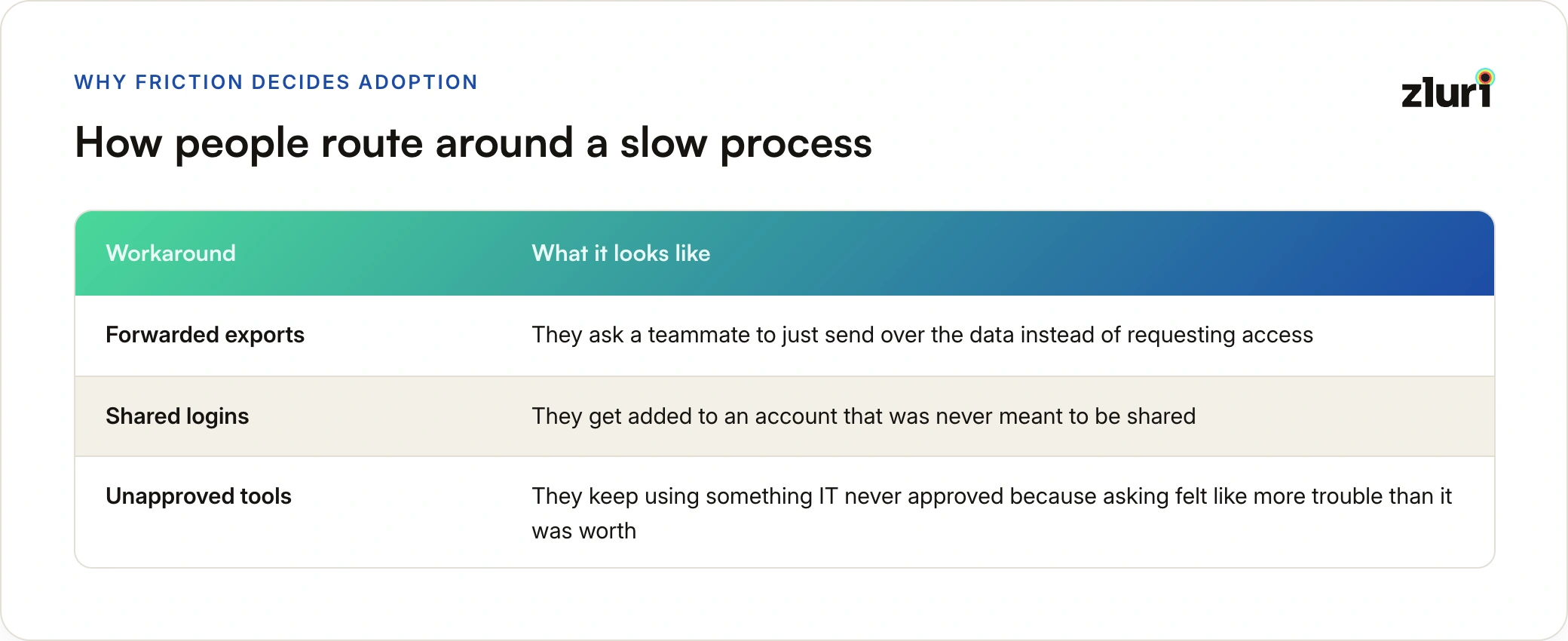
- Forwarded exports: they ask a teammate to just send over the data instead of requesting access
- Shared logins: they get added to an account that was never meant to be shared
- Unapproved tools: they keep using something IT never approved because asking felt like more trouble than it was worth
None of these show up as a security incident in the moment. They show up months later as an access review that can't be fully explained, or an audit that turns up accounts with no record of how they got there. Getting this right is also part of a better employee experience around access.
This is the part that's easy to miss when evaluating a request flow purely on convenience. A flow that's genuinely easy to use isn't just pleasant, it's what keeps access decisions inside a system that can actually account for them. Every request that goes through the sanctioned path instead of around it is one more decision with a business justification attached, an approver on record, and a timestamp.
Friction doesn't just slow people down. It quietly pushes some share of access decisions outside anywhere governance can see them.
What Changes for the People on the Other Side of the Request
The requester isn't the only one dealing with a bad process. Whoever's approving requests, a manager, an app owner, a security reviewer, inherits a version of the same problem from the other direction.
A generic ticket or a forwarded email gives an approver a request with inconsistent information, because every requester fills in whatever they happen to think to include. Some tickets have a clear business reason attached, others just say "need access," and the approver has to chase down context before they can make a decision at all, which is a known reason approvers make bad decisions. Multiply that by however many requests come through in a week, and a meaningful share of an approver's time isn't spent deciding, it's spent figuring out what's actually being asked.
With a generic ticket or a forwarded email, the business justification can range from a detailed explanation to just "need access," the role and duration are often missing and have to be asked for, the approver chases the requester for context, and most of their time goes into reconstructing what's being asked. With a structured request form, the justification lands in the same field every time, role and duration are standard fields on every request, everything the approver needs sits on one page, and their time goes into the decision itself.
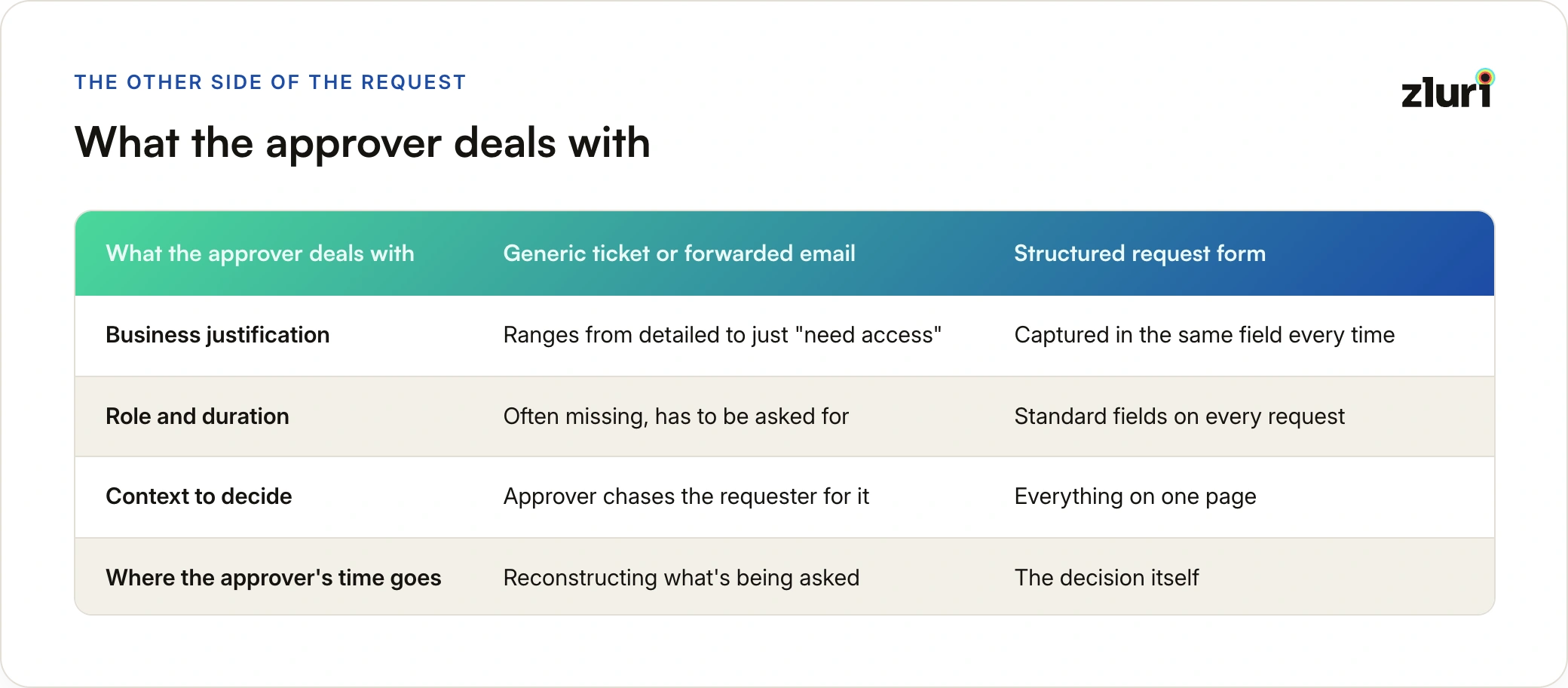
That's a smaller, less visible win than the requester-facing improvements, but it compounds across every request an organization processes, and it's a big part of why a well-designed flow ends up faster overall, not just less annoying to use.
A Request From Start to Finish
It's easier to see the difference by walking through one request rather than describing it abstractly. Here is how self-service access requests work for someone on the sales team who needs a reporting tool for a project starting next week:
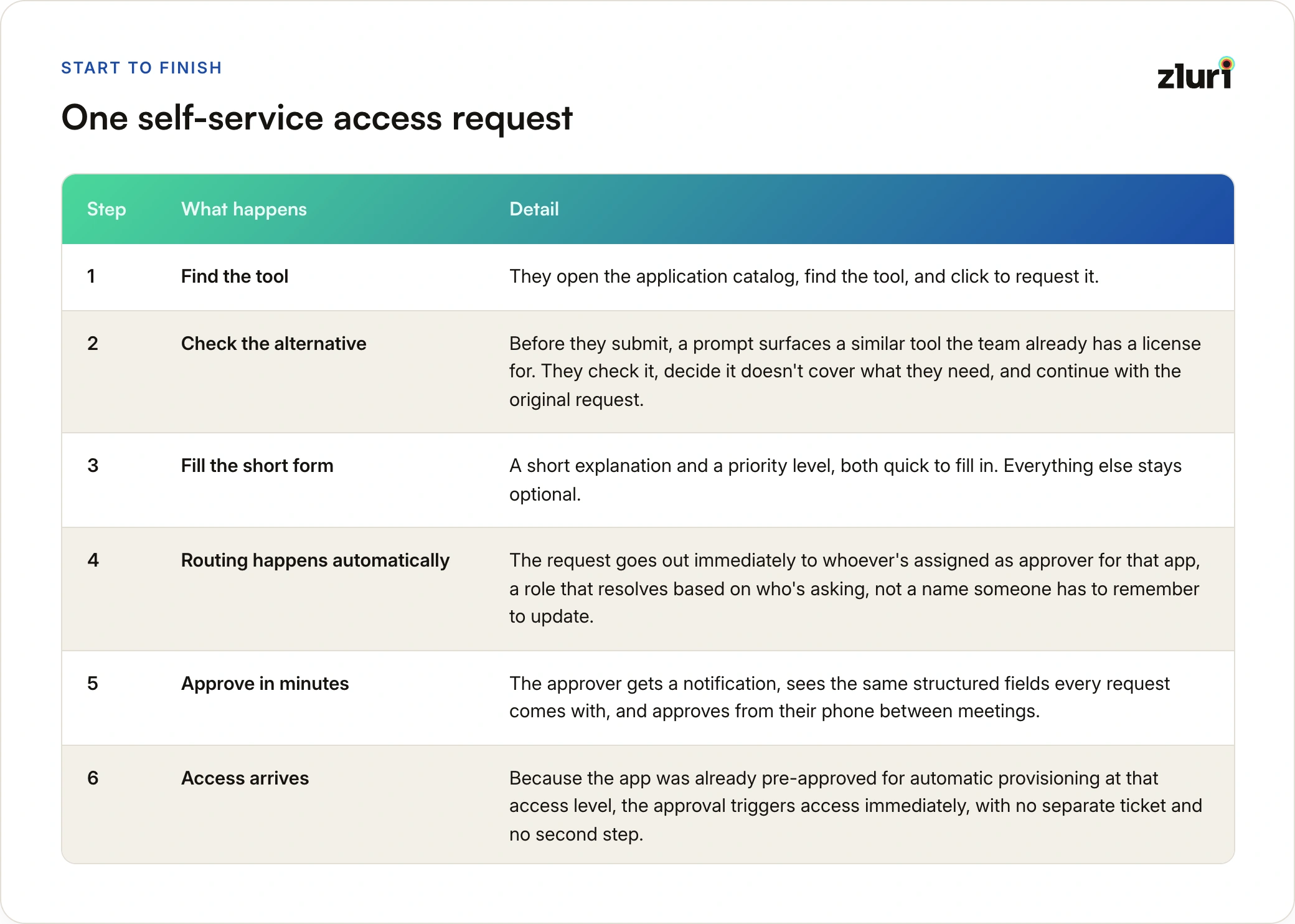
- Find the tool: they open the application catalog, find the tool, and click to request it.
- Check the alternative: before they submit, a prompt surfaces a similar tool the team already has a license for. They check it, decide it doesn't cover what they need, and continue with the original request.
- Fill the short form: a short explanation and a priority level, both quick to fill in. Everything else stays optional.
- Routing happens automatically: the request goes out immediately to whoever's assigned as approver for that app, a role that resolves based on who's asking, not a name someone has to remember to update.
- Approve in minutes: the approver gets a notification, sees the same structured fields every request comes with, and approves from their phone between meetings.
- Access arrives: because the app was already pre-approved for automatic provisioning at that access level, the approval triggers access immediately, with no separate ticket and no second step.
The requester finds out access is ready the same way they'd expect an app install confirmation to arrive, a notification, not a status check. If they need to reference the decision later, for an audit or just to remember what they asked for, the full record, the request, the approval, the exact time provisioning completed, sits on one page.
None of this required anyone to know who to email, guess which queue to file into, or wait for a ticket to get triaged.
Why This Gets Harder to Ignore as an Organization Grows
A slow, unclear request process is annoying at small scale and genuinely damaging at larger scale, and the difference isn't just volume, it's what starts breaking down as more people and more apps enter the picture.
At a handful of employees and a dozen apps, informal routing works because one person can remember who owns what and field requests without much getting lost, but that depends entirely on institutional memory, which gets thinner and less reliable as headcount and turnover grow. Access requests via tickets hold up slightly longer, yet more requests means more competition for the same triage capacity, so the unclear status and inconsistent context it was already generating multiply, and what was a minor annoyance at twenty requests a month becomes a real operational drag at two hundred. A structured flow behaves the same at both ends, because matching a request to the right approver, capturing the right context, and tracking status is done by a system rather than by someone's memory or a queue's triage capacity.
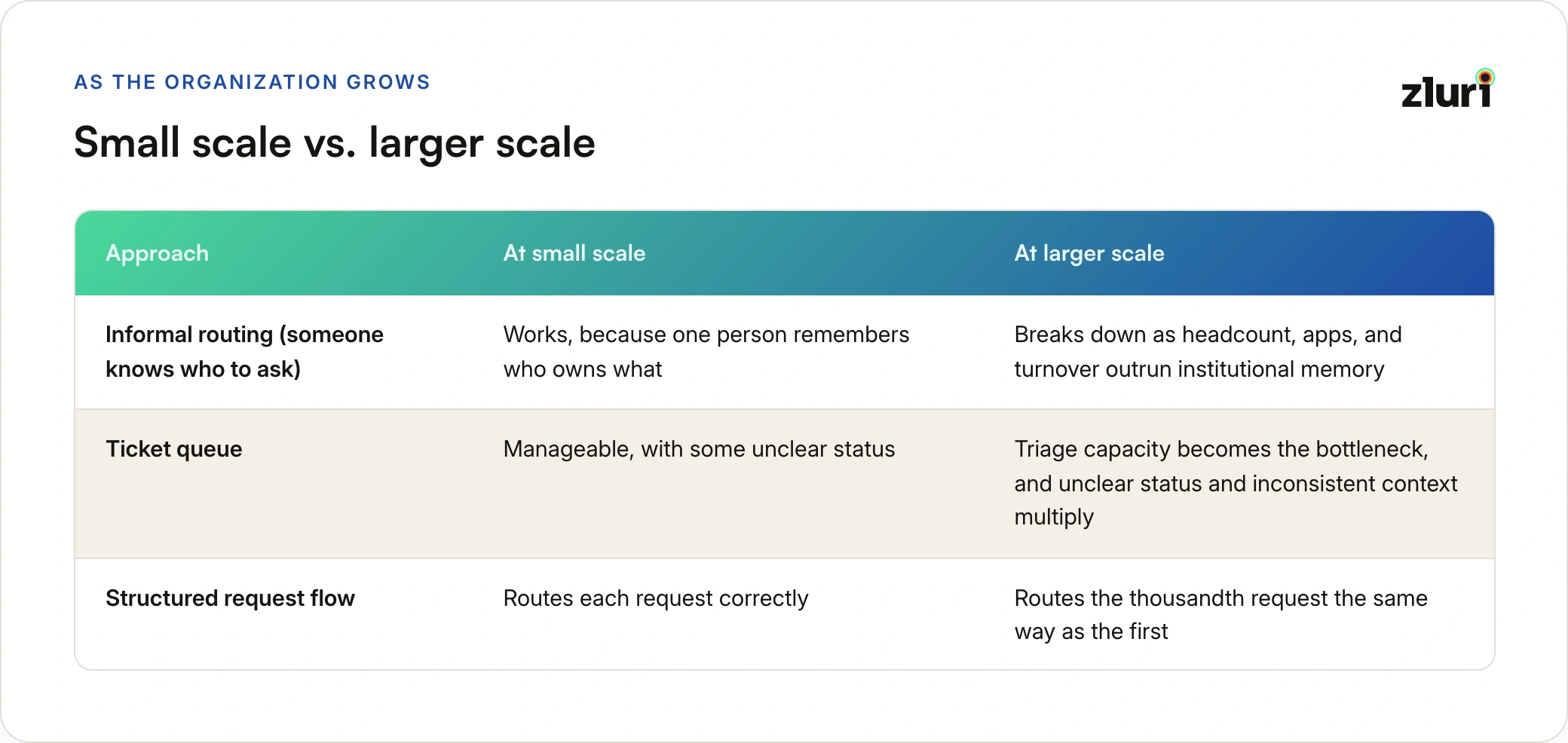
The same rules that route one request correctly route the thousandth one the same way. That's not a claim that the flow itself gets easier to use as the organization grows, it's that the alternative gets harder in a way this one doesn't.
What Actually Changes
None of this strips out the judgment behind an access decision, someone still decides whether a request gets granted, and for anything genuinely sensitive, that decision still gets routed to a person rather than resolved automatically. What changes is where the friction lives. It moves out of the requester's way, and out of the approver's way too, and into the parts of the system built to handle it:
- Routing logic: matching each request to the right approver automatically
- The audit trail: one record per request, with every decision attached
- Automation rules: deciding what can resolve on its own and what goes to a person
For more on how that automated part of the decision actually works, see automatic approvals and rejections. For what the switch involves in practice, see migrating to a request flow.
Frequently Asked Questions
What's the single biggest difference between a ticket and a purpose-built request flow?
Where the request can start, and what happens to the friction that gets removed. A ticket usually lives in one place and puts the burden of navigating it entirely on the requester. A purpose-built flow removes that burden without removing the judgment behind the decision, it just relocates where that judgment happens.
Does making requests easier to submit actually affect governance, or just convenience?
It affects governance directly. When the formal process is slow or confusing enough, some share of requests get routed around it entirely, through shared logins, informal DMs, or tools nobody approved. An easier sanctioned path keeps more of those decisions inside a system that can account for them.
Does a better request flow only help the requester, or does it help approvers too?
Both. A structured form means every request an approver sees has the same fields filled in consistently, which removes the time they'd otherwise spend chasing down missing context before they can even start deciding.
Do requests still get reviewed by a person if the app is sensitive?
Yes. Nothing about a faster, easier flow removes human review for anything that needs it, it just means the routing to that person happens automatically and immediately instead of depending on someone knowing who to ask.