
An access request sitting in a ticket queue looks like it's being handled. It has a status, an assignee, a timestamp. What it doesn't have is anything built to actually process an access decision, and the gap between looking handled and being handled is where the real cost sits.
A ticket queue isn't a bad idea for what it was built for (the limits are covered in what tickets can't do), hardware issues, password resets, general IT problems that need a person to look at them and figure out what's going on. Access requests get put through the same system because it's already there, not because it's the right tool for this specific job.
That mismatch is easy to miss from the outside. The ticket exists, it has a status, it eventually closes. Here's what's actually happening underneath that, and who ends up paying for it.
In this piece, we cover:
- The status problem: why "Open" and "In Progress" hide the difference between waiting and stuck
- The form problem: why free text forces manual back-and-forth
- The record problem: why access decisions get lost inside unrelated IT history
- Who pays: how the cost lands on requesters, agents, and auditors differently
The Status Doesn't Tell You What's Actually Wrong
A ticket sitting at "Open" or "In Progress" could mean two very different things: it's waiting on a specific approver who hasn't gotten to it yet, or nobody's actually looked at it since it was filed. From the requester's side, both look identical. Finding out which one it is means adding a comment and waiting for a reply, which is itself another round trip through the same slow system that created the problem. Ticket statuses were designed for IT issues in general, as laid out in this guide to ticket statuses.
This is the first hidden cost: a status that looks informative but doesn't actually tell the requester, or anyone else, what's genuinely happening. Worse, it doesn't distinguish a normal delay from an actual problem. A ticket that's been sitting untouched for three days looks identical, on the surface, to one that's one comment away from approval. Nobody escalates the first kind unless they happen to notice, because the system gives no signal that escalation is warranted.
A status that can't tell "waiting on an approver" from "nobody has looked at this" isn't really a status. It's a label.
The Form Wasn't Built for This Decision
A ticket form typically has a free-text field and a category dropdown, not a structured way to capture what's actually being requested, for how long, or why. That gap doesn't disappear, it gets filled by back-and-forth: the assigned agent has to ask clarifying questions, figure out who the real approver is, and manually route the request to them.
None of that manual routing is visible to the person who filed the ticket. It's happening, it's just happening somewhere the requester can't see, which means the delay reads as "nothing's happening" even when something actually is. And because the information gathered this way lives in comments rather than structured fields, it's effectively unsearchable later. Nobody can filter for "all requests where the business justification was X" or "all requests for admin-level access in the last quarter," because that information was never captured anywhere consistent enough to query.
The Record Disappears Into an Unrelated History
A ticket's comment thread sits in the same system as every other IT issue, hardware requests, software bugs, password resets. There's no dedicated place where "why was this access request approved or denied" lives on its own. Finding that answer six months later means searching through a ticket history that was never organized around access decisions specifically, assuming the ticket wasn't closed and archived somewhere even less accessible.
This matters more than it sounds like it should, because access records are exactly the kind of thing that gets asked about later, during an audit, during an incident investigation, during a routine access review trying to figure out why someone has a particular permission. A ticket system can technically produce this information if someone's willing to dig, but "technically retrievable with enough effort" and "actually usable as a record" are different standards, and only one of them holds up under real time pressure. The same applies to denials, covered in rejected requests as policy records.
How These Costs Land Differently Depending on Who's Affected
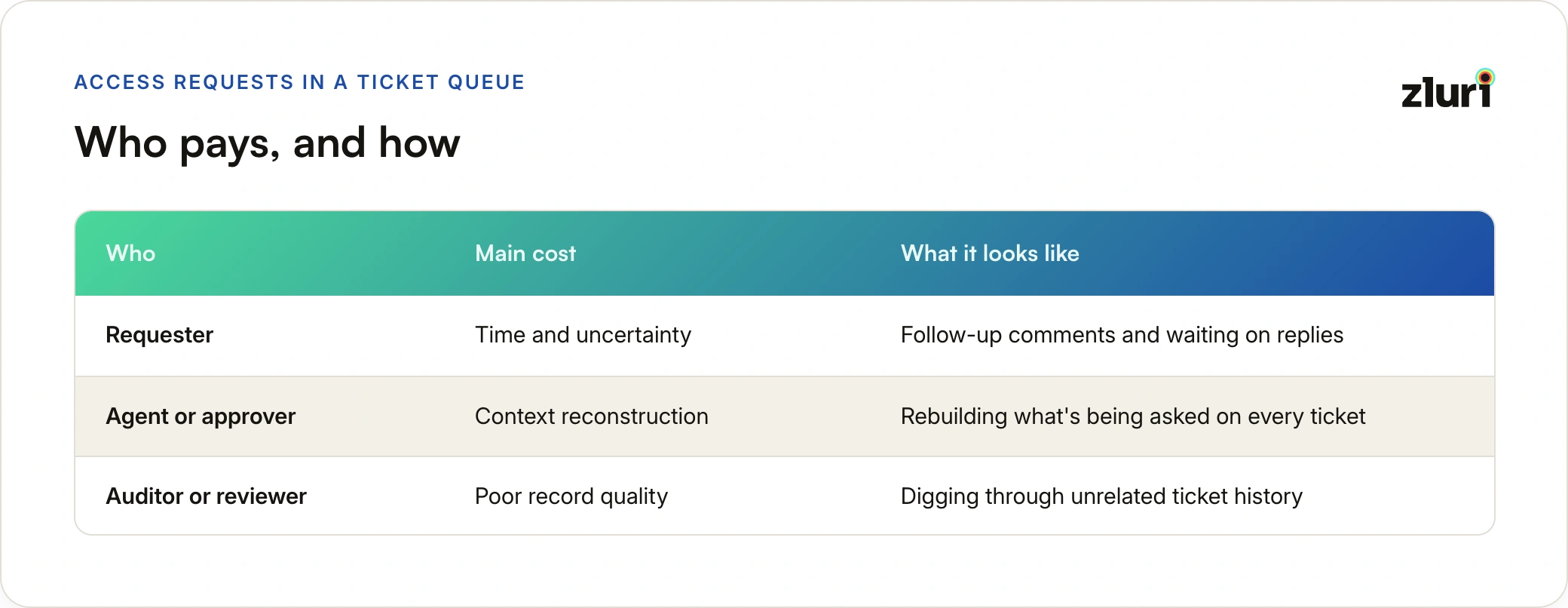
The costs above don't fall evenly. They show up differently depending on which side of the request someone's standing on:
- The requester: pays in time and uncertainty. They don't know what's happening, have to follow up, and wait longer than the actual approval decision should have taken.
- The IT agent or approver: pays in context reconstruction. Every ticket requires figuring out what's being asked before any real decision-making can start, which eats time that should go to deciding (and is one reason approvers make bad decisions when context is thin).
- The compliance lead, auditor, or security reviewer: pays in record quality. The record technically exists, but it isn't organized in a way that makes it fast or reliable to use.
Three different people, three different costs, all coming from the same underlying design mismatch. For the requester the main cost is uncertainty and repeated follow-ups. For the agent or approver it is rebuilding context on every ticket, which delays the decision itself. For the auditor it is a record that exists but takes real digging to use, which makes answers slow under pressure. None of these shows up in a ticket-resolution-time metric.
A Request, Step by Step, Inside a Ticket Queue
The costs above are easier to see laid out against an actual sequence of events.
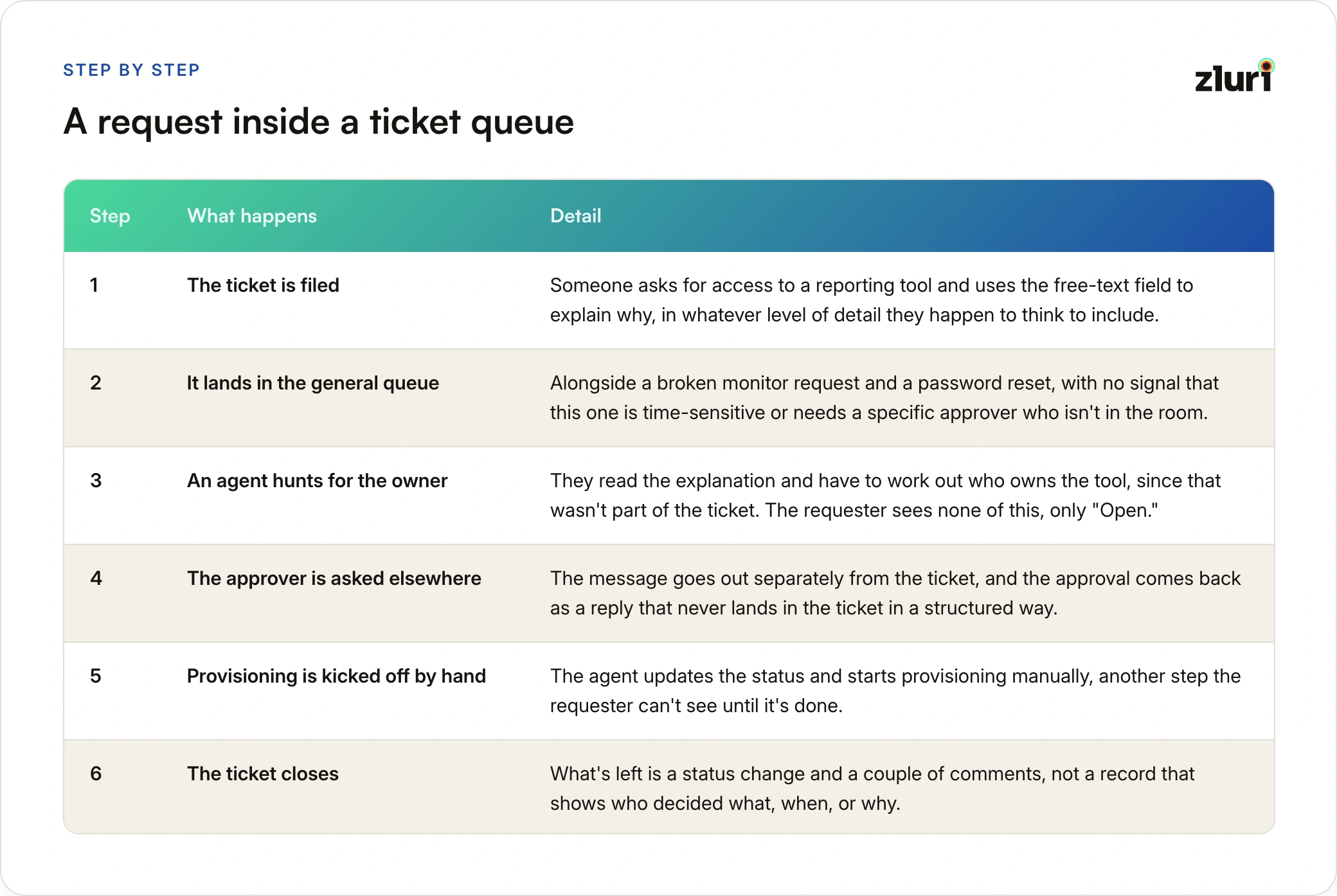
- The ticket is filed: someone asks for access to a reporting tool and uses the free-text field to explain why, in whatever level of detail they happen to think to include.
- It lands in the general queue: alongside a broken monitor request and a password reset, with no signal that this one is time-sensitive or needs a specific approver who isn't in the room.
- An agent hunts for the owner: they read the explanation and have to work out who owns the tool, since that wasn't part of the ticket. That means a message to a manager or a search through another system. The requester sees none of this, only "Open."
- The approver is asked elsewhere: the message goes out separately from the ticket, in whatever channel the agent happens to use, and the approval comes back as a reply that never lands in the ticket in a structured way.
- Provisioning is kicked off by hand: the agent updates the status and starts provisioning manually, another step the requester can't see until it's done.
- The ticket closes: what's left is a status change and a couple of comments, not a record that shows who decided what, when, or why.
Nothing about this sequence was unreasonable given the tool being used. It's what a ticket queue produces when it's asked to do a job it wasn't built for, one extra manual step at every stage, each one invisible to the person who actually needs to see it.
The Real Cost Compounds Across the Organization
None of these individual costs looks large in isolation, a few extra minutes here, a slightly confusing status there. What makes a ticket queue expensive is that every one of these costs repeats on every single access request, and they compound in a specific direction: toward people giving up on the formal process.
Put plainly, generic status labels mean a requester can't tell whether a request is stuck or just waiting. A free-text form that wasn't built for access means manual back-and-forth to capture what a structured form would capture instantly. A shared queue with unrelated IT issues means there is no dedicated, findable record of access decisions. And no visibility into approver routing means delay reads as inaction even when routing is actually happening.
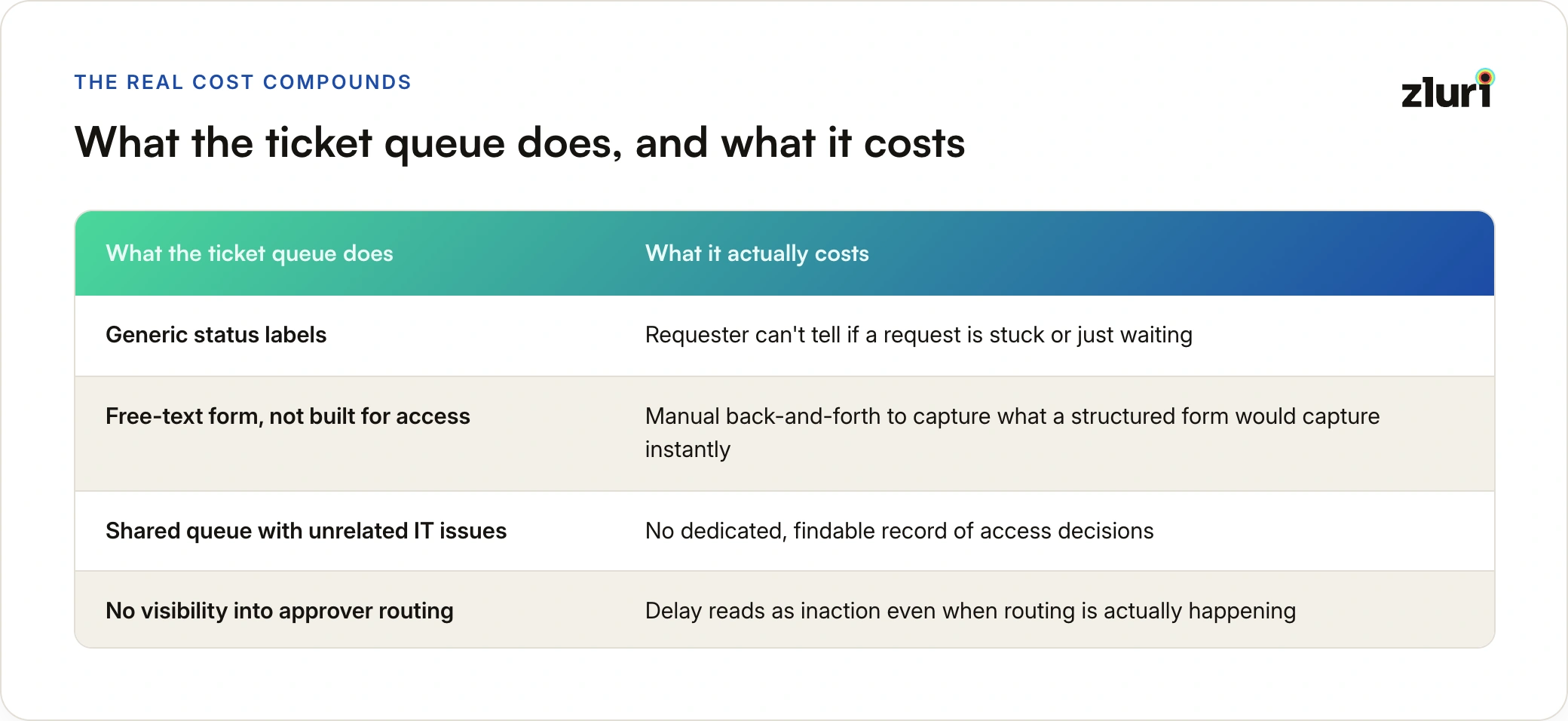
When the formal path is consistently slower and less transparent than just messaging someone directly, people start doing exactly that, which quietly shifts access decisions out of any tracked system at all. The ticket queue doesn't just cost time on the requests that go through it, it pushes some requests out of the process entirely, and those are the requests nobody can account for later.
The costliest access requests are the ones that never enter the queue at all.
What This Points To
None of this means the ticket system is badly built for its actual job, and what ITSM software gets wrong about access is a design gap, not a bug. It means access requests are a different kind of problem than the one a ticket queue was designed to solve, one with its own structure, its own approval logic, and its own need for a record that's actually organized around access decisions rather than sitting inside a general IT history. For what that dedicated structure looks like in practice, see automatic approvals and rejections. For the requester-side view, see a better request experience, and for what the switch involves, see moving to a request flow.
Frequently Asked Questions
Isn't a ticket queue good enough if access eventually gets granted?
Access getting granted eventually is the minimum bar, not the actual goal. The real cost is everything around that outcome: the requester unable to tell what's happening, the manual routing invisible to everyone but the assigned agent, and the record that's hard to find again later.
Why does the status label matter if the ticket eventually resolves?
Because an uninformative status pushes the requester to add comments and wait for replies just to find out what's actually going on, which adds delay on top of whatever delay already exists in the approval itself, and it hides the difference between a normal wait and a request that's genuinely stuck.
Does using a ticket queue for access requests actually weaken governance?
Indirectly, yes. When the formal process is slow and opaque enough, people start routing around it through direct messages or informal channels, which moves the actual decision outside of any tracked system entirely.
Who's most affected by a ticket queue's shortcomings, the requester or IT?
Both, in different ways. The requester deals with uncertainty and delay. The IT agent or approver deals with the burden of reconstructing context on every single ticket before they can actually make a decision. Neither cost shows up in a ticket-resolution-time metric, which is part of why it goes unmeasured.
What would actually fix this without abandoning ticketing for everything else?
The fix isn't abandoning ticketing generally, hardware and general IT issues still fit that model well. It's giving access requests their own dedicated flow, as in access request management, built around what an access decision actually needs: structured conditions, clear status, and a record that's easy to find later.