.png)




The best career moves are initiatives that your company needs, that nobody currently owns, and that build skills the broader market is actively short on. For an IAM manager at a mid-market company right now, identity governance checks all three boxes at once.
Picture where you are. SSO is deployed and stable. MFA is enforced. Provisioning to your core apps works well enough that nobody complains about it in meetings anymore. The identity foundation you were hired to build is, more or less, built.
That's an accomplishment. It's also a plateau, and it's worth being clear-eyed about why.
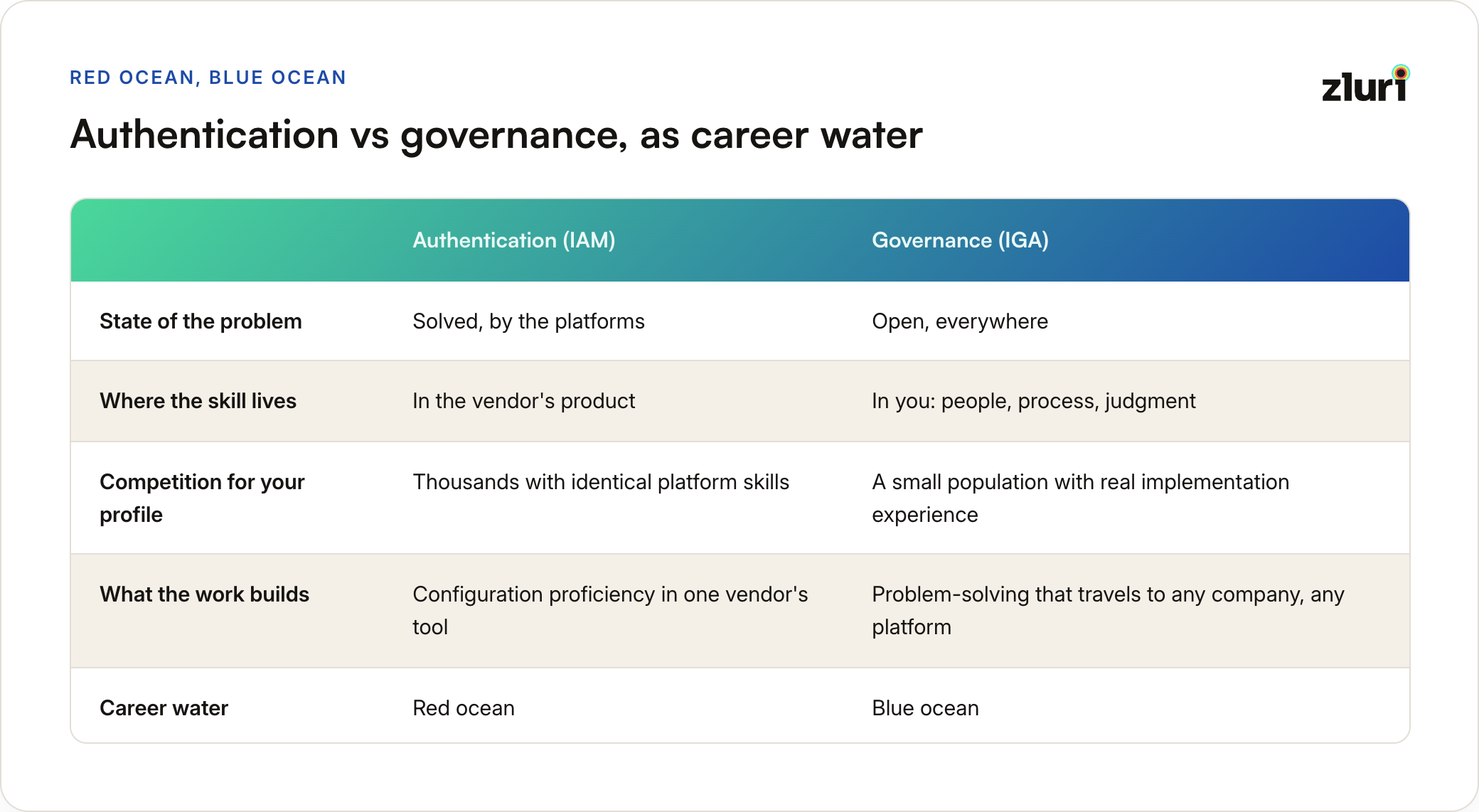
Authentication is a solved problem, and the platforms solved it. Okta, Entra, and their peers turned SSO, MFA, and federation into mature, well-documented product categories. The interesting decisions were made by the vendors years ago. What remains is configuration and maintenance of someone else's platform.
Doing that well is real work, but it's commodity work: thousands of people can run an IdP competently, the playbooks are public, and "kept SSO running" is not a bullet point that moves a resume. A red ocean, in strategy terms: crowded, mature, differentiated only on price.
Identity and access governance is the opposite: an open field. The problems, who should have access, whether they still need it, how to prove it, how to catch what nobody procured, are far from solved anywhere, and the practitioner playbooks barely exist yet.
That's a blue ocean for a career: instead of competing with thousands who hold the same commodity skill, you build a skill the market needs badly and holds rarely.
The question that determines the next three years of your career isn't whether you can maintain what exists. It's whether you move from the crowded water into the open one. Here's the argument of this piece: the move is identity governance, and the window for claiming it is open right now.
Why IGA Is the Open Slot
At most mid-market companies, nobody owns governance. IAM ownership is settled: that's you. But ask who owns access reviews, who owns making sure departed employees actually lose access everywhere, who owns the evidence trail the next audit will demand, and the answer is some combination of "sort of compliance," "sort of IT," and "honestly, nobody." Unowned, important work is the raw material of career growth, and this particular unowned work sits directly adjacent to what you already do.
You are the natural owner. Governance builds directly on the identity infrastructure you already run. The directory data, the SSO integrations, the provisioning workflows: IGA is the layer on top of them, and you're the person who understands the layer underneath better than anyone in the building. No one else can claim this initiative with a straighter face.
The company genuinely needs it, whether it knows yet or not. Access accumulating unchecked, offboarding that misses the apps outside SSO, review evidence that takes weeks to assemble: these problems exist at your company today. The only question is whether they get addressed proactively by someone who claims them, or reactively after an audit finding forces it, at which point the initiative gets assigned rather than owned.
The Market Is Telling You the Same Thing
This isn't just an internal opportunity. The external market has moved, decisively, toward exactly this skill set.
The demand side: the identity governance and administration market was estimated at USD 7.95 billion in 2024 and is projected to reach USD 27.11 billion by 2033, growing at a CAGR of 14.9%, per Grand View Research's IGA market analysis. A market more than tripling over a decade means thousands of companies buying and deploying platforms, all of them needing people who have actually done this before.
The supply side, and why the experience is genuinely scarce: according to CyberArk's 2025 State of IGA Survey:
- Only 6% of organizations have achieved full automation of their identity governance
- 99% of companies perform user access reviews
- 55% manage five or more compliance frameworks
Read those together: nearly every company is doing this work, almost none has done it well, and the people who can close that gap are rare enough that having led even one real implementation puts you in a small population.
That's a seller's market for a skill. In authentication, you'd be one of thousands with the same platform skills. In governance, right now, you'd be one of the few who has actually done it.
The Skills Are Yours, Not the Vendor's
Here's the property of IGA experience that makes it a fundamentally different career asset than platform expertise, and it's worth sitting with before the playbook.
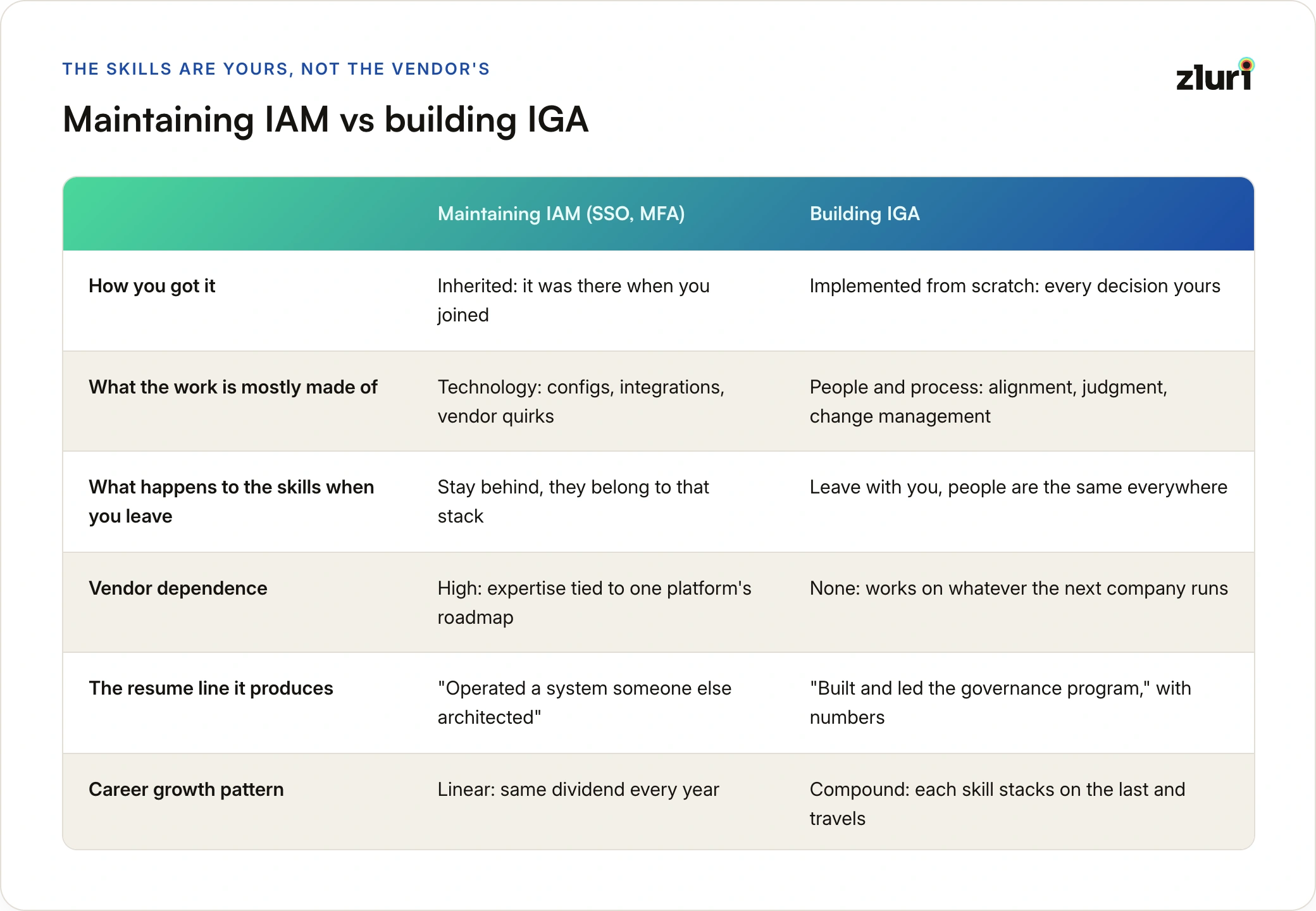
Start with an honest question about your current resume: did you build the SSO, or inherit it? For most IAM managers, the SSO and MFA stack was already there when they joined. Someone else made the design decisions; the job was to maintain and extend them. That's real work, but it puts a ceiling on the story you can tell: "operated a system someone else architected" is a maintainer's line, at any company, in any interview.
IGA is the reverse. At most mid-market companies there's nothing to inherit, which means you get the thing careers are actually built on: implementing something from scratch. The scoping decisions, the stakeholder map, the rollout sequence, the review design, the failure recoveries: all yours, start to finish. Builder stories are what promotion cases and interviews are made of, and this is a rare chance to earn one without changing jobs.
And IGA is mostly people and process. The technology is the smallest part. An access review succeeds or fails on whether managers engage with it, not on which tool renders the screen. A rollout succeeds on stakeholder alignment, scope discipline, and change management. Least-privilege judgment, what access a role actually needs, is a human call no platform makes for you.
That's exactly why the lessons leave with you. Technology lessons stay behind when you leave, because they belong to the stack: the configurations, the integrations, the vendor quirks are all property of that environment. People lessons are yours permanently, because people are the same everywhere. How to win over a skeptical department head, how to design a review a busy manager will actually complete, how to sequence change so an organization absorbs it: learned once, applicable forever, at every company you'll ever work at.
Which means the experience you accumulate isn't locked inside a vendor's product:
- Platform skills depreciate and don't transfer. Deep Okta expertise is worth less the day your next company runs Entra. Vendor-specific knowledge is rented; the vendor's roadmap decides its value.
- Governance skills are portable by nature. Stakeholder negotiation, review design, policy judgment, evidence discipline, program leadership: every one of these works identically at your next company, on whatever platform they happen to run. You carry them with you, independent of any vendor.
- What you're ultimately learning is problem-solving. Strip away the acronyms and an IGA program is a series of genuinely hard, ambiguous problems: how do you get busy people to make good access decisions, how do you prove a negative to an auditor, how do you sequence a rollout so it survives contact with the organization. Learning to solve problems of that shape is the most transferable skill that exists, and it's the actual thing leadership roles select for.
Put those properties together and you get the career math: this is compound growth, not linear growth. Maintaining a platform pays the same skill dividend every year, and it stays behind when you leave. Building a governance program pays skills that stack, negotiation compounding into program leadership compounding into executive-level judgment, and every bit of it travels to the next role, where it keeps compounding. Ten years of maintenance is one year of experience repeated ten times. Ten years of building is a career.
Platform expertise makes you valuable to companies running that platform. Governance expertise makes you valuable to companies, full stop.
What You Actually Gain: Three Distinct Assets
1. Skills that compound beyond identity. An IGA initiative forces you to learn things basic IAM never demands:
- Cross-functional negotiation: governance touches finance, HR, compliance, and every department head. You learn to translate technical requirements into each of their languages, which is precisely the skill that separates managers from directors.
- Program leadership: phased rollouts, exit criteria, stakeholder reporting, change management. This is running a program, not administering a system, and it's the experience leadership roles screen for.
- Compliance fluency: working directly with auditors builds a vocabulary most infrastructure-side IAM people never acquire, and it makes you conversant in the language your CISO and board actually speak.
2. Outcomes you can point at. Basic IAM produces the absence of problems, which is invisible. IGA produces measurable, narratable wins:
- Provisioning time cut from days to hours for the pilot scope
- Offboarding completeness at 100 percent, verified, where it was previously unmeasured
- Access review cycles compressed from weeks of spreadsheet work to days
- Audit evidence produced on demand instead of assembled in a panic
- Unused licenses and duplicate SaaS spend surfaced, a number the CFO remembers
Every one of those is a line for your internal performance review and your external resume simultaneously. "Led the identity governance program" with numbers attached is a fundamentally different career artifact than "administered IAM."
3. A title trajectory. The path from IAM Manager runs through exactly this kind of scope expansion: Identity and Governance Lead, Head of Identity Security, Director of IAM. Each of those roles exists because someone's identity remit grew beyond authentication into governance, and the person who led the initiative is the default candidate for the title that gets created around it.
The Playbook: How to Claim It
Step 1: Build the case from problems, not products. Don't open with "we should buy an IGA platform." Open with evidence of the gap:
- Pull the list of employees who left in the last six months and check, honestly, how many still have access to something
- Time how long assembling access evidence for one application actually takes
- Count the apps in finance's expense data that don't appear in your SSO
Two or three concrete findings make the initiative self-justifying in a way no vendor deck can.
Step 2: Frame it for each stakeholder, before the budget meeting. You already know the translation game from running IAM. Apply it here: finance hears the SaaS waste the initiative will surface, HR hears faster day-one onboarding, compliance hears audit evidence on demand, department heads hear twenty-minute reviews instead of half-day spreadsheet sessions. Walk into the budget conversation with those allies already briefed, and the initiative stops being an IT request and becomes a cross-functional program you happen to lead.
Step 3: Scope the first phase to be winnable. Ten to twenty high-value applications, one department pilot, one complete access review cycle. Your career outcome depends on a visible early win far more than on comprehensive coverage. A working pilot in eight weeks builds the momentum, and the internal reputation, that a two-year boil-the-ocean plan never survives long enough to deliver.
Step 4: Measure from day one, report monthly. Baseline everything before you change it: current provisioning time, current offboarding completeness, current review effort. Then report the improvement monthly, in one short update, to the stakeholders you briefed in Step 2. Measurement discipline converts work you did into outcomes you demonstrably delivered, which is the difference between having done the project and getting credit for it.
Step 5: Put your name on it formally. Ask for the initiative explicitly: a line in your goals, a program name, a steering group you chair. Informal ownership evaporates the moment the work succeeds and someone senior notices it. Formal ownership is what appears in promotion cases and reference calls.
The Honest Caveats
This is real work on top of your existing job, at least initially. The pitch here is not that IGA is easy. It's that the effort-to-career-return ratio is unusually favorable right now, because market demand is ahead of talent supply. That window is a function of timing, and it narrows as more practitioners accumulate the experience.
Pick a scope your company can actually support. If your organization is genuinely too small, too chaotic, or too budget-frozen to sustain any governance initiative, forcing one anyway produces a stalled project with your name on it, which is the opposite of the goal. Most mid-market companies with real compliance or security pressure clear the bar. Verify yours does before you attach your name.
The tooling era matters for what this asks of you. A decade ago, leading IGA meant a multi-year enterprise-suite deployment with dedicated engineering, career-defining in the exhausting sense. Modern SaaS-native platforms compress the technical lift dramatically, which changes the shape of the opportunity: the scarce skill is no longer connector engineering. It's program leadership, stakeholder navigation, and governance judgment, exactly the skills that transfer upward, and the ones no vendor can take back from you.
The Underlying Logic
Careers advance on initiatives that sit at the intersection of three things: what your company needs, what nobody else owns, and what the market values. Most opportunities hit one of the three. A few hit two.
For an IAM manager at a mid-market company in this specific moment, with the foundation built, governance unowned, and an industry tripling its investment in exactly this capability while only 6% of organizations have achieved full automation, identity governance hits all three. That alignment doesn't stay open indefinitely. Someone at your company will eventually own this work.
The entire argument of this piece is that it should be you, and that the time to raise your hand is before the audit finding raises it for you.
And when you do raise it, the playbook above gets you the ownership; running the program itself, phases, sequencing, pilots, and the mistakes that stall first-time rollouts, has its own detailed guide: the IGA implementation strategy.
Frequently Asked Questions
I have no formal IGA experience. Am I qualified to lead this?
More qualified than anyone else available, which is the standard that actually applies. You understand the identity infrastructure governance sits on, you know the application landscape, and you have the internal relationships. The market data cuts in your favor too: with so few organizations having mature, automated governance, almost nobody has deep experience, which means the field is being led by people learning it through exactly the kind of first implementation you'd be running.
Should I get a certification first, or start the initiative first?
Start the initiative. A certification (CISM, CIDPRO, vendor-specific credentials) is a fine complement, but hiring managers and promotion committees weight demonstrated outcomes over coursework heavily in this field, precisely because so few people have the hands-on experience. Run the real program, collect the real numbers, and add the certification alongside it if you want the credential signal too.
If I learn IGA on one vendor's platform, does the experience transfer to companies running a different one?
Almost entirely, and this is what makes it different from platform expertise. The parts of IGA that are hard, stakeholder alignment, review design, policy judgment, rollout sequencing, evidence discipline, are identical regardless of the tool underneath, because they're people-and-process problems, not configuration problems. The platform-specific layer is thin and relearnable in weeks. The judgment layer is the actual asset, and it travels with you to any company, on any vendor.
What if my company won't fund a platform right now?
You can start the ownership claim without a purchase. The gap evidence from Step 1, a documented access review run manually for one critical application, a written governance policy where none existed: these establish you as the owner of the problem space and build the case that eventually funds the platform. The career value starts with claiming the territory, not with the procurement.
Is this opportunity specific to mid-market, or does it apply at enterprises too?
The dynamics are sharpest at mid-market. Enterprises typically already have identity governance functions with established owners, so the slot isn't open in the same way. At a mid-market company, the combination of real governance need, no incumbent owner, and modern tooling that a small team can actually run creates the specific vacuum this piece describes. That's also why mid-market IGA experience travels well: you'll have owned the whole program end to end, rather than one slice of a large machine.