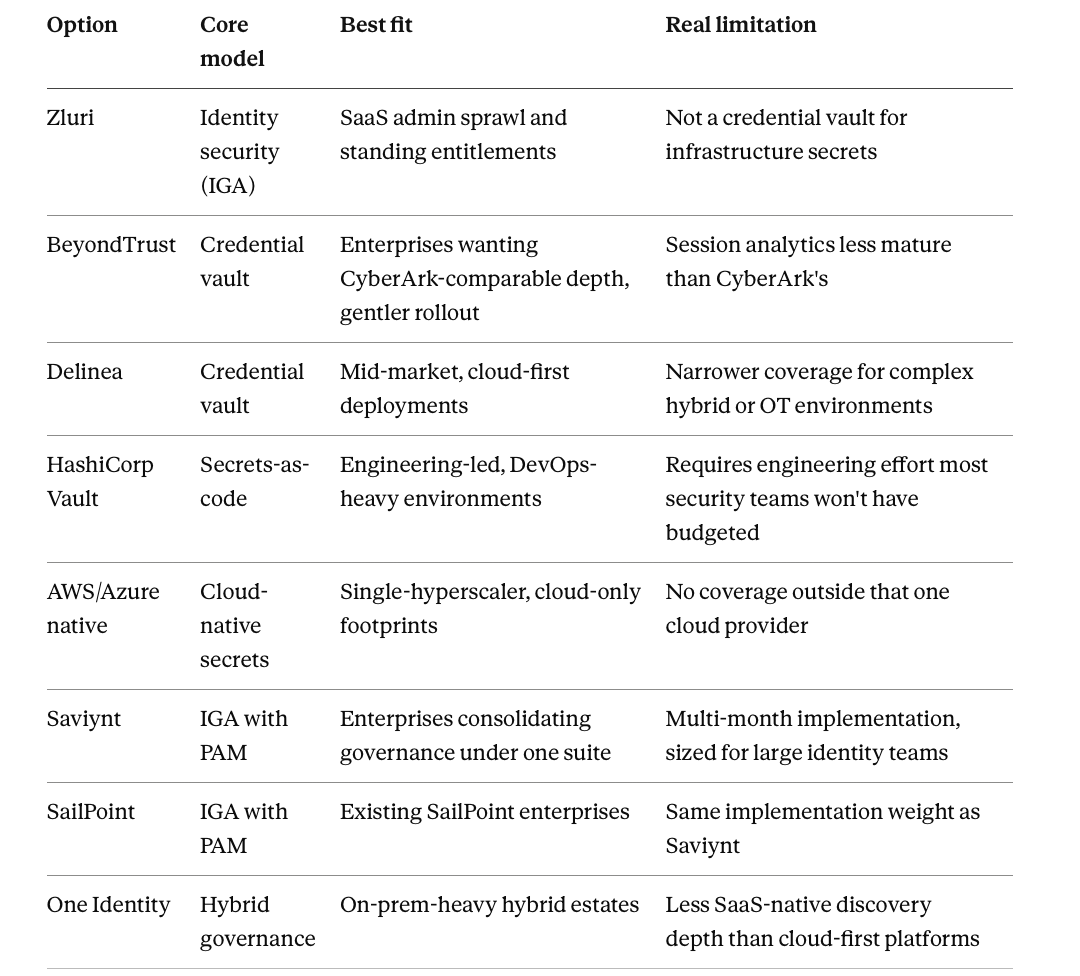
"CyberArk alternative" usually means one of two very different things. This guide splits 8 options by which problem they actually solve, not by whose homepage has more bullet points.
CyberArk stores privileged passwords and hands them out only when someone needs them. A person or a script checks out a credential, uses it, and loses access again once the job's done. That's the whole idea: passwords for your most sensitive systems shouldn't live in a spreadsheet or a config file somewhere. CyberArk is good at this, and it's a big reason so many large, regulated companies use it.
There are two pretty different reasons IT and security teams end up looking for a CyberArk alternative.
- Some just want a cheaper or simpler vault. Same job as CyberArk, different vendor. The credentials they're managing are the usual kind: servers, databases, network devices. Nothing complicated about the ask.
- Others have a problem that was never really about the vault. Think about the marketing person who still has admin rights to a tool, left over from a project that ended over a year ago. Or the three people who all have Salesforce super-admin because nobody wanted to be the one who says no to a request. Or the Google Workspace admin account nobody's touched in months that still technically has full access. None of that is a rotating password. It's access that got handed out once and never taken back. CyberArk was never built to catch any of it, and no amount of switching vaults will change that.
So before comparing tools, it's worth figuring out which of these two you actually have. That's how this list is split. (We've written about this same divide in more depth, credential security versus access governance, as the two types of privileged access management software, if you want the fuller framework before diving into specific tools.)
If Your Real Problem Is Standing Privileged Access, Not Vaulting
Start here if the CyberArk gap isn't a vault at all, it's the admin roles and standing entitlements sitting outside any vault entirely.
Zluri
Best for: organizations whose privileged-access risk is concentrated in SaaS admin roles and standing entitlements rather than infrastructure secrets.
Zluri is an identity security platform built around IGA, and privileged access is governed as part of that core, not as a bolted-on module. That's the structural reason its approach looks different from a vault: it treats a privileged SaaS admin role the same way it treats any other entitlement, as data to be discovered, scored, reviewed, and revoked, rather than a secret to be stored.
Key capabilities:
- Discovers every privileged and admin-level account across the SaaS stack, including the ones nobody remembers granting, using discovery methods that go beyond SSO logs alone
- Time-bound, just-in-time access instead of standing privilege by default, so admin rights expire on their own rather than requiring someone to remember to revoke them
- Automated review cycles scoped specifically to privileged and admin roles, run more frequently than standard annual access certifications given the higher risk
- Revocation tied to the same identity events (HRMS-driven joiner, mover, and leaver triggers) that govern the rest of the access lifecycle, so privileged access doesn't sit in a separate, disconnected process from everything else IT already automates
This is the layer classic PAM tools, CyberArk included, generally leave untouched. They were built to manage a defined, relatively small set of infrastructure credentials, not the sprawl of admin roles scattered across hundreds of SaaS applications, each with its own permission model. For a fuller look at how this works without functioning as a credential vault, see how Zluri governs privileged access.
The tradeoff: Zluri is not a credential vault, and doesn't claim to be one. If the actual requirement is rotating and brokering infrastructure secrets, a database service account's password, an SSH key, a network device credential, none of that is Zluri's job. It's built for exactly the opposite half of the "CyberArk alternative" search, the standing SaaS access CyberArk was never built to see, and it sits alongside a vault rather than replacing one for infrastructure use cases.
If You Need a Different Vault
These options solve the same problem CyberArk solves: securing, rotating, and brokering access to privileged credentials for infrastructure, not SaaS admin roles. Compare them on deployment fit, pricing structure, and how each handles the session-recording and approval workflows CyberArk owns today, since that's usually where the real differences between vaults show up, not in the base feature list.
BeyondTrust
Best for: organizations that want vault depth comparable to CyberArk without CyberArk's implementation timeline.
Key capabilities:
- Privileged password and session management with automated rotation and checkout, delivered as Password Safe
- Privileged Remote Access for vendor and third-party session brokering without exposing internal network access directly
- Endpoint Privilege Management for least-privilege enforcement on workstations and servers, removing standing local admin rights
- Generally a gentler implementation curve than CyberArk, which tends to require more specialized deployment expertise and a longer professional-services engagement
The tradeoff: BeyondTrust's endpoint privilege management is a genuine strength, arguably its most differentiated capability against CyberArk, but its session recording and forensic analytics are generally considered less mature than CyberArk's. A security team that leans heavily on detailed session playback and behavioral analytics for incident investigation may find the switch a step down in that specific capability even as deployment and administration get easier elsewhere.
Delinea
Best for: mid-market and growing enterprises that find CyberArk's pricing and complexity disproportionate to their actual privileged-account footprint.
Key capabilities:
- Secret Server for privileged password and session management, the core product from the Thycotic side of the 2021 Thycotic-Centrify merger
- Server PAM for privileged access to Linux, Windows, and cloud infrastructure, inherited from Centrify's identity-centric approach
- Cloud-first deployment option that avoids much of the on-prem infrastructure overhead CyberArk's older architecture still carries in some deployment models
- Broad, well-regarded coverage across standard Windows, Linux, and public cloud environments
The tradeoff: that approachability comes from a narrower scope than CyberArk's. Organizations with complex hybrid infrastructure, mainframe access requirements, or deep OT and industrial-control-system environments tend to outgrow Delinea's coverage faster than they'd outgrow CyberArk's, which makes it a stronger fit for straightforward cloud and Windows/Linux estates than for organizations carrying unusual infrastructure diversity.
HashiCorp Vault
Best for: engineering-led organizations that want secrets management as code rather than as a security-team-administered appliance.
Key capabilities:
- Dynamic secrets: generates short-lived, unique credentials on demand for things like AWS IAM roles or database logins, instead of storing and rotating one static credential
- Policy-as-code configuration through Sentinel and HCL, fitting infrastructure that's already defined and provisioned programmatically rather than through a GUI
- An open-source core that lets a team start without a large upfront licensing commitment, with a paid Enterprise tier adding replication, HSM support, and advanced governance features when the deployment scales
- Deep, native integration with common CI/CD and infrastructure-as-code tooling, so secrets retrieval becomes part of the deployment pipeline itself
The tradeoff: Vault is a toolkit, not a turnkey PAM platform. It expects a team capable of configuring and operating it as infrastructure, with policy written as code rather than a GUI-driven approval workflow, which is a poor fit for a security team that wants CyberArk's out-of-the-box approval chains and session monitoring without engineering the equivalent themselves from scratch.
AWS Secrets Manager and Azure Key Vault
Best for: organizations whose privileged-credential footprint is now overwhelmingly cloud-native and largely confined to a single hyperscaler.
Key capabilities:
- Native integration with the cloud provider's own IAM and permissions model, so access to secrets inherits the same policy engine already governing everything else in the environment
- Automatic rotation for supported credential types out of the box (RDS, DocumentDB, and Redshift on the AWS side; via scheduled Lambda functions for other credential types) without a separate rotation engine to configure
- A fraction of the licensing cost of a dedicated PAM platform, since the capability is bundled into infrastructure the organization is already paying for
- No third-party vendor dependency or separate console for credentials that already live entirely inside the cloud provider's ecosystem
The tradeoff: coverage stops firmly at the cloud boundary. On-prem systems, other SaaS applications, and any genuine multi-cloud sprawl fall outside scope entirely, and neither tool was built to broker privileged access for human users the way CyberArk or a dedicated PAM platform does, only for application and service credentials within their own single-provider ecosystem.
If You Want Privileged Access Folded Into a Broader Governance Program
These are enterprise IGA suites that treat privileged access as one governed category inside a larger identity program, rather than a standalone vault or a SaaS-specific governance layer. They overlap partly with both groups above: they can broker some privileged sessions, and they govern more than just SaaS admin roles, but they're a distinct, heavier category of their own.
Saviynt
Best for: large enterprises that want privileged access governed within a broader identity governance program spanning both infrastructure and applications.
Key capabilities:
- Privileged access reviews and certifications running through the same engine as standard access governance, under the Enterprise Identity Cloud platform
- SoD checks that span both standard and privileged access in one policy set, rather than reconciling two separate rule engines after the fact
- Broad connector coverage across infrastructure, SaaS applications, and cloud platforms, delivered as a cloud-native, SaaS-hosted product rather than an on-prem deployment
- Consolidates governance tooling instead of running PAM as a separate silo alongside standard IGA processes
The tradeoff: that breadth comes with IGA-grade implementation weight. Saviynt deployments typically run in the months, not weeks, and are sized for enterprises with a dedicated identity team capable of owning a platform this configurable, a mismatch for a mid-market buyer whose real, narrower need is faster coverage of SaaS admin sprawl specifically rather than an enterprise-wide governance transformation.
SailPoint
Best for: enterprises already standardized on SailPoint for broader identity governance who want privileged access folded into the same program rather than managed separately.
Key capabilities:
- Privileged access treated as one governed category within the larger IGA framework, whether on IdentityNow (the SaaS product line) or IdentityIQ (the more customizable, traditionally on-prem line)
- Certification campaigns spanning standard and privileged access together in one review cycle
- AI-driven access recommendations that flag outlier or risky privileged entitlements for reviewers, reducing rubber-stamp certifications
- A mature, extensive connector ecosystem built up over years of enterprise IGA deployments
The tradeoff: the same one that applies across most legacy IGA suites: implementation and ongoing administration overhead sized for large enterprise identity teams, which makes it a heavy answer for an organization whose specific problem is SaaS privileged access sprawl rather than an enterprise-wide identity governance transformation they were already planning to undertake.
One Identity
Best for: enterprises running a hybrid mix of legacy on-prem infrastructure and SaaS applications who want a single governance layer spanning both.
Key capabilities:
- Safeguard module covers privileged session management and credential vaulting for infrastructure, functioning as the CyberArk-equivalent piece inside a broader suite
- Active Roles for granular Active Directory and Azure AD management, a strength for organizations still heavily invested in AD-centric identity infrastructure
- One Identity Manager for standard access review and governance workflows, running under the same vendor relationship as the privileged-access piece
- Strong fit for organizations with significant legacy on-prem footprint who don't want a second vendor purely for that layer
The tradeoff: that on-prem heritage shows up as comparatively less depth in pure SaaS-native discovery than platforms built cloud-first, making it a stronger fit for infrastructure-heavy hybrid estates than for an organization whose privileged access problem is now almost entirely inside cloud applications rather than on-prem directory infrastructure.
Choose Based On Your Actual Problem, Not the Search Term
A quick mapping, because the right answer depends entirely on which problem above is actually yours:
- Standing SaaS admin access nobody's reviewing, roles that outlived the project they were granted for: Zluri. Nothing else on this list solves that specific problem as directly.
- A cheaper or faster-to-deploy vault with comparable depth to CyberArk: BeyondTrust or Delinea.
- Infrastructure defined as code, with engineering already owning secrets management as part of the deployment pipeline: HashiCorp Vault.
- Privileged credentials almost entirely inside one hyperscaler, with multi-cloud sprawl not a near-term concern: that provider's native secrets manager.
- Privileged access folded into a broader enterprise IGA program, with the implementation runway and dedicated identity headcount for it: Saviynt, SailPoint, or One Identity, depending on how much of your infrastructure is still on-prem versus cloud-native.
Frequently Asked Questions
What's the difference between a CyberArk alternative and a PAM alternative?
Often nothing, but sometimes everything. If the goal is replacing what CyberArk does, vaulting and rotating privileged infrastructure credentials, a like-for-like vault such as BeyondTrust or Delinea is the right comparison. If the actual pain point is ungoverned standing access, especially across SaaS admin roles that were never a rotating credential to begin with, that's a different category of tool entirely. No vault swap fixes it, however good the vault is.
Can I replace CyberArk with an identity security platform like Zluri?
Only if CyberArk's vaulting function isn't actually the problem you're trying to solve. Zluri is an identity security platform built around IGA, and it governs standing access and privileged roles across SaaS applications as part of that core, but it doesn't vault or rotate infrastructure credentials. An organization that genuinely needs credential vaulting for servers, databases, or network devices still needs a vault; Zluri fits alongside one, covering the SaaS admin layer that vault products have never addressed and generally aren't built to address.
Why is CyberArk considered expensive or complex to implement?
Its depth, broad infrastructure coverage, mature session recording, extensive policy controls, comes with implementation and licensing costs sized for large enterprise deployments, and the platform generally requires more specialized administration expertise than lighter-weight or cloud-first alternatives, often including a dedicated professional-services engagement to get fully deployed.
Is HashiCorp Vault a good CyberArk replacement for a small security team?
Usually not without engineering support already in place. Vault's power comes from configuring it as infrastructure via policy-as-code, which fits organizations where engineering already owns secrets management as part of the deployment process, but is a heavier lift than a turnkey platform for a security team expecting CyberArk's GUI-driven approval and monitoring workflows to work out of the box.
What should I evaluate first when comparing CyberArk alternatives?
Whether the problem is the vault itself (cost, complexity, deployment fit for infrastructure credentials) or the access that sits entirely outside any vault (standing SaaS entitlements, admin roles nobody reviews, permissions that outlived their original purpose). The two require fundamentally different categories of tool. Starting an evaluation without making that distinction first is the most common reason these searches end up comparing tools that were never actually competing for the same job.
.webp)


.svg)