.png)


DocuSign CLM, Ironclad, ContractWorks, and PandaDoc are all excellent at what a contract management platform is built to do: draft it, redline it, sign it, store it, and remind you when it's due. None of them know whether the product behind a SaaS contract is actually being used. That's a different problem, and it's usually the one that actually drives a SaaS renewal decision.
Teams evaluating contract management often put general-purpose CLM platforms and Zluri side by side, as if they're competing for the same job. For most contract types, that comparison makes sense, these tools genuinely compete on drafting, e-signature, and repository features. For SaaS contracts specifically, the comparison misses the actual differentiator: usage data.
This piece looks at several of the general contract management tools teams actually evaluate, what each is genuinely good at, and where the category as a whole stops for SaaS contracts specifically.
The General Contract Management Tools
DocuSign CLM
DocuSign CLM extends DocuSign's e-signature strength into full lifecycle management: drafting, negotiation, approval routing, and centralized storage, with strong version control and audit trails throughout. For organizations already running e-signature through DocuSign, extending into full CLM inside the same ecosystem is a natural fit.
Where it's strong: E-signature depth, workflow automation, and integration with the broader DocuSign ecosystem.
Where it stops for SaaS: DocuSign CLM tracks the contract document and its key dates. It has no native visibility into whether the SaaS product a given contract covers is actually being used, by whom, or how many of the licensed seats are active.
Ironclad
Ironclad is built around collaborative contract workflows, letting legal and business teams negotiate and redline inside a shared, structured process rather than bouncing documents through email. Its workflow designer is a genuine strength for organizations with complex, multi-stakeholder approval chains.
Where it's strong: Collaborative redlining and structured approval workflows for complex contract negotiations.
Where it stops for SaaS: Ironclad's data model is built around the contract and its workflow state, not the application it describes. It doesn't discover SaaS applications, doesn't track license utilization, and has no way to flag that a contract's seat count has drifted from actual usage.
ContractWorks
ContractWorks focuses on straightforward contract storage, AI-driven tagging, and renewal alerts, positioned as a simpler, faster-to-deploy alternative to heavier enterprise CLM platforms. Its AI tagging of dates, obligations, and key terms is a genuine time-saver for teams drowning in unorganized contract files.
Where it's strong: Fast deployment, AI-assisted tagging, and renewal date tracking without a heavy implementation lift.
Where it stops for SaaS: Renewal alerts based on contract dates are useful, but they answer "when does this expire" rather than "should this actually be renewed at this size." ContractWorks has no usage data to inform that second, more important question.
PandaDoc
PandaDoc combines document creation, real-time collaborative editing, and e-signature in one platform, with strong integrations into CRMs and payment tools like Stripe and QuickBooks. It's particularly popular with sales and finance teams that want contract creation and billing connected directly.
Where it's strong: Fast document creation, real-time collaboration, and tight integration with sales and billing tools.
Where it stops for SaaS: PandaDoc's integrations connect contracts to CRM and payment data, not to the actual SaaS application usage that should inform a renewal or downgrade decision.
What All Four Have in Common
Every one of these tools is built around the same core object: the contract as a document, with parties, terms, dates, and approval state. That's genuinely the right design for the majority of contracts an organization holds, NDAs, employment agreements, leases, sales contracts, none of which have a "usage rate" in any meaningful sense.
A lease doesn't have a usage rate. An NDA doesn't have unassigned seats. A SaaS contract does, and that's precisely the data none of these platforms were built to capture, because it doesn't come from the contract document at all. It comes from the product itself: who's actually logging in, how many of the licensed seats are active, whether the tool is even the one people are using day to day.
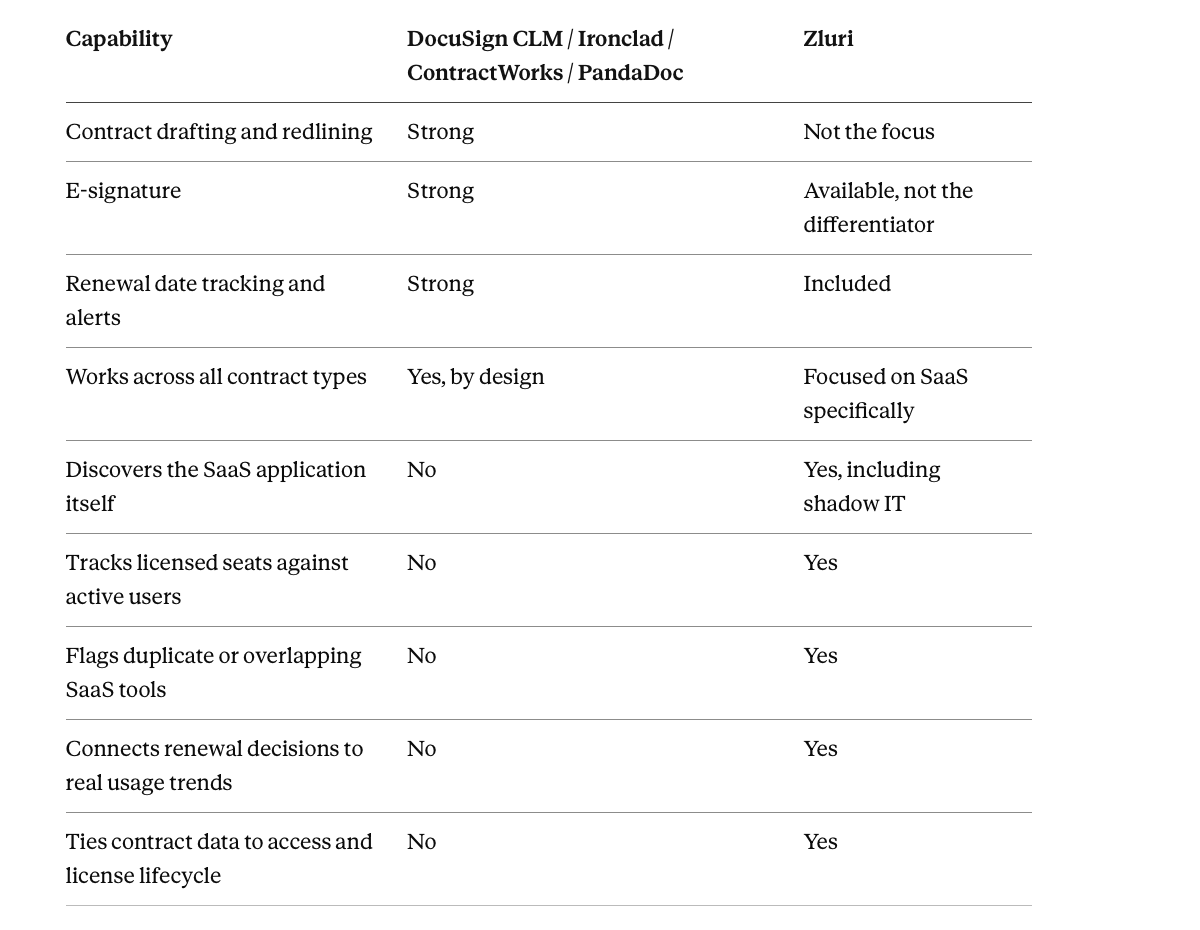
A general CLM platform can tell you a SaaS contract renews in 45 days, costs $80,000 annually, and includes 200 seats. It generally cannot tell you that only 140 of those seats have logged in this quarter, that a different team is running a near-identical tool under a separate contract, or that usage has been declining for two renewal cycles running. That data lives in the application layer, not the document, and a platform built to treat every contract type identically, by design, has no natural path to it, no matter how sophisticated its AI tagging or workflow automation gets.
The Comparison
What SaaS Contract Management Actually Requires
Discovery of the application behind the contract, not just the document. A SaaS contract without a connection to the actual application, its users, and its usage is missing the exact data that should drive the renewal decision. General CLM tools don't discover applications. They store whatever document gets uploaded to them.
Usage data tied directly to the contract. Knowing a contract's terms and knowing whether the product is earning its cost are two different questions, and only the second one actually tells you whether to renew, downsize, or cancel.
Seat and license tracking against real activity. A 200-seat contract with 140 active users is a different renewal decision than one with 195 active users, and that comparison requires data a document repository was never built to hold.
Detection of redundant tools. Two departments running functionally identical SaaS products under separate contracts, each properly drafted and stored in the same CLM platform, is a pattern only visible when contract data is connected to actual application usage across the organization, not when each contract is filed independently as its own clean record.
Where Zluri Fits
Zluri isn't trying to out-draft DocuSign CLM or out-negotiate Ironclad's workflow designer, and it isn't built to replace any of them for the broad range of contracts that genuinely need that document-lifecycle depth: NDAs, leases, employment agreements, and complex commercial deals with heavy redlining.
What Zluri does specifically is connect SaaS contract terms to the application layer those contracts actually describe. Cost, renewal dates, and terms sit alongside real usage data, active users measured against licensed seats, and discovery that surfaces SaaS applications regardless of whether they were ever routed through a formal procurement or contracting process in the first place. A SaaS renewal decision in Zluri draws on what's actually happening inside the product, not just what the contract document says should be happening.
Many organizations run both: a general CLM platform for the broad range of contracts across legal, sales, and HR, and Zluri specifically for the SaaS subscriptions where usage data is the deciding factor. The two aren't competing for the same job, even when they get shortlisted against each other.
Frequently Asked Questions
Is Zluri a replacement for DocuSign CLM or Ironclad?
Not for the broad range of contracts those platforms handle well, NDAs, employment agreements, leases, and complex commercial deals with heavy redlining and negotiation. Zluri is focused specifically on SaaS contracts, where the deciding factor is usage data those platforms don't have visibility into.
Can general CLM tools like ContractWorks or PandaDoc track SaaS license usage if configured to?
Not natively. Usage data comes from the SaaS application itself, logins, seat activity, engagement, which requires application discovery and integration work that's a different core competency than document management, redlining, or e-signature. It's not a configuration gap so much as a different product built around a different data source.
Why do SaaS renewal decisions need usage data specifically, when other contract renewals don't?
Because SaaS pricing is typically tied to seats or usage tiers that drift from actual need over the course of a contract term in a way most other contract types don't. A lease or a services agreement doesn't have unused capacity in the same measurable sense a 200-seat SaaS contract with 140 active users does.
Should an organization pick one platform for all contracts, or use a general CLM tool alongside Zluri?
Many organizations run both, a general CLM platform for the majority of non-SaaS contracts, and Zluri specifically for SaaS subscriptions where usage data drives the renewal decision. Which setup makes sense depends on how much of the organization's total contract volume is actually SaaS versus other contract types.