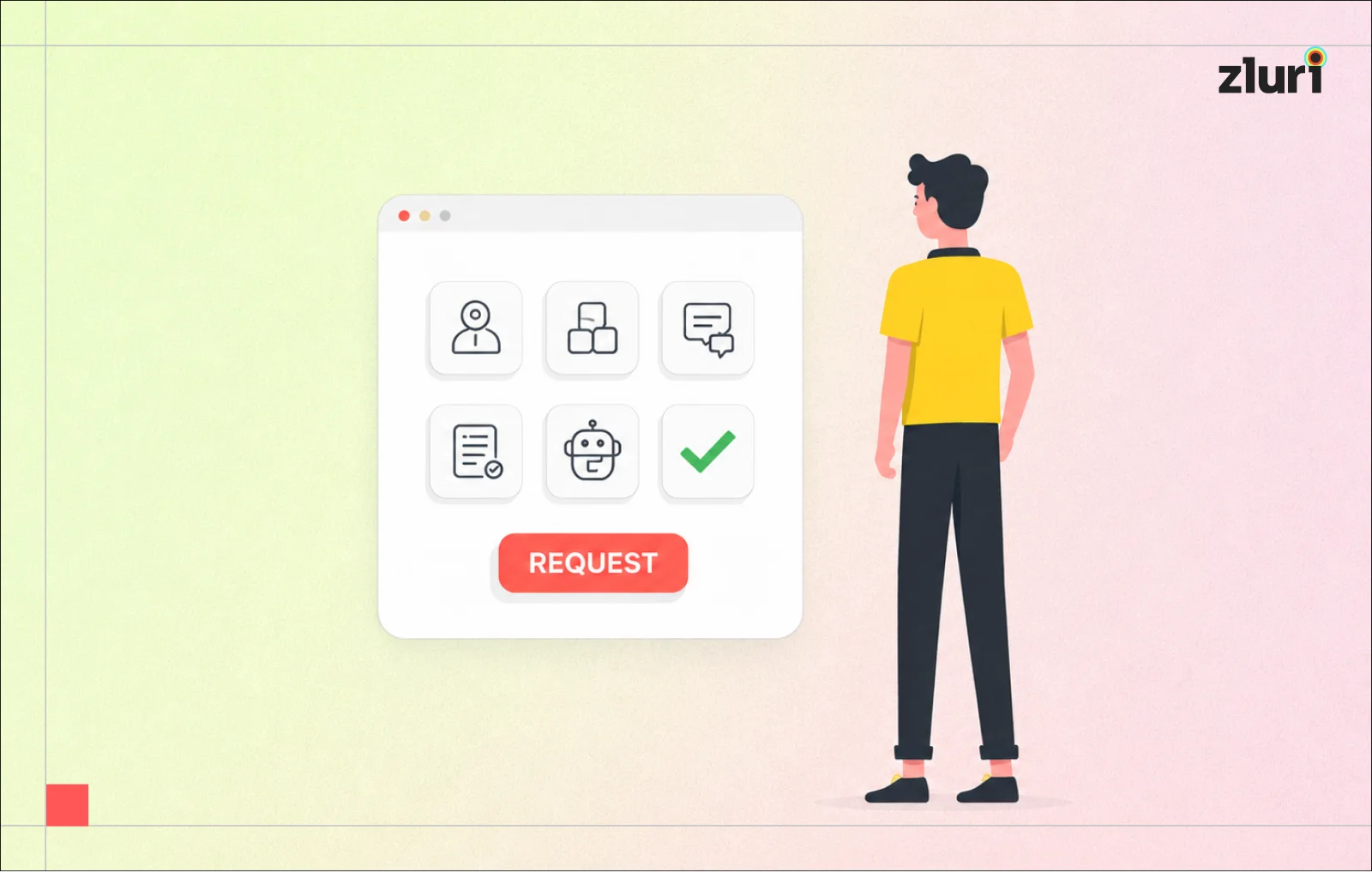

Most access request tools make it easy to submit a request. Far fewer make it easy to govern what gets approved, track what was granted, and clean it up when it no longer belongs.
Your help desk gets 40 access requests a week. Half of them are variations of the same three apps. A third get approved without anyone checking what the user already has. And when someone leaves, there's no reliable way to know which of those requests ever got revoked.
This is what access request management looks like when it's handled through email threads, spreadsheet trackers, and IT tickets. The process works until it doesn't, and when it fails, it tends to fail quietly.
The tools in this list exist to replace that. They bring structure to how access is requested, reviewed, approved, and removed — and the best ones connect those steps into a single, auditable workflow rather than a patchwork of manual handoffs.
Here's what to actually look for before we get into the list: native integrations with your SaaS stack, workflow automation that doesn't require custom scripting, visibility into what access already exists before new requests are approved, and deprovisioning that goes beyond SSO removal.
10 Best Access Request Management Tools in 2026
1. Zluri
Zluri is an identity security platform for mid-market and enterprise organizations running SaaS-heavy environments. Its access request system, built around the Employee App Store, replaces the typical patchwork of Slack messages, Jira tickets, and email threads with a structured, policy-driven workflow that covers the full lifecycle: discovery, request, approval, provisioning, and eventual deprovisioning.
The employee experience is built for actual adoption.
Employees land on a curated App Catalog that surfaces apps three ways: everything available across the organization, apps used in their department, and apps currently assigned to them. Before submitting a request, they can check compliance badges (SOC 2, ISO 27001), risk scores, and app ownership directly from the catalog page.
When they do submit, the request form captures business justification, license type, application role, and access duration (permanent or time-bound). Every request gets a unique REQ ID and real-time status tracking, so employees aren't left chasing approvers for updates.
Request forms are configurable per application, not just org-wide.
A single default form works for most apps, but high-risk applications need more context and everyday collaboration tools need less. Admins get a full form builder: show or hide default fields, drag to reorder them, customize field descriptions and placeholder text, mark fields mandatory or optional, and add custom fields (text, dropdown, date picker, boolean). A preview mode simulates exactly what employees will see before any changes go live, so there's no guessing how a form will render.
Every managed application can then have its own form configuration on top of that baseline. For a tool like Azure AD, that means requiring a security group, directory role, and conditional access exception flag on every request, so approvers have full context without a Slack follow-up. For Notion or Lucidchart, it means stripping the form down to three or four fields so employees can submit in under 30 seconds. Custom fields render in the web UI, the Slack request modal, approval notifications, and data exports.
Changes to the default form cascade intelligently: org-wide structural changes apply only to apps still on the default, while field-level changes (renaming, deleting) propagate to all forms using that field in its original state. App-specific forms are never overwritten by default form updates. Request forms also have direct shareable URLs, which matters for teams migrating from ITSM tools: employees can bookmark or be sent a direct link to an app's request form without needing to navigate the catalog first.
Approvers get context, not just a notification.
Most access request tools send an approver an email with the requester's name and the app they want. Zluri sends the full picture: the requester's role, their existing access stack, the business justification, any supporting documents, and the app's risk and compliance profile. That context is the difference between an approval that takes 30 seconds and one that takes three days because someone had to go look things up.
Zluri goes further with Approver Insights, a panel that surfaces three categories of structured data before any decision is made:
- Peer Insights: What percentage of people with the same job title and department already have this app, and at what access level
- User Insights: How many times this person has requested this app in the last 12 months, what share were approved, and the outcome of the most recent decision
- Access Insights: Whether the requested access level is standard or privileged, with license cost context where available
At the top of every request, these signals collapse into a single status: Approval Recommended, Review Carefully, or Potential Risk Detected. A CSM requesting Okta when 65% of CSMs already have it looks very different from the same person requesting an enterprise access tier that 0% of their peers have ever been approved for. When the approver confirms their decision, they select the specific insights that informed it and add a free-text reason. Both are captured in the decision log, creating an audit trail that links not just who approved what, but what data they were looking at when they did.
Approval workflows are configurable without professional services.
IT teams define the structure per application: single approver, multi-level sequential chains, or group approval (any one approver, or all approvers required). Each level can be assigned to the app owner, direct manager, department head, compliance team, or a custom role. Conditional routing applies different workflows based on request attributes, so an admin-level request routes differently than a read-only one. Admins also control app visibility per department, hiding apps that certain employees have no business requesting in the first place.
For low-risk or routine requests, admins can configure auto-approval rules that bypass the approval queue entirely. When a request matches a defined condition — department, role, app type, or any combination — it's automatically approved and provisioning runs immediately, with no approver action required. Requests that don't meet those conditions follow the standard workflow. This means a sales rep requesting a standard sales tool gets access in minutes, while a request for elevated access to a sensitive system still routes through the full approval chain.
For team-wide provisioning, the multi-user request capability lets a manager select an entire team in a single submission. Each selected user gets their own request ID, their own approval chain routed through their direct manager (not the submitter), and their own notifications throughout. The approval workflow follows the organizational hierarchy of who is receiving access, not who asked. A project launch that previously meant 15 separate requests, 15 approval threads, and 15 provisioning actions becomes one submission that fans out correctly from the start.
Provisioning is automated where possible, tracked when it isn't.
Once a request clears the approval chain, Zluri checks whether an automation exists for that application. If it does, provisioning runs without any admin intervention: the user is added, assigned the right license, given the correct role, and added to relevant groups.
If automation isn't available, Zluri creates a Task for the designated owner, with instructions, a due date, and Slack and email notifications. Task completion updates the request status and notifies the employee. Nothing falls through the gap between "approved" and "actually has access."
Slack-native for teams that live there.
Employees can initiate requests directly from Slack using /accessrequest and fill out the form without switching tools. Approvers receive Slack notifications with inline Approve and Reject buttons, so decisions happen where work is already happening.
Guesty, a global hospitality technology company, implemented Zluri's Slack-based access request automation and saw 8x faster access request handling and more than 15,000 hours saved annually. Rootz, a gaming company that had been routing requests through Jira, reduced turnaround times significantly and now has a clear audit trail on every request.
The audit trail is complete by default, including decisions made outside the platform.
Every request, approval, rejection, provisioning action, and task completion is logged with timestamps. This isn't a separate reporting module. It's how the platform works.
A recent addition closes a gap that most teams don't notice until a compliance review: approvers acting from email can now document their decision reason directly on the confirmation page, without logging into Zluri. The note is mandatory before the action confirms, and it appears in the request's changelog. Previously, email-based approvals were logged without a reason. That gap is now closed. (Slack notification parity is in development.)
Access that isn't needed gets removed, not just forgotten.
When someone leaves or changes roles, Zluri's deprovisioning checks usage signals and audit logs across all connected applications, not just what's visible through the identity provider. Most organizations have far more access persisting in individual apps than their SSO layer reflects.
Anzu moved from email-based access requests to Zluri's App Catalog and saw an 88% reduction in turnaround time, with consistent provisioning and auditable tracking their previous process couldn't provide.
For IT and security teams losing control of who has access to what, Zluri closes the gap between access approved and access governed.
2. Oracle Identity Cloud Service
Oracle Identity Cloud Service is built for enterprises running hybrid cloud architectures or managing identity across multi-tenant environments. Its strength is in policy depth: administrators can configure role-based and attribute-based access policies with granular controls, and the platform supports regular attestation cycles where managers verify that their team's access still makes sense.
The user portal is customizable, which helps when you need different experiences for different user populations. There's also a sizable API surface for organizations that need to connect internal applications that don't have native integrations.
Where Oracle tends to show its complexity: deployment and configuration require significant time investment, and teams without dedicated IAM resources often find the initial setup harder than expected. It's a strong fit for large enterprises that already run Oracle infrastructure and have the technical depth to maintain it.
Key capabilities: Self-service access requests with manager approval, role-based and attribute-based policy management, password management and administration, usage analytics and audit reporting, and attestation tooling for periodic access certification.
3. CyberArk
CyberArk is primarily known as a privileged access management platform, and that's where its access request capabilities are strongest. For organizations managing sensitive infrastructure, admin accounts, or developer access to production systems, CyberArk builds in controls that general-purpose IAM tools don't match: just-in-time access, session recording, and credential vaulting sit alongside its broader identity workflows.
The platform integrates with Active Directory, LDAP, and Google Workspace, and its MFA layer uses behavioral signals rather than just second-factor prompts. The dashboard gives security teams clear visibility into failed authentications, risky access patterns, and integration health.
The tradeoff is that CyberArk is architected around privileged access first. Teams looking for self-service access request workflows for everyday SaaS applications will find it more capable than necessary in some areas and underbuilt in others.
Key capabilities: AI-backed adaptive MFA, SSO with password security improvements, biometric authentication, privileged lifecycle management, and session monitoring for sensitive access.
4. SailPoint
SailPoint positions itself around AI-driven identity governance, and its core product, IdentityIQ, is built for organizations that need rigorous access certification, compliance reporting, and policy enforcement across a complex application landscape. The integration wizard handles up to 99% of existing applications according to SailPoint's own benchmarks, and the compliance manager automates audit reporting and policy violations.
Predictive Identity, SailPoint's AI layer, adds recommendations on top of the base platform: access role suggestions, anomaly detection, and risk scoring that gives approvers better context. That capability is sold as a separate add-on and integrates with IdentityIQ rather than replacing it.
SailPoint suits large enterprises where IGA is a compliance requirement rather than an IT convenience. For teams that primarily need streamlined self-service access requests without the full governance stack, the platform can feel like substantial overhead.
Key capabilities: Self-service lifecycle management with automated provisioning, password management, risk-based identity intelligence, compliance and audit reporting, and multi-device access management.
5. IBM Security Verify
IBM Security Verify is a cloud-based identity platform designed to manage both workforce and customer identities from a single interface. Its value proposition centers on integrating identity into zero-trust security architectures: it adds strong authentication layers to existing applications and handles MFA across all account types, including users without federated identities.
The two-step verification layer is straightforward: even if credentials are compromised, secondary verification keeps the account protected. TOTP support covers IBMid users, and unified user management makes adding or removing access across the organization administratively manageable.
IBM Security Verify tends to be a fit for organizations already invested in IBM's security ecosystem. Integration with non-IBM tooling works, but the operational experience is smoother for teams running IBM infrastructure.
Key capabilities: Unified user and access management, MFA for all account types including non-federated users, TOTP authentication, and zero-trust integration.
6. Auth0
Auth0 is primarily a developer-facing authentication platform, which shapes what it does well and where its access request capabilities are limited. For engineering teams building applications that need secure authentication infrastructure, Auth0 provides the underlying identity layer: OAuth, OIDC, social login, enterprise SSO, and MFA are all handled by the platform rather than built from scratch.
The dashboard covers user management, MFA configuration, SSO integrations, and additional security controls. Auth0 also handles third-party authentication providers and supports network-independent access for employees not on the corporate LAN.
As an access request management tool for an IT organization managing SaaS access for employees, Auth0 is not the primary use case. It's built for developer teams embedding identity into products, not IT teams governing internal access workflows.
Key capabilities: Developer-facing SSO, third-party authentication support, self-service password management, multi-factor authentication, and off-network access.
7. Ping Identity
Ping Identity is designed for enterprises managing access across hybrid, multi-cloud, and multi-generational environments. Its strength is in centralizing authentication across a heterogeneous infrastructure: SaaS apps, on-premises systems, mobile applications, and APIs can all run through a single access security layer without requiring agents or proxies on each system.
No-code workflow orchestration is a notable feature for teams that want to customize authentication flows and access logic without engineering involvement. Ping's identity intelligence layer supports passwordless sign-on and adaptive authentication based on risk signals.
The platform targets large financial institutions and enterprises with complex infrastructure requirements. For mid-market teams with primarily SaaS-based environments, it's more platform than necessary.
Key capabilities: Centralized access security for web, mobile, and API surfaces, scalable identity data store, no-code authentication orchestration, hybrid and multi-cloud support, and passwordless authentication.
8. OneLogin
OneLogin delivers SSO and lifecycle management for enterprises that need consistent access policies across cloud and on-premises applications. The core value is in the offboarding workflow: removing a user from Active Directory triggers access revocation across connected applications, which reduces the window between termination and access removal.
Directory synchronization covers Workday, Active Directory, LDAP, G Suite, and other major sources, so the identity source of record doesn't have to change when adding OneLogin to the stack. Smart MFA adds a risk-based layer on top of standard second-factor prompts.
OneLogin's enterprise positioning means it's built for organizations with established directory infrastructure and compliance requirements around access termination. Teams looking for a lighter, employee-facing self-service experience may find the employee portal less polished than dedicated access request tools.
Key capabilities: Multi-directory synchronization, smart MFA, identity lifecycle management, SAML-based federated SSO, and automated provisioning and deprovisioning.
9. Okta
Okta is the most widely deployed workforce identity platform in the market, and its footprint reflects that: 4,000+ application integrations, strong enterprise SSO, adaptive MFA, and a well-developed partner ecosystem. It integrates with existing directories rather than replacing them, which matters for organizations with established Active Directory or LDAP infrastructure.
The Okta Identity Engine adds flexibility to authentication and authorization flows, allowing teams to customize how users are verified and what they can access based on device, location, and behavioral signals. The platform is designed to scale quickly across large user populations.
Where Okta shows limits: it's fundamentally an authentication and SSO platform. Access governance capabilities, particularly access reviews, lifecycle management for SaaS apps, and request approval workflows, often require integrating Okta with a separate IGA layer. For full access request management, Okta is usually one part of a larger stack rather than the complete answer.
Key capabilities: SSO across 4,000+ applications, adaptive MFA, secure identity data management, Identity Engine customization, and compliance-oriented access controls.
10. RSA SecurID
RSA SecurID Suite handles access management across on-premises, hybrid cloud, and full SaaS deployment models, making it one of the more deployment-flexible options on this list. Its MFA capabilities are broad, covering hardware tokens, mobile authenticators, and software-based options depending on the security requirements of a given environment.
The suite covers SSO, identity governance, and lifecycle management, which gives enterprise security teams a unified view of who has access to what. User activity monitoring logs all actions, and the password management module handles resets and authentication without requiring user-initiated tickets.
RSA SecurID is positioned for larger enterprises with complex, mixed-infrastructure environments. The range of deployment options is its clearest differentiator, but that flexibility often comes with configuration complexity.
Key capabilities: MFA across hardware and software token types, SSO, identity governance, lifecycle management, user activity monitoring, and SSH key-based passwordless authentication.
How to Choose the Right Access Request Management Tool
The tools in this list don't serve the same use case equally well. A few questions worth working through before shortlisting:
What's your primary environment? If your stack is primarily SaaS applications, you need a platform with deep SaaS integrations, not one optimized for on-premises or hybrid infrastructure. A tool with 4,000 application integrations sounds impressive; what matters is whether it covers the specific 30 to 50 apps your organization actually runs.
Who manages the tool day to day? Enterprise IAM platforms built for large IT organizations with dedicated identity engineering resources are a different product category from tools designed for lean IT teams that need workflows that run without constant administration.
Does it handle both ends of the lifecycle? Access request is only one half. The platform also needs to handle access removal reliably when roles change and when employees leave. Check whether deprovisioning covers apps outside SSO, not just the SSO layer itself.
What does the approval workflow actually look like for approvers? An access request tool that gives approvers no context about what access the user already has, or what the app actually does, creates rubber-stamp approvals. That's not governance.
How does it handle apps not already in the stack? A request for an app your organization doesn't yet have a license for should route somewhere useful, whether that's procurement or a defined exception process, not into a dead end.
For most mid-market organizations managing a growing SaaS environment, Zluri's Employee App Store addresses these questions directly: broad integrations, lightweight administration, and a deprovisioning process that actually closes access rather than just revoking the SSO token.
Frequently Asked Questions
What is access request management?
Access request management is the process by which employees formally request access to applications, systems, or data, and those requests are evaluated, approved or denied, and tracked. It covers the full lifecycle: submission, routing, approval, provisioning, and eventual deprovisioning when access is no longer needed.
How is access request management different from general IAM?
IAM (Identity and Access Management) is the broader category covering how identities are created, verified, and managed across an organization. Access request management is a specific subset focused on the workflow for requesting and approving access, rather than the underlying identity infrastructure.
What features should I prioritize in an access request management tool?
Prioritize self-service request workflows that reduce IT ticket volume, approval routing that gives approvers meaningful context, integration depth with your existing SaaS stack, automated provisioning after approval, and deprovisioning that covers all access, not just SSO-connected apps.
Do access request tools handle compliance?
Most do, to varying degrees. Look specifically for audit logs that capture who approved what and when, support for access certification workflows, and reporting that maps to the compliance frameworks your organization is subject to (SOC 2, ISO 27001, HIPAA, and similar).
Can access request management tools integrate with our HRMS?
Some can. This integration matters most for lifecycle automation: onboarding access provisioned automatically when a new hire is added in Workday or BambooHR, and deprovisioning triggered when a termination event is recorded. Not every tool on this list supports this natively.
How does Zluri's Employee App Store differ from a standard access request tool?
Most access request tools digitize the ticket submission process. Zluri's Employee App Store goes further: employees browse a curated catalog of approved apps, approvers see the employee's existing access stack before approving, provisioning happens automatically through native integrations, and deprovisioning covers all 800+ connected applications when access needs to be removed.



.svg)