Saviynt and SailPoint have more in common than their marketing suggests. Here's where they agree, where they part ways — and where Zluri fits into the picture.
When security and IT teams evaluate identity governance platforms, they often treat Saviynt, SailPoint, and Zluri as three equally distinct alternatives. In practice, the picture is more nuanced. Saviynt and SailPoint were built from similar assumptions about enterprise identity — large organizations, long timelines, ERP-centric governance, dedicated IAM teams. They differ in meaningful ways, but they share a common architecture and a common buyer profile.
Zluri is a different kind of platform built on a different premise entirely.
This article covers all three: where Saviynt and SailPoint genuinely overlap, where they diverge from each other, and how Zluri compares to both.
Where Saviynt and SailPoint Overlap
Before getting into the differences, it's worth being direct about what these two platforms share — because the overlap is substantial.
Both were built for large enterprise environments. Saviynt and SailPoint were designed for organizations with dedicated IAM teams, multi-year implementation budgets, and complex compliance requirements centered on ERP systems like SAP and Oracle. Their feature depth reflects that context.
Both require significant implementation investment. SailPoint implementations typically run 6 to 18 months with certified implementation partners. Saviynt is faster, but configuration and workflow changes require ongoing engagement with Saviynt's professional services team. Neither platform is self-serve in any meaningful sense — both assume a consultant or a certified resource is involved in the implementation and in ongoing operations.
Both use SSO-first discovery. Saviynt's discovery is SSO and integration-fed. SailPoint's Shadow AI Remediation launched in March 2026 via browser extension — a recent addition — but finance and HRMS apps that bypass SSO remain invisible on both platforms. Neither was built with the assumption that shadow IT represents a material portion of your access risk surface.
Both are ERP-first on SoD. Saviynt and SailPoint's separation of duties engines were designed for SAP and Oracle. SaaS-to-SaaS conflict rules — Salesforce, Okta, GitHub, the modern SaaS stack — require complex custom configuration on both platforms. Neither handles SaaS SoD natively out of the box.
Both have limited non-human identity governance. Service accounts, API tokens, AI agents, and automation workflows fall outside the governance model both platforms were originally built for. Human users on scheduled review cycles is the architecture both were designed around.
Both assume access governance is periodic. Certification campaigns run on a schedule. Between cycles, access posture is largely unmonitored on both platforms. SailPoint has no dedicated ISPM layer. Saviynt added ISPM as a separate module, though it sits on top of their IGA core rather than being natively integrated.
Understanding these shared characteristics matters because it reframes the Saviynt vs. SailPoint choice: you're not choosing between two fundamentally different philosophies. You're choosing between two implementations of the same philosophy, applied to slightly different buyer profiles.
Where Saviynt and SailPoint Differ
Within that shared foundation, there are real and meaningful differences worth understanding.
Deployment model
SailPoint requires certified implementation partners and runs 6 to 18 months before governance is live. Saviynt is cloud-native and deploys faster — but "cloud-native" doesn't mean self-serve. G2 reviewers consistently flag that configuration changes, workflow modifications, and anything beyond standard setup requires Saviynt's professional services engagement. The dependency is ongoing, not just at implementation.
ERP SoD depth
Both platforms are strong here, but they approach it differently. SailPoint has decades of SAP, Oracle, and mainframe SoD maturity — advanced role mining, fine-grained entitlement management, and a legacy connector library spanning 800 to 1,000+ integrations. Saviynt offers comparable ERP SoD strength, including instantaneous SoD supervision for SAP and Oracle with compensating controls and entitlement-level conflict detection, but within a somewhat smaller ecosystem.
PAM and IGA convergence
Saviynt converges privileged access management and identity governance in a single control plane. If your security requirements include managing privileged accounts alongside standard user governance — without running two separate platforms — Saviynt's convergence model is a genuine differentiator. SailPoint treats PAM as a separate concern that integrates with IGA rather than being natively unified with it.
ISPM maturity
Saviynt offers a dedicated ISPM module. SailPoint has no equivalent posture management layer. If continuous identity security posture monitoring is a requirement, Saviynt has a meaningful advantage over SailPoint here.
Analyst positioning and ecosystem
SailPoint holds a Gartner Magic Quadrant leader position and has the larger ecosystem — more third-party integrations, more certified partners, more community resources. For procurement committees that weight analyst validation, SailPoint's market presence carries more weight. Saviynt's smaller ecosystem means fewer resources when you hit edge cases.
How Zluri Compares to Both
Zluri is not a variation on the same architecture. It's built on a fundamentally different premise — one that begins with a question neither Saviynt nor SailPoint asks first: do you actually know what's in your environment?
The visibility-first difference
Saviynt and SailPoint go straight to automation and governance. They assume your identity landscape is known, mapped, and flowing through your SSO. That assumption leaves a gap — the apps, identities, and access that exist outside the mapped environment are invisible to governance from day one.
Zluri's architecture starts with discovery. Our patented discovery engine uses 8 methods — browser extension, MDM scans, finance system integrations, HRMS data, SSO feeds, and more — to build a real-time inventory against a catalog of approximately 150,000 applications before any governance workflow is applied. Shadow IT, disconnected apps, non-human identities, AI agents — all of it gets surfaced first. Customers consistently discover three times more apps than they expected before connecting to Zluri.
That inventory becomes the foundation that IRIS — our Identity Risk Intelligence System — runs on. IRIS ingests identity signals, standardizes and deduplicates records into canonical identities, maps effective permissions across every app through a relationship graph, and surfaces risk detections with prioritized recommendations and clear remediation actions. The output is continuous visibility into identity risk, not a periodic snapshot between campaigns.
This matters because governing an incomplete picture of your environment is not governance — it's documentation of what you already knew. Zluri's value starts with making the invisible visible, then building governance on top of that complete picture.
Deployment: weeks, not months
Where both Saviynt and SailPoint require significant implementation investment — vendor teams, certified partners, multi-month timelines — Zluri is self-serve. IT admins configure governance workflows through a no-code builder, modify them in minutes without opening a support ticket, and go live in weeks. No consulting engagement required before you see results.
This is the democratization argument at the center of how Zluri is positioned. Enterprise-grade identity security used to require an enterprise implementation budget and an 18-month project. Zluri brings that same governance to mid-market and fast-growing organizations at a fraction of the cost, in a fraction of the time.
Roller Networks cut provisioning time from 30 minutes to 1 minute per user — self-configured, no consulting. Assured Allies reduced SOC 2 audit prep from a full workday to 30 minutes, live without an implementation partner. Tripledot Studios improved IT productivity by 40% and reduced SaaS spend by 30% through zero-touch onboarding automation.
SaaS-native SoD vs. ERP-first SoD
Both Saviynt and SailPoint built their SoD engines for ERP environments. Salesforce, Okta, GitHub — SaaS-to-SaaS conflict detection on both platforms requires complex custom configuration that often doesn't get built. A third-party Veza analysis confirms Saviynt focuses primarily on traditional ERP applications for SoD, and SailPoint's engine was designed for SAP transaction-level conflicts.
Zluri's SoD is SaaS-first. Toxic access combinations across the modern SaaS stack are detected natively, with traditional system support layered in. If your SoD requirements live in SaaS applications rather than ERP transactions, Zluri maps directly to that risk surface. If they live in SAP and Oracle, this is a limitation to weigh honestly.
Continuous posture vs. periodic governance
Both Saviynt and SailPoint operate primarily on a campaign model: certifications run, access gets reviewed, the cycle repeats. Saviynt added ISPM as a separate module. SailPoint has no equivalent. Between cycles on either platform, access risk that accumulates — over-provisioned accounts, dormant identities, access drift — goes undetected.
Zluri's ISPM is natively integrated with IVIP and IGA in a single platform. Continuous over-privilege detection, dormant account monitoring, identity risk scoring, and access drift flagging run alongside governance — not as a separate module layered on top. The result is that access posture stays visible between certification cycles, not just during them.
Non-human identity and AI agents
This is the frontier where both legacy platforms are most visibly behind their own roadmaps.
Non-human identities now outnumber human users in most modern enterprises at a ratio approaching 45:1, with 97% carrying excessive privileges and no governance in place. Both Saviynt and SailPoint were built for human user governance and scheduled review cycles. Neither has a systematic native answer to governing AI agents, automation workflows, and service accounts at the velocity they're being deployed.
Zluri's IVIP discovers and governs all identity types — employees, contractors, non-human identities, and AI agents — through the same platform and the same governance workflows. For organizations where AI tool adoption is accelerating and NHI sprawl is becoming a compliance concern, this is a meaningful gap in both legacy platforms.
Where Zluri doesn't lead
Being credible in a comparison means being direct about limitations.
Zluri's ERP SoD coverage is limited. If SAP/Oracle SoD is a primary compliance requirement, SailPoint and Saviynt both have significantly more maturity here. Zluri's ISPM is newer than Saviynt's. Role mining is less advanced than SailPoint's. If any of these are hard requirements today, they need to be weighed explicitly.
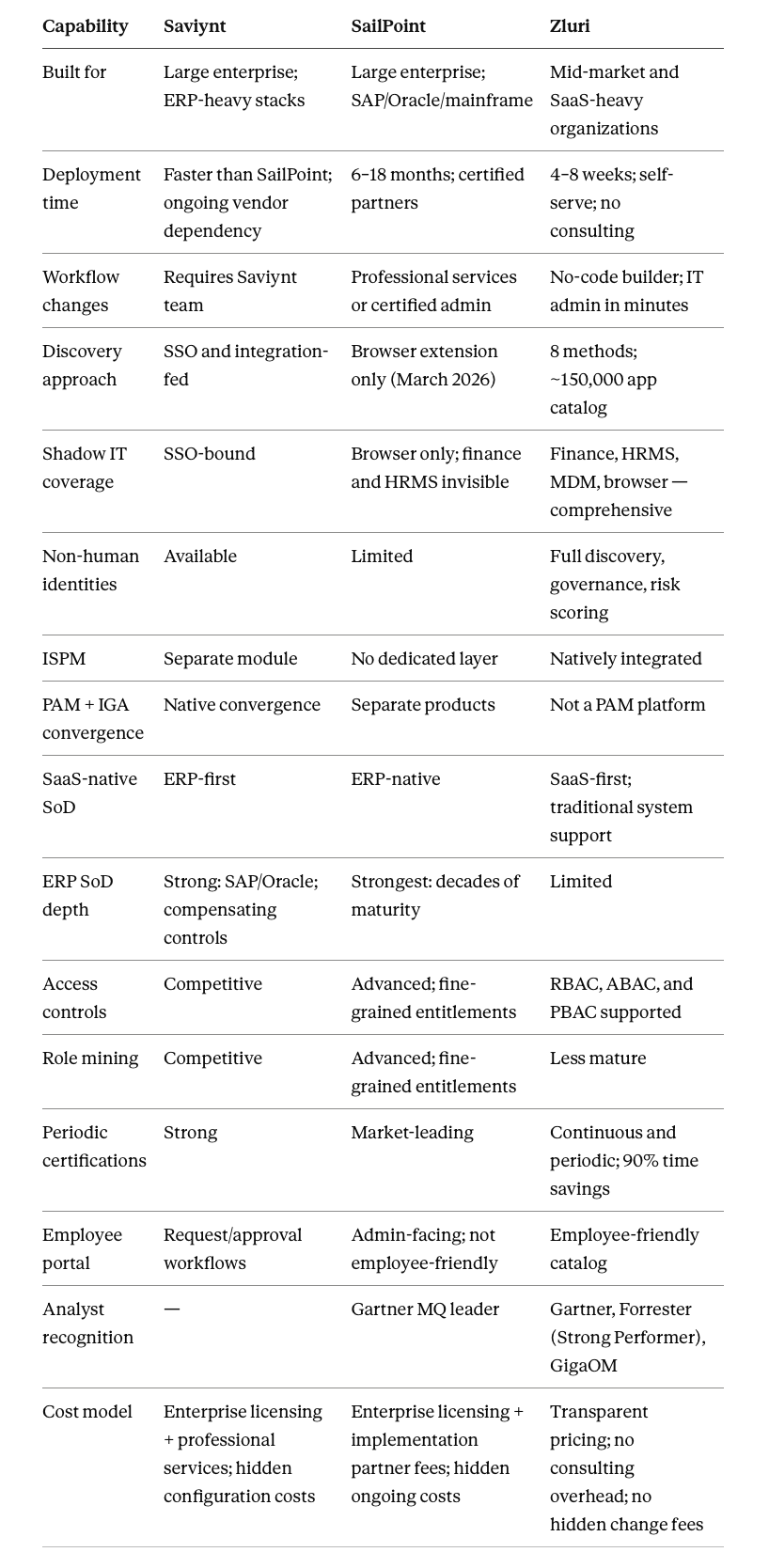
Side-by-Side Comparison
Real Results from Zluri Deployments
Tripledot Studios (UK, Mobile Gaming) IT teams were manually logging into multiple apps to provision and deprovision access with no visibility into shadow IT. Zluri automated provisioning via HRMS integration, built role-based playbooks, eliminated stale access on offboarding, and surfaced shadow IT continuously. Result: 40% improvement in IT productivity, 30% reduction in SaaS spend, zero-touch onboarding.
Dmitry Tabolich, Senior IT Engineer: "Zluri's automation capabilities have significantly reduced the time spent on provisioning and deprovisioning, saving 6 hours each week and improving IT productivity by 40%."
Narvar (USA, Technology) Manual offboarding across 300+ users in multiple time zones, with external and service accounts staying active after projects ended and no visibility into unapproved SaaS and AI tool usage. Zluri automated the full lifecycle, deployed a policy engine to auto-suspend inactive accounts after 90 days, and flagged 20+ new shadow tools monthly. Result: 50% faster provisioning and deprovisioning, 100% savings on annual audit costs.
Philip Zhou, Director of IT Operations: "Zluri moved us from manual tracking to proactive governance. Automation isn't just helpful, it's essential."
Assured Allies: 90% reduction in SOC 2 audit prep — from a full workday to 30 minutes. Live without a consulting engagement.
Roller Networks: Provisioning cut from 30 minutes to 1 minute per user. Self-configured by IT admin.
Platform ROI benchmarks: 90% time saved on access reviews (2–3 FTEs reclaimed per quarterly cycle for a 500-person organization). 20x identity visibility improvement in 3 months. 400 hours saved annually via provisioning automation (~$40,000 in avoided labor cost).
Who Should Choose What
Choose Saviynt when your organization needs PAM and IGA converged in a single platform, you're migrating from on-prem SailPoint to a cloud-native architecture, SAP/Oracle SoD is a primary compliance requirement, and you need a dedicated ISPM module. Be prepared for ongoing vendor engagement on configuration.
Choose SailPoint when your environment is dominated by SAP, Oracle, or mainframe systems requiring deep ERP SoD. If you have a dedicated IAM team, budget for certified implementation partners and a 6 to 18 month engagement, and Gartner Magic Quadrant positioning is a procurement gate — SailPoint's depth in legacy enterprise identity governance is still the reference standard.
Choose Zluri when your application estate is primarily SaaS and cloud, you want to understand your full identity surface before automating governance over it, and you need governed access this quarter rather than after an 18-month implementation. For mid-market organizations that want enterprise-grade identity security without the enterprise consulting overhead — and for security teams that want continuous posture management natively integrated with governance rather than bolted on as a module — Zluri was built for this.
Frequently Asked Questions
What do Saviynt and SailPoint have in common?
More than most comparisons acknowledge. Both were built for large enterprise environments with dedicated IAM teams and ERP-centric governance requirements. Both require significant implementation investment — vendor teams or certified partners. Both use SSO-first discovery that leaves shadow IT largely invisible. Both built their SoD engines primarily for SAP and Oracle. Both operate on a periodic governance model with limited continuous posture monitoring. Understanding this shared foundation matters: the choice between them is primarily about implementation model, PAM convergence, and ERP SoD depth — not fundamentally different governance philosophies.
What makes Zluri architecturally different from both?
The sequence. Saviynt and SailPoint go straight to automation and governance, assuming your identity landscape is already known. Zluri starts with discovery — 8 methods across a catalog of approximately 150,000 applications — to build a complete real-time inventory of every identity and every app before any governance workflow is applied. That visibility-first approach is what makes governance comprehensive rather than partial. Everything else (IRIS, IGA, ISPM, automation) runs on top of that foundation.
Which platform is best for mid-market organizations?
Zluri. Both Saviynt and SailPoint were built for large enterprises with dedicated IAM functions and long implementation budgets. Zluri is self-serve, deploys in weeks, and is priced at a fraction of legacy IGA cost with no consulting overhead. For organizations that need enterprise-grade identity security without an enterprise implementation project, Zluri was built specifically for that problem.
Which platform leads on ERP SoD?
SailPoint, followed closely by Saviynt. Both have decades of SAP/Oracle SoD maturity that Zluri doesn't match. If ERP SoD is a primary compliance requirement, either of the legacy platforms is the better fit.
Where does Saviynt genuinely beat SailPoint?
PAM and IGA convergence in a single platform. Dedicated ISPM module where SailPoint has no equivalent. Faster deployment than SailPoint's 6 to 18 month implementation model.
Where does SailPoint genuinely beat Saviynt?
ERP SoD depth and maturity, particularly for SAP and Oracle. Integration breadth (800 to 1,000+ connectors including mainframe and legacy enterprise systems). Advanced role mining and fine-grained entitlement management. Gartner Magic Quadrant recognition and a larger ecosystem of certified partners and third-party resources.
How does Zluri handle non-human identity governance?
Through IVIP, which discovers and governs all identity types — employees, contractors, service accounts, API tokens, AI agents, and automation workflows — through the same platform and governance model. This is a growing gap in both Saviynt and SailPoint, which were designed primarily for human user governance on scheduled review cycles.
What's the realistic total cost difference?
Substantial — and the gap is wider than the licensing numbers suggest. SailPoint and Saviynt both carry enterprise licensing costs, but the real cost driver is what sits on top: implementation partner fees for SailPoint that run parallel to a 6 to 18 month project, and ongoing professional services dependency for Saviynt every time a workflow needs to change. Those costs don't show up in the initial quote and compound over the life of the contract. Zluri's pricing is transparent: self-serve deployment means no consulting overhead at the start, and a no-code workflow builder means no vendor engagement fees every time your governance requirements evolve. For mid-market organizations, the total cost of ownership difference is often the deciding factor before any feature comparison begins.
.webp)


.svg)