

Centralized vs decentralized access management isn't a choice most organizations consciously make. It's a state most of them are already in, by accident: SSO centralizes the login while a dozen department-owned SaaS tools decentralize everything after it. The comparison matters because that accident is where governance gaps come from.
Ask an IT team whether their access management is centralized or decentralized, and the honest answer is usually both, in the worst combination.
Login is centralized. SSO federates the workforce through one identity provider, one MFA policy, one point of entry.
Administration is decentralized. Salesforce is run by a sales ops admin. The marketing stack by marketing. Finance tools by finance. Each grants, changes, and revokes access inside their own console, on their own schedule, answerable to no one outside their department.
Nobody designed this combination. It's what happens when SSO adoption (a centralization project) meets SaaS sprawl (a decentralization trend) without anyone reconciling the two. Understanding both models, and where the accidental hybrid breaks, is the actual use of this comparison.
What Is Centralized Access Management?
Centralized access management means access decisions, policy, and administration are controlled from one point: typically central IT or a security team, operating through a unified system.
- One console shows who has access to what
- One policy set applies everywhere it's enforced
- One team can grant, modify, or revoke access without routing through another department
SSO is the clearest expression of this model at the authentication layer: a single sign-on collapses the login for dozens of apps into one governed session, so a user experiences one identity instead of a dozen. Centralized IAM extends the same principle to authorization when it works as intended: role-based policy applied consistently through a single administrative layer.
What Is Decentralized Access Management?
Decentralized access management means control is distributed to multiple points, typically at the department, regional, or system level, each with independent authority over its own access decisions.
In practice, this is rarely a strategy. It's what happens when applications are administered outside central IT by default: a department buys a SaaS tool, becomes its admin, and grants and revokes access to it on its own judgment.
Multiply across every department-owned tool in a modern SaaS stack, and access control isn't a policy decision anymore. It's whatever each app owner happens to do.
Centralized vs Decentralized Access Management: The Comparison
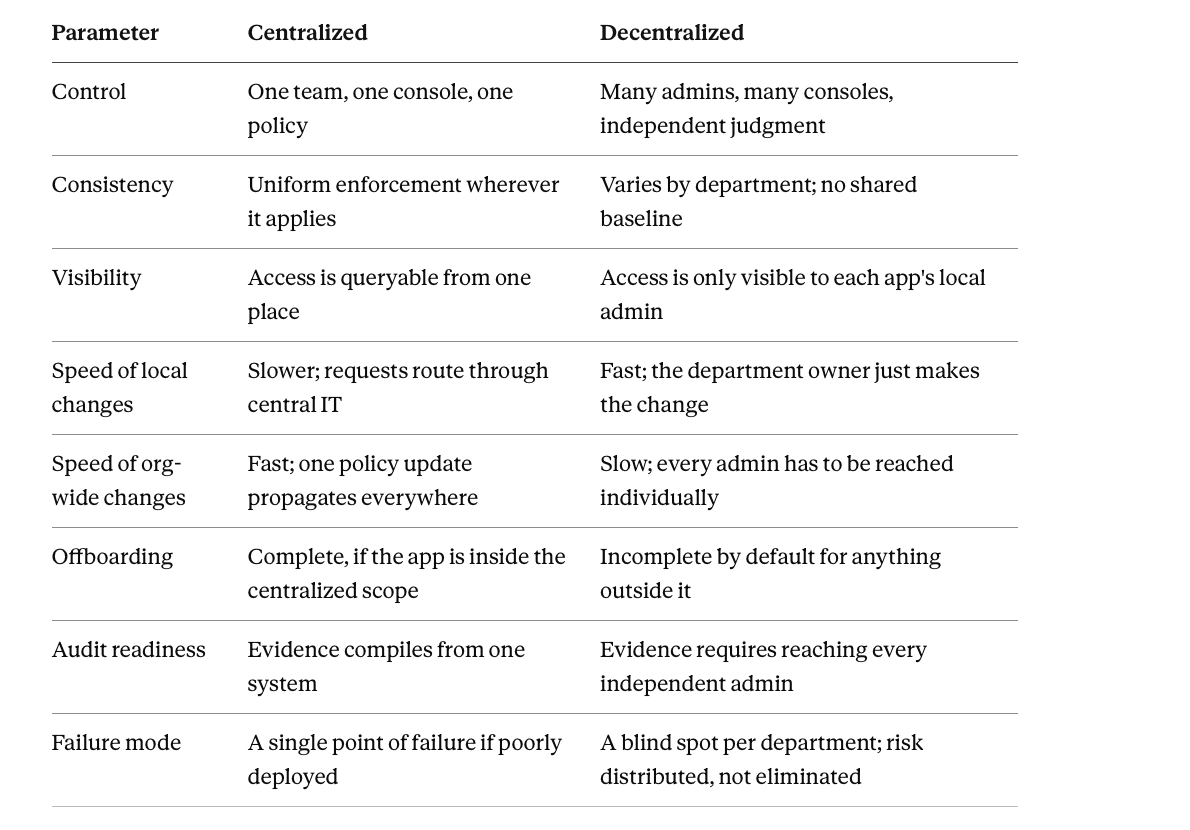
The two rows that explain most real-world incidents: offboarding and failure mode.
Centralized access management fails loudly and rarely. A misconfigured SSO or an over-permissioned admin account is a single, visible point of failure.
Decentralized access management fails quietly and constantly. An app outside the centralized scope keeps a departed employee's account active because nobody outside that department was ever going to know to check.
Why Most Organizations Run Both at Once
The comparison above describes two clean models. Real environments run a blend, and it's worth naming precisely why.
SSO adoption centralized authentication for good reason: fewer passwords, consistent MFA, one place to disable a compromised account. But SSO only governs what's connected to it.
SaaS buying decentralized administration for an equally understandable reason: departments need tools fast, and waiting on IT procurement is friction nobody tolerates anymore.
The result is a stack that's centralized at the front door and decentralized everywhere behind it. This split is exactly where the familiar identity risks come from:
- A departing employee's SSO account gets disabled on day one. Their access to the department-owned analytics tool, granted by a local admin who never heard about the exit, survives indefinitely.
- A role change updates the person's SSO groups. The admin rights they hold inside three decentralized apps, granted through separate local requests over the years, go untouched.
- Ownership of the access map is scattered across a dozen people who don't report to security, and no single view can add it up.
Neither model, run in isolation, would produce this outcome. The gap exists specifically at the seam between them.
Which Model Should You Choose?
The honest answer: this isn't a binary choice, and organizations that try to force one usually create a different problem.
Full centralization sounds like the safe answer, but it isn't achievable for most environments and isn't fully desirable even where it is. Central IT can't realistically administer every department-owned SaaS tool at the granularity local teams need, and forcing every access decision through one team recreates the ticket bottleneck that pushed departments toward their own tools in the first place.
Full decentralization solves the bottleneck but destroys the two things centralization was providing: a single view of who has access to what, and a consistent policy that applies regardless of which admin happens to own a given app.
The workable answer is neither pure model. It's centralized visibility and governance over decentralized administration:
- Let department admins keep the operational speed of managing their own tools
- Require every tool, account, and entitlement to feed into one identity system that governs the whole picture
- Centralize the map. Decentralize the day-to-day clicks, where the organization needs the speed.
That's a governance layer, not an access management model, and the difference is worth being precise about. Access management decides who can do what, in the moment. Governance is what makes sure a hundred independent access decisions, made by a hundred different admins, still add up to one coherent, reviewable, revocable picture.
How Zluri Reconciles the Two
Zluri is an identity security platform for autonomous enterprises, built as four products on one platform: Identity Visibility & Intelligence (IVIP), Identity Governance & Administration (IGA) with its four modules (Access Management, Access Requests, Access Reviews, and SoD), Identity Security Posture Management (ISPM), and SaaS Management (SMP).
It's built for exactly the hybrid reality most organizations are already running: centralized authentication through your existing SSO and MFA, decentralized administration across department-owned apps, and one governance layer over both.
IVIP builds the unified view. Using 8 discovery methods, it surfaces every application regardless of who administers it: federated apps behind SSO, directly integrated tools, and department-bought or shadow SaaS that never touched central IT, unifying them into one identity graph so decentralized administration stops meaning invisible administration.
IGA's modules govern from that unified view:
- Lifecycle workflows deprovision a departing employee across every account they held, centralized or not
- Access reviews certify entitlements app by app regardless of who owns the app locally, with auto-remediation that revokes what's flagged
- Access requests give departments the self-service speed they wanted from decentralization, routed through policy checks that give security the consistency it wanted from centralization
ISPM keeps the reconciled picture current with continuous monitoring, flagging drift and dormant access wherever it originates.
The result isn't a choice between centralized and decentralized. It's decentralized operation with centralized accountability, which is the version of this comparison that actually matches how modern organizations buy and run software.
The Comparison That Matters Is the Seam, Not the Sides
Centralized vs decentralized access management reads like a choice between two architectures. In practice, it's a description of a gap most organizations are already living inside: centralized where the login happens, decentralized everywhere administration happens, and governed by neither.
The fix isn't picking a side. It's building the one thing that spans both: a governance layer that can see and control access regardless of which model granted it.
Frequently Asked Questions
What is the main difference between centralized and decentralized access management?
Centralized access management concentrates control, policy, and administration in one team and one system, so access is queryable and consistently enforced from a single place. Decentralized access management distributes that control to multiple points, typically department or system owners, each making independent access decisions with no shared view across them.
Is centralized or decentralized access management more secure?
Neither is inherently more secure; each has a different failure mode. Centralized systems fail loudly and rarely (a single misconfiguration or over-permissioned account is a visible point of failure). Decentralized systems fail quietly and constantly (each unreviewed department-owned app is a blind spot). Most real-world breaches exploit the decentralized blind spots specifically, because nobody outside the local admin is watching them.
Why do most organizations end up running both models at once?
Because the two trends that produced each model happened for independent reasons. SSO adoption centralized authentication for consistency and convenience. SaaS buying decentralized administration because departments needed tools faster than centralized IT procurement could deliver them. Neither trend was designed to work with the other, so most environments end up centralized at login and decentralized everywhere behind it, with a governance gap at the seam.
How do you fix the gap between centralized and decentralized access management?
Not by forcing everything into one model. The workable approach is centralizing visibility and governance while leaving day-to-day administration decentralized where local teams need the speed: every app and every account, regardless of who administers it, feeds into one identity system that can see, review, and revoke access across the whole environment. That requires a governance layer on top of both models, not a choice between them.
Does decentralized access management mean the same thing as shadow IT?
They overlap but aren't identical. Decentralized access management describes intentional local administration; a department knowingly runs its own tool. Shadow IT describes tools central IT doesn't know exist at all. In practice, unmanaged decentralization is often how shadow IT starts: an app a department adopted and administers on its own can drift entirely off IT's radar if nothing requires it to be discovered and governed centrally.


.svg)