Most IT governance best practices advice hasn't changed in fifteen years: form a committee, write policies, review access periodically, train your people. The practices are still right. The way organizations implement them was designed for an environment that no longer exists. This guide covers seven practices that carry the real weight of governance, and for each one, the old way, why it fails now, and what works instead.
Search "IT governance best practices" and you'll find the same list everywhere: align IT with business strategy, define roles and responsibilities, manage risk, don't forget compliance. None of it is wrong. All of it is so general that an organization could check every box and still fail its next audit, because the advice never touches the layer where governance actually operates or breaks: who has access to what.
That's where this guide is different. The practices below are the ones auditors test, breaches exploit, and governance programs live or die on. And each one gets the honest treatment: the way it's traditionally been done, why that way stopped working when the environment went SaaS-first, and what the working version looks like now.
Why the old playbook broke: traditional governance practices assume IT can see the whole estate (it was procured centrally), that change is slow enough for periodic checks (it isn't anymore), and that the network perimeter is the control point (identity is). Every failure pattern below traces back to one of those three broken assumptions.
1. Maintain a Complete Inventory of Applications and Identities
The old way. An asset register, updated when procurement bought something. IT knew the estate because IT built the estate. The inventory was a spreadsheet, refreshed annually, and it was mostly accurate because nothing entered the environment without a purchase order.
Why it fails now. Business teams adopt SaaS directly. Employees connect tools with corporate credentials and OAuth grants. AI applications spread through free tiers before anyone evaluates them. Meanwhile the identity side has exploded past employees: service accounts, API keys, integrations, and AI agents now outnumber humans in most environments, and none of them appear in an HR-driven inventory. Every governance practice downstream, reviews, provisioning, risk assessment, inherits the blind spots of an incomplete inventory. You cannot govern what you cannot see.
What works now. Continuous, automated discovery across multiple signal sources, SSO and IdP data, direct integrations, finance systems, browser and desktop agents, so the inventory rebuilds itself as the environment changes. This is the practice that makes every other practice on this list real, which is why it comes first.
2. Govern the Full Access Lifecycle, Not Just Day One
The old way. Onboarding checklists and offboarding tickets. A new hire's manager emailed IT a list of needed systems; when someone left, HR notified IT and a checklist got worked through over the following days or weeks.
Why it fails now. The checklist covers the systems IT knows about and the tickets someone remembered to file. Leavers retain access to SaaS tools that were never on the offboarding list. Role-changers accumulate access from every previous role because nothing triggers removal when they move (the mover problem is consistently the most neglected of the three). And the lag itself is the exposure: days of retained access for a departed employee is precisely the window account-takeover and insider incidents exploit.
What works now. Lifecycle automation driven by the HR system of record. A joiner event provisions access by role policy, a mover event recalculates entitlements against the new role, and a leaver event executes deprovisioning across every connected application within minutes, with the actions logged as they happen. We cover the full discipline in our guide to user access management, which pairs naturally with this practice.
3. Enforce Least Privilege by Policy, Not by Request Hygiene
The old way. Least privilege as an aspiration enforced by human judgment: requesters were expected to ask only for what they needed, and approvers were expected to notice when they didn't. Standing broad access was tolerated because re-requesting was painful.
Why it fails now. Human judgment doesn't scale to hundreds of applications with dozens of permission tiers each. Approvers rubber-stamp because they lack the context to do anything else. Access accumulates monotonically, granted often, revoked almost never, until the average identity carries far more privilege than its role requires, and every over-privileged account is amplified blast radius in a breach.
What works now. Policy does the work humans can't. Role and attribute-based provisioning grants a baseline automatically, requests above the baseline route through approvers who see context (role, department, existing access, license tier), and time-bound access expires on its own instead of persisting by default. The requester's discipline stops being the control.
4. Replace Periodic Certifications With Continuous Access Review
The old way. The quarterly or annual certification campaign: export user lists from each in-scope application, mail spreadsheets to managers, chase signatures for weeks, file the results for the auditor. The classic best practices document calls this "conduct regular access reviews" and leave it there.
Why it fails now. Two ways at once. Coverage: manual campaigns only cover applications someone thought to include, and the sprawled estate guarantees the list is partial. Quality: reviewers facing five hundred rows of entitlements they don't understand approve everything, which auditors have learned to detect, rubber-stamped reviews increasingly draw findings rather than passing them. And whatever the review catches, remediation happens through tickets that may or may not get worked.
What works now. Reviews that run on schedule automatically, present reviewers with context instead of raw rows, auto-remediate revocations when reviewers reject access, and generate the evidence trail as a byproduct. Between campaigns, event-triggered micro-reviews (role change, unusual access pattern) keep the picture current instead of quarterly-stale. Our access review resource hub covers the practice in full depth.
5. Enforce Segregation of Duties at Grant Time
The old way. SoD as an annual audit exercise: after the fact, someone cross-referenced who could both create and approve transactions, and conflicts found their way into a remediation list.
Why it fails now. Detecting a conflict a year after it was created means a year of exposure, and the sprawl of financially-relevant SaaS means conflicts now form across applications, someone with create-rights in the billing tool and approve-rights in the ERP, where no single-system report will ever see them. Auditors, especially under SOX, have followed the risk across those application boundaries.
What works now. SoD rules evaluated at the moment access is requested, so a conflicting grant is flagged or blocked before it exists, with cross-application conflict detection running continuously against the full inventory rather than annually against one system.
6. Make Audit Evidence a Byproduct, Not a Project
The old way. Evidence assembly as a pre-audit sprint: screenshots, exported logs, reconstructed approval emails, a shared folder assembled in the weeks before the auditor arrives. The old best practices framing was "don't forget about compliance," which in practice meant "remember to start the scramble early."
Why it fails now. Reconstructed evidence has gaps, and gaps become findings. The approval email can't be found, the deprovisioning date can't be proven, the review for one in-scope application never happened. Each audit cycle repeats the same cost, and the cost grows with the estate. Worse, evidence assembled retroactively proves what you can document, not what actually happened, and modern audits probe that difference.
What works now. Controls that generate their own evidence in real time: every grant carries its approval, every leaver event carries its deprovisioning log, every review carries its decisions and remediations. When the audit comes, the evidence already exists in the system of record, and audit prep becomes export rather than archaeology.
7. Keep the Human Practices, But Aim Them at the Right Layer
The old way. The people-side advice from the standard lists: form a governance committee, define roles and responsibilities, train employees on phishing, write a vision statement. Delivered generically, this is the filler that makes best practices articles interchangeable.
Why it fails now. Not because the human layer stopped mattering, but because it was aimed at the wrong altitude. A committee that reviews project budgets while nobody owns the access layer governs the part of IT where the risk isn't. Security training that covers phishing but never explains why access requests get scoped down produces employees who route around controls instead of through them.
What works now. The same human structures, pointed at the layer that carries the risk. The governance body owns named controls with named owners: someone answers for review completion rates, deprovisioning SLAs, and SoD exceptions, and those metrics reach the committee as standing agenda items. Training explains the why behind access discipline, and the self-service request experience is smooth enough that the governed path is also the easy path, which is what actually changes behavior.
The Seven Practices at a Glance
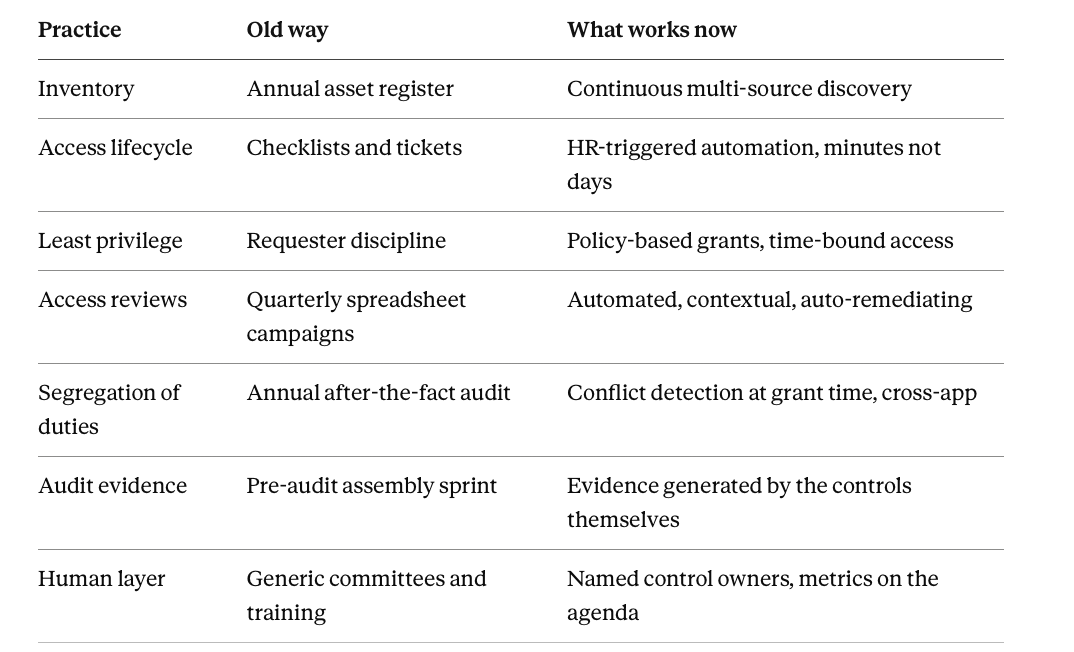
Read down the right-hand column and a pattern emerges: every modern version depends on the same underlying capabilities, complete visibility, automation triggered by events rather than calendars, and evidence created in the flow of work.
Running These Practices With Zluri
That shared foundation is what Zluri provides as the operational layer beneath the practices.
Discovery makes practice one real. Eight discovery methods, spanning SSO and identity providers, direct integrations, browser and desktop agents, finance systems, and more, build and maintain the complete application and identity inventory that every other practice depends on, including the shadow SaaS and non-human identities that manual registers never capture.
Automation carries practices two through five. With 300+ integrations, lifecycle workflows execute provisioning and deprovisioning on HR events, policy-based approvals enforce least privilege with context in front of every approver, automated access reviews run on schedule with auto-remediation, and SoD conflicts surface at request time rather than at audit time.
Evidence takes care of practice six by design. Every action, grant, approval, revocation, review decision, is logged as it happens, so the audit trail is the system's normal output rather than a quarterly reconstruction.
The practices are the strategy. The platform is what makes them run at the scale and speed the environment now demands.
Frequently Asked Questions
What are the most important IT governance best practices?
The practices that carry the most weight are the ones governing access: maintaining a complete application and identity inventory, automating the access lifecycle, enforcing least privilege by policy, running continuous access reviews, enforcing segregation of duties at grant time, and generating audit evidence as a byproduct of the controls. Organizational practices like governance committees matter, but only when aimed at owning these controls.
How often should access reviews be conducted?
Regulatory floors are typically quarterly or annual depending on the framework, but the calendar-based question is increasingly the wrong one. Modern practice runs scheduled certifications for compliance while triggering event-based reviews continuously, on role changes, unusual access patterns, or new application adoption, so the access picture never goes a quarter stale.
Why do traditional IT governance best practices fail in SaaS environments?
Because they assume visibility that no longer exists (centrally procured estates), a pace of change that periodic checks could track, and a network perimeter as the control point. SaaS-first environments break all three assumptions, which is why practices built on manual inventories, ticket-based lifecycle management, and spreadsheet certifications produce audit findings and breach exposure despite being followed faithfully.
What is the difference between IT governance best practices and IT governance frameworks?
Frameworks like COBIT, ISO/IEC 27001, and NIST define what your governance program must achieve and prove. Best practices are how you achieve it operationally. The two meet at the access layer: the frameworks' requirements around least privilege, lifecycle management, and access certification are satisfied (or failed) by exactly the practices covered in this guide.


.svg)